Procurement Pitfalls in GovTech RFP Writing
Poor RFP design filters out innovative vendors before agencies even read their proposals.

NASCIO corporate members report reviewing as many as 10,000 RFPs annually. Seventy percent are ones they'd never realistically bid on. For a quarter of those vendors, that number climbs to 90%. These aren't fringe players passing on obscure solicitations. These are established technology companies, many of them purpose-built for government work, closing the tab before the evaluation even starts.
That's not a vendor problem. That's a document problem.
Key information gets scattered across solicitations that routinely run hundreds of pages with no navigational logic. A USDR and NASCIO study found that 68% of vendors reported receiving RFPs from other vendors rather than through official channels, because informal networks had simply become faster than parsing the official process. Half said RFPs only sometimes or rarely included a cover letter explaining what the solicitation was even for. Smaller vendors, often the most innovative ones, have started using AI tools just to extract basic requirements from documents that should have led with them. Let that sink in for a moment: vendors are building workarounds to read government documents. That's the state of things.
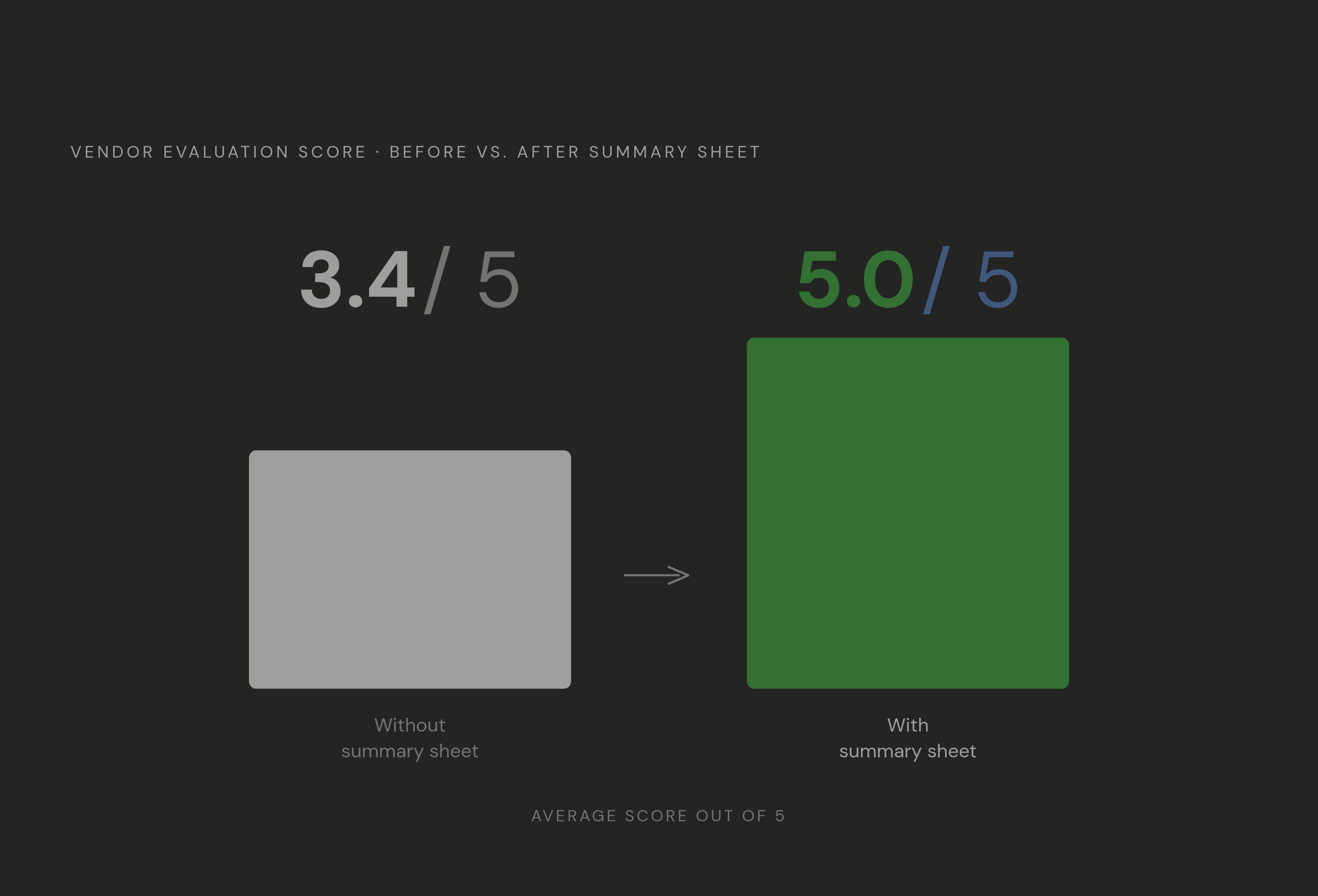
The same research tested something simple: adding a one-page summary sheet to an RFP. Without it, average vendor evaluation scores sat at 3.4 out of 5. With it, scores hit a perfect 5.0. One structural addition, a page most agencies already have the information to write, produced a categorical shift in how well vendors could engage with the solicitation.
Document architecture is a procurement decision, whether agencies treat it that way or not. Burying requirements inside dense, disorganized solicitations doesn't create a neutral waiting room for the market to respond. It filters out the vendors least equipped to run document archaeology on behalf of an agency they haven't yet worked with. Plain-language section titles, logical layout, hyperlinked navigation that takes a reader directly to each section: these aren't design flourishes. They are functional requirements for a document that is supposed to attract competition, not quietly reduce it.
Prescriptive Requirements That Describe the Current System Instead of the Needed Outcome
Here's something that happens constantly and quietly derails procurements before they start: agencies write requirements documents that describe, in exhaustive detail, how the existing system works. The "as-is" state. The system they're trying to replace.
The effect is a solicitation that disqualifies vendors capable of delivering something better, simply because their architecture doesn't conform to the template of the thing already failing. A requirements matrix mandating specific reporting formats, interface conventions, or workflow sequences isn't protecting the agency from bad solutions. It's protecting the current solution from competition. That distinction matters enormously, and it's almost never named explicitly during the drafting process.
Many RFPs are copied from a prior solicitation or borrowed wholesale from a neighboring municipality, which imports another agency's implicit vendor preference rather than reflecting the procuring agency's actual size, processes, or needs. The vendor that won that original contract had their system effectively spec'd into the new solicitation before anyone submitted a response. Nobody made that decision consciously. It happened because copying was faster than thinking.
Consider a concrete scenario: a department evaluating whether to add a community development module to an existing ERP. If the RFP describes the ERP's native conventions as requirements, purpose-built software that serves end users dramatically better gets eliminated before evaluation begins. The agency never sees the better option because the document precluded it. The procurement team probably thought they were being thorough.
Outcome-based language is the corrective. Define what the system must accomplish and how performance will be measured. "A permits system must reduce average processing time and provide applicants with real-time status updates" is a requirement. Specifying which interface elements must appear on which screens is a constraint that narrows the field to vendors already intimate with the current environment, which is almost always the incumbent. The difference between those two approaches is the difference between a competitive market and a formality.
Vague or Cost-Weighted Evaluation Criteria That Invite Protests and Poor Vendor Selection
Ambiguous evaluation criteria create a specific, predictable problem: bidders interpret requirements differently, responses become incomparable, and evaluators end up making subjective judgments with no defensible basis. That's the condition that produces bid protests. A vendor who scores poorly under criteria that were improvised or reweighted after the fact has every rational incentive to challenge the award, stalling the project further and consuming procurement resources that were already thin.
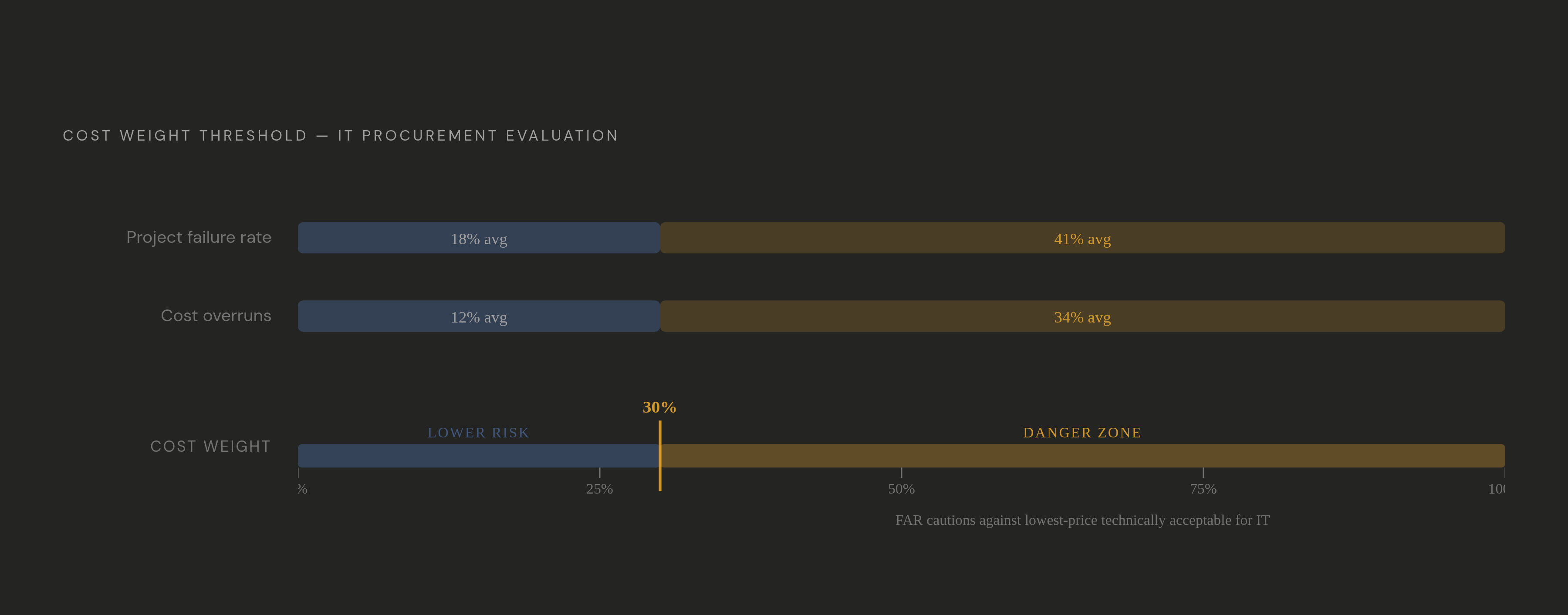
The research on cost weighting is unambiguous. Agencies that weight cost above 30% of total score experience significantly more project failures and cost overruns than those weighting technical factors more heavily. The Federal Acquisition Regulation explicitly cautions against lowest-price technically acceptable source selection for IT services, cybersecurity, knowledge-based professional services, and systems engineering. Both the policy guidance and the empirical outcomes point the same direction: selecting the cheapest technically acceptable IT vendor is a reliable way to acquire a project that will cost considerably more by the time it concludes.
Behavioral factors compound the structural ones. Redefining requirements mid-evaluation, introducing demonstration scenarios that weren't disclosed in advance, adjusting weights after vendor identities become known: these practices introduce bias, undermine defensibility, and increase the probability of protest. None of them require bad intent. They emerge naturally when criteria were never specified precisely enough to constrain evaluator discretion in the first place. Evaluators filling ambiguous rubrics aren't being dishonest; they're improvising in a vacuum the document created.
Publishing explicit criteria with assigned weights before proposals are submitted tells the market what the agency actually values. That signal improves the quality of responses, because vendors optimize their proposals against known priorities rather than guessing what the evaluation panel will find compelling. It also gives the agency something to stand behind if the award is challenged.
Compliance Thresholds That Eliminate Qualified Vendors Before Content Is Ever Read
Thirty-seven percent of proposals are disqualified for non-compliance before evaluators read a word of the actual content. A quarter of contracts fail during the pre-award tender phase. These aren't outcomes of rigorous vetting. They're outcomes of compliance regimes calibrated to catch administrative errors rather than identify genuine capability.
Contracting officers tend to be deeply experienced with procurement regulation and process. They are far less often experienced with software development, cloud architecture, or how modern technology teams actually operate. Requirements they regard as standard, particular documentation formats, signature conventions, submission protocols, can be structurally incompatible with how contemporary vendors work. The compliance gate then functions not as a quality filter but as an incumbency filter, favoring established vendors who've learned the administrative habits of a particular agency over new entrants who offer meaningfully better technical approaches. I've watched this happen firsthand: a strong proposal killed by a missing signature page that nobody would have noticed if the vendor had been around long enough to know the local conventions.
A missing signature page that eliminates an otherwise strong proposal is not procurement discipline. It is an administrative reflex that reduces competition and tells you nothing about whether the vendor could have delivered.
Procurement teams should audit compliance requirements before any document goes out the door. The questions are specific: which items are legally required, which reflect agency preference, and which can be waived without any real risk to the agency or the public? That audit almost always surfaces a meaningful share of requirements that are habitual rather than essential. Reducing them doesn't lower standards. It redirects the screening function toward factors that actually predict delivery success.
Procurement Timelines So Long That the Problem Has Changed by the Time the Contract Is Signed
Standard procurement cycles run 18 to 24 months. In a technology environment where meaningful change in cloud infrastructure, AI capabilities, and security threats occurs on a quarterly cadence, that means an agency is signing a contract for a solution designed around a problem definition that is nearly two years old.
Washington State's CIO described the RFP process as "problematic for all of us because of the duration required to create the RFP, issue the RFP, score the RFP," then negotiate and begin work, all in an environment where speed is operationally critical. That's not a complaint about bureaucracy for its own sake. It's a recognition that prolonged procurement cycles produce contracts that are obsolescent at signing. By the time the ink is dry, the underlying technology landscape has already moved.
The volume of questions inside solicitations has grown substantially, with enterprise technology RFPs now commonly containing 200 to 500 questions. Response windows, meanwhile, have compressed, dropping from four to six weeks earlier in the decade to two to three weeks more recently. Agencies are demanding more comprehensive responses while providing less time to produce them. The vendors capable of meeting that combination are the largest organizations with dedicated proposal teams. Smaller, more agile competitors who deliver better outcomes on the work itself are disqualified by the response process before any evaluation criterion is applied. There's something almost comically backwards about that.
Phased or modular procurement structures address this directly. Scoping the initial contract more narrowly, with contractual options to expand upon demonstrated performance, reduces the time required to get a capable vendor under contract and creates a natural checkpoint to validate delivery before committing the full scope. It's not a radical idea. It's just one most procurement processes weren't designed to accommodate.
RFP Designs That Only Incumbent Vendors Can Realistically Win
More than 18% of startups fail because they cannot navigate bureaucratic procurement. U.S. governments miss an estimated $100 billion or more annually by not deploying innovative solutions faster. Those two facts are related.
Only the largest, most well-capitalized vendors can absorb the full cost of responding to complex solicitations with extensive compliance documentation, compressed timelines, and evaluation processes that stretch over many months. The civil servants evaluating those responses also face an asymmetric risk calculus that rarely gets acknowledged openly: selecting a well-known incumbent carries minimal personal exposure if the project underperforms, while selecting an unfamiliar vendor who struggles creates institutional and reputational risk for the evaluator. That calculation is entirely rational at the individual level and systematically destructive at the institutional level. It's worth sitting with that tension rather than pretending it doesn't exist.
Speakers at a recent NASCIO annual conference explicitly warned states to avoid writing RFPs that only one vendor could realistically win. The warning would not need to be issued if the problem weren't widespread.
The consequence is a procurement ecosystem that screens out the vendors most likely to bring genuinely new approaches to entrenched problems, while selecting the vendors most experienced at winning contracts and least incentivized to disrupt existing arrangements. Structural remedies exist: shorter initial contract terms with renewal options tied to demonstrated performance, simplified compliance pathways for small businesses, pre-qualification stages that allow agencies to understand the actual vendor landscape before writing requirements that inadvertently exclude most of it. None of these are exotic interventions. They require someone with authority to decide the current approach isn't good enough and act accordingly.
Total Cost of Ownership Blind Spots and Vendor Lock-In Risks That Surface Years After Award
The acquisition price is the number that appears in the budget document and receives the most scrutiny during procurement. It's also, frequently, the least informative indicator of what a technology system will actually cost.
When an agency becomes dependent on a sole supplier, that supplier can raise licensing and maintenance fees with confidence that migration costs make departure prohibitively expensive. The European Commission estimated that adopting open standards, and thereby avoiding proprietary lock-in, could save the EU public sector over one billion euros annually. A separate analysis put the cost of brand-specific procurement at approximately 1.1 billion euros per year in elevated prices paid by public bodies that had no viable competitive alternative. The scale varies by jurisdiction, but the dynamic is identical everywhere: once you're locked in, the negotiating leverage is gone. The vendor knows it. The agency, often, doesn't fully reckon with it until a renewal conversation that was never going to go well.
The World Bank has established that total lifecycle cost must account for transactional costs, transition costs, and contingency costs, not just acquisition price. RFPs that don't require data portability standards, open APIs, or exit provisions effectively transfer control of an agency's infrastructure to the winning vendor at contract signing. The agency discovers this not during procurement review but years later, in a renewal negotiation where there is no realistic alternative.
Agencies rarely model switching costs when comparing bids, which means those costs never enter the evaluation. Requiring vendors to disclose migration costs, data export capabilities, and API openness as scored proposal elements forces those numbers into the comparison where they belong. A vendor offering a lower acquisition price alongside proprietary data formats and no documented exit path is presenting a more expensive long-term arrangement. Figuring that out during procurement is infinitely cheaper than figuring it out five years into a contract, which is when most agencies figure it out.
What a Better-Constructed GovTech RFP Actually Looks Like
None of this requires legislative reform or a systemic overhaul of procurement policy. It requires deliberate construction of the document itself, which is something procurement teams have full authority to control right now.
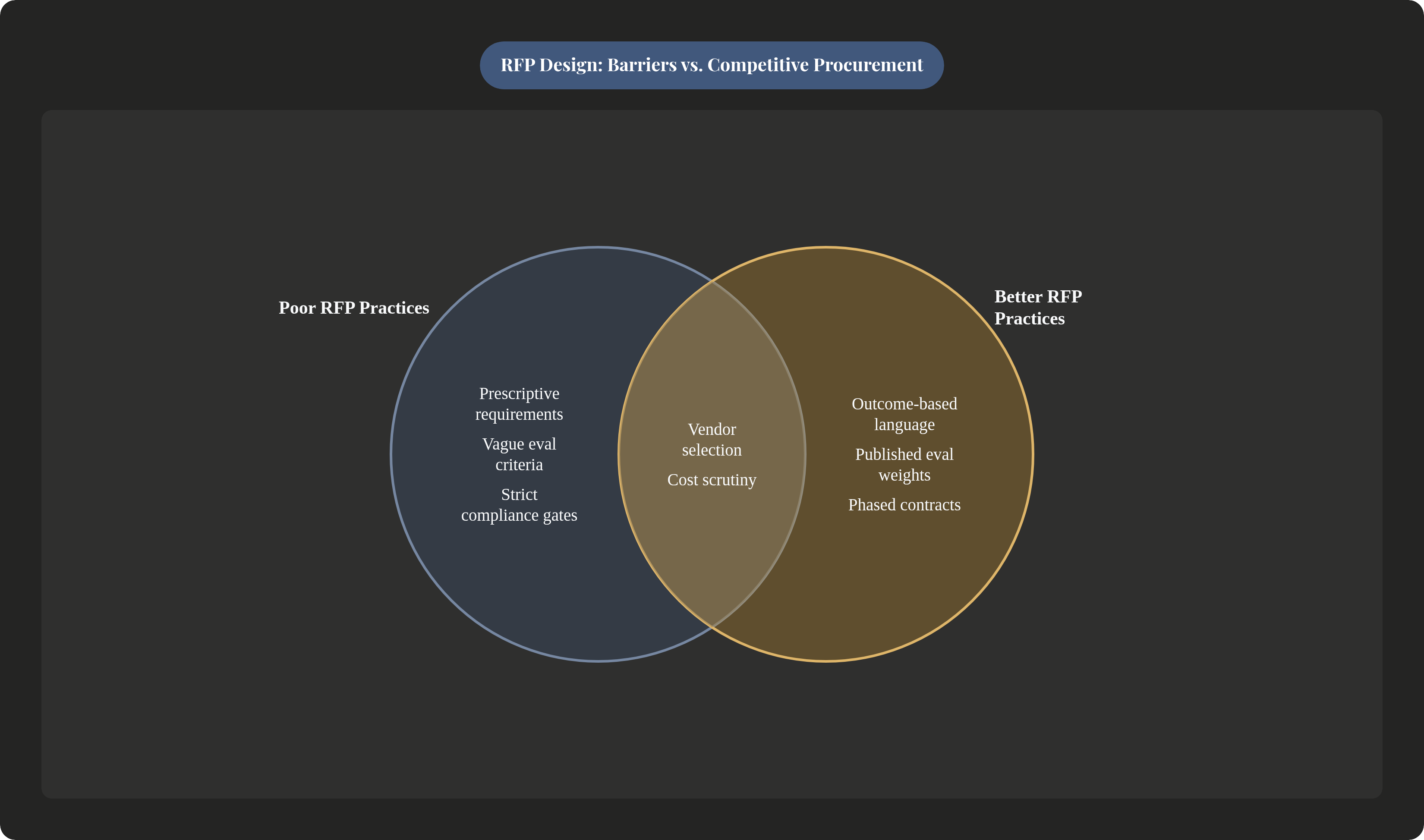
Outcome-oriented requirements define what the system must accomplish and how performance will be measured. They don't specify interface conventions, workflow sequences, or architectural approaches. That distinction is the difference between attracting the full range of capable vendors and pre-selecting for whoever built the last system.
Write the summary sheet first, not last. The NASCIO and USDR research showed it moved average vendor evaluation scores from 3.4 to 5.0. It costs almost nothing to produce. It is the single highest-return structural change available, and most agencies still don't include it.
Publish evaluation criteria before proposals are due, with explicit weighting. Technical factors should carry more weight than cost for IT services, consistent with regulatory guidance and the empirical findings on project outcomes. Criteria visible before proposals are written produce proposals responsive to what the agency actually needs. Criteria that emerge during evaluation produce protests, and the agency deserves whatever follows.
Conduct a pre-issue audit of compliance requirements. Distinguish legally required items from administrative convention. Reduce the ones that screen for resources rather than capability. Broadening the competitive field without lowering substantive standards is not a complicated trade-off once someone is willing to make it.
Require vendors to disclose data portability provisions, transition costs, and API openness as scored elements. Build lifecycle cost framing into the scoring model from the start. That's the only way an honest cost comparison is possible before the contract is signed rather than after.
Scope initial contracts narrowly, with expansion options tied to demonstrated performance. The alternative is a comprehensive multi-year contract awarded after a two-year procurement cycle, where all the risk and all the timeline pressure concentrate in a single transaction with no off-ramp.
Finally, engage the market before writing the solicitation. Requests for information and industry days allow agencies to calibrate requirements against what the actual vendor landscape can deliver. Requirements written in isolation from market reality reflect the capabilities of the last system purchased. That gap is where avoidable failures begin, and closing it before the document goes out the door is entirely within an agency's control.