FAR and DFAR Plain-Language Guide for Technology Vendors
A guide to FAR and DFARS rules reshaping federal tech contracts in 2026.

The Revolutionary FAR Overhaul and CMMC 2.0 aren't side projects for federal tech vendors to skim once a year. They're the operating system underneath every bid, every clause, every dollar that changes hands. This piece walks through the parts that matter right now, late 2025 into 2026, while a big chunk of the rulebook is actively getting rewritten. FAR is the government-wide procurement rulebook, covering pricing, competition, ethics, data rights, all of it. DFARS sits on top for anything touching the Department of Defense, adding clauses without replacing what's underneath, so read them apart and you'll miss half the picture.
Scale is why this deserves your attention rather than your dread. Federal IT spending crossed $82 billion in fiscal year 2024, per GSA, so the pool of vendors caught in this net is neither small nor shrinking. FAR itself has historically run past 2,300 pages, written by contracting officers for contracting officers, not for the product managers and in-house counsel now stuck parsing it at 11pm before a bid deadline. That mismatch is why so many tech companies shove compliance into a back room and call it legal's problem. It's really shaping pricing, delivery timelines, who owns your IP, and what your security stack looks like on day one.
The Revolutionary FAR Overhaul and what it means for vendors navigating the rules right now
In May 2025, the FAR Council kicked off the Revolutionary FAR Overhaul, RFO for short, under Executive Order 14275, "Restoring Common Sense to Federal Procurement." So far the direction backs up the name: fewer rigid mandates, more discretion for contracting officers, a push toward outcomes over box-checking. More than 500 provisions have already been stripped out, with more on the way.
The rollout has two phases. Phase I let agencies test slimmed-down FAR parts through temporary deviations while permanent language got drafted behind closed doors. Phase II moves that into formal notice-and-comment rulemaking, and on June 23, 2026, the FAR Council dropped four proposed rules covering twenty FAR parts in one go. More batches are coming for the heavily used sections, Parts 8, 12, 13, 15, 16, and 19, with everything supposed to land by the end of 2026.
Here's the part that bites you if you're not careful. SAM.gov and other contract writing systems can still prompt vendors for provisions that don't exist anymore under RFO deviations. GSA's own deviation notice for FAR Part 4, from August 2025, admits flat out that system updates lag behind policy updates. A system telling you to certify something is not proof the something still applies. Vendors have been known to copy exactly what SAM.gov spits out, sign it, and certify to rules that got retired months earlier, no one flagging it along the way. Add a new sunset mechanism, where provisions that don't survive review simply expire on their own, and this stops being a one-time cleanup job. It's ongoing churn, and tracking that churn is just part of the work now.
How FAR Part 39 now governs technology acquisition specifically
On June 12, 2025, the FAR Council swapped the old FAR Part 39 for a version built around ICT, information and communication technology, not the narrower "information technology" it used to say. Small word swap, bigger signal. Tech isn't a support function bolted onto the side of a mission anymore; it's core to how the mission gets delivered at all.
Two sections carry most of the weight. Section 39.101 requires the whole acquisition team, contracting officers, technical staff, and program stakeholders together, to assess and plan for risk before a solicitation even goes out the door. For vendors, that means more scrutiny of your technical approach before award, not after you've already signed. Section 39.103 sets a strong preference for performance-based metrics once the contract starts, so getting paid and keeping the contract increasingly ties to measurable outcomes rather than clocking in and doing the work.
One clause worth calling out by number: 52.239-1, which used to cover privacy in a narrow way that agencies applied inconsistently anyway, has been retired outright. If your compliance posture around that clause was baked into an older contract, don't assume it still does anything for you. For vendors pitching ICT work, the smart move is building performance metrics into the proposal itself, not scrambling to invent them after you've already won.
The cybersecurity baseline every federal tech vendor must meet: FAR 52.204-21
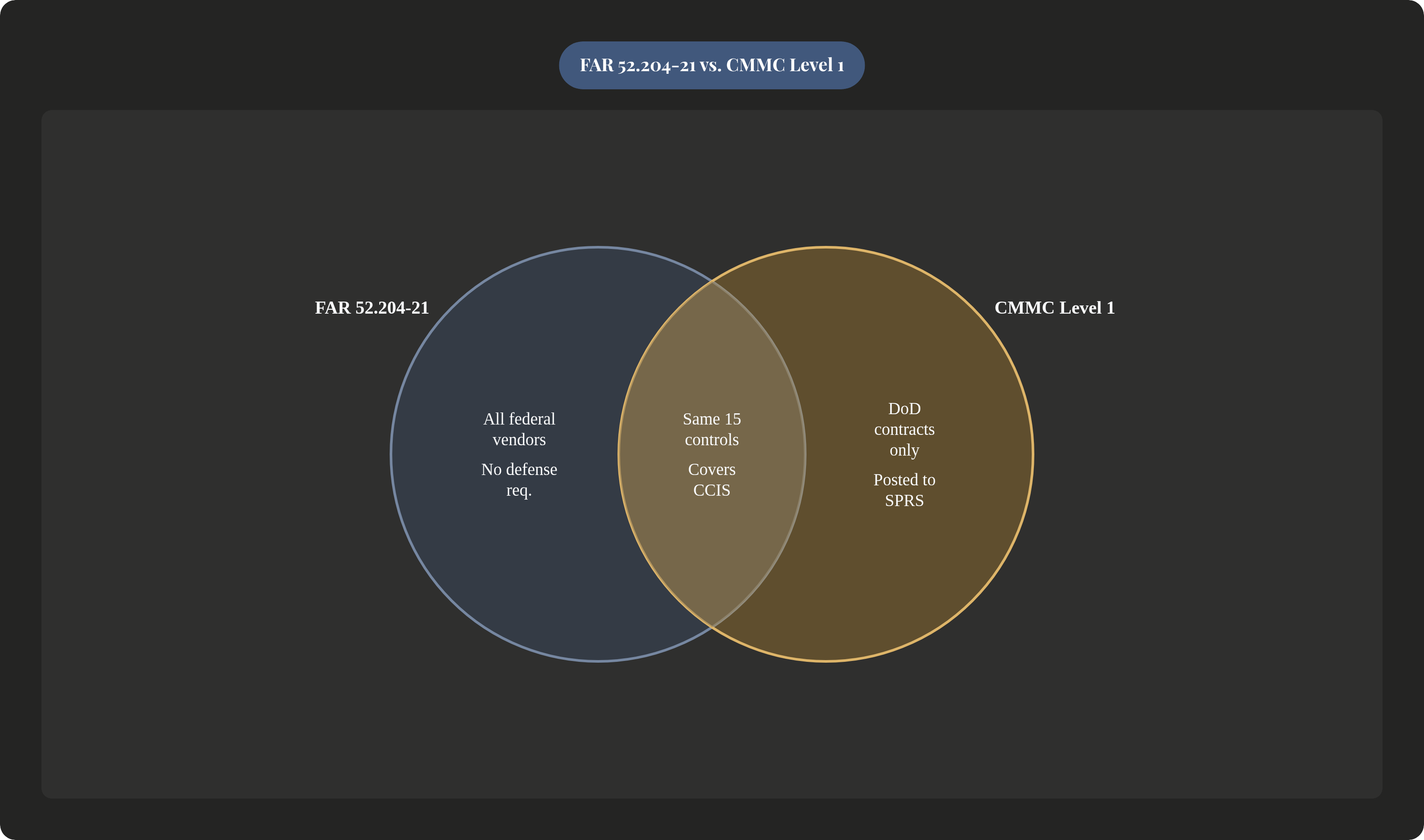
FAR 52.204-21 applies to any contractor whose systems touch covered contractor information, and this has nothing to do with defense specifically. It's the floor. Everyone selling tech to the federal government stands on it, no exceptions. The clause lays out 15 cybersecurity requirements protecting what's called covered contractor information systems, or CCIS.
In plain terms: limit system access to authorized users, control what gets posted on public-facing systems, verify identity before granting entry, wipe media clean before disposal or reuse, lock down physical access to machines holding federal data. Nothing exotic. Most IT departments already do a version of this out of habit, which is exactly the problem.
Vendors treat this like a checklist you run through once and forget, when agencies increasingly want proof, not a shrug and a "yeah, we do that." This is where the thread picks up in the next section: these same 15 requirements are the literal foundation of CMMC Level 1. Get comfortable with 52.204-21 first. Everything in CMMC builds on top of it.
CMMC 2.0: the defense-specific cybersecurity certification now written into contracts
On September 10, 2025, DoD published the DFARS CMMC Final Rule, which the law firm White & Case called the single most consequential shift of 2025 for defense and tech contractors. The scope backs up the claim: this covers essentially all DoD contracts and subcontracts where contractor systems touch Federal Contract Information or Controlled Unclassified Information, commercial products included, with a narrow carve-out for pure COTS items. Starting November 10, 2025, certification requirements began showing up directly inside DoD solicitations.
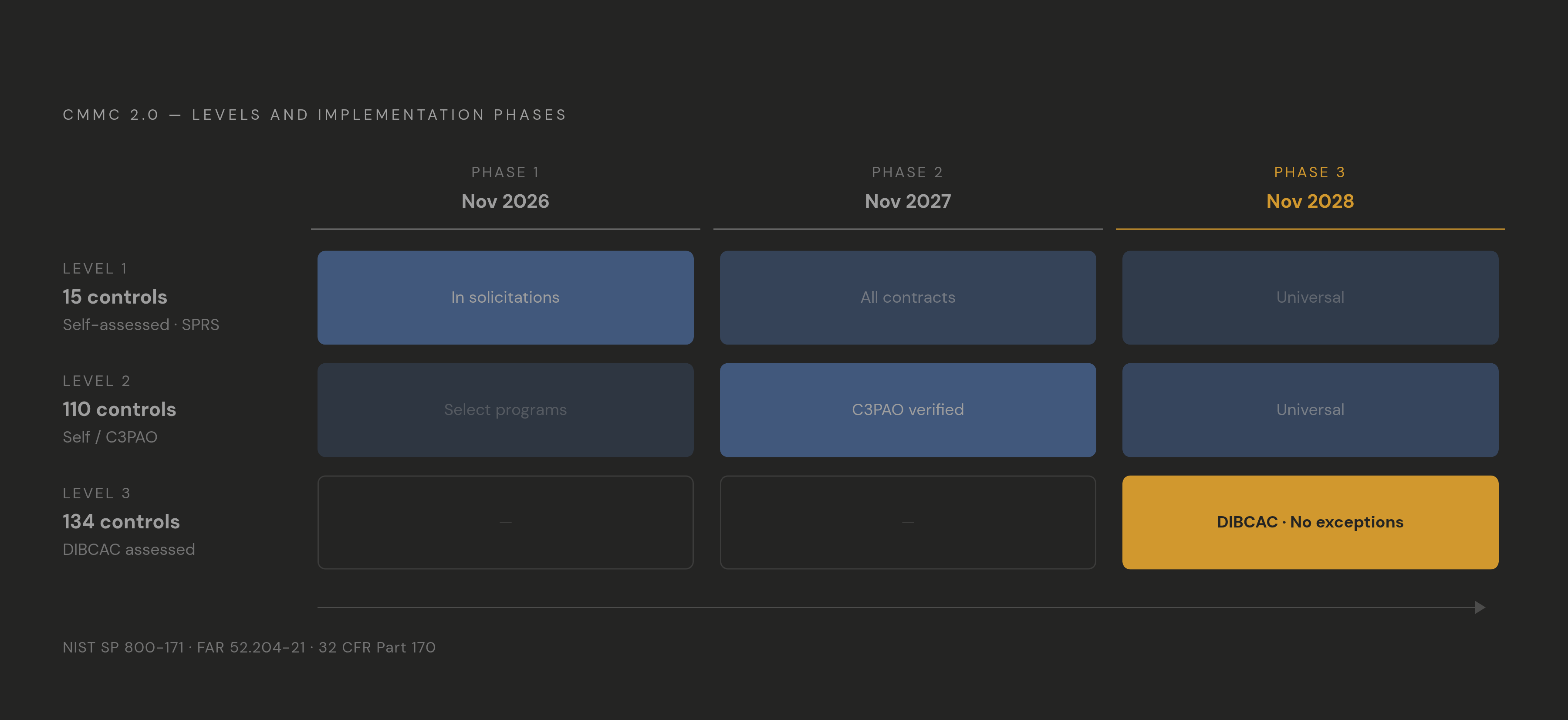
Three levels, scaling with sensitivity. Level 1 is an annual self-assessment against the same 15 requirements from FAR 52.204-21, posted to SPRS before award or extension. Level 2 covers vendors handling CUI, layering in the 110 NIST SP 800-171 controls, the same ones already baked into DFARS 252.204-7012, either self-assessed or verified by a third-party assessor called a C3PAO, depending on program sensitivity. Level 3, reserved for the most critical programs, stacks an additional 24 controls from NIST SP 800-172 on top of the 110, assessed directly by the Defense Industrial Base Cybersecurity Assessment Center (DIBCAC).
The rollout is staged across three years. Phase 1 runs through November 2026, with Level 1 and Level 2 appearing in select solicitations. Phase 2, through November 2027, widens third-party Level 2 assessments. Phase 3, through November 2028, brings Level 3 DIBCAC assessments online for the most sensitive work. After November 2028, CMMC applies across the board, no exceptions and no grace period.
One detail trips up almost everyone: every contractor system touching FCI or CUI needs a CMMC UID registered before work even starts, not after. And subcontractors, pay attention here, because prime contractors are on the hook for making sure their subs comply, but that's not a hiding place for the sub. If your system processes the CUI, your certification is what matters, right alongside the prime's paperwork, not instead of it.
More than 500 provisions have already been stripped out, with more on the way.
DFARS 252.204-7012 and the 72-hour incident reporting obligation most vendors underestimate
This clause predates CMMC and isn't going anywhere; it runs beside the new framework rather than beneath it. Vendors routinely blur two separate obligations here, and that confusion is exactly where things go sideways. One is implementing the 110 NIST SP 800-171 controls, an ongoing posture you maintain every day. The other is reporting any cyber incident to DoD within 72 hours of discovering it, a one-time clock that starts the moment you find out, not once you've figured out what actually happened.
72 hours means 72 hours, not 72 business hours, and the clock starts at discovery. Not confirmation, not once the investigation wraps. Contractors also have to preserve forensic images of compromised systems, and wiping or reimaging affected machines before DoD gets a look is its own separate violation, stacked right on top of whatever caused the breach in the first place.
The CMMC Final Rule raises the stakes further by adding explicit False Claims Act exposure for anyone who misrepresents their cybersecurity posture in an SPRS self-assessment. That's federal fraud liability, well past a lost contract or an awkward phone call with your contracting officer. An incident response plan needs to exist before you win a DoD contract, not get sketched out in a panic somewhere around hour 40 of a 72-hour window.
IP and data rights: what vendors keep, what the government gets, and why funding source is the deciding factor
DFARS 252.227-7014 decides who owns what in noncommercial software, and it comes down to one question: who paid for it? Three tiers. Restricted rights apply when software was built entirely at private expense; the government gets a narrow license to use it, and the vendor keeps the core IP. Government purpose rights apply with mixed funding, giving the government broader use while the vendor retains certain rights. Unlimited rights apply when the government funded the whole build; at that point it can use, modify, and release the software however it wants.
Take a defense software contractor that won a Navy logistics tracking contract. Before the contract even started, the company had already put its own independent R&D money into the core algorithms; the government then funded everything layered on top of that base. Under 252.227-7014, the contractor kept restricted rights on the pre-existing algorithms but handed over unlimited rights on every module the government paid to build. Split funding, split ownership. That's the whole mechanism, and it's less complicated than it sounds until you're the one trying to prove which line of code came first.
The risk hiding underneath all this: if you don't document what you built before the contract existed, good luck proving it later. The default assumption favors the government, not you, so silence works against the vendor every time. Commercial software runs on a separate track, generally acquired under your standard commercial license rather than the government-specific regime, unless that license collides with procurement law somewhere along the way. That distinction, commercial versus noncommercial, matters at the proposal stage, not after signatures. Document your IP boundaries early: what you built on your own dime, what was funded by the government versus built at private expense, before you sign anything new.
How to read a solicitation for the clauses that actually apply to your contract
Not every clause in FAR and DFARS touches every contract. What applies depends on contract type, dollar value, whether CUI is involved, whether DoD is the buyer, and whether what you're selling counts as a commercial item. So where do you actually look?
Start with Section H, Special Contract Requirements, where agencies bolt on their own additions. Then Section I, Contract Clauses, which lists everything that applies to you; note that "incorporated by reference" means a clause still governs even when it's not printed in full text in front of your face. The representations and certifications section is what you're formally attesting to. This is exactly where the RFO transition turns messy, since SAM.gov prompts might not match what the solicitation's actual deviated provisions require.
During this transition, the solicitation's deviated text governs, no matter what a legacy system happens to prompt. Read Section I yourself, directly, and watch for a short set of red flags on any DoD solicitation. Does DFARS 252.204-7012 show up, pulling in the 110-control and 72-hour obligations? Is a CMMC level specified, and is that self-assessment or a C3PAO review before you can even be considered? Any mention of CUI or FCI handling, which drags in the full CMMC chain, subcontractor flowdown included? Does the scope involve software development, triggering the IP rights analysis under 252.227-7014? Build these questions into your bid or no-bid checklist. Compliance gaps caught during proposal review are annoying. The same gaps found after you've already won the award get expensive fast.
Building a compliance posture that doesn't slow down product and delivery teams
The most common failure mode is treating compliance like a box checked once before award, then filed away and forgotten. That produces SPRS scores that don't match what's actually running in production, incident response plans sitting as untouched PDFs nobody's ever opened, and IP documentation assembled after the fact when someone finally asks where it is.
A few things matter more than the rest here, and none of them are complicated on their own, just easy to skip when you're busy. SPRS scores need to stay accurate and current, since misrepresenting them is now explicit False Claims Act exposure and not just a contracting headache. IP provenance needs documenting before you sign anything, tracking what was built at private expense against what came from prior government funding, because ambiguity defaults to the government every time. Your incident response plan needs writing and actual testing before you go after DoD work at all; the 72-hour clock under 252.204-7012 does not care that your plan is still a draft sitting in someone's inbox. And RFO developments need tracking straight through the end of 2026, because the FAR parts governing competition, pricing, and commercial item acquisition are still being rewritten in real time. A contract awarded early in 2026 could run under noticeably different rules than one awarded that December.
For vendors churning out proposals and compliance paperwork at real volume, the useful split is between what has to be exact and what doesn't. Clause representations and SPRS inputs need precision, no wiggle room, no rounding up. Capability narratives and past performance write-ups have more give, and they can move faster without the same risk attached to them. Keep those two categories separate in how your team works, and compliance stops being the thing that grinds the whole pipeline to a halt.
Sources
- https://www.swlaw.com/publication/department-of-defense-releases-long-awaited-dfars-cybersecurity-final-rule-for-government-contractors-and-subcontractors/
Provided details on the DFARS CMMC Final Rule publication date, scope, and phased rollout timeline.
- https://www.whitecase.com/insight-alert/2025-upheaval-2026-strategy-key-regulatory-risks-and-opportunities-government
Sourced the figure of more than 500 provisions stripped out under the Revolutionary FAR Overhaul.
- https://www.dbllawyers.com/far-2025-updates/
Provided details on the RFO's two-phase rollout structure and the June 2026 proposed rules covering twenty FAR parts.
- https://www.reedsmith.com/articles/far-overhaul-underway/
Provided background on the FAR Council's Revolutionary FAR Overhaul, including the sunset mechanism for provisions that don't survive review.
- https://www.pillsburylaw.com/en/news-and-insights/revolutionary-far-overhaul.html
Provided details on the Executive Order 14275 basis for the RFO and the direction toward fewer mandates and more contracting officer discretion.
- https://www.wolterskluwer.com/en/expert-insights/the-revolutionary-far-overhaul-what-is-changing-and-what-to-do-next
Informed the description of system update lags behind policy changes, including the GSA deviation notice for FAR Part 4.
- https://www.hlc.com/en/publications/far-council-releases-multiple-rfo-proposed-rules-key-contractor-impacts-across-the-far-overhaul
Provided details on the specific FAR parts targeted in upcoming RFO batches, including Parts 8, 12, 13, 15, 16, and 19.