Government Procurement Law for First-Time Vendor Bids
New vendors must navigate FAR rules and dollar thresholds before their bid gets read.

The federal government spent $793 billion on contracts in fiscal year 2025. State and local governments added over $1.5 trillion more, often with far less competition chasing every dollar. Small businesses took home nearly 28% of federal prime contract dollars that year, clearing the 23% statutory goal for the third straight year running, which tells you something important: the market isn't an accident. It's built, on purpose, with ramps for smaller vendors to get in. But here's the thing nobody tells first-timers: almost nobody loses because their product is bad or their price is too high. They lose before any of that even gets read, because they tripped over a rule they didn't know existed.
This piece is for anyone bidding on government work for the first time, whether you're a two-person consulting shop or a mid-size firm eyeing a state contract for the first time. The goal here isn't to make you an expert in fourteen minutes. It's to walk through the legal scaffolding, piece by piece, so you know where the trapdoors are before you step on one.
How the Federal Acquisition Regulation governs every stage of a bid
The FAR is the rulebook. All of it, for every executive branch purchase, codified across Parts 1 through 53 of Title 48, Chapter 1 of the Code of Federal Regulations. It's not a bidding manual that you consult once and set aside. It governs planning before a solicitation ever gets posted, the solicitation itself, evaluation, award, and what happens after the contract closes out. Think of it less like a single instruction sheet and more like the entire operating system underneath every transaction the government makes.
Four things it nails down matter most for a first-time bidder: competitive bidding rules, contract types (and yes, each type comes with its own rulebook within the rulebook), contractor qualification standards, and how disputes get resolved when something goes sideways. Small business rules live in a related but separate body of law, Title 13, Part 125 of the CFR, administered by the Small Business Administration. And labor compliance statutes, the Service Contract Act among them, along with the Contract Work Hours and Safety Standards Act, apply to most contracts unless a solicitation explicitly says otherwise.
Something changed recently, and it's worth flagging. In September 2025, the government rolled out what's being called the Revolutionary FAR Overhaul, or RFO, which rewrote large chunks of the regulation in plain language and stripped out rules that weren't tied to actual statutes. The results: about a third fewer boilerplate requirements for commercial work, wider use of simplified acquisition procedures, easier access to task and delivery order contracts through what the government calls "on-ramps," and a stronger push toward post-award debriefings. That last one matters more than it sounds. A debriefing is where a losing bidder gets to ask the agency, in plain terms, why they lost. First-timers should plan to use that resource every single time, win or lose, because it's the closest thing to a free lesson the government offers.
None of this means the FAR got shorter or simpler as a whole. It means the parts a first-time vendor is likely to touch got a little less baffling. You still need to know which sections apply to your bid type and your size category, because the FAR doesn't treat a $12,000 purchase order and a large systems contract the same way, and it never will.
The three procurement methods and which legal rules apply to each
There are three ways the government buys things, and each one plays by a different legal script.
Sealed bidding, formally an Invitation for Bid, works like an auction in reverse. The government publishes exact specifications, vendors submit sealed price bids, and the lowest-priced technically acceptable bid wins. No negotiation, no charm offensive, no "let me sweeten the deal" phone call after the envelopes open. FAR Part 14 governs this method, and it's most common for commodities and services that are easy to define precisely, think office supplies or grounds maintenance. The compliance trap here is unforgiving: you either meet every specification exactly, or you don't. There's no partial credit.
Competitive proposals, the Request for Proposal process, work differently. Evaluators weigh technical approach, past performance, and price together, arriving at what's called a "best value" determination. The cheapest bid does not automatically win, and that surprises a lot of first-timers who assumed government contracting was just a race to the bottom on price. FAR Part 15 governs RFPs, and this is the format you'll see most often for services and anything complicated enough to need judgment calls. The legal wrinkle: every evaluation factor listed in the solicitation is binding. Skip one, even a factor that seems minor, and your proposal can get marked non-responsive regardless of how good the rest of it is.
Then there's the simplified acquisition process, often run as a Request for Quotation, where the government picks from a small pool of vendors, often just three to five, and moves fast. Less competition, shorter timelines, lower stakes. This is where most first-time vendors should be aiming their earliest efforts, not because it's easier to win, necessarily, but because the learning curve is gentler and the mistakes cost less.
Knowing which of these three methods you're dealing with shapes every decision downstream. Assume you're in a best-value competition when you're actually in a sealed bid, and you'll spend pages explaining your technical approach nobody asked for. That mismatch, more than any pricing error, is one of the most common first-bid mistakes out there.
Dollar thresholds that determine which procurement rules apply to a specific contract
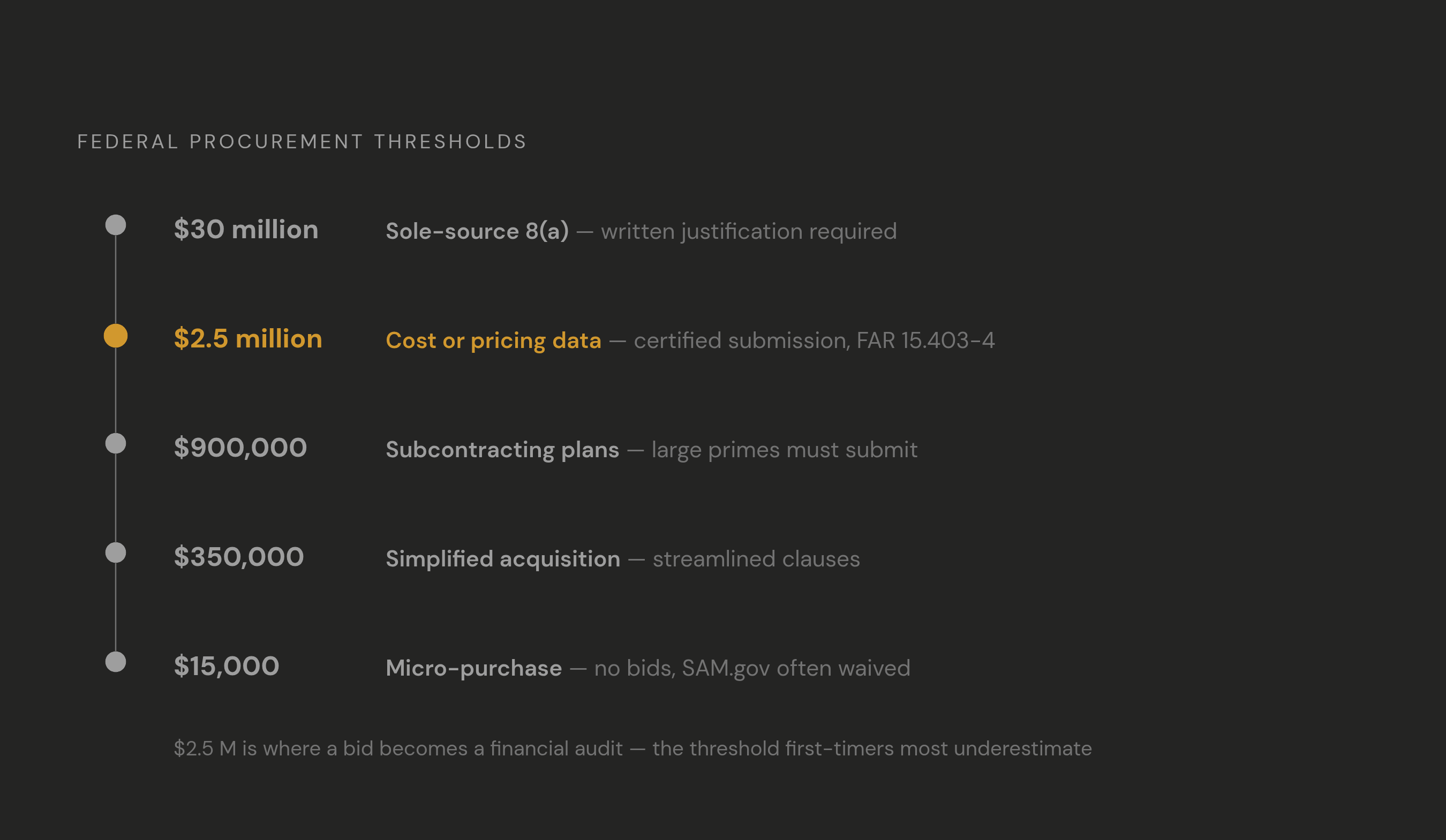
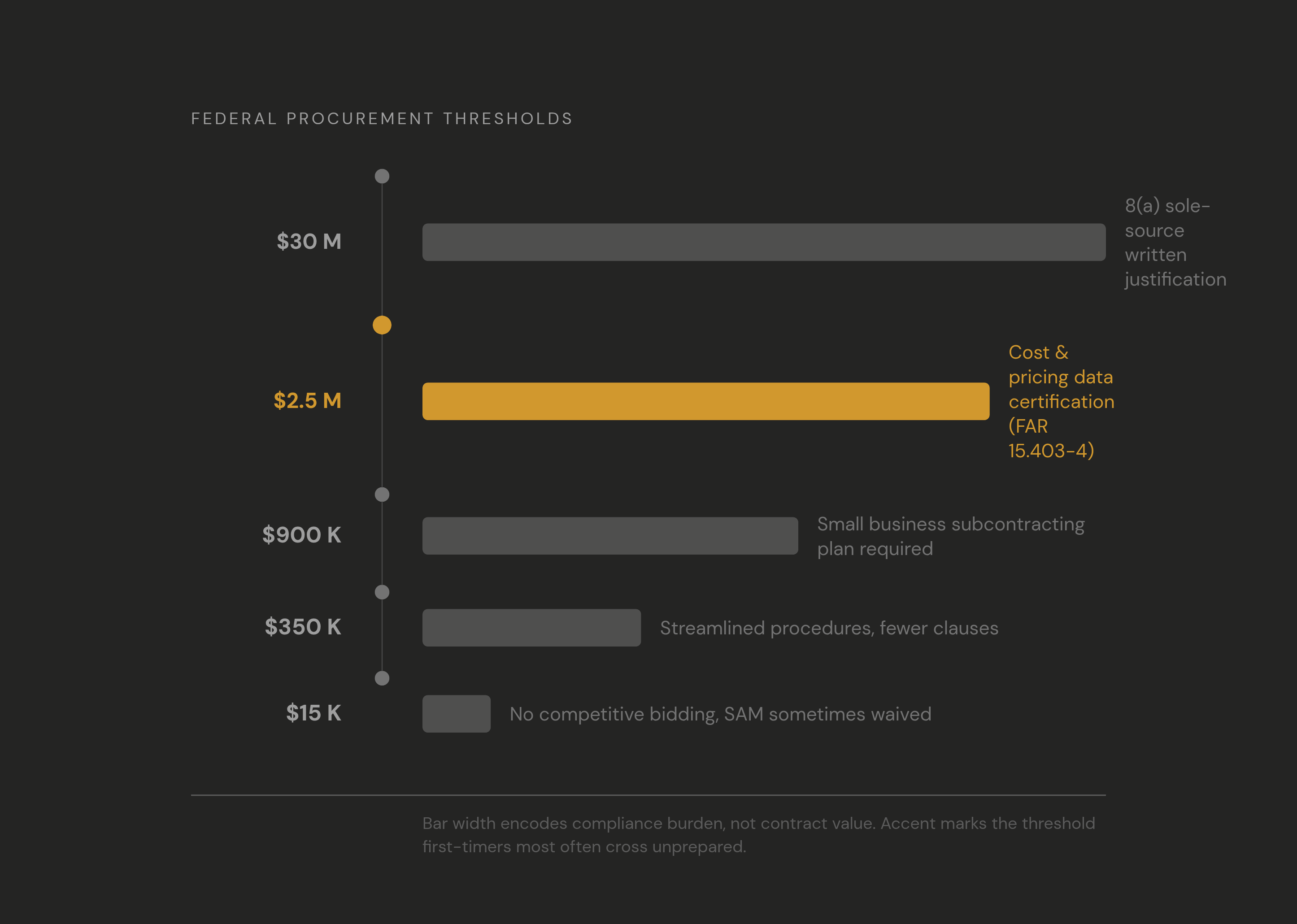
As of October 1, 2025, the dollar thresholds that trigger different sets of FAR rules got adjusted for inflation, under a final rule issued August 27, 2025. These numbers are current, and they matter more than most first-timers realize, because the threshold a contract falls under determines which rules apply and which you can safely ignore.
At the bottom sits the micro-purchase threshold, now $15,000. Contracts at or below that level can be awarded without competitive bidding, and in some cases without SAM.gov registration at all. For contingency operations, that threshold jumps to $25,000 domestically and $40,000 overseas. This is the lowest-friction entry point available, and if you're supplying routine goods or services, it's worth knowing this door exists.
Next up, the Simplified Acquisition Threshold, or SAT, now set at $350,000. Below this line, contracting officers use streamlined procedures: fewer mandatory clauses, shorter timelines, less paperwork weight. For domestic contingency operations that threshold rises to $1 million, and for overseas contingency work, $2 million. Most of the RFQ activity mentioned earlier lives under this SAT line, which is exactly why it's relevant to where most first-time vendors start their federal career. A higher SAT means more procurements qualify for the simplified track, which in practical terms lowers the barrier to entry for vendors who've never done this before.
Above $900,000, a different rule kicks in, though it's aimed less at you and more at the large prime contractors above you: they're required to submit small business subcontracting plans. If you're chasing subcontract work rather than a prime position, this threshold is the one to watch, because it's the mechanism that forces big primes to go looking for smaller partners.
At $2.5 million, the compliance weight gets heavier. Above that figure, vendors must certify and submit detailed cost or pricing data under FAR 15.403-4, a requirement that turns a straightforward bid into something closer to a financial audit. And at $30 million, there's a threshold specific to the 8(a) program: contracting officers seeking to sole-source above that amount to an 8(a) firm need separate written justification.
The takeaway, stated plainly: find out which bracket your target contract sits in, and you'll know exactly which rules apply to you, and just as usefully, which ones don't.
All of it, for every executive branch purchase, codified across Parts 1 through 53 of Title 48, Chapter 1 of the Code of Federal Regulations.
SAM.gov registration and the UEI — the prerequisite that disqualifies bids before they're read
Here's the blunt version: no active SAM.gov registration, no federal contract. Full stop. It doesn't matter how good your proposal is if the award can't legally go to an unregistered entity.
Since April 4, 2022, the federal government has used something called a Unique Entity Identifier, or UEI, as the primary way to track contractors, replacing the old DUNS Number system. It's a 12-character alphanumeric code, issued free through SAM.gov directly, no third-party broker required (and if anyone offers to sell you one, that's worth a raised eyebrow). One quirk worth knowing: requesting a UEI through multiple submissions, perhaps because you got impatient waiting, actually creates duplicate entries that delay your registration until someone sorts out the mess. Patience, in this one narrow case, actually moves faster than urgency.
There's also a CAGE Code, a 5-character identifier assigned during or shortly after SAM registration, required for Department of Defense work and plenty of other federal systems beyond it.
In August 2025, the FAR Council clarified something that had been murky since a 2018 amendment left people arguing about it: registration needs to be active at two specific moments, when you submit your offer, and again at the time of award. That resolved years of confusion over whether continuous registration was required in between. It isn't, technically, but don't let that lull you: registration is only valid for one year, and if it's lapsed at the moment of award, that's a disqualifying condition regardless of how strong your bid was.
The single most common mistake trips people up before they even get to the interesting parts: your legal business name in SAM.gov has to match IRS records exactly. Not approximately. Exactly. A missing comma, a period where the IRS record doesn't have one, a "Inc." versus "Incorporated" mismatch, and the whole registration bounces back for correction. It's a small thing that eats weeks. Start your SAM registration well before any bid deadline, because processing takes time and errors require correction cycles that you cannot rush.
Small business size standards and set-aside programs that determine eligibility for reserved competitions
Whether you count as "small" depends on your NAICS code, the six-digit classification assigned to your industry, and the SBA measures that either by employee headcount or average annual receipts, depending on which industry you're in. A construction firm and a software consultancy get measured on totally different scales, and knowing your own NAICS code before you go hunting for opportunities is step one, not step five.
In January 2025, the SBA issued a final rule (89 FR 102448, effective January 16, 2025) that consolidated and refined the affiliation rules governing who counts as small. Then in August 2025, the agency proposed inflation-adjusted increases to monetary size standards across more than 200 NAICS codes, construction being one example, where average annual receipts limits would rise substantially. Translation: more firms are likely to qualify as "small" soon than do right now, which is worth watching if you're sitting right on the edge of a threshold.
The mechanism that actually creates set-aside competitions is called the Rule of Two, preserved in the September 2025 rewrite of FAR Part 19: if a contracting officer determines that two or more small businesses are capable of doing the work, the contract has to be set aside for small business competition. Recognizing when this rule applies to an opportunity you're eyeing is, frankly, half the battle of figuring out whether you belong in that competition at all.
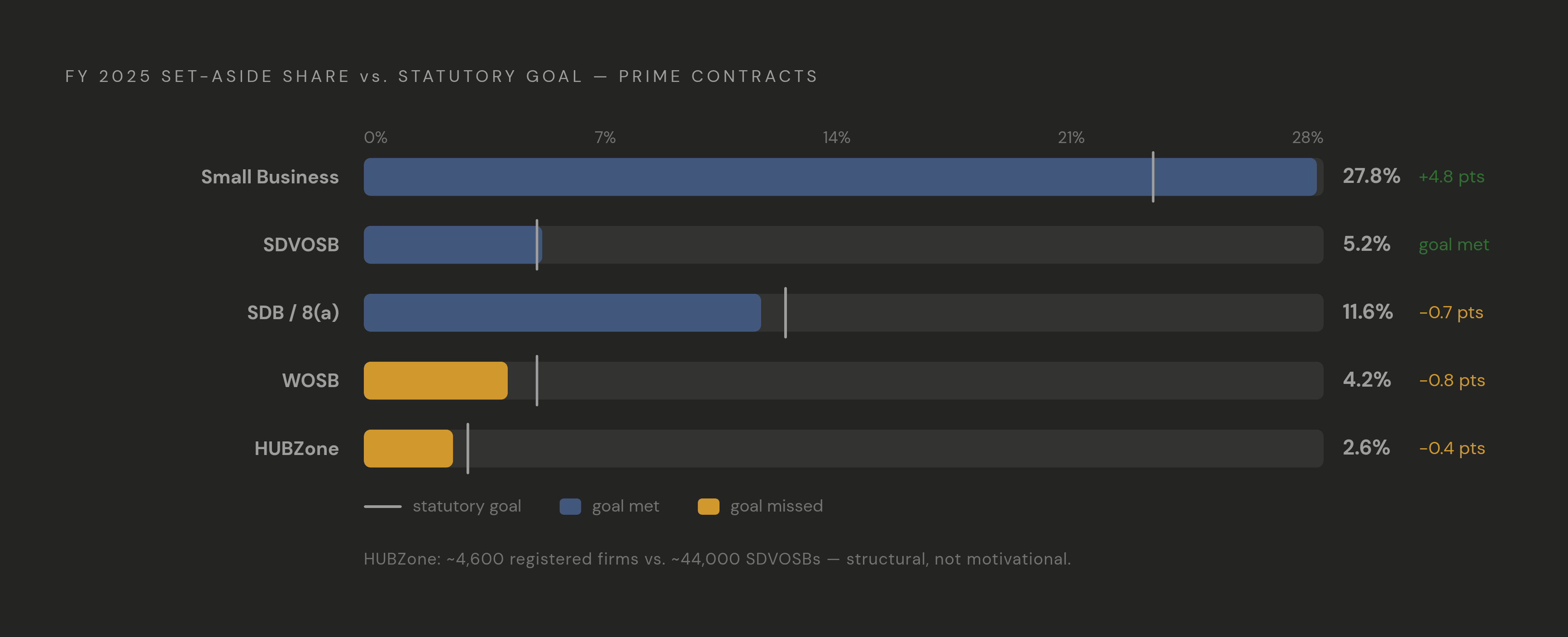
The set-aside categories performed unevenly in FY 2025. Service-disabled veteran-owned small businesses pulled in $32.5 billion in awards, clearing the 5% statutory goal. Small disadvantaged businesses and the 8(a) program captured 11.6% of prime contracts, worth $75.3 billion, down from 12.27% the year before, amid heightened scrutiny of the 8(a) program generally. Women-owned small businesses landed around 4.2%, short of the 5% goal, a program that's underperformed its target consistently rather than as a one-year blip. HUBZone businesses captured roughly 2.6% against a 3% target, and part of the reason is structural: there are only about 4,600 HUBZone-registered firms in SAM.gov, compared to roughly 44,000 SDVOSBs. You can't hit a participation goal with a category that small, no matter how generous the preference.
Affiliation rules deserve their own warning label. The SBA looks at your relationships, investors, teaming partners, parent companies, and if those relationships push your combined size over the threshold, you're no longer small in the government's eyes, even if your own headcount looks tiny on paper. This is the legal trap that catches first-timers who've taken outside investment or built informal partnerships without checking how the SBA views them.
One more thing worth knowing: a FAR rule effective January 3, 2025 harmonized suspension and debarment procedures across contracts and grants. A vendor debarred in one program now faces unified scrutiny across all federal awards, not just the one where the violation happened. Misrepresenting your size status on a set-aside bid isn't a paperwork slip; it's a federal violation, and the consequences follow you across the whole system now.
Reading a solicitation for compliance requirements, not just scope of work
A solicitation isn't a suggestion document. It's a legally binding instruction manual, and every deadline, format requirement, and evaluation factor inside it functions as an enforceable condition, whether or not it feels that way when you're skimming past page 40.
Four sections deserve more attention than first-timers typically give them. Section L, Instructions, Conditions, and Notices to Offerors, spells out exactly how to format and submit your bid, and deviating from those instructions is grounds for outright rejection, no matter how strong the substance underneath. Section M, Evaluation Factors, lists the actual criteria the agency will score you against, and every factor named there needs a direct answer somewhere in your proposal. Section H, Special Contract Requirements, holds the agency-specific clauses, often cybersecurity obligations, insurance minimums, or reporting requirements that don't appear anywhere in the general FAR baseline. And Section I, Contract Clauses, lists what becomes binding on you the moment you're awarded the contract; reading it before you bid, not after, is how you catch cost and delivery obligations that would otherwise blindside you.
Late submissions get treated with a strictness that surprises people used to more forgiving deadlines elsewhere in business. Under sealed bidding especially, a bid that arrives after the stamped deadline gets rejected, ordinarily, regardless of the excuse. Traffic, a server outage, a courier who got lost; none of it typically matters once that clock runs out.
Amendments carry their own quiet trap. If an agency issues an amendment to a solicitation, and they do this more often than you'd expect, right down to the final week sometimes, you're required to acknowledge it in your bid. Miss that acknowledgment, and your bid can get flagged as non-responsive on a technicality that has nothing to do with your qualifications.
And on communications: most solicitations name a single contracting officer as the sole authorized point of contact. Reaching out to some other agency employee you happen to know, even with good intentions, even just to ask a clarifying question, can be treated as a disqualifying violation. Treat Section L the way you'd treat a technical spec for the deliverable itself: it's not background reading, it's the actual requirement you're being measured against.
Representations, certifications, and the legal consequences of getting them wrong
Every federal bid carries a set of representations and certifications, formal statements signed under penalty of law, not casual checkboxes. Most of these live in SAM.gov's annual representations module, and they get pulled into your bid, and eventually the contract itself, by reference.
What are you actually certifying? Your business size and any socioeconomic status you're claiming, whether that's small business, SDVOSB, WOSB, 8(a), or HUBZone. That you're not currently suspended or debarred. Compliance with labor law, equal opportunity requirements, drug-free workplace policy. Country of origin for products under the Buy American Act. And that there's no conflict of interest lurking behind the bid.
Get one of these wrong, whether through carelessness or intent, and you're exposed under the False Claims Act, which allows for treble damages and civil penalties, and in serious cases, criminal liability. This isn't a hypothetical scare tactic; it's the actual statute that governs false certifications to the federal government, and it doesn't distinguish neatly between "I lied" and "I didn't check carefully enough." Both can land you in trouble.
The January 2025 harmonization rule mentioned earlier compounds this risk. A violation discovered in a grant context now creates exposure in the contracting context too, meaning the walls between these systems are thinner than they used to be.
The mistakes first-timers make tend to cluster in familiar spots: certifying as small under a NAICS code when an affiliation with another company actually pushes the firm above the size threshold, or letting SAM.gov annual representations auto-renew without checking whether anything, size, ownership, socioeconomic status, has changed since last year. Neither mistake looks dramatic in the moment. Both carry the same legal weight as a deliberate misstatement, once discovered, which is exactly why the paperwork deserves the same seriousness as the actual work you're bidding to do.
Sources
- https://www.sledai.com/blog/how-to-bid-on-government-contracts/
Provided the $1.5 trillion state and local government spending figure cited in the opening paragraph.
- https://www.acquisition.gov/far/part-14
Cited as the governing regulation for the sealed bidding procurement method.
- https://www.fema.gov/node/what-unique-entity-identifier-uei-and-how-it-related-system-award-management-sam
Informed the explanation of the Unique Entity Identifier and its replacement of the DUNS Number system.
- https://ies.ed.gov/ies/2025/01/transition-duns-number-unique-entity-identifier-uei-fact-sheet
Supported the description of the UEI as a 12-character alphanumeric code issued free through SAM.gov, replacing the DUNS Number.