Procurement Integrity Act Compliance for GovTech Vendors
Government vendors face dual-role conflicts that the PIA was written to prevent.
The PIA, codified at 41 U.S.C. §§ 2101–2107, was born from embarrassment. A 1980s defense contracting scandal made it politically untenable to leave procurement integrity to professional norms and good intentions, so Congress gave it teeth. Its implementing regulations live in FAR Section 3.104, and that section deserves to be a living reference for vendor compliance teams, not a document someone read once during onboarding and forgot about.
Four provisions, each with its own bite.
The prohibition on disclosing protected procurement information applies to anyone who has or had access to contractor bid or proposal information, or to source selection information, while working on or advising a procurement. That definition of "protected" is broader than most vendors assume: it captures cost or pricing data, proprietary manufacturing details, and any material properly marked as bid or proposal information. The prohibition runs until contract award, which is precisely the window when competitive harm is most acute and most achievable.
The prohibition on obtaining protected information is equally expansive. A vendor who should have recognized incoming information as protected, even when the agency contact shared it with the best of intentions, doesn't walk away clean. Receiving information through a well-meaning source isn't a defense. It's a fact pattern.
The employment contact reporting requirement compels an agency official who is personally and substantially participating in a procurement above the simplified acquisition threshold to report, in writing, any contact from a bidder about possible non-federal employment. The obligation fires even if the outreach was unsolicited. Vendors need to understand this provision from both directions simultaneously: the official's legal duty and the vendor's role in triggering it.
Post-government employment compensation restrictions prohibit former officials who held specific enumerated roles on procurements above a defined threshold from accepting compensation from an awardee for one year after leaving government service. The enumerated roles include contracting officer, source selection authority, evaluation board member, and program manager. Those two words, "any compensated," do considerable heavy lifting that most hiring managers don't know to look for.
One clarifying point worth stating directly: the PIA is not a general ethics statute. It is procurement-specific, timed to the procurement lifecycle, and that is precisely why FAR 3.104 is its operational home. Treating it like a general conduct policy misses the risk entirely — like using a smoke detector as a fire extinguisher.
Who the PIA Covers, and Why GovTech Vendors Are More Exposed Than They Assume
The PIA's reach extends to contractors, subcontractors, consultants, experts, and advisers acting on behalf of the government in any phase of a covered procurement. The Act's definition of "employee of an agency" explicitly includes third-party contractors. Not civil servants. Contractors.
Most vendors think of the PIA as something that governs government employees. The statute disagrees, and the disagreement is consequential.
That raises an important question: what does this mean for the vendor engaged to assess an agency's IT architecture, help draft requirements, or evaluate existing systems? Functionally, that vendor is acting as an agency adviser. If that same vendor is also a potential or actual bidder on the resulting procurement, it simultaneously holds obligations as a quasi-government participant and competitive interests as a market player. The PIA was designed specifically to address this structural collision, which is a generous way of saying the statute saw GovTech's business model coming before GovTech had a business model.
The dual-role trap is not hypothetical. It is the operating posture of a significant share of the GovTech market. Systems integrators, technology assessors, and advisory consultants routinely do both things: help agencies define their needs and then bid to fill them. Think of it as being handed the answer key and then being asked to take the test — the statute noticed, even if the vendor didn't. The compliance implications of that pattern are not ambiguous in the law. They are just underappreciated in practice.
It is also worth considering the subcontractor question. A prime contractor's PIA compliance posture extends down the supply chain, which means a vendor with rigorous internal controls can still be implicated by a partner who doesn't know what source selection information looks like. Vendor compliance programs need to extend, at minimum, to the disclosure and training obligations embedded in subcontractor agreements.
Internal counsel should be assessing PIA obligations at the start of any advisory engagement, not after a solicitation drops. By the time the RFP is published, the exposure has already accumulated.
Organizational Conflicts of Interest as the PIA's Closest Neighbor, and a Growing Regulatory Target
OCI and the PIA are not the same thing, but they are cousins. Both arise from the same underlying fact pattern: a vendor with privileged access to agency information competing for contracts that access influences. Understanding where one ends and the other begins matters because the remedies and enforcement mechanisms differ, even when the root cause is identical.
FAR mandates that contracting officers avoid, neutralize, or mitigate OCIs. Vendors who self-identify and disclose early retain considerably more control over the outcome than those who are caught later. This is one of those situations where the cover-up is worse than the underlying problem, because it is substantially harder to explain to a contracting officer who just found out.
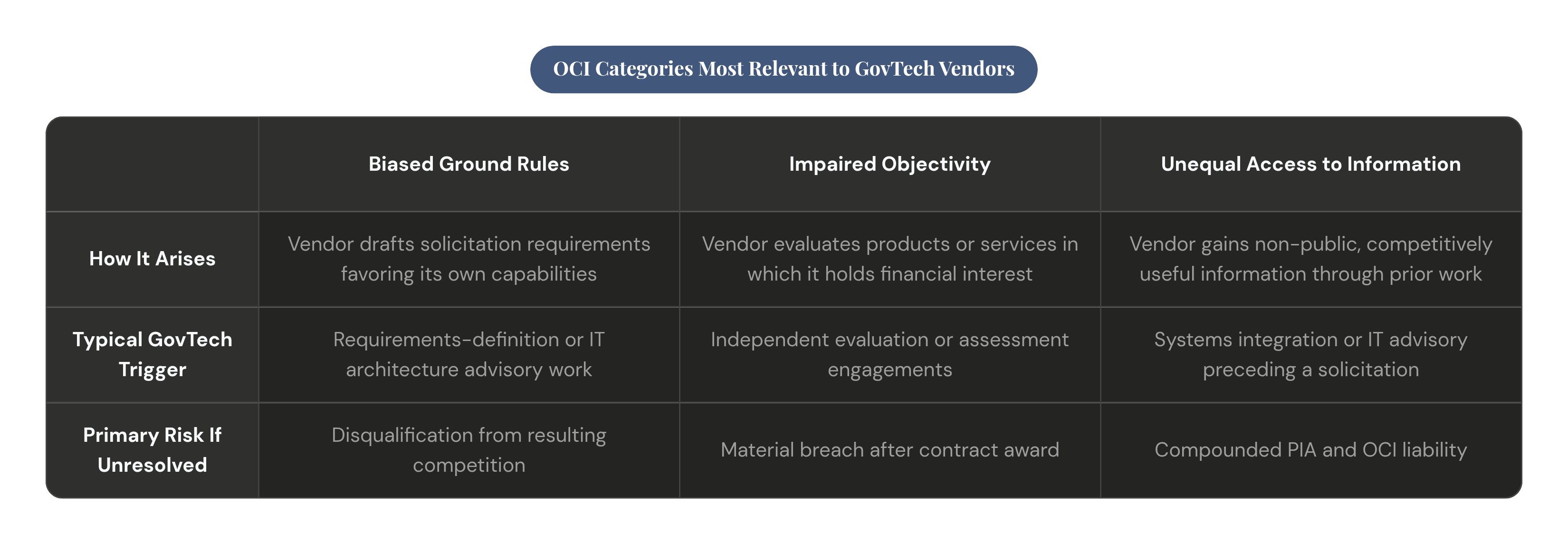
Three OCI categories appear with regularity in GovTech engagements. Biased ground rules arise when a vendor helps draft solicitation requirements in ways that tilt competition toward its own capabilities. Impaired objectivity arises when a vendor evaluates products or services in which it has a financial interest. Unequal access to information, the scenario most directly entangled with PIA source selection concerns, arises when a vendor gains non-public, competitively useful information through prior work.
An unresolved OCI doesn't just threaten bid eligibility. It can constitute material breach after contract award and, in FCA-sensitive contexts, can escalate to fraud liability. The GAO has upheld disqualification based on OCI findings. This is not a theoretical risk category; it has ended competitive opportunities on large procurements, often without much public attention.
The regulatory trajectory is tightening. A proposed FAR rule published in early 2025 by DoD, GSA, and NASA would broaden OCI definitions and require proactive multi-stage disclosure, with mandated mitigation measures including firewalls, organizational separation, and in some cases divestiture. Vendors who treat OCI as a bid-time consideration, rather than an engagement-intake consideration, will find that rule a rude awakening.
The prohibition runs until contract award, which is precisely the window when competitive harm is most acute and most achievable.
How the Revolving Door Specifically Threatens GovTech Vendor Eligibility
GovTech vendors compete partly on the strength of their agency relationships and institutional knowledge. The sector's hiring practices reflect this openly: former government IT officials are valuable candidates precisely because of what they know and who they know. The problem is that the PIA's post-employment restrictions are calibrated exactly to that value proposition.
The restriction is precise. Former officials who held specific enumerated roles on procurements above the relevant threshold cannot accept compensation from an awardee for one year after departure, and not just in a representational capacity. The compensation restriction and the access-to-information restriction do not care about job titles or org charts. They care about what the individual knew and when they stopped being a government employee.
The CACI Inc.–Fed. v. United States case is the clearest illustration of the stakes available in the case law. The Court of Federal Claims upheld a contracting officer's decision to exclude CACI from competing on a large Army IT follow-on procurement. The basis: CACI had employed a consultant who, as a former Army official, had overseen the incumbent's performance on the predecessor contract and had access to non-public, proprietary information. CACI lost not the contract but the right to compete for it. You could say CACI didn't just miss the shot — they lost the ability to step onto the court.
Why does this happen so often? Standard pre-hire screening processes, even rigorous ones, typically check credentials, clearances, and background. They do not systematically assess post-employment restrictions under the PIA. That gap is not negligence exactly; it is a process design problem. The screening tool was built for a different compliance universe.
Large-scale movement of senior IT officials between government and industry, particularly during presidential transitions, increases the pool of candidates whose hiring triggers restrictions at any given moment. GovTech firms that hired aggressively during a transition window have frequently encountered restrictions they didn't see coming. The risk is cyclical and somewhat predictable, which makes it all the more frustrating that so many vendors encounter it as a surprise.
What the Current Enforcement Environment Means for Vendors Who Get This Wrong
Criminal exposure under the PIA is substantial. Knowing disclosure or receipt of protected procurement information carries multi-year imprisonment and significant fines. Civil penalties scale sharply for organizations, and the additional penalty of twice the compensation received or offered means exposure grows proportionally with deal size.
Administrative consequences are often more immediately damaging. Suspension or debarment effectively ends a vendor's ability to compete while proceedings are underway. For a company whose entire revenue base is government contracts, that is not a setback; it is an existential event.
The DOJ Procurement Collusion Strike Force, active since 2019, deepened its focus on IT vendors specifically, with its first guilty pleas in an IT manufacturer and reseller investigation announced in early 2025. That announcement signals that the sector is now a named enforcement priority, not an incidental target. A new DOJ Antitrust Division whistleblower program, announced in mid-2025, compounds the picture further. The program pays a percentage of recoveries above a meaningful threshold and has already yielded its first reward. Insiders, former employees, and competitors now have financial incentives to report what they observe. The assumption that internal compliance concerns stay internal is no longer a viable risk posture.
False Claims Act exposure runs parallel to PIA risk and tends to compound it. FCA qui tam filings reached record volume in the most recent fiscal year. The DOJ Civil Cyber-Fraud Initiative uses the FCA to pursue cybersecurity misrepresentation, a risk that compounds specifically for vendors who mishandle source selection information while simultaneously overstating their security posture. The Administrative False Claims Act, enacted in late 2024, extends the recovery window to a decade and doesn't require prior payment to the contractor. One procurement incident can simultaneously trigger PIA criminal liability, OCI-based disqualification, FCA whistleblower action, and CMMC-related enforcement. Vendors facing one investigation frequently find themselves managing all four.
That compounding is the feature of the current enforcement environment that most vendor compliance programs are not designed to handle. They are designed for single-track problems. The enforcement environment no longer presents those.
Building Internal Practices That Make PIA Compliance Operational Rather Than Aspirational
The recurring failure mode in vendor compliance programs is treating the PIA as a legal department concern, something activated by an incident rather than embedded in how business development, human resources, and delivery functions operate day to day. The irony is that PIA risks concentrate in exactly those three functions: BD conversations surface source selection information, HR hires former government officials, and delivery teams handle sensitive procurement data as a normal byproduct of their work. Legal finds out afterward.
Six practice areas, each addressable with deliberate process design.
Information handling at the point of contact. Every employee in a client-facing or BD role needs a working definition of source selection information and contractor bid or proposal information. Not a legal brief; a practical checklist. When agency contacts share documents or data during a procurement cycle, the default posture should be to pause and assess before receiving, not after. Establish a clear escalation path: who does an employee call when they suspect they've received protected information? If that path doesn't exist in writing, it doesn't exist.
Pre-hire screening for former government officials. Standard background checks don't capture PIA post-employment restrictions. A supplemental process is necessary, one that screens for which procurements the candidate participated in, in what capacity, at what contract value, and when they departed. Document the analysis before extending an offer. If restrictions apply, legal guidance on scope comes before the hire proceeds, not after the new employee has already attended their first client meeting.
OCI assessment at engagement intake. Before accepting any advisory, assessment, or systems-integration engagement, map the work against the three OCI categories. If a biased ground rules or unequal access scenario is plausible, assess whether a firewall, scope limitation, or disclosure obligation is needed before the statement of work is signed. With the proposed FAR OCI rule moving toward finalization, proactive multi-stage disclosure is likely to become a contractual requirement. Building that habit now is worth doing regardless of whether the rule finalizes on schedule.
Employment contact reporting awareness for both sides of the conversation. Train BD and recruiting staff to understand that outreach to an agency official who is actively participating in a procurement, even a casual conversation about career paths, triggers the official's statutory reporting obligation. Establish a bright-line internal rule: no employment discussions with agency officials on active procurements until legal clearance, regardless of who initiates the conversation. "They reached out to us" is not a defense.
Role-calibrated training, not seniority-calibrated training. PIA risks don't concentrate at the executive level. They arise in BD conversations, delivery team relationships, and hiring manager outreach. A once-a-year certification exercise that covers everyone the same way is not compliance training. It is paperwork. Scenario-based training, calibrated to the situations each role actually encounters, is what changes behavior.
Incident response protocol. The PIA's remediation options narrow sharply once a violation is known and unreported. Early self-disclosure to the contracting officer and agency ethics official is generally preferable to discovery. Establish a documented internal protocol covering who assesses the incident, who has authority to disclose, and what the timeline looks like. In an enforcement environment with financial incentives for whistleblowers, assuming a concern reported internally will remain internal is not risk management.
One final argument worth addressing directly: that building this kind of operational infrastructure is disproportionate for smaller vendors or newer market entrants who haven't yet won the contracts that trigger the highest-threshold restrictions. That argument inverts the logic of how enforcement actually works. Smaller vendors are precisely the ones least equipped to absorb a disqualification, an investigation, or a debarment proceeding. The companies best positioned to absorb a compliance failure are often the ones least likely to have one, because they built the infrastructure before they needed it.
The GovTech market is expanding through the early 2030s by most credible projections, drawing new entrants who lack compliance infrastructure into a sector where enforcement agencies, inspectors general, and whistleblower programs have all scaled to match the dollars at stake. More competition, more money, more scrutiny. The vendors who internalize that combination early will tend to avoid the downside and remain eligible to compete when their peers are navigating proceedings they didn't see coming.
Sources
- https://www.justice.gov/jmd/procurement-integrity
Provided background on DOJ's role in PIA enforcement, informing the article's discussion of criminal penalties and the enforcement environment.
- https://govcon.mofo.com/topics/procurement-integrity-act
Covered the PIA's core prohibitions and post-employment restrictions, which the article draws on for its four-provision breakdown and the CACI case discussion.
- https://www.acquisition.gov/far/3.104
Served as the primary regulatory reference for the PIA's implementing rules in FAR Section 3.104, cited directly in the article.
- https://www.seyfarth.com/news-insights/six-essential-tips-for-handling-procurement-information-for-government-contractors.html
Informed the article's practical guidance on information handling, pre-hire screening, and internal compliance practices for government contractors.
- https://www.dau.edu/acquipedia-article/procurement-integrity
Provided reference material on PIA definitions and the enumerated roles subject to post-employment restrictions.
- https://www.buildsmartbradley.com/2025/06/6-tips-for-government-contractors-to-avoid-neutralize-and-mitigate-organizational-conflicts-of-interest/
Informed the article's treatment of OCI categories and mitigation strategies, including firewalls and early self-disclosure.
- https://governmentcontracts.foxrothschild.com/2025/05/articles/general-federal-government-contracts-news-updates/new-gao-decision-highlights-effective-oci-identification-and-mitigation-practices/
Supported the article's discussion of GAO upholding disqualification based on OCI findings and the tightening regulatory trajectory.