Small Business Set-Asides in Technology Procurement
Understanding the Rule of Two unlocks federal IT contracts for small firms.

The federal small business set-aside system is not a preference program; it is a legal procurement framework with specific triggers, thresholds, and certification requirements that determine which contracts small firms can compete for and under what terms. If you are running a small technology company and you are not fluent in these mechanics, you are leaving money on the table and competing blind in a market where your larger rivals have dedicated BD teams who understand every lever. Think of it like showing up to a chess tournament having only ever played checkers — the board looks familiar, but the rules are different and your opponents know it.
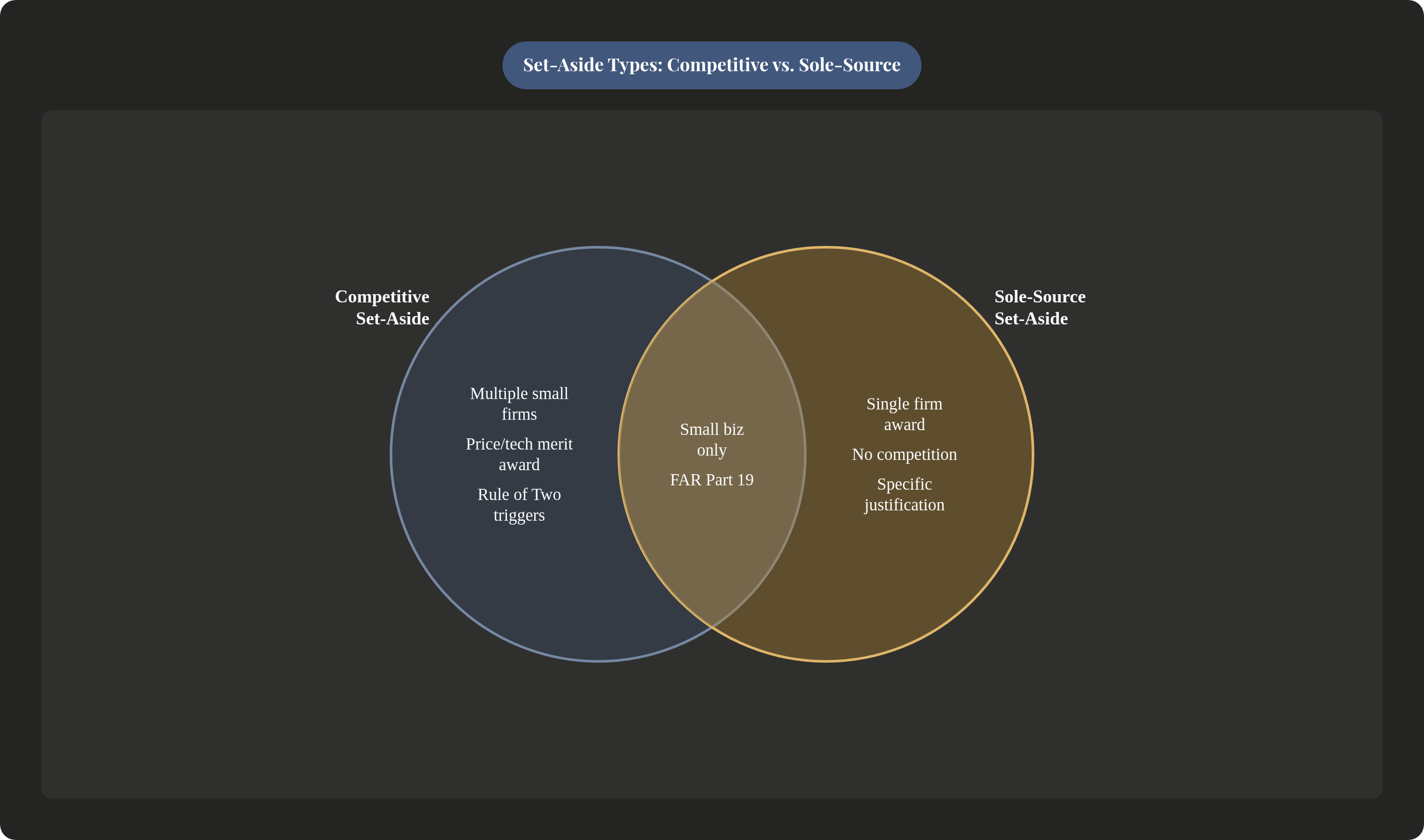
Set-asides come in two structural forms. Competitive set-asides restrict a solicitation to multiple small businesses who then compete for the award on price and technical merit. Sole-source set-asides go directly to a single firm without competition, typically under specific justification thresholds. Below $150,000, set-aside treatment is essentially automatic. Above that threshold, the contracting officer has to make a judgment call. That judgment call has a name: the Rule of Two.
The technology market context matters here. Federal IT procurement is large, consolidated, and dominated by a relatively small number of large prime contractors who have spent decades building relationships, clearances, and past performance records. Without the set-aside framework, most small firms would have a realistic path to exactly nothing at the prime contract level. That is not hyperbole; it is the structural reality the program exists to correct.
How the Rule of Two Actually Triggers a Set-Aside
The standard is straightforward on paper. A contracting officer must reasonably expect that at least two responsible small businesses will submit offers and that award can be made at a fair market price. If that condition is met, the contract must be set aside for small businesses. If it is not met, it does not have to be.
"Reasonably expect" is where the real action happens. That phrase is a judgment call, and it is grounded in market research the contracting officer conducts before the solicitation drops. Sources sought notices and Requests for Information are the primary instruments of that research. When your firm responds to one of those notices, you are not just gathering competitive intelligence, though you are doing that too; you are contributing direct evidence that the Rule of Two can be satisfied. Your response is part of the evidentiary record the contracting officer uses to make the determination.
This is one of the most underappreciated mechanics in federal BD. A small IT firm that systematically responds to sources sought notices is literally shaping which contracts get set aside. That is a consequential activity dressed up in administrative clothing.
The rule itself sits in a precarious legal position. It has not been codified by statute for acquisitions above the simplified acquisition threshold, which means it lives in the FAR as regulation, not in law. H.R. 2804, the Protecting Small Business Competitions Act of 2025, is the current legislative vehicle seeking to lock it into statute. Separately, a proposed rule published in October 2024 would extend the Rule of Two to task and delivery orders placed under government-wide contracts. That extension matters enormously because the bulk of federal IT spending flows through those vehicles, not through standalone solicitations. Until both the statutory protection and the task-order extension are finalized, small businesses have a direct interest in monitoring FAR Part 19 rulemaking activity; the rule that protects your access to this market is not yet fully bulletproof.
One more structural note: where full set-asides are not viable, partial set-asides become mandatory. If a large IT contract mixes commodity hardware procurement with complex custom development, and market research shows small firms can perform the custom portion, the contracting officer must carve out that portion and set it aside separately. Knowing to look for those partial structures in large IT solicitations is a practical skill, not a theoretical one.
How Size Is Determined: NAICS Codes, Employee Counts, and Revenue Thresholds
The SBA uses two types of size standards: number of employees and average annual receipts. Which standard applies to a given contract depends on the NAICS code assigned to that solicitation. For most IT services firms, the relevant codes are 541512 for Computer Systems Design Services and 541519 for Other Computer Related Services, both of which use employee counts rather than revenue as the measuring stick.
The critical point that trips up a lot of firms: the NAICS code on the solicitation governs your eligibility for that specific contract, not the primary NAICS code registered in your SAM profile. If an agency assigns a code to a procurement that falls outside your usual lane, your size status is evaluated under that code's standard. You need to check every solicitation individually.
In August 2025, the SBA published a proposed rule to raise receipts-based size standards across a substantial number of industries. The practical effect is that growing firms can retain their small business status longer before aging out of eligibility. That is a meaningful runway extension for firms in growth mode.
The more immediately consequential regulatory development involves mergers and acquisitions. Under rules with key provisions taking effect January 17, 2026, a firm that cannot recertify as small within 30 days of a transaction loses eligibility for set-aside contracts tied to multiple-award vehicles. Deal timing now has direct procurement consequences. If your firm is approaching a threshold and contemplating an acquisition or a significant growth event, recertification modeling needs to be part of that planning process from the beginning, not something the general counsel's office remembers at closing.
The Socioeconomic Set-Aside Tiers and Their Certification Requirements
Above the $250,000 threshold, contracting officers do not simply default to a general small business set-aside. They are required to work through a statutory priority order: 8(a), HUBZone, Service-Disabled Veteran-Owned Small Business, and Women-Owned Small Business programs each get consideration before the contracting officer moves to a general small business set-aside. This ordering has real dollar consequences.
Each program has its own certification process administered through the SBA's online platform. Certification is not a self-certification on a form; it requires documentation, SBA review, and approval before you can compete under the program. That process takes time, and starting it after a relevant opportunity appears in SAM.gov is already too late. Waiting until you spot the contract to start your certification is like deciding to build the boat after the flood arrives.
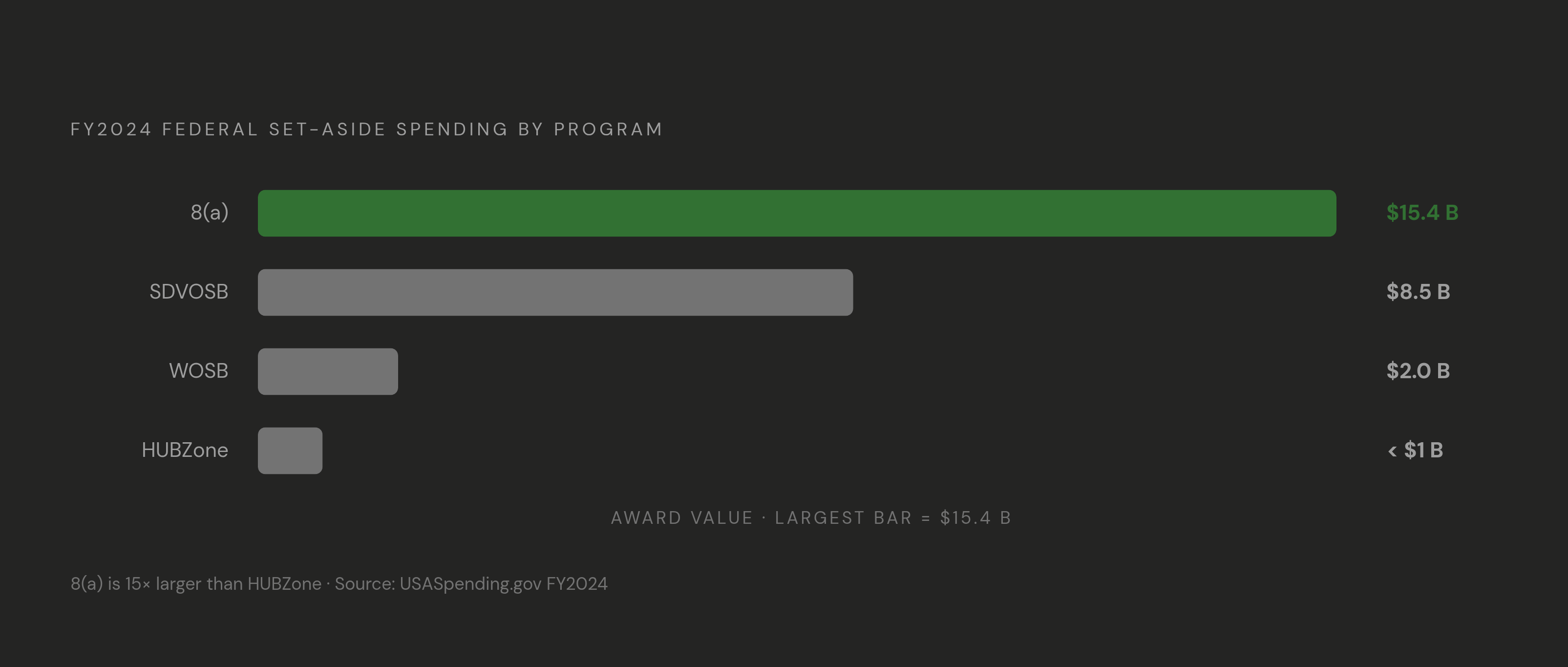
The FY2024 numbers illustrate the scale of what is available at each tier. The 8(a) program generated $15.4 billion in contract dollars. SDVOSB set-asides accounted for $8.5 billion. WOSB set-asides totaled $2 billion. HUBZone came in under $1 billion, reflecting the persistent challenge of meeting the geographic and employee residency requirements that program demands. The SDVOSB goal increased to 5% of eligible federal contracting dollars under the FY2024 NDAA, which expands the target pool for veteran-owned technology firms with the right certifications in place.
The 8(a) program is navigating significant legal turbulence. Following the 2023 Ultima Services ruling, the SBA issued guidance in January 2026 eliminating race-based presumptive social disadvantage status. Firms must now document individual social disadvantage rather than relying on group membership as the presumption. More than 1,000 firms were suspended for noncompliance with the new documentation requirements. If your firm holds an 8(a) certification, the practical implication is not abstract: your eligibility needs to be re-documented regardless of when the original certification was granted. Treat this as an immediate compliance task, not a future consideration.
The Scale of the Set-Aside Market in FY2024 and Where IT Fits
The headline figure from FY2024: agencies spent a record $69.6 billion through small business set-aside contracts, up from $66.6 billion the prior fiscal year. Total prime contract dollars flowing to small businesses exceeded $183 billion, representing 28.8% of all federal contracting dollars and surpassing the 23% statutory goal by a meaningful margin.
Those numbers tell an optimistic story. There is a counter-signal worth sitting with. The number of small business prime contractors fell in FY2024, continuing a consolidation trend where more dollars are concentrating among fewer firms. The aggregate opportunity is growing, but the firms capturing it are becoming a smaller and more exclusive group.
The implication is structural. Competing exclusively on open-market, standalone contracts means competing for a share of the market that is getting proportionally smaller. The action is on the vehicles, specifically the Government-Wide Acquisition Contracts that channel the majority of federal IT spending. Winning a position on a major GWAC is increasingly the gateway to the meaningful set-aside dollars. Firms that have not pursued vehicle placement are missing access to the dominant procurement channel in their market, and individual contracts besides.
The set-aside rules that apply to individual contracts apply equally to task orders under those vehicles. That is why the October 2024 proposed rule extending the Rule of Two to task orders carries such specific weight for IT firms. The vehicle is the market, and the rules governing the vehicle are the rules that govern access.
How GWACs Structure Set-Aside Access in Federal IT: The SEWP Example
GWACs are pre-competed, multi-vendor contracts that give agencies a compliant, streamlined path to IT procurement. Instead of running a full competition for every IT requirement, an agency can issue a task order against an existing GWAC. The compliance work is front-loaded into the vehicle competition; the task order process is faster and lighter. For an agency trying to move quickly on a technology need, that efficiency is the point.
NASA's Solutions for Enterprise-Wide Procurement, known as SEWP, is the most instructive example to understand right now because SEWP VI, the successor vehicle, just came online. SEWP V generated $12.1 billion in total revenue on roughly 51,000 orders in fiscal 2025, with approximately 80% of all dollars flowing to small firms. The program has moved more than $86 billion since 2015. These are not marginal numbers.
SEWP VI carries a $60 billion ceiling across a performance period running from November 2026 through October 2036. NASA awarded 2,115 contracts across three categories to 1,490 vendors. Category C is restricted exclusively to small businesses and covers IT mission-based services, the more complex, services-intensive work that carries higher margins and longer relationships. Categories A and B are unrestricted, but small businesses captured 88% and 80% of awards respectively in those categories, demonstrating that small firms are genuinely competitive across the full vehicle even where the restriction does not apply.
SEWP VI faced 16 protests following the May 2024 final solicitation. GAO denied six; nine were dismissed after NASA took corrective action. That protest volume is instructive. Even the on-ramp competition for a vehicle of this scale is contested enough that protest strategy is a relevant consideration, not an afterthought reserved for the truly aggrieved.
SEWP VI does not exist in isolation. GSA's Alliant 3 and NIH's CIO-SP4 compete for similar agency customers and similar task order dollars. Firms deciding which vehicles to pursue with limited BD resources should assess each vehicle's category structure, small business reservations, and the competitive profile of the vendor pool before committing to a proposal investment.
What the 2025 FAR Overhaul Changes for Small Business Competitors
The Revolutionary FAR Overhaul, referred to as the RFO, is the most significant restructuring of the Federal Acquisition Regulation since the regulation was created. The first phase removed more than 1,600 requirements from the FAR, streamlining a document that had accumulated decades of accretion. The stated goal is simplification and modernization.
The core set-aside obligation survived the first phase. When two or more competitive small businesses can perform the work, the set-aside requirement remains intact. That is the foundational protection, and it held.
What changed, and what remains uncertain, is the surrounding architecture. The FAR Part 6 rewrite, which governs competition requirements, removed explicit references to certain socioeconomic program provisions. Industry observers have raised legitimate concerns that the forthcoming FAR Part 19 rewrite, covering small business programs, will inadvertently or deliberately weaken set-aside mandates as the overhaul continues. That rewrite has not been finalized. The concern is worth monitoring, not dismissing.
On the constructive side, the overhaul places new emphasis on on-ramps to existing GWACs and set-asides, creating lower barriers for small firms to access vehicles they missed at original award. That is a meaningful structural change for firms that were not yet positioned when a major vehicle competed.
A separate proposed FAR rule addresses the persistent problem of multiple-award contracts being structured without any small business set-aside or reserve. FPDS data for FY2021 through FY2023 shows the government awards roughly 3,700 multiple-award contracts per year with no such designation. That represents a substantial volume of procurement activity where small business protections are structurally absent from the vehicle itself. The proposed rule targets that gap directly.
SAM registration reform is also included in the overhaul. This matters because a lapsed SAM registration disqualifies a firm from award regardless of set-aside status, certification status, or competitive position; it is the kind of administrative failure that ends opportunities with no recourse. Treat SAM maintenance as infrastructure, not paperwork.
How Government-Wide Contracting Goals Shape Agency Behavior Toward Small Businesses
The statutory goals are the baseline. Twenty-three percent of eligible contracting dollars to small business overall. Five percent each to Women-Owned Small Business and Service-Disabled Veteran-Owned Small Business. Three percent to HUBZone. These targets drive agency planning and, more practically, agency behavior in the back half of the fiscal year.
In FY2024, the government exceeded three of five prime contracting goals, and 21 of 24 agencies received an "A" or "A+" on their SBA Procurement Scorecard. Those are strong aggregate results. Missing a goal carries no financial penalty, but it triggers a required written corrective plan to the SBA. The administrative burden and reputational cost of that corrective plan create a genuine incentive to meet targets without mandate enforcement being the driver.
Here is the practical application for small firms: an agency that is tracking behind on a socioeconomic goal late in the fiscal year is actively seeking qualifying vendors. Monitoring SBA Procurement Scorecard progress mid-year is not esoteric; it is a legitimate pipeline signal. An agency that needs SDVOSB dollars before September 30 is more receptive to a qualified SDVOSB firm with a relevant capability than it was in November.
In 2025, individual agency SDB goals were standardized to 5% each across agencies. Previously, those goals varied widely, with some agencies carrying substantially higher targets than others. The standardization creates a more uniform incentive structure for small disadvantaged business contracting across the government. For SDB firms, this means the demand signal is more evenly distributed across agencies rather than concentrated in a few.
The combination of record set-aside dollars, a consolidating prime contractor base, an active FAR overhaul, and ongoing changes to socioeconomic program requirements means the rules governing access to this market are in more active flux than they have been in a long time. Firms that track regulatory changes in real time are positioned differently from those that treat compliance as a one-time onboarding checkbox; the former are playing the game as it is actually being played, while the latter are playing the version that existed when they registered.