GovTech Vendors Missing Government Opportunities Before RFPs
Vendors who wait for RFPs to post have already lost the deal.

What RFP means
A starting gun is what the RFP seems like when it hits the portal. But that starting gun can be misleading, because it's not one. Before any solicitation posts, that agency defined its issue, already drafted a budget ask, and pushed it past informal checks; usually it asked vendors what can be done. On paper it looks like a request to bid. Really, that document just records choices settled months earlier, so GovTech vendor teams lose the most money by seeing it as where sales begin.
For federal agencies, following this order is required. Under FAR (Federal Acquisition Regulation), agencies must conduct market research ahead of every solicitation. The stretch a vendor hopes to shape is thus formal and required, and all of it precedes the RFP existing. City and county offices follow their own purchasing rules, yet the pattern stays: early market research is part of government purchasing, not an extra task dropped under time pressure.
Vendors often lump several document forms into one bucket, though each signals something distinct, and the mix-up hurts them. An RFI or Sources Sought notice comes out to collect market intelligence rather than lock in a buy, and vendor input shapes the final requirements. Before that RFP is finished, an early heads-up says one is coming, making this the remaining chance to shape the result. Finally, the RFP lands: with requirements now fixed, the language often traces directly into earlier vendor discussions most others missed.
A report from NASCIO and the civic tech group Digital Response, "Improving RFPs With User Research," found that RFPs routinely bury evaluation criteria, due dates, and contractual terms deep inside the document. As a sign of agency plans, the RFP is imperfect and often muddled. The imperfect artifact is assembled in a rush, with staff having already worked through the tough parts earlier. Putting one together takes roughly 250 staff hours at the agency, and it only makes that effort once everyone inside has already agreed. Holding off till the notice comes leaves each vendor at the point in the whole cycle with the lowest say.
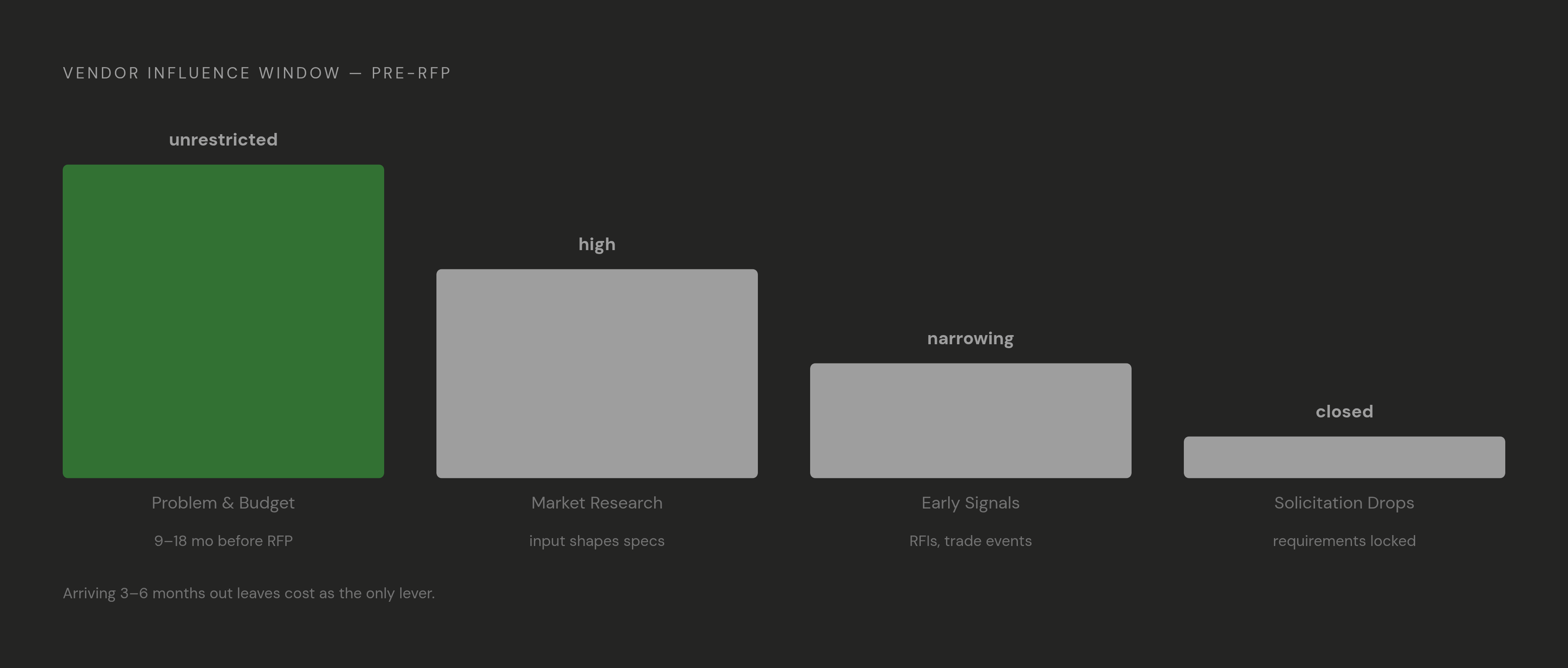
In the six-to-eighteen months leading up to the RFP, the outcome is shaped
Procurement officers often take as long as eighteen months evaluating choices, earning buy-in while shaping specs before a notice appears. The contract's fate is set during that stretch, well ahead of any document ID. Companies that ignore this period lose the deal before it starts.
The process has 4 steps. Figuring out what's missing and working out the budget happens initially: agency heads notice a hole and begin securing money, often linked to the regular budget cycle, while vendor communication at that point flows freely. Market research comes next, as procurement staff plus project leads check what's out there and who supplies it; at this stage, the vendor's input lands baked within requirements. Next, early signs appear: RFIs, Sources Sought posts, and trade events; answering one gets a company noticed before requirements are fixed. Then the solicitation gets dropped with requirements set, and the wording often leans toward whoever shaped the conversation earlier.
Budget workshops often signal an upcoming contract, based on early market research. Funding is approved before specifications are drafted, which matches the timeline.
The best time to get involved is 9 to eighteen months before, not 3. Staff continue evaluating, procurement guidelines remain open to discussion, budget allocations stay flexible, and requirements remain unhardened. Companies arriving three to six months out can still land the deal, in theory, though cost is all they can offer, since the connection already goes to those who arrived earlier. That's more than marginal disadvantage; that decides the whole thing. Research about B2G procurement shows it: months ahead of a formal notice, procurement officers consult vendor materials, other agencies, plus cooperative contract partners, while RFP details often repeat language taken right out of earlier vendor demos or an existing contract. By the time that wording has been locked in, a vendor's strongest move is just answering another firm's terms. That's answering someone else's draft effectively. That's doing it.
What vendors who act first can do that later entrants cannot
A vendor arriving ahead of time differs from one reacting once the portal alert goes off in 4 ways.
They can shape requirements, and the language often shows up nearly verbatim within an RFP that structurally favors whoever supplied it. They can get to know the future evaluators of that response ahead of when formal rules locks communication down (after a solicitation posts, evaluators are often off limits for direct talks under procurement policy). They can get a read on the competition early enough to stand apart, rather than entering a contest that's already wrapped up. They can share previous work, plus case studies, to key stakeholders as they're forming views, instead of arguing against a conclusion already made.
Show up once the RFP lands, and that earlier conversation is the true competitor. Whoever got there early built that specification, on purpose or not.
SLED procurement cycles go fast next to federal work, and contacts matter more there, so advance contact proves far more decisive in SLED market specifically. Buyers at this stage usually like hearing from companies while what they want is still up in the air. Having the phase existing is its whole point. That's literally why the phase exists. After ARPA, caution makes this even clearer: buyers pick suppliers that can show they work well, and that case isn't built through an unfamiliar RFP response. It grows out of months spent talking, demoed skills, and a brand the evaluator recognizes before grading begins.
The signals that show a procurement is forming before any notice is posted
All of it sits in plain sight. The information sits in places few GovTech sales teams ever bother to look.
Board meeting agendas often include tech review discussions, plus vendor presentations months ahead of something formal exists. Budget documents list the money set aside for a planned system ahead of any drafted solicitation. When incumbents don't get renewals, Contract expirations almost always start a procurement, and any rebid opens things up. When agencies answer Sources Sought or an RFI, they're still doing market-research, arguably a clear sign an RFP is taking shape. Formal, sanctioned announcements let vendors engage agency staff ahead of communication limits taking effect. Budget talks, spending workshops, and capital appropriations debates often spell out the precise item being bought, usually a budget cycle ahead of any scope of work being drafted.
Procurement portals reveal choices already made. Such portals only satisfy a regulatory requirement, yet offer no one any competitive advantage. Many GovTech sales teams get almost everything from portal alerts, so they often arrive once someone already wrote the spec. A sales group cannot watch board sessions, spending records, and agency notices by hand for so many agencies at once. Staying consistent like that can't happen. Intelligence platforms exist to bridge that divide.
The platforms built to surface pre-RFP opportunities before competitors see them
A few tools now target such signals specifically before any notice posting, and none are interchangeable. A bad fit brings federal-scale access but leaves out that key SLED signal, or the other way around.
Civic IQ follows over 80,000 SLED agencies, watching for signals of pre-solicitation: budget approvals, vendor discussions, evaluations of technology, and board meeting notes as searchable pre-RFP intelligence. SLED sits at its centre, and its signals reach past federal-first tools. With AI-powered SLED procurement forecasts, it tracks budget approvals, allocations, contract expirations, draft solicitations, and board notes, helping vendors spot opportunities before they appear.
Navigator (the Government Navigator tool) highlights callouts labeled "Developing Opportunity" when shifting dollars might create RFPs, it changes once budgets are enacted, plus Excel lets users move budget numbers into a CRM platform (they say an AI-powered conversational feature covering procurements and more is on the way). SAM is still the no-cost federal portal handling solicitations above $25,000 and required for federal sign-up, and it does cover Sources Sought notices plus award history, only items already made public. That's the limit this write-up is pushing against. Deltek's IQ platform covers SLED research alongside federal work, spanning a broad range of government data.
GovSpend shows past buys by specific product, transcripts from meetings, contract expiration records, plus procurement officer info. Samsearch runs AI on over 50,000 portals, extracts requirements inside RFP documents, and helps teams decide whether to pursue a deal or go no-bid. BidNet Direct aggregates government contracts from municipalities and counties, with specialized buying networks sending notices straight to a focused vendor platform. FindRFP pulls from government sources nationwide and sends keyword alerts every day. USAspending doesn't operate as a tender portal but serves as the go-to site when tracking federal dollars going to vendors, which matters when looking into award history and researching incumbents despite never showing any current opportunity.
How AI-driven discovery is changing where procurement research begins
All of this comes from a wider shift, backed by Forrester's tracking and G2's Buyer Behavior Report. Per G2's Buyer Behavior Report, most B2B buyers turn to AI when researching vendors, not to a search engine or an industry site, and the same shift to AI programs such as ChatGPT shows up across B2B buyers overall, per Forrester. IT heads and Procurement staff belong squarely inside it. The real impact: vendor research is beginning in spots no procurement portal can reach, and nothing an alert does will let a vendor know it took place.
Gartner says normal web lookups will fall when queries shift toward conversational AI tools. Absent from such AI-generated answers, a vendor gets missed by more and more buyers right when they're picking which names even make the cut. Bain reports that nearly all B2B deals land with a vendor the buyer had already put on their shortlist. When AI compiles a shortlist during each prompt reply, being left out is still functionally like showing up after an RFP went live. Arguably, it's even harder because a portal alert never warns any vendor that the chance is gone.
The 2026 edition of the 2X AI Visibility Index reported that barely a fraction of firms keep a working discovery funnel, so their names surface during early-stage buyer research. Most fall short at the precise discovery window that counts most. DerivateX ran a benchmark of 50 SaaS firms using 1,400 buyer-intent prompts and saw that many were functionally absent for AI buyers. Take a GovTech vendor: if a procurement lead asks an AI tool, now, "which vendors handle cybersecurity modernization for mid-size municipalities", that's pre-RFP research in progress, and any vendor left out of that reply is out of the conversation.
What it takes to show up in AI answers during pre-RFP research
Known as GEO, Generative Engine Optimization means structuring pages so language tools like ChatGPT and Perplexity, plus Google AI Overviews, will spot, read, then cite them. That's not the same aim as regular SEO; vendors seeing it as SEO's family are already losing. Appearing in regular search results matters little if a buyer quits at the AI's response without clicking further. Being mentioned in that summary is what matters today, and plenty of GovTech vendors still aren't playing for it.
For any GovTech seller, that calls for site pages and proof points that respond to what a buyer might enter using AI software. It requires getting mentioned over and over in material that AI pulls from when someone prompts it about the vendor that handles cybersecurity modernization. Over the coming years, government tech budgets at regional and municipal levels are expected to grow significantly. With more than half the B2B buyers beginning research with AI, not a portal, appearing in the earliest AI-generated reply is vital. This is the fresh entry point for pre-RFP dialogue, which once moved through budget session or Sources Sought notice and, more and more now, begins with a prompt.