Federal Broadband Funding Programs Reaching Underserved Municipalities
Federal funding reaches underserved towns only if they navigate five complex bureaucratic stages.

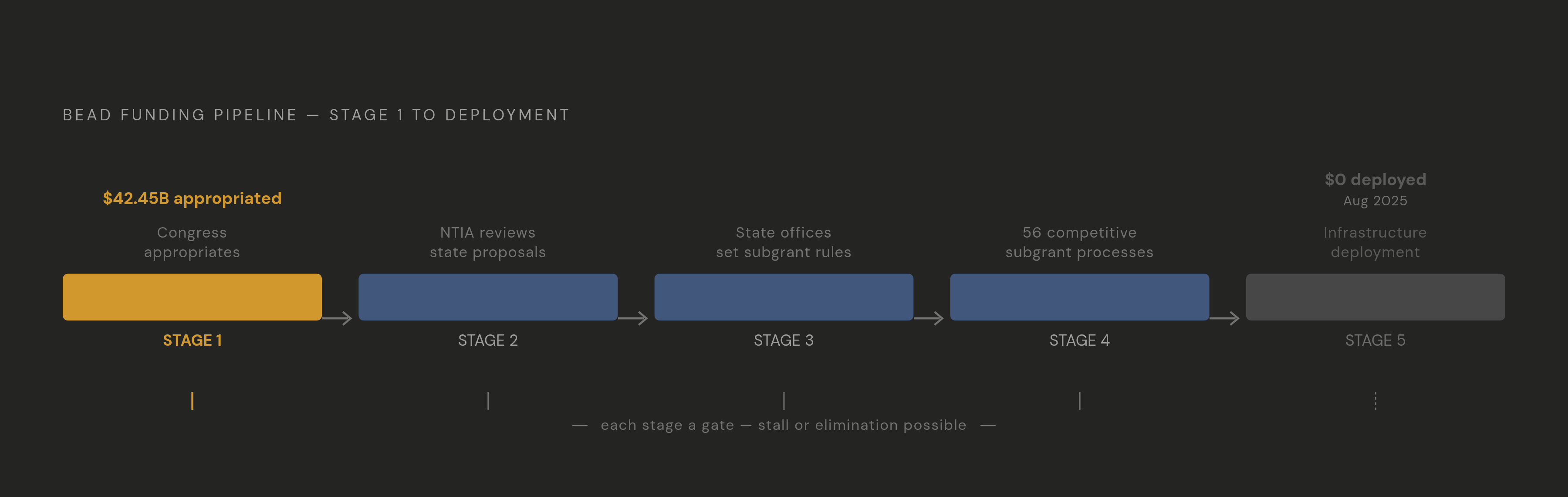
Broadband cash never travels directly from the national office to your local government. Federal broadband money flows through five stages: Congress, NTIA, state broadband offices, competitive subgrant processes, and the actual build, so where a municipality gets held up in that sequence decides its outcome on any subgrant round. The Broadband, Equity, Access, and Deployment program has the most money, $42.45 billion through the Infrastructure Investment and Jobs Act, yet NTIA doesn't pay municipalities. It approves proposals from each state and passes the funds along to those states' broadband offices, which set subgrantee selection processes and timelines themselves. So every state alongside each territory runs its own plan, with unique guidelines, plus scoring and due dates across 56 efforts.
BEAD works alongside other programs, even though it is much larger in scale. USDA's ReConnect program directed roughly $4.4 billion across 360 rural projects, reaching over 680,000 residents by offering grants alongside funding for providers plus some municipalities. Roughly $1 billion from the Middle Mile program supports backbone infrastructure, making last-mile builds cheaper to construct where locations remain unserved. Under the Digital Equity Act, $2.75 billion is allocated for digital equity grants to states. Everything turns on thresholds spelled out in the statute: an "unserved" spot has no connection or runs under 25/3 Mbps, while an "underserved" spot sits between that and just under 100/20 Mbps. Block by block, those figures set who even qualifies.
Where municipalities actually stand in the eligibility determination
A single dataset, namely FCC's National Broadband Map, is where everything upstream from any subgrant award traces. States use the FCC's National Broadband Map as a baseline when prioritizing BEAD dollars, meaning a mapping slip carries real money stakes. One mapping error can mean a site gets funding or drops out of the system.
There are still real flaws in the map. Reviews have noted persistent problems in FCC's challenge process for broadband mapping, while USDA, NTIA, and FCC use that map for steering tens of billions in dollars. Under the previous approach, one connected spot made a whole Census block "served", which papered over many unserved homes right beside it. That newer, location-by-location method fixes part of it. Not everything.
States must hold challenge processes in the BEAD proposals they submit, and that is the stage where municipalities, nonprofits, plus ISPs dispute each location's designation using field data. States like Pennsylvania hold challenge processes where stakeholders can dispute FCC records to determine BEAD eligibility. If a municipality opts out here, it can end up wrongly labeled "served" on the map, and there's no good path back to eligibility. This is the top unforced mistake a municipality can make during the process, well before people discuss subgrant funding applications. Your Mapping position controls access, and access decides everything downstream, even the state-level options you can use.
How states structure access for municipalities, and where they are in the process
How states handle municipalities varies a lot, and the divide between best-located and worst-located places keeps growing. An advocacy group's review finds 29 states allow municipalities to seek BEAD subgrant funding on their own. Several more states, including Louisiana, Minnesota, Montana, Nevada, New Jersey, North Carolina, Pennsylvania, Tennessee and Utah, plus Wisconsin, once accepted municipal applications having conditions attached, but the June 2025 restructuring stripped out earlier municipal-preference rules and forced those states to update their processes. Still, Nevada limits eligibility to municipalities with fewer than 25,000 people. Utah needs nonprofit backing. State-level broadband preemption is why some states restrict or prohibit municipal applications.
When states box municipalities out, backing from them carries real force, and passing it off as mere formality is wrong. That works as a scoring lever. Many state offices award points when ISP applicants who've won municipal support apply, or demand proof of contact with city officials before filing. If access to BEAD is blocked, it's usually the sole official route remaining.
Every one of the 50 states and other jurisdictions has had an initial proposal approved, and each owes a final proposal within a year of that approval. Some states are already selecting providers. NTIA approved final proposals from Nevada, Louisiana, and Delaware until that Trump Administration's restructuring in June 2025 rescinded the approvals, forcing them to start over using the new framework for technology-neutral rules.
Where states stand varies wildly by state; that variance matters. On December 4, 2025, the Final Proposal for Texas won approval, picking 22 applicants to reach over 240,000 broadband serviceable locations plus anchor institutions in communities numbering more than 2,700, using federal grants alongside state funding. NTIA approval covers that subgrantee selection plan, unlocking federal funds for deployment. Pennsylvania has more than $1.16 billion in BEAD funding allocated, and separately, its Broadband Development Authority has already put $204 million in Broadband Infrastructure Program grants into 53 projects across 42 counties, connecting 40,000 homes and businesses and more than 100,000 residents, matched by over $200 million in private capital. Massachusetts got its BEAD Final Proposal approved on February 6, 2026, with Massachusetts received approval for its BEAD Final Proposal, with funding allocated for unserved and underserved locations. By August 2025, not one cent from BEAD funding ever made it to any deployment build. All that paperwork proceeds. The funds remain stuck in motion.
The 2025 BEAD restructuring and what it changed for municipalities mid-process
June 6, 2025 saw NTIA release a Policy Notice rewiring the program's main guidelines, the largest mid-program change in BEAD's history. Fiber's built-in edge no longer exists. Since the program is technology-neutral today, low-earth systems including Starlink plus fixed wireless access go head-to-head against fiber over identical subgrant dollars. Cost efficiency now plays a key role in scoring, marking a shift from the previous framework. The prior framework's non-infrastructure efforts were no longer part of the updated guidelines.
States faced a deadline of September 4, 2025, for conforming with the updated Policy Notice plus holding one more subgrantee selection cycle, while States faced a September 2025 deadline to conform to the updated Policy Notice. By November 2025, Final Proposals had come in from 53 of 56 entities, with NTIA pegging restructuring cost cuts above $21 billion.
Partisan reactions fell into predictable camps. House and upper-chamber leaders framed it as an overdue acceleration that trimmed needless parts of the process. Ranking members countered that it forced states back to square one and pushed deployment timelines out by at least another year. Neither camp has resolved the dispute. Both claims can stand together: a few states carried bloated, technology-biased proposals needing revisiting; also, each state gave up time it won’t recover.
One unresolved issue remains: discussions continue about potential conditions tied to BEAD funding allocations. Analysts flagged the BEAD Act may not grant NTIA authority to attach that requirement. Nobody has resolved this dispute yet, so it might change if and when the funds get released.
Municipalities face a blunt takeaway: a plan built on the fiber-first framework no longer matches how the contest is run. Challenge process records filed, or statements backing plans drafted, under the old assumptions deserve fresh review with the state broadband office rather than filing-cabinet burial.
Why urban and suburban underserved municipalities face a structural funding gap
In BEAD's funding order, unserved locations rank ahead of underserved ones, with rural places dominating the unserved group by far. Tufts University's Digital Planet team makes its implication explicit, with BEAD dollars tilting mostly to unserved, rural geography, so suburban and urban underserved stakeholders must turn to other sources, usually ARPA funds, for filling that gap. The priority order says this outright, with no hedge in it, and an underserved city block queued patiently behind others in BEAD may find its moment never arrives.
That safety net has almost run out. ARPA broadband dollars sit largely spoken for or gone, with no similar government fund stepping up to fill the gap.
Beyond the funding-priority issue, another gap exists: neither BEAD nor the Digital Equity Act got built to touch affordability. None of these programs can subsidize what a household pays. Before its funds dried up during April 2024, that Affordable Connectivity Program handled the expense by taking $30 off broadband bills each month for over 23 million low-income households. Unless Congress acts, such households no longer have any substitute.
Any urban underserved municipality is squeezed on all sides: it holds little priority inside that BEAD queue, while no infrastructure program was built addressing affordability, and every low-income subsidy program is gone. Infrastructure funding can't fix the problem by itself when it also turns on a family's budget, not just service at the road. ReConnect falls short here, too. It was built for rural places, with fifth-round funding of $476.45 mn for 33 projects reaching 19,234 households, concentrated there, not in underserved city and suburb blocks. No national program is built to help a city block or suburb limited to 50/10 Mbps right now. The gap isn't some oversight, and nobody should count on it fixing itself.
What an underserved municipality can do to improve its position in the subgrant competition
Check the map first. Use FCC challenge process by the time it closes, that’s your prerequisite for all of everything downstream, because any municipality with a wrong "served" designation in place cannot change its eligibility when the state leaves that step. Miss it, and every remaining item here is useless, however strong your follow-up turns out.
Reach out to the broadband office in each state ahead of time, and follow its own subgrantee selection timeline. Each of the 56 efforts follows its own schedules, so if you hold off until officials post something, your real chance to get involved ended long ago.
Then determine the state's position on municipal involvement. If states accept direct applications, the next steps are clear: create your Capital Improvement Plan with broadband listed as the top priority, record unserved areas plus underserved locations using town records instead of relying only on the FCC map, and prepare an affordability and use plan required by each scoring rubric. Should the state restrict municipal applications outright, written notes backing ISP applicants turn into the actual lever that matters, because scoring methods give out points for such help.
Broadband also counts for more than scoring when it's in a municipality's Capital Improvement Plan. Keep it out, and your state program office plus a prospective ISP may take that to mean a municipality has not prioritized this investment, weakening direct applications and negotiations.
Even if BEAD probably won’t help underserved urban or suburban locations anytime quickly, they can still turn to state broadband efforts backed by older funding, Digital Equity Competitive Grants (a $1.25 billion program for state subdivisions, nonprofits and Native entities, community anchor institutions, and more), plus partnerships between public-private groups.
Since June 2025 restructuring, every competitive picture calls for a close re-read, not just a skim. Because neutrality allows LEO and fixed wireless providers to compete against fiber firms in the same rounds, municipalities must find out what is planned for their region and if it serves long-term goals of the community instead of just a near-term connectivity mark.
The court battle around AI-policy conditions tied to BEAD funds also deserves attention. Should Congress or judges act on that executive order tying BEAD dollars toward state AI rollbacks, timelines might change once more, so municipalities need a backup fallback plan ready rather than setting capital budgets for when they expect BEAD.
ReConnect's next funding cycle deserves attention as its own separate lane, not a fallback. The program put $476.45 million into 33 projects in fiscal year 2024, with municipalities among the eligible applicants. A rural municipality that qualifies holds one live funding path, which runs entirely independent of BEAD's timeline, and within a process so layered, such separation matters by itself.
Sources
- Finding Funding for Broadband: A State Comparison
- Shapiro Administration Invests $204 Million in Federal Funding to Provide 40,000 Homes and Businesses Affordable and Reliable High-Speed Internet Across - Pennsylvania Broadband Development Authority
- Broadband Grant Programs | National Telecommunications and Information Administration
- usda.gov
- ntia.gov