Civic Tech Startup Ecosystem and Government Partnerships

U.S. government technology spending is projected to reach $357 billion in 2026 across federal, state, and local levels. That number goes abstract fast. What matters more: civic tech is the largest sub-sector within govtech by share, roughly 31% of the space per Tracxn data, ahead of public safety, defense tech, permitting, and HR and procurement software combined.
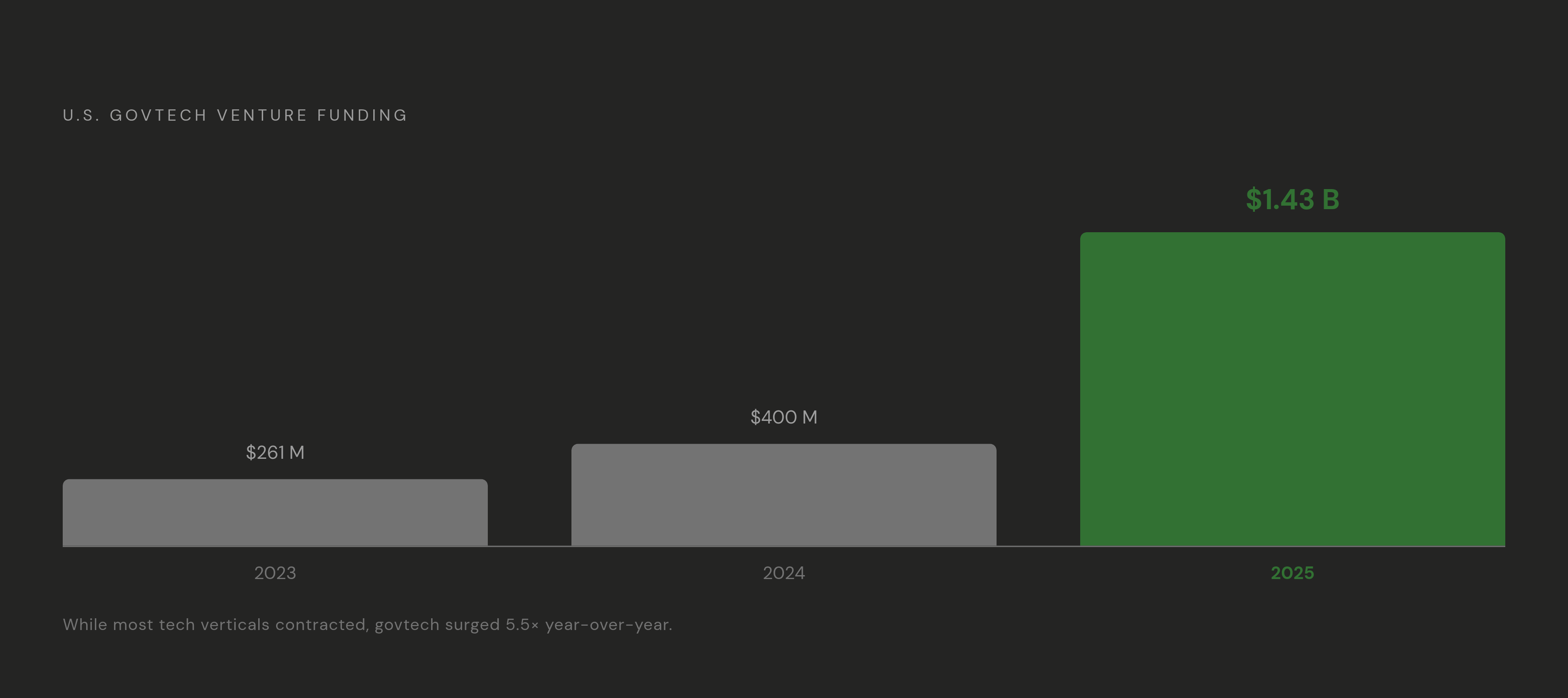
The funding signal reinforces this. The govtech sector attracted $1.43 billion in 2025, up from $400 million raised by U.S. govtech companies in 2024, which itself was up from $261 million in 2023. Three consecutive years of growth while most other tech verticals were contracting. Globally, the sector has attracted over $9.66 billion in total funding over the past decade; the U.S. accounts for $7.58 billion of that. More than 870 companies globally have secured funding, with over half at Series A or higher.
Here is the thing the numbers obscure: market size and actual startup accessibility are two entirely different things. There are more than 90,000 state and local government entities in the United States, each running its own procurement process with its own rules, timelines, and risk tolerances. A large total addressable market means very little when your product must be individually sold, approved, and deployed jurisdiction by jurisdiction. I've watched founders burn through seed rounds just trying to close their first two or three contracts. The market is massive. Getting into it is something else entirely.
Why Silicon Valley Is Paying Attention to Government Software Now
The most visible signal came from Y Combinator. Its Winter 2025 Request for Startups explicitly named government software, specifically AI-powered automation of administrative tasks, as a priority area. By mid-2026, YC had funded 45 govtech and 36 government-focused startups. That institutional endorsement shapes where technical founders point their attention, and it sends a message worth taking seriously: government software is no longer a career detour for people who couldn't get into consumer or enterprise tech. It is a destination serious founders are choosing deliberately.
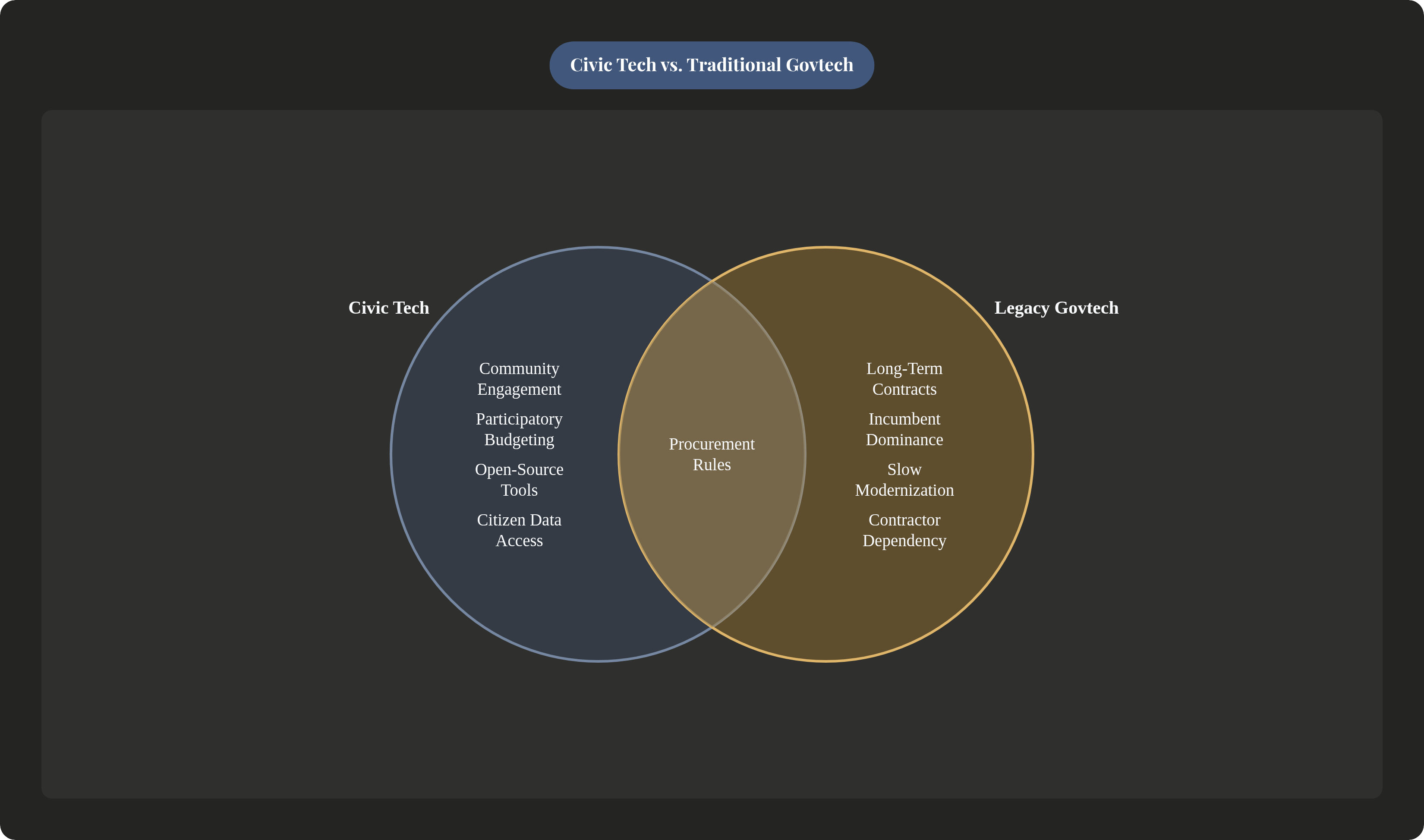
What created the opening is the legacy contractor problem. Government software has long been dominated by slow, expensive incumbents who won long-term contracts and then underdelivered for decades without consequence. Startups pitch speed, modularity, and cost reduction. That pitch didn't used to land because the procurement infrastructure wasn't there to receive it. Now it is, at least partially, and that "at least partially" is doing a lot of work.
A new generation of specialist investors has emerged alongside the YC signal. Urban Innovation Fund focuses on urban challenges. Serent Capital concentrates on fragmented govtech verticals like asset management and licensing. Form Ventures in the UK backs startups in regulated markets, including civic platforms. These are not generalist VCs making a trend bet; they are funds built on the understanding that navigating procurement is as central to their thesis as product-market fit is. That distinction matters. A generalist VC gets impatient at month eighteen of a sales cycle. These funds don't.
The tailwinds are structural, not cyclical. Federal modernization mandates, AI adoption across public agencies, and cybersecurity demands at every level of government are not going to reverse when interest rates shift or consumer sentiment changes. The sector's workforce has grown to more than 497,000 employees, with over 33,000 added in the past year alone. Investment is translating into operating companies with real headcount, which is the only signal that actually counts.
What Funded Civic Tech Startups Are Actually Building
The range is wider than most people realize, and you need to understand the range to understand how the ecosystem actually functions.
On community engagement and data, Zencity raised a $40 million Series C in 2024, bringing its total to $91 million, and counts eight of the ten largest U.S. cities among its customers. In January 2025, it acquired the UK platform Commonplace to expand into zoning and planning globally. CivicPlus has raised $474 million and serves more than 4,000 local governments with websites, emergency notifications, and citizen engagement infrastructure. These are not scrappy pilots.
Government payments represent another significant vertical. PayIt raised over $190 million to handle transactions like DMV renewals and property tax payments. Permitting has attracted serious early-stage capital: PermitFlow, a YC alum, raised $31 million simplifying construction permitting. Waypoint Transit, also YC-backed, generates civil infrastructure studies at 30% of what cities currently pay.
Criminal justice and public safety have produced some of the most consequential work in the sector, and some of the least commercial. Recidiviz, a nonprofit, built open-source infrastructure to standardize data across correctional systems and surface it for evidence-based policy decisions. No price tag. A shared data layer that serves governments and the people they incarcerate simultaneously. That is civic tech at its most structurally ambitious.
European civic participation has its own developed ecosystem. CitizenLab in Belgium works with more than 300 local governments across 18 countries. Adhocracy+ in Berlin facilitates participatory projects through open-source tooling rooted in liquid democracy principles.
Civic tech is not one product category. It is a field defined by a common structural condition rather than a common technical approach. A participatory budgeting portal, a DMV payment processor, a body camera report generator: they are completely different products. Every single one of them requires a government to say yes before a single citizen can use it. That shared constraint is what makes them the same business problem.
How AI Is Reshaping What Civic Tech Can Promise Governments and Citizens
Governments that are serious about serving residents are increasingly treating AI as foundational infrastructure, not a feature. Think about how prior generations of public infrastructure investment unfolded: roads, electrical grids. What was optional became a baseline expectation. Some governments are approaching AI in public services the same way, and the ones that aren't are starting to feel the operational gap.
On the citizen-facing side, the District of Columbia's DC Compass beta uses AI to respond to resident queries and generate maps from open city data. The chatbot part is not interesting. What is interesting is the idea that complex municipal data, the kind that usually requires a FOIA request and a consultant to interpret, can be surfaced to an ordinary resident asking a plain-language question. That is a genuinely different relationship between a city and its residents.
On the operations side, the gains are more concrete and easier to sell. Patrol officers currently spend roughly one-third of a shift on paperwork. Abel converts police body camera footage into completed reports. A city administrator can do the math on that without any help.
CivicReach uses AI to backfill phone capacity for understaffed government call centers. That is a narrow use case, and the narrowness is precisely why it gets pilots approved: it solves an immediate operational problem that every mid-sized city can identify on a spreadsheet. CivicPlus's AI chatbot handles routine resident queries around the clock, freeing live staff for complex cases without extending payroll.
The tension AI introduces is real. When algorithms touch policing, benefits, or permitting decisions, the procurement scrutiny that follows is qualitatively different from what a website or a payment portal faces. Governments become accountable to their constituents for how those algorithms behave, and that accountability flows directly back to the startups that built them. The trust gap between government buyers and startup vendors widens further when the product in question makes decisions that affect people's lives. Anyone who tells you otherwise hasn't sat through those procurement meetings.
Why Government Procurement Is Structurally Difficult for Startups to Survive
The 90,000-plus state and local government entities in the United States each run their own procurement process. This is not primarily a bureaucracy problem. It is a fragmentation problem. There is no unified market to enter; there are tens of thousands of micro-markets, each with its own rules, timelines, and risk thresholds. Selling into government is less like launching a product and more like planting a garden in 90,000 different soil types simultaneously, with different weather, different pests, and a different neighbor watching you from the fence.
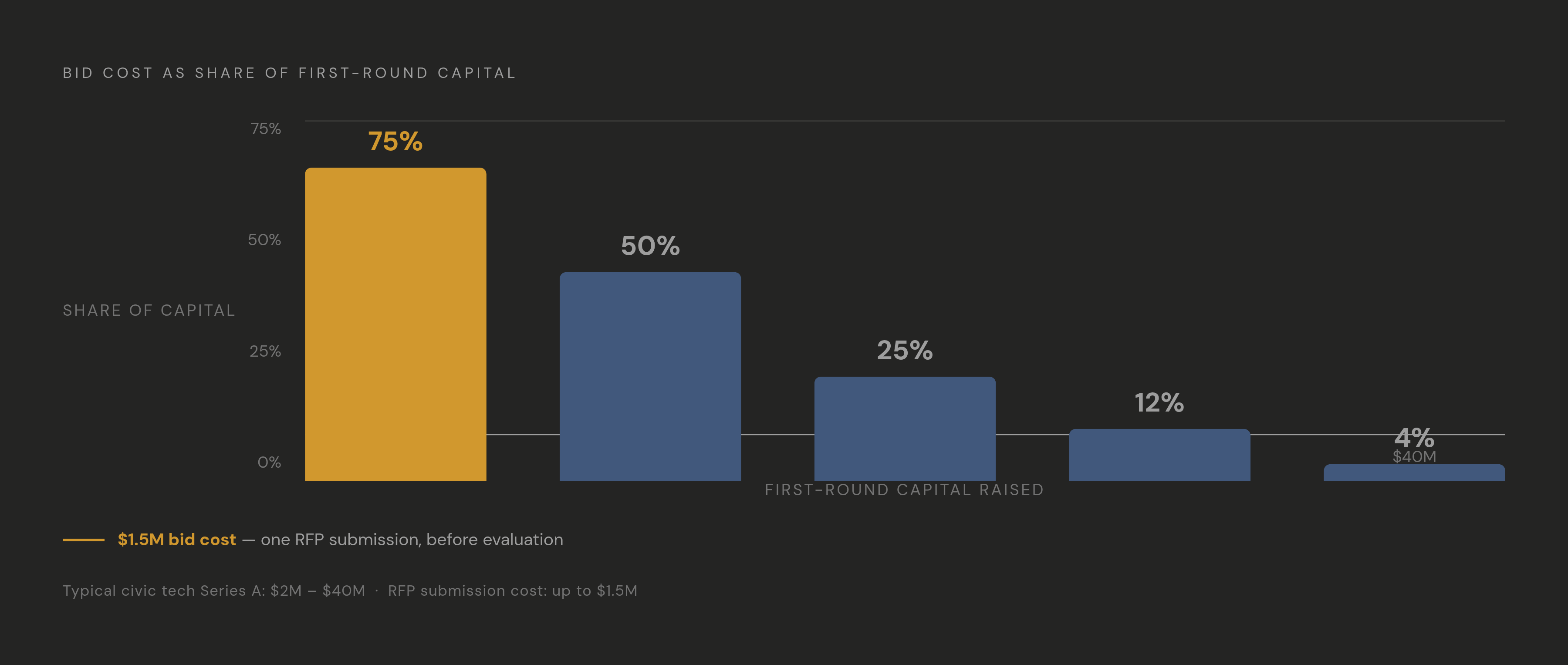
A full RFP process can take six to eighteen months and cost a vendor up to $1.5 million to submit a bid. Early-stage civic tech companies typically raise between $2 million and $40 million in their first rounds. Against that runway, a $1.5 million bid cost is not theoretical friction. It is a plausible company-ending event before a single evaluation is completed. I've seen good teams not survive that math.
The trust gap is structural, not personal. Government officials are not being paranoid when they worry about startup reliability and long-term support. Public money, constituent services, and political accountability are all at stake if a vendor folds or fails to deliver. That caution is reasonable. The problem is that the mechanisms for resolving it are slow and expensive for everyone involved.
Cooperative contracting offers a partial solution. When one government entity negotiates and awards a contract, other entities can purchase from that same contract without re-competing. Currently, this mechanism represents less than 20% of public procurement spending. A startup that wins one cooperative contract can scale into hundreds of jurisdictions without going through the full RFP process again. The economics of that are transformative for a company that would otherwise be stuck in sequential, expensive procurement cycles. The underutilization of cooperative contracting is one of the more frustrating inefficiencies in the space.
The workarounds that actually work share a common logic: reduce perceived risk before asking for a full commitment. Startups that embed directly within city or state departments build in partnership with public workers rather than pitching from the outside, which makes the government a co-author of the product rather than a skeptical buyer evaluating it at arm's length. Open APIs that layer onto existing legacy systems rather than replacing them accomplish the same risk reduction from a technical direction. Geographic origin matters too. Companies that emerge from cities like Kansas City, Indianapolis, and Raleigh often build the local trust relationships that make procurement approvals faster before they attempt to scale nationally, because they started somewhere someone already knew them.
How Accelerators and Ecosystem Infrastructure Are Lowering the Barrier to Entry
CivStart operates as a sector-specific accelerator for the state, local, and education space. Its AI-in-government program, launched in partnership with the National League of Cities and the GovAI Coalition led by the City of San Jose, combines fundraising support, mentorship, and direct pitching opportunities to public-sector buyers. Most accelerators give you access to other founders and to investors. CivStart gives you access to the actual buyers, which in this sector are the governments themselves. That distinction is not minor.
In November 2025, CivStart and Civic Marketplace formalized a partnership establishing joint standards around risk disclosure, due diligence, and performance verification. The goal is a trusted procurement channel that reduces information asymmetry between startups and government buyers. Governments don't buy slowly because they enjoy the process; they buy slowly because they lack reliable signals about which vendors will still be operating and supported in three years. That is a solvable information problem.
The accelerator model functions as a trust intermediary. CivStart pre-screens startups for governments, compressing the due diligence burden on resource-constrained public procurement teams. A government that doesn't have the bandwidth to evaluate fifty vendors can evaluate five that have already been vetted on financial and technical readiness. The reduction in friction on both sides is where the real value sits.
The European ecosystem offers a useful comparison. More than 100 vendors operate in the online participation, deliberation, and voting space alone. Most internationally active ones are startups scaling quickly with relatively lean headcount, many integrating AI into existing civic participation platforms. Infrastructure supporting them differs by country, but the pattern is consistent: the ecosystem around the startups is what makes individual startups viable. No single company builds its own procurement relationships from scratch; it builds on top of trust infrastructure that someone else spent years establishing.
What accelerators don't change is the underlying procurement rules. They change the information environment on both sides of the transaction. The startups that succeed understand the goal is to work within the existing system with enough credibility to eventually influence it, not to wait for the system to change before engaging.
What Happened When Federal Civic Tech Capacity Was Dismantled in 2025
On March 1, 2025, 18F was shut down entirely under White House direction. Around 200 employees left the U.S. Digital Service through resignations or firings around the same period. 18F had been responsible for building and updating government digital services, including the IRS Direct File platform.
What 18F represented was not just a set of products. It was the most visible institutionalization of civic tech inside government: the idea that serious technical capacity could be embedded within the bureaucracy rather than perpetually outsourced to vendors. Its elimination was not a budget decision in any meaningful sense. It was a signal about whether internal government technical capacity was valued as a counterweight to contractor dependency.
Donald Moynihan of the University of Michigan observed that the disruptions made things difficult, in certain respects, by tarnishing some of the tools that customer experience reform had relied on to improve services. The word "modernization" now carries political freight it did not before. That is a real cost to the civic tech community, because making the case for digital reform inside government has become more complicated when digital reform has been publicly associated with mass firings and political controversy. The argument used to be obvious. Now you have to work around the baggage first.
Amanda Renteria of Code for America noted the mixed signal: the public conversation about modernization is more active than ever, but the association with DOGE has complicated the civic tech community's ability to advance that conversation constructively.
The structural critique the 18F episode exposed is one the civic tech movement had been avoiding for years. It never built a durable champion at the center of government. When political conditions shifted, internal technical capacity had no institutional protection. The government's long-standing preference for outsourcing technology, a preference with roots in bipartisan policy thinking from the 1990s, created an information advantage for contractors over the agencies that managed them. Internal civic tech capacity was one of the few meaningful counterweights to that dynamic. Its removal leaves agencies more dependent on private vendors, not less, even as public trust in those arrangements has been disrupted.
The lesson for startups is not fatalism about federal partnership. It is to become genuinely strategic about where you root your relationships. Partnerships that depend on a single federal champion or a particular political moment are fragile in a way that only becomes obvious when they disappear. Partnerships built with career civil servants, department heads, and city-level officials across many jurisdictions are substantially more durable, because no single executive order touches all of them at once.
What Makes a Government Partnership Actually Work for a Civic Tech Startup
Most partnerships that fail skip the same step: agreeing on what success actually looks like before anything gets signed. Not contract terms. Shared definitions of what success looks like for the government buyer and for the citizen end user. A startup that can articulate measurable outcomes for both simultaneously is in a different conversation entirely than one showing up with a product demo.
The dual-stakeholder problem gets resolved through translation. Startups that survive procurement have learned to convert citizen-facing value into government-legible metrics: reduced call volume, faster permitting decisions, lower administrative cost per resident interaction. These are the numbers that move budget conversations inside city halls. They require the startup to understand both the citizen's experience and the government's operational constraints well enough to connect them coherently. That is harder than it sounds, and most founders underestimate it until they've lost a deal they thought was closed.
Trust is built through proximity, not pitch decks. The startups that break through share a pattern: they reduce perceived risk before asking for a full commitment. Embedding in departments, emerging from local markets, using cooperative contracts to expand without re-competing. These are all versions of the same basic move, making the government a participant in the product's success rather than an evaluator of it.
The AI inflection point changes the terms of partnership negotiation in ways that require specific preparation. Governments considering AI-powered civic tools now face constituent accountability questions that didn't exist in prior procurement cycles. Algorithmic decisions in policing, benefits, or permitting require startups to arrive with governance frameworks. The startup that cannot explain how its AI makes decisions, and what happens when it makes the wrong one, will not clear the procurement bar in any jurisdiction that is paying attention.
What the ecosystem infrastructure, accelerators, cooperative contracting, verified marketplaces, actually provides is a narrowing of the information gap between startup and government buyer. That gap is the real source of procurement slowness, not bureaucratic obstinacy. Every mechanism that narrows it accelerates the entire market.
The 18F lesson, applied forward, points toward distribution. The most durable civic tech partnerships are spread across many jurisdictions and embedded at the operational level. They don't depend on a single political moment or a federal champion who can be eliminated by executive order. The market opportunity is real precisely because the structural challenges are high. The barriers that eliminate most startups are what protect the margins and the relationships of those that learn, through actual friction and failure and occasionally a six-month RFP that goes nowhere, to navigate them.