GovTech Prize Competitions and Challenge Grants
Government pays only when prize-winning solutions prove they actually work.

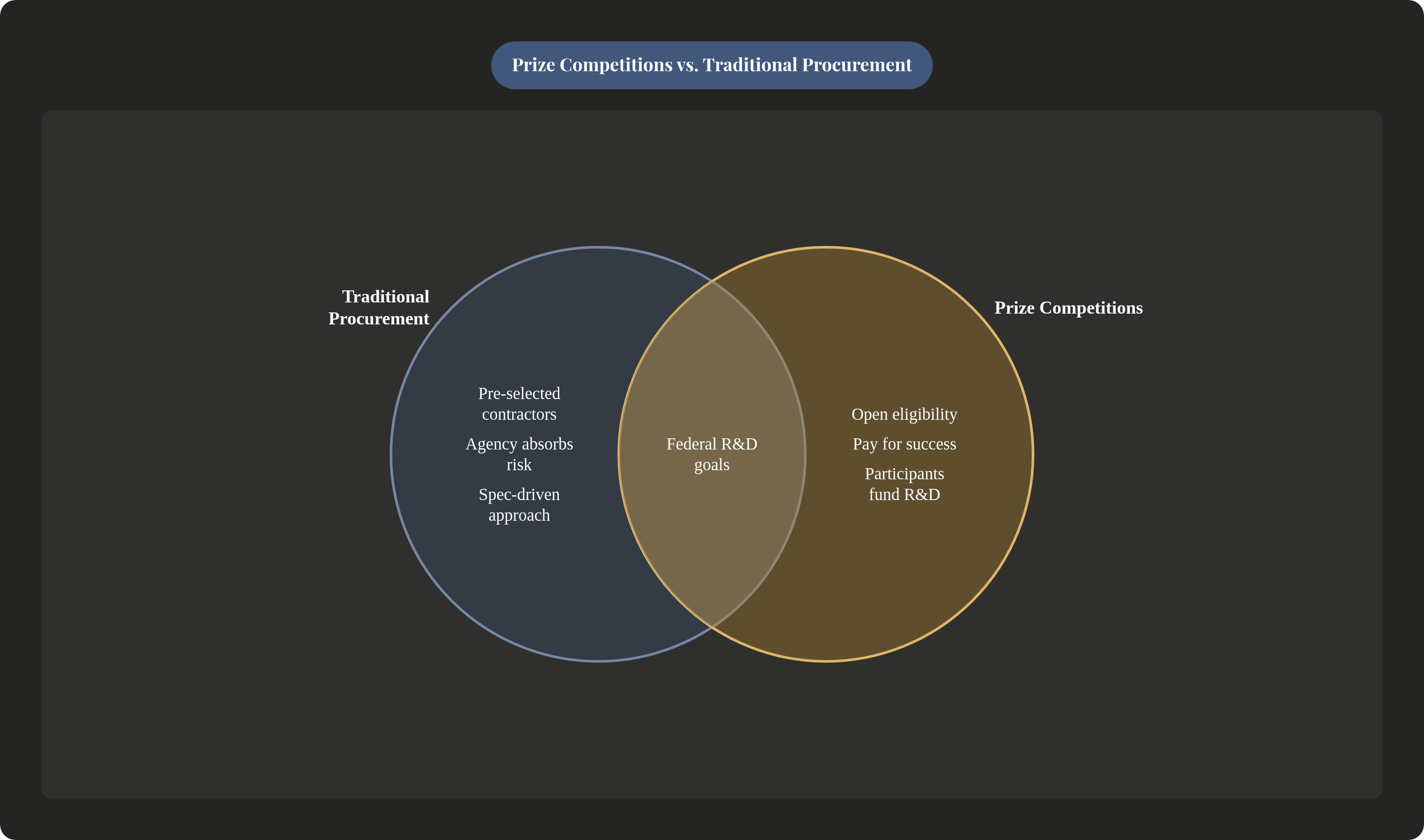
Traditional government procurement follows a familiar sequence: agency identifies a need, writes a specification, selects a contractor, and funds the work as it proceeds. The agency absorbs the uncertainty. If the approach fails, public dollars are already gone.
Prize competitions flip that entirely. Work happens before any payment changes hands. Only the winner collects, sometimes in a tiered structure. The agency never has to predict which team or technical approach will succeed, because the competition surfaces that answer. Think of it like a fishing net cast wide across an ocean of unknown solutions — traditional procurement is a single line dropped in one spot, hoping the fish are there. "Pay for success" is not marketing language. It describes a structural reality: participants absorb the cost and risk of failure, and government pays only when something demonstrably works.
Challenge grants sit in the middle. Phased models select stage winners as development milestones are reached, blending prize logic with incremental support. Financial exposure grows alongside demonstrated results. It is not pure prize competition and not pure grant, but the underlying principle is the same: funding follows performance.
Open eligibility is a feature, not an accident. Low barriers to entry are deliberate. Anyone can attempt the problem. This draws in solvers from outside the traditional contractor or researcher pool: citizen innovators, entrepreneurs, cross-disciplinary teams who would never appear on a federal contractor registry but who hold exactly the right approach. Government framing consistently emphasizes "out-of-discipline perspectives," but that language understates what is actually happening. Open eligibility is the mechanism by which unknown solutions become discoverable. You cannot write a procurement spec for an answer you do not yet know.
None of this works without credible rules and robust judging. Those are not administrative overhead; they are the infrastructure that makes participants trust the process enough to invest their own time and money. Without that trust, the competition cannot attract the outside-perspective solvers who justify running it.
Multi-stage competitions filter the field progressively, rewarding incremental progress early and testing operational effectiveness before any scaling decision. In some cases, the competition itself becomes the acquisition pathway, compressing the timeline from problem identification to deployable solution considerably.
The U.S. federal legal authority that made prize competitions routine
The America COMPETES Reauthorization Act of 2010 gave federal agencies statutory authority to run prize competitions. The American Innovation and Competitiveness Act of 2017 updated that foundation. Together, they normalized prize competitions as a standard agency tool rather than an experimental workaround requiring special justification each time someone wanted to try one.
The oversight mechanism matters too. The White House Office of Science and Technology Policy is required to produce biennial reports to Congress on prize and citizen science activity under these authorities. That reporting requirement institutionalizes accountability and creates a public record of what is being run, at what scale, and toward what ends.
Challenge.gov served as the central public registry for federally sponsored prize competitions. It was sunset on March 30, 2026, with active challenges migrated to individual agency websites. The authority and activity continue. The registry's closure does not signal retreat from the model; it reflects a maturation in how agencies manage their own competition infrastructure, which is itself a sign the model has taken root.
Before statutory authority existed, prize competitions required special approvals and were treated as anomalies. After 2010, they became a line item in the standard toolkit. That shift is what made everything that followed possible.
What the scale of federal prize activity actually looks like
Between 2010 and 2020, 814 federal prize competitions ran, awarding roughly $243 million in total. Over that same period, total federal R&D outlays were approximately $1.3 trillion. Prize competitions were not replacing that investment. They were augmenting it, targeting problems where open competition offered structural advantages that traditional procurement simply cannot.
From 2020 to 2025, an additional 607 competitions were recorded from Challenge.gov data. Of those, 178 focused on health, life science, or biomedical R&D, reflecting HHS's consistent presence as a top sponsoring department alongside DoD and DoE. The distribution across agencies has broadened over time, which is a signal of genuine institutionalization, not a single agency experimenting in isolation.
The $243 million figure over ten years is modest relative to overall R&D spending by design. The model is structured to leverage private-sector and non-traditional investment rather than replace sustained federal R&D commitments. What the numbers actually show is steady, durable growth over more than a decade. This is not a spike or a political moment. It is a mature instrument that has been expanding quietly and consistently.
How AI and cybersecurity competitions became the fastest-growing segment
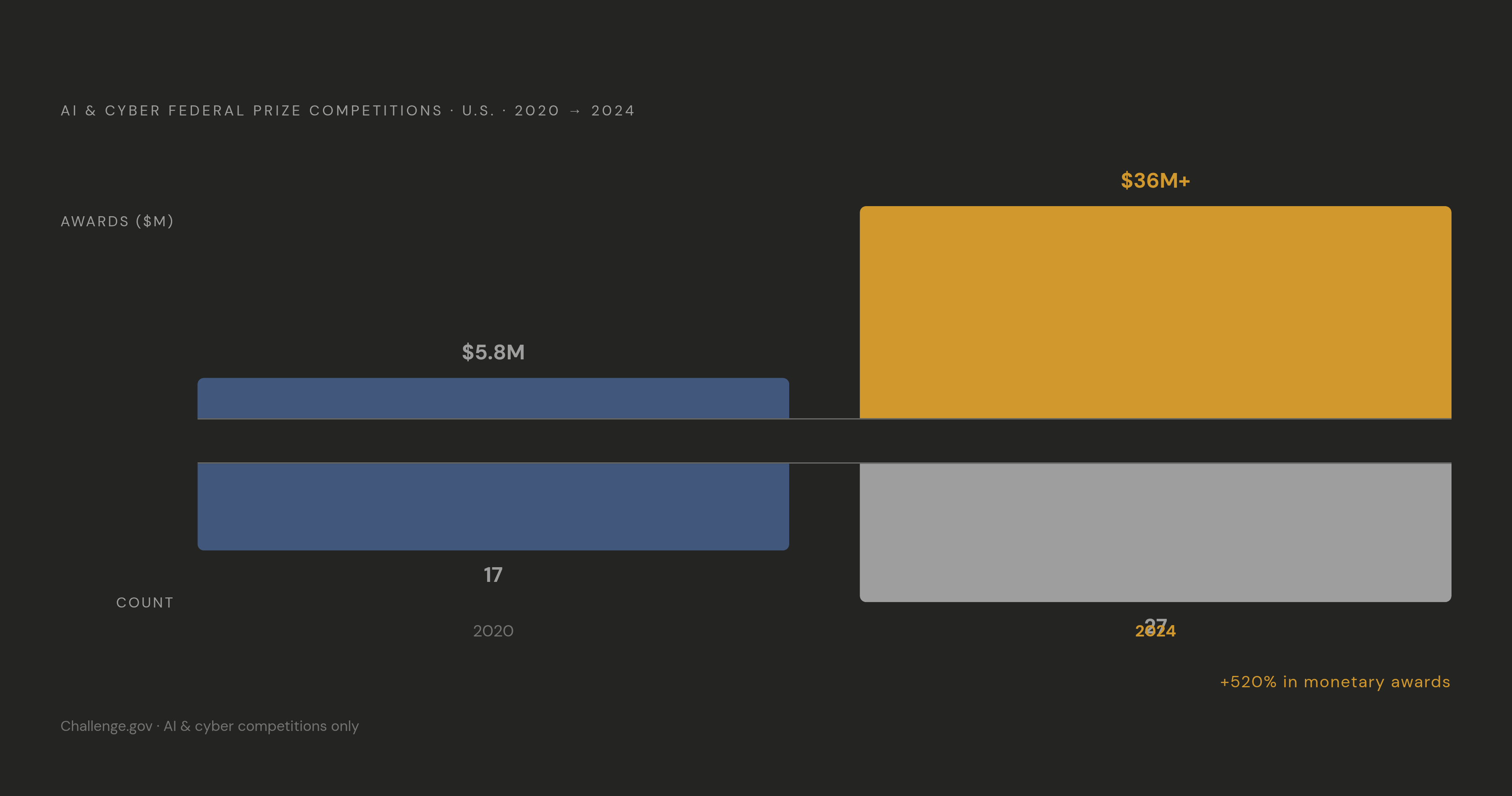
In 2020, U.S. departments and agencies sponsored 17 AI- and cyber-specific prize competitions valued at $5.8 million. By 2024, according to CSET/Georgetown analysis published in December 2025, that had grown to 27 competitions with monetary and non-monetary incentives totaling over $36 million. Nearly a 60% increase in the number of competitions, and a 520% increase in monetary awards, in four years.
DoD led AI and cyber prize sponsorship as of 2024. That growth pattern reflects something important about these domains specifically: government cannot anticipate which approach will work. That uncertainty is not a temporary condition pending more research. It is structural to how AI and cybersecurity evolve. Open competition is the right instrument precisely because the solution space is genuinely unknown, and it will stay that way.
DARPA's AIxCC makes this concrete. The two-year challenge ran from 2023 to 2025 with a total prize pool of $29.5 million. In March 2024, ARPA-H added $20 million to extend the scope to medical device and hospital IT vulnerabilities. At the finals held at DEF CON in August 2025, Team Atlanta won $4 million for cyber reasoning systems that identified and patched vulnerabilities across 54 million lines of code. No single contractor could have been pre-selected for that outcome, because the effective approach was not known when the competition was designed. The competition was the discovery process, not the validation of a decision already made somewhere upstream.
Three active federal competitions that show the range of problems prize mechanisms can address
The DARPA Triage Challenge runs from 2023 to 2026 with $7 million in total prizes, targeting novel physiological features for autonomous medical triage in disaster conditions. Challenge Event 1 was held in October 2024 in Perry, Georgia, where teams competed on speed and accuracy of autonomous casualty identification. There is no existing procurement channel that could source an answer to this problem, because the relevant physiological markers and sensor fusion approaches have not yet been validated at scale. The competition is the R&D process.
The DARPA Lift Challenge covers 2025 to 2026, targeting unmanned aerial systems capable of carrying at least 110 pounds while exceeding payload-to-weight ratios typical of small drones. A $6.5 million prize structure with tiered awards leaves the method entirely open. DARPA is not specifying propulsion, materials, or control architecture. It is specifying a performance threshold and trusting the field to determine how to reach it.
The DOE American-Made Challenges program was established in 2018 via contract with the National Renewable Energy Laboratory to administer prizes across all DOE offices. It spans clean energy, technology entrepreneurship, student and workforce development tracks, and programs specifically targeting Minority Serving Institutions and Tribal Colleges. That last dimension carries practical weight: prize infrastructure can explicitly serve equity goals alongside technical ones, lowering the barrier to entry for institutions that would rarely surface in a standard federal procurement process.
Three different technical domains. One common condition: the winning approach was unknown at the outset. That is not incidental. It is the core selection criterion for when prize competitions are the appropriate tool rather than a procurement or a grant.
How the Genesis Mission and the AI Grand Challenges Act are expanding prize competition authority
Executive Order 14363, signed November 24, 2025 and titled the Genesis Mission, explicitly directs federal agencies to launch prize competitions to incentivize private-sector participation in AI-driven research. The stated goal is doubling the productivity and impact of federally funded R&D within a decade, and prize competitions are named as one of the primary implementation mechanisms.
The Department of Energy has identified 26 National Science and Technology Challenges under the Genesis framework, spanning biotechnology, nuclear energy, quantum information science, grid modernization, and related areas. That breadth clarifies something important: the Genesis Mission is not an AI-specific initiative. It is a whole-of-government R&D acceleration agenda that uses prize competition authority as connective tissue across technical domains.
What makes the current moment genuinely distinctive is convergence across branches. Prize competitions appear as implementation tools in three concurrent policy documents: the Genesis Mission executive order, the FY26 National Defense Authorization Act, and recommendations from the National Security Commission on Emerging Biotechnology. When executive and legislative signals align on the same mechanism simultaneously, the policy architecture becomes durable rather than contingent on any single administration's priorities. That kind of alignment is relatively rare.
Analysts at C3 Solutions have proposed an AI2 Prize Program with three tracks: AI for Science, AI for Energy Innovation, and AI for DOE Operations. Anticipated outputs include new AI benchmarks, startup creation, and measurable progress on Genesis challenges. Whether that specific structure is adopted matters less than the underlying logic, which will shape how DoE deploys prize authority over the next several years regardless.
The AI Grand Challenges Act, a bipartisan proposal from 2024, would direct NSF to establish a challenge program for AI-specific competitions across sectors from energy to healthcare. It remains a legislative proposal. But its bipartisan sponsorship reflects congressional appetite for codifying what executive agencies are already running experimentally, which is usually how durable legislative authority gets built.
How the World Bank's GovTech Innovation Challenge applies the same logic to developing economies
The World Bank's GovTech Innovation Challenge runs with co-sponsorship from Switzerland's SECO and Trust Valley. All core program services are provided at no cost to selected companies, including bootcamp, mentorship, training, travel, accommodation, and meals. That cost structure is not incidental generosity. It is the mechanism that makes participation viable for startups and SMEs in lower-income economies that would otherwise be priced out of international competitions built around self-funded applicants.
The 2025 edition focused on Ghana. It drew 136 global applicants, with six finalists from Ghana, Kenya, Nigeria, Singapore, and South Africa. The challenge centered on modernizing tax administration and resource mobilization for the Ghana Revenue Authority, with submitted solutions including digital identity platforms, AI-powered payment service provider monitoring, and geospatial mapping for revenue purposes. The underlying problem structure is identical to the U.S. federal model: government cannot anticipate which technical approach will work, so open competition surfaces it.
The 2026 edition launched July 1, 2026, in partnership with Morocco's Supreme Audit Institution, seeking AI-powered solutions for risk-based audit mission programming and intelligent public procurement auditing, with applications open through August 21, 2026. The progression from Ghana to Morocco is deliberate. It reflects an effort to run the model across different governance contexts and revenue administration challenges, stress-testing the approach rather than assuming the first iteration generalizes.
The GovTech Global Partnership has funded over 30 GovTech initiatives since 2019. That sustained program is worth distinguishing from a one-off competition: a single contest produces a winner, while a sustained program builds a pipeline of validated approaches and a community of implementers who know how to deploy solutions in low-resource governance environments. The pipeline matters as much as any individual result.
The UAE GovTech Prize and what recognition-based competitions accomplish differently
The UAE GovTech Prize is organized by the Emirates Government Service Excellence Program at the UAE Prime Minister's Office and presented as part of the World Government Summit. The 2026 edition carries three categories: Best Human-Centric Government Service, Best Use of Generative AI in Government Services, and Best Government Service in the World. Over more than a decade of operation, the competition has drawn tens of thousands of submissions from over 126 countries across five continents.
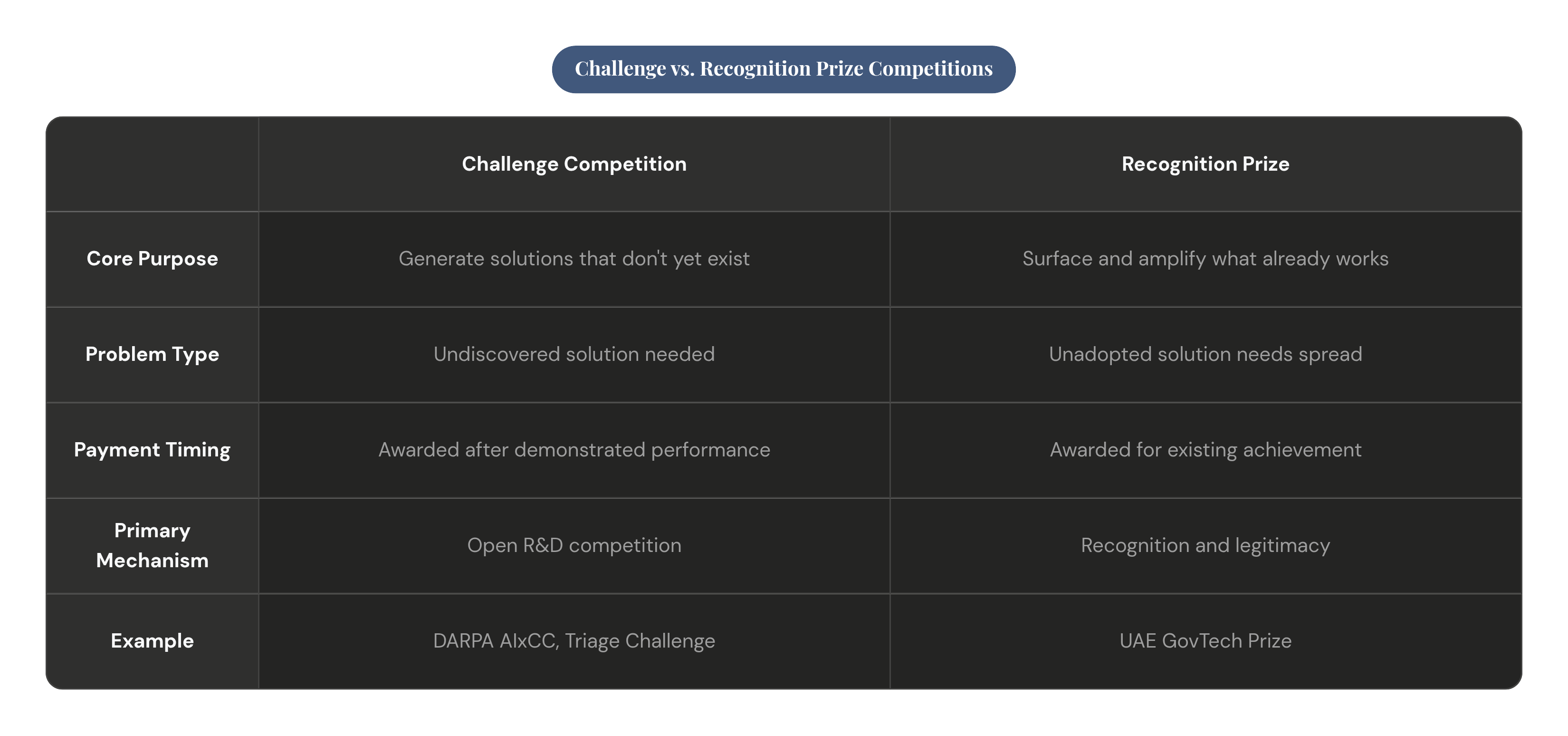
What this type of competition accomplishes is structurally different from a challenge competition. It surfaces and amplifies what is already working in government service delivery globally, rather than soliciting solutions to a defined technical problem. When a government agency wins or is shortlisted, the solution gains international visibility, legitimacy, and a replication pathway it would not otherwise have. The mechanism is recognition and diffusion, not R&D.
Both are called prize competitions, but they serve different government needs and should not be conflated. Recognition prizes catalog and legitimate innovation that already exists, accelerating its spread across jurisdictions. Challenge competitions generate innovation that does not yet exist. A government agency choosing between mechanisms needs clarity on which problem it actually has: an undiscovered solution, or an unadopted one. Picking the wrong instrument does not just waste resources; it produces the wrong kind of answer. As one evaluator put it: choosing a recognition prize when you need a challenge competition is like hiring a museum curator to build you a bridge.
The global digital divide that gives prize competitions urgency in low-maturity GovTech contexts
The World Bank GovTech Maturity Index 2025 covers 197 economies across four areas: core government systems, online public service delivery, digital citizen engagement, and GovTech enablers. As of 2025, 41% of economies fall into the group with extensive GovTech maturity, up from 35% in 2022. That is real progress. But the gap between the top and bottom groups is widening, not closing.
High-income economies are advancing; low-income ones are regressing. Europe, Central Asia, and North America lead. Africa lags. Over 75% of economies have core online services, including tax portals, e-filing systems, and customs single windows. Fifty-nine percent use digital ID for identification. Progress on infrastructure is real and measurable, which makes the engagement gap harder to explain away.
Citizen engagement remains the least mature component across economies globally. Only 31% of economies publish citizen engagement statistics. Transparency on outcomes is weak even where services nominally exist. That means the gap between service availability and service quality is often invisible to the very governments delivering those services.
The implications for prize competitions are direct. The problems that challenge grants target, tax administration in Ghana, public audit in Morocco, are not edge cases. They represent the governance reality for a large share of the world's economies. Uneven GovTech capacity is not a temporary condition in transition toward uniformity. It is a persistent structural feature of the global governance landscape, and it is getting more persistent, not less.
Prize competitions can reach organizations and teams inside those economies that traditional procurement and international consulting models cannot. A large international consultancy is well positioned to win a competitive procurement in Accra or Rabat. A Ghanaian fintech startup with local knowledge of informal market structures and mobile money behavior is not. Open eligibility changes that calculus. In low-maturity GovTech contexts, that structural openness is not a side benefit of the instrument. It is the primary reason to use it.