Cloud Migration Strategy for Government Agencies
Agencies must sequence cloud moves with compliance-first planning.

Government agencies are spending billions moving workloads to the cloud while simultaneously spending more billions keeping the systems they're supposed to be replacing alive. That structural tension is not a management failure; it is the defining characteristic of federal IT modernization, and any migration strategy that doesn't account for it will stall. Succeeding here requires a phased, compliance-aware framework built specifically around how government operates, not a commercial playbook with agency logos swapped in.
The Regulatory and Policy Environment Agencies Must Navigate Before Touching Infrastructure
Policy has matured considerably, but the landscape is genuinely complex. Before a single workload moves, planners need to understand which frameworks govern their specific environment and in what priority order.
The current federal baseline is OMB's Cloud Smart policy from 2019. It matters because it shifted the government away from reflexive "cloud first" mandates toward a more deliberate, mission-appropriate decision model built around three pillars: security, procurement, and workforce. That change in framing had real downstream effects on how agencies justify and scope modernization efforts.
The zero-trust mandate is not aspirational. OMB's National Cybersecurity Strategy places a clear policy obligation on agencies to remove legacy systems that cannot support zero-trust architecture within a defined timeline. That's a sunset clause on a significant portion of current federal IT infrastructure, and migration planners need to treat it as a hard constraint when prioritizing which systems to move and which to replace.
FedRAMP 20x has changed the procurement calculus meaningfully. By automating a significant portion of cloud authorization workflows, the initiative has compressed what used to take years into a matter of weeks. Hundreds of cloud services now carry authorization under this framework. The historical argument that compliant cloud options were too limited is no longer credible, and procurement timelines should reflect that.
Executive Order 14240, signed in March 2025, centralized IT acquisition under GSA, including governmentwide acquisition contracts. Agencies need to understand how this reshapes their procurement pathway before they select vendors, not after.
Defense environments carry additional complexity. The JWCC contract has improved access to commercial cloud capabilities, but numerous OSD enterprise systems and critical defense business systems have yet to fully transition. DoD's own March 2025 Cloud Migration Primer acknowledges this gap directly. Impact Level designations govern what can go where, and that determination must be made before vendor conversations begin.
Three practical implications for any migration planner: first, the authorization pathway, whether FedRAMP, agency ATO, or DoD IL designation, must be determined before vendor selection, not as a parallel track. Second, data classification governs deployment model, and not all workloads can share the same environment. Third, and this one gets ignored constantly, compliance documentation is not a final step. It runs in parallel throughout the entire migration.
The GAO has documented how structurally misaligned federal procurement rules remain. The Federal Acquisition Regulation still contains no definition of cloud computing, and its definition of information technology is decades old. Agencies are migrating into a modern architecture using regulatory language built for a different era. That's not a reason to wait; it's a reason to plan carefully.
How to Assess What You Actually Have Before Deciding What to Move
The most common and costly early mistake is opening vendor conversations before the agency has a complete, honest picture of its own application portfolio. Vendors will happily help you scope a migration based on assumptions. Those assumptions will be wrong, and you will pay for it in schedule delays and change orders.
The 2024 Nutanix Enterprise Cloud Index found that a large majority of federal respondents cited application migration as a moderate-to-significant challenge. The majority of that difficulty traces back to inadequate discovery at the outset. In federal IT, the map is often classified, outdated, or simply missing.
A thorough application inventory captures more than a list of systems. It captures the age and primary language of each application, every dependency including the undocumented integrations that exist because someone built a workaround twelve years ago and never documented it, the data classification level for each workload, the current hosting model, the business criticality, acceptable downtime thresholds, and the licensing terms. That last item is a landmine for government agencies specifically: many legacy software licenses were negotiated for on-premises deployment and do not transfer to cloud environments without renegotiation or repurchase.
The same 2024 Nutanix Enterprise Cloud Index reports that the federal and central government sector has the highest hybrid cloud utilization of any sector surveyed, at 52%, with datacenter and private cloud accounting for another 34%. Most agencies are not starting from a clean on-premises baseline. They're starting from a mixed, partially cloud-adjacent state, and the inventory needs to reflect that reality.
Automated discovery tools, network scanning platforms, and vendor-provided assessment services can accelerate the technical mapping. They're worth using. But human review of business logic remains non-negotiable for legacy systems. No automated tool will tell you that a nightly batch job silently feeds a downstream system that nobody documented and three people have forgotten about.
The output of this phase is a prioritized application portfolio with a preliminary migration candidate list. Not a migration plan. The plan comes after strategy selection, not before.
Matching Migration Strategy to Each Workload Using the 6 Rs Framework
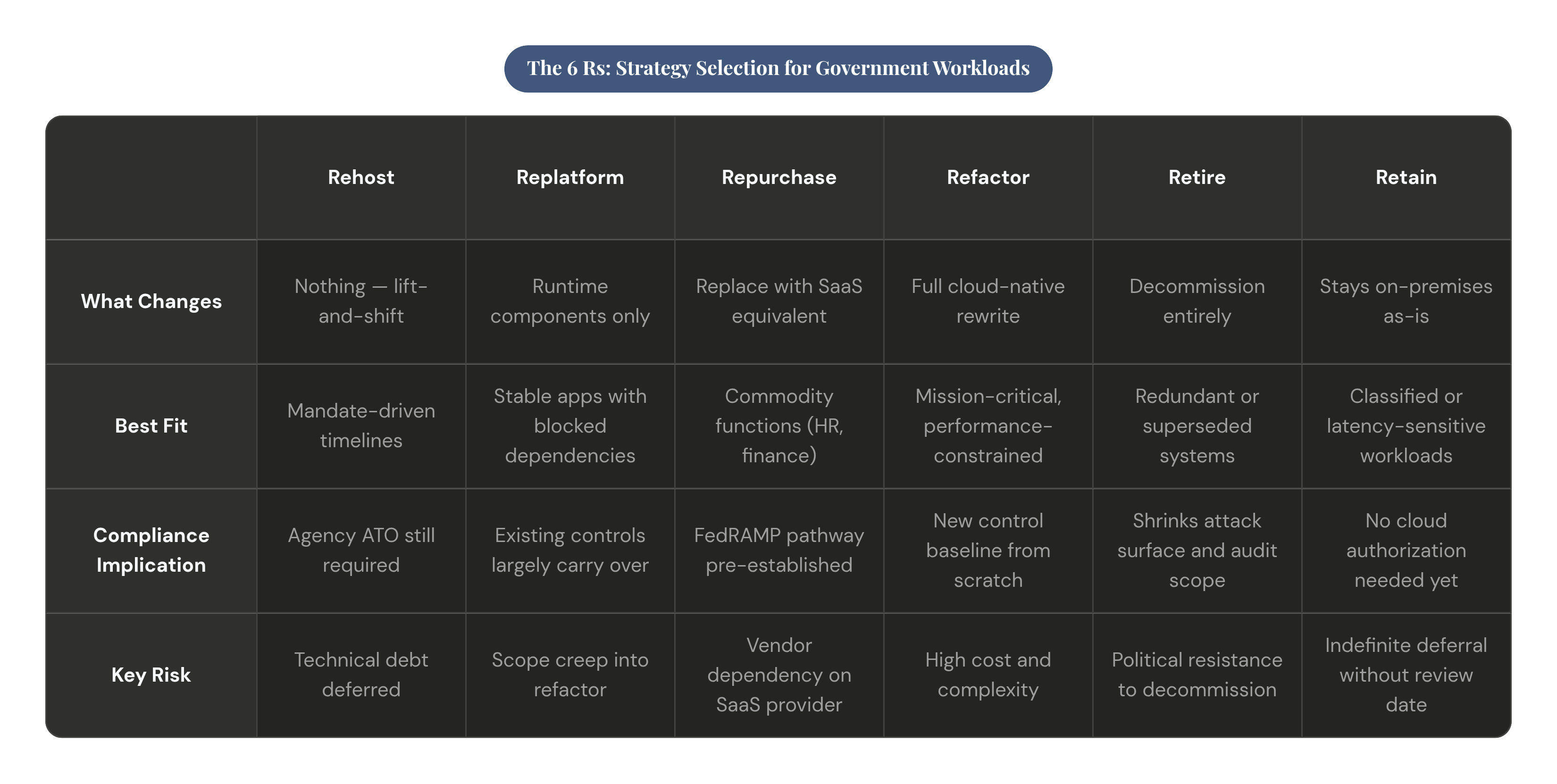
The 6 Rs framework, covering Rehost, Replatform, Repurchase, Refactor, Retire, and Retain, is well-established in commercial cloud practice. What makes it particularly valuable in government is that it forces workload-level decision-making rather than portfolio-level assumptions. Applying the right strategy to each application is one of the highest-leverage decisions in the entire process, and getting it wrong at scale is expensive.
Rehost
Rehosting moves an application as-is, with no code changes. It is the fastest path and the most appropriate when schedule pressure is the binding constraint and cloud-native optimization can happen in a subsequent phase.
Rehosting accounts for the largest share of cloud migration activity across industries, and for agencies operating under mandate timelines, it is a legitimate first step rather than an admission of insufficient ambition. Guidance from major cloud providers recommends rehosting first for large migrations and modernizing afterward. This aligns well with government's phased budget cycles, where it is far easier to secure appropriations for a defined move than for an open-ended rewrite.
Replatform
Replatforming modifies underlying components, the database engine, the operating system, without rewriting the application itself. It's the appropriate middle path for stable applications whose dependencies block a direct lift-and-shift but whose business logic doesn't justify a full re-architecture.
Repurchase
Repurchasing replaces an on-premises application with a FedRAMP-authorized SaaS equivalent. For commodity functions like HR, finance, collaboration, and document management, agencies should exhaust this option before attempting a custom migration. The migration complexity disappears. The compliance pathway is established. The operational burden shifts to the vendor.
Refactor
Refactoring rewrites the application using cloud-native services: microservices, containers, serverless compute. The long-term payoff is the highest of any strategy. So is the complexity and the cost.
Cloud migration practitioners generally advise against refactoring during large migrations. Reserve refactoring for mission-critical systems where performance or scalability requirements genuinely cannot be met any other way, not for systems where the ambition to build something elegant exceeds the mandate to keep something running.
Retire
Retiring decommissions applications that are redundant, unused, or superseded by a repurchased SaaS solution. Typically, somewhere between 10 and 20 percent of a government portfolio qualifies for retirement upon honest assessment. Every retired system reduces attack surface, eliminates a maintenance burden, and frees budget that the dual-funding problem desperately needs back.
Retain
Retaining keeps a workload on-premises when regulatory constraints, latency requirements, or data classification levels make cloud placement impractical at this time. The critical discipline here is the phrase "at this time." Retain is not a permanent designation. Every retained application should carry a reassessment date, not an indefinite deferral.
One point that government-specific practitioners understand but commercial frameworks often gloss over: the strategy selected for each application directly determines which FedRAMP authorization pathway and which NIST control baseline applies. Strategy selection and compliance planning are co-dependent choices, not sequential ones.
How to Handle Legacy Systems That Can't Be Cleanly Migrated Under Any of the 6 Rs
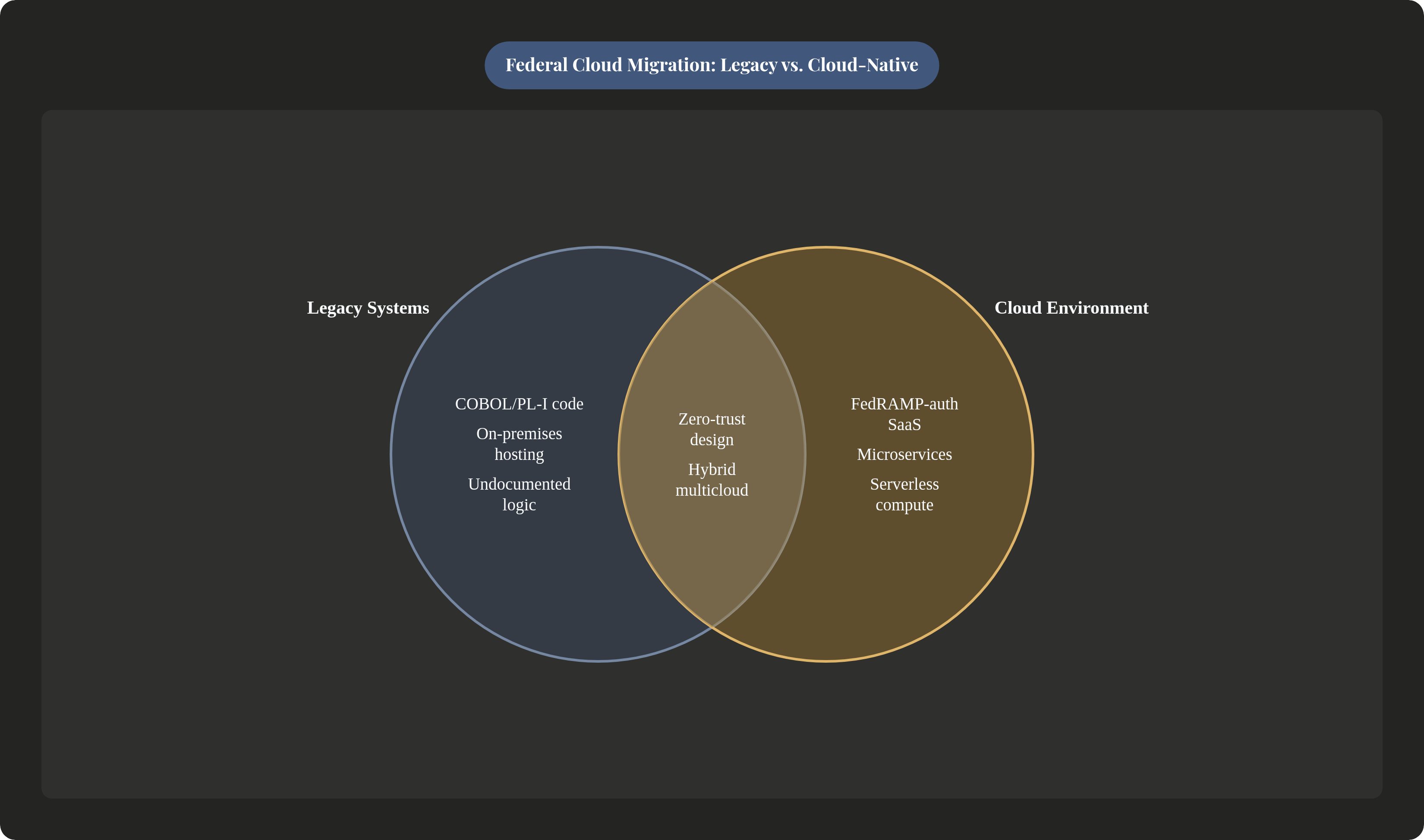
The 6 Rs assume the application is at least comprehensible. Many government legacy systems are not. Undocumented business logic, source code that no longer exists, dependencies on hardware that left commercial production years ago, institutional knowledge that retired with the developers who wrote the system: these conditions disqualify a workload from any straightforward migration path.
Two techniques have gained genuine traction in government modernization contexts.
Strangler Fig and API-First Wrapping
Rather than replacing a legacy system in a single high-risk cutover, agencies wrap it in APIs and gradually redirect traffic to new microservices built alongside the original. The legacy system continues running throughout the transition. Each functional component is retired incrementally as its replacement proves stable. No single point of catastrophic failure.
This approach is well-suited to benefits administration platforms, permitting systems, and case management applications where data integrity requirements and continuity-of-operations mandates make a big-bang replacement untenable. The Social Security Administration's long-running modernization work is a frequently cited example of why incremental replacement survives while wholesale rewrites stall.
AI-Assisted Code Translation
Large language models can now read legacy COBOL or PL/I and generate modern equivalents in Java or Python with meaningful fidelity. This cuts the manual reverse-engineering effort that previously consumed years of contractor time.
It is not a fully automated solution. Output requires human review and rigorous testing, particularly for complex branching logic and edge cases embedded in decades-old business rules. But for agencies carrying large COBOL portfolios, it materially changes the cost and timeline calculus for modernization.
Both techniques require dedicated budget, skilled personnel, and realistic timelines. The discovery cost for legacy modernization is the most consistently underestimated line item in government migration planning. If an application lands in this category, it warrants its own sub-project with its own governance structure, its own budget line, and its own program manager. It is not a lane in the main migration workstream.
Choosing the Right Deployment Model: Why Most Agencies End Up in Hybrid Multicloud
No single deployment model accommodates a government agency's full application portfolio. The question is never "which model?" It is "which combination, and why?"
The 2024 Nutanix Enterprise Cloud Index shows the current state clearly: the federal and central government sector leads all sectors in hybrid cloud adoption at 52%, with datacenter and private cloud accounting for another 34%. The same index projects that over the following one to three years, hybrid multicloud adoption is expected to rise substantially, exclusive datacenter and private cloud to decline, and multiple public cloud configurations to increase.
This is not a preference shift. It is structural. Classified, sensitive, and unclassified workloads require different environments by regulation. An agency handling all three categories has no architectural choice but to operate across multiple environments. The multicloud outcome is an artifact of the data classification regime, not a technology decision.
The decision criteria for government deployment model selection follow a clear hierarchy. Data sensitivity and classification level is the dominant driver. Mission criticality and data sovereignty requirements, specifically whether data can leave government-controlled infrastructure, follow closely. Latency and edge requirements apply to law enforcement, emergency response, and tactical military systems. Finally, existing contract vehicles, JWCC, or other GWACs, will constrain or enable specific provider choices before any technical evaluation begins.
Forrester's 2024 cloud research found that the substantial majority of public sector decision-makers already use hybrid cloud approaches, and a significant share use multiple public clouds simultaneously. Agencies planning for a single-provider, single-environment future are building a strategy for a future that isn't coming.
The architecture decisions made now will determine interoperability flexibility or vendor lock-in for the following decade. That risk should be weighted explicitly in procurement, not discovered after contract signature.
Security and Zero-Trust Integration as Migration Requirements, Not Post-Migration Additions
The common failure mode is predictable and avoidable: agencies treat security controls as a hardening phase that follows successful migration. In government, the authorization process requires security to be demonstrable before go-live. Treating security as a post-migration activity is not only strategically unsound; it is procedurally incompatible with how federal systems achieve operational authority.
Forrester's "The State of Cloud in Government in 2025" found that roughly a third of public agencies cite improved security posture as a primary driver for cloud adoption. Cloud can improve security, but only if the migration is designed with that outcome as a first-order requirement.
Zero-Trust Architecture as a Design Input
OMB's zero-trust mandate establishes a target state, not a recommendation. Any migration that produces infrastructure incompatible with zero-trust architecture is generating technical debt at the moment of deployment.
The DoD Zero Trust strategy operates on the explicit assumption that all users and devices are potential threat vectors. Identity federation, device health verification, micro-segmentation, and least-privilege access enforcement at every layer are not optional enhancements; they are foundational design requirements. These need to be specified in the migration architecture before a workload moves, not retrofitted afterward when the cost and disruption are an order of magnitude higher.
FedRAMP authorization status should gate vendor selection, not follow it. The FedRAMP 20x initiative has expanded the pool of authorized services enough that the historical argument about limited compliant options no longer holds.
FISMA compliance requires continuous monitoring after migration. The tooling, staffing, and reporting cadence for that monitoring obligation need to be planned and budgeted before the migration completes, not after the first compliance review surfaces the gap.
Data residency requirements and encryption key management are consistently underspecified in early migration plans. For agencies handling personally identifiable information or controlled unclassified information, these are foundational decisions that need to be resolved before the deployment model is finalized.
Building a Phased Migration Roadmap That Accounts for Budget Cycles and Workforce Realities
Government migrations fail not because agencies lack strategy. They fail because agencies design execution plans that ignore the structural realities of how government operates: annual appropriations that constrain multi-year commitments, procurement lead times that can consume months before a contract is in place, and IT staff who built expertise on mainframes and legacy systems and were never hired or trained to manage cloud transitions.
A roadmap that doesn't account for those constraints isn't a plan. It's a wish list.
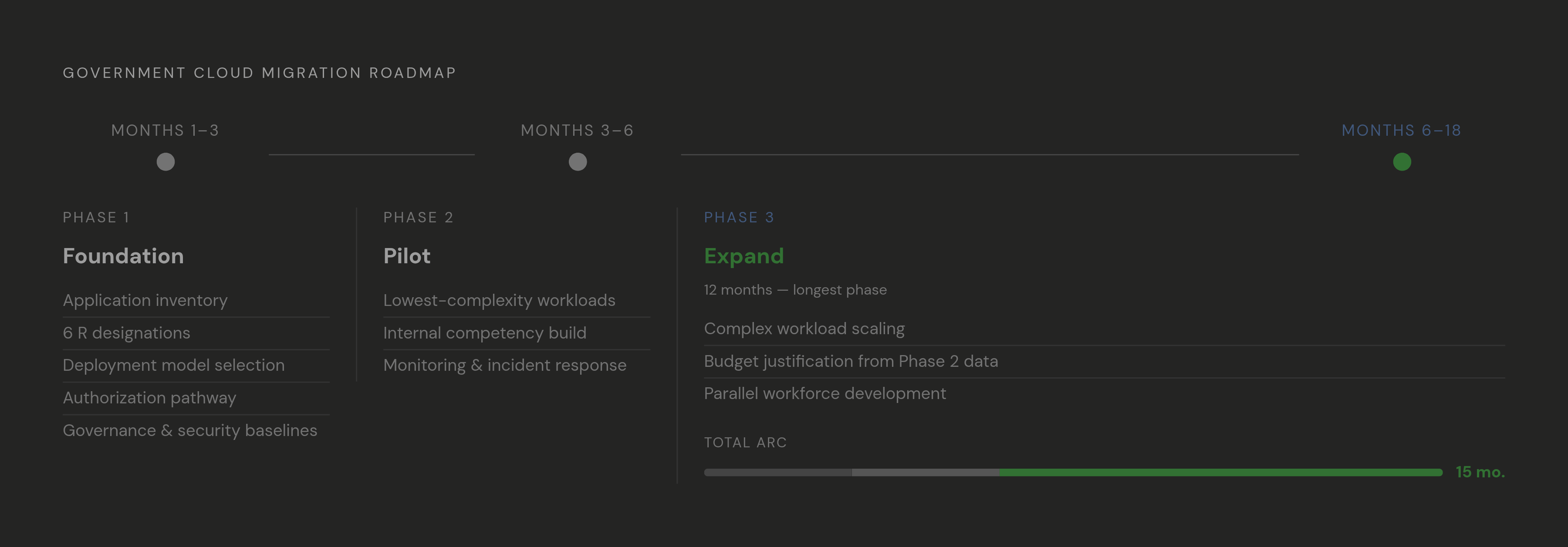
Phase 1: Foundation (Months 1 Through 3)
Complete the application inventory. Assign 6 R designations to each workload. Select the deployment model. Confirm the authorization pathway for every cloud service under consideration. Establish the cloud governance structure, the security baselines, and the monitoring framework before a single workload moves. This phase has no visible deliverable to stakeholders outside the program, which makes it politically difficult and technically non-negotiable.
Phase 2: Pilot (Months 3 Through 6)
Migrate the lowest-complexity, lowest-risk workloads first. The objective is not to move the most workloads. The objective is to build internal competency, validate the monitoring and incident response capabilities in the new environment, and identify the gaps in the plan before they manifest in a high-stakes migration. Every program has a divergence between theory and reality, and you want to discover it on a low-criticality system, not a mission-critical one.
Phase 3: Expand (Months 6 Through 18)
With a validated foundation and a trained team, the program scales. More complex workloads move. Budget justifications for subsequent fiscal years are built on the performance and cost data generated in Phase 2, which is the only language that translates into appropriations requests. Workforce development runs in parallel: cloud certifications, upskilling programs, and in some cases targeted hiring need to accompany the technical migration, not follow it.
The workforce dimension is where many government migration programs underinvest and then wonder why adoption stalls. Staff who don't understand the new environment can't operate it effectively, can't identify anomalies, and can't advocate internally for continued investment. Technical migration without workforce migration produces cloud infrastructure managed with a mainframe mindset.
The phase structure maps directly to how budget requests are built, reviewed, and approved in the federal cycle. A program that can demonstrate concrete outcomes from Phase 1 and Phase 2 is a program that can secure the appropriations to complete Phase 3.