FedRAMP Authorization Process for Technology Vendors
Choosing the right impact level shapes your entire authorization timeline and cost.
How the three impact levels determine what a vendor must build and prove
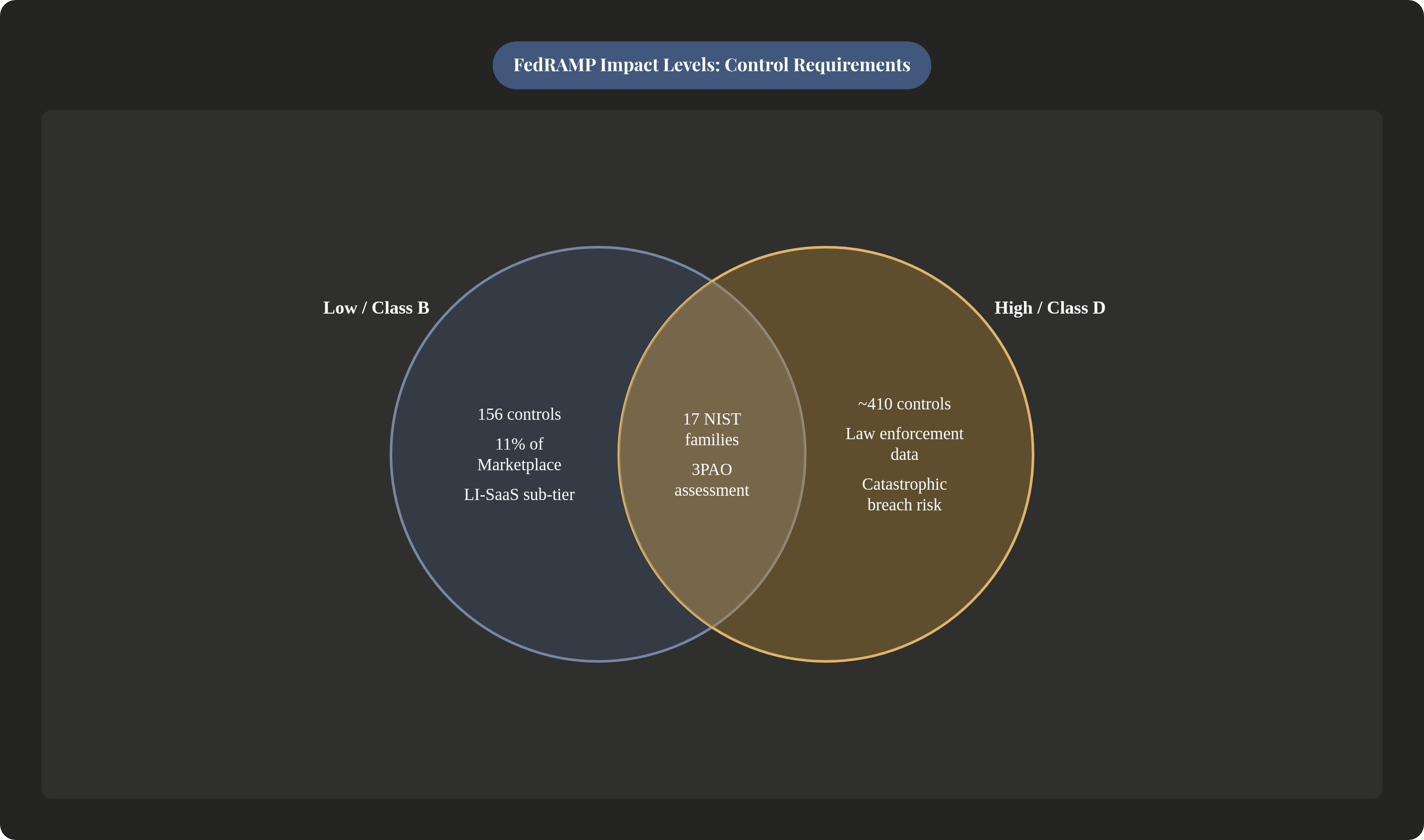
Impact level is the first decision a vendor makes, and it shapes everything that follows: control count, documentation burden, assessment scope, total cost. Get it wrong early and you spend years overbuilding, or you hit a wall when an agency informs you that your authorization doesn't cover what they actually purchased you to do.
The framework runs three levels: Low, Moderate, and High. All three draw from the same 17 NIST SP 800-53 control families. What changes is depth of implementation. Low requires 156 controls and covers roughly 11% of Marketplace offerings. Moderate requires 323 controls under Rev. 5 and represents about 80% of authorized services. It is the de facto standard for most SaaS vendors. High sits at approximately 410 controls and applies to systems handling law enforcement sensitive data, certain national security records, or anything where a breach produces severe or catastrophic consequences. Agencies building for High aren't being bureaucratic. They are pricing in the real cost of getting it wrong.
There is also LI-SaaS, a constrained sub-tier of Low for offerings that handle only the lowest-risk federal data. Not a standalone level, but if your product qualifies, the timeline and cost compress substantially. Worth confirming before you assume Moderate is your floor.
What actually catches vendors off guard isn't the control families themselves. ISO 27001, SOC 2, NIST 800-171: all of these overlap meaningfully with FedRAMP requirements, and vendors with mature commercial security programs walk in assuming the gap is manageable. Sometimes it is. What they miss is the FedRAMP-specific overlay sitting on top of the NIST baseline: prescribed parameter values for session timeouts and encryption key lengths, mandatory Control Implementation Summaries, requirements for U.S.-person-only access at certain levels, U.S.-based data storage at Moderate and High. None of it is negotiable. Existing certifications narrow the remediation gap. They do not close it.
One nomenclature note worth tracking: the Consolidated Rules for 2026 rename Low, Moderate, and High to Classes B, C, and D, and introduce a new Class A pilot tier. Existing authorizations carry forward without re-authorization. This is a labeling change, not a substantive redesign, and it should not alter anything for vendors currently in process.
Securing an agency sponsor before the formal process can begin
Agency Authorization is currently the only active path to FedRAMP authorization for most vendors. And Agency Authorization requires a federal agency willing to put their name on you. There is no workaround, no self-nomination, no way around this dependency.
A sponsor is not a casual endorsement. The sponsoring agency's Authorizing Official is staking professional credibility on your security posture. Agencies are selective and often slow to commit, and they have earned that caution. They have seen vendors enter the process with optimistic timelines and exit with documentation disasters, incomplete evidence packages, controls that look good on paper and fall apart under assessment.
For vendors without existing federal relationships, finding a sponsor alone can take six to twelve months. No amount of documentation work, security investment, or 3PAO engagement accelerates that search if there is no sponsor. The practical implication is uncomfortable but clear: if you don't already have a federal relationship, that relationship-building has to begin before you commit capital to the authorization process. Federal pilot programs, agency proof-of-concept contracts, and reseller partnerships through GSA Schedule holders are all viable on-ramps. The goal is to create a situation where an agency sees enough operational value in your product that sponsoring the authorization becomes their interest, not just yours.
Once a sponsor is identified, the vendor submits an In Process Request to the FedRAMP PMO, along with a Work Breakdown Structure outlining the project timeline and confirmation that the system is fully operational. Being listed as In Process on the Marketplace has a secondary benefit many vendors underestimate: it signals to other potential agency customers that authorization is underway, which generates additional interest well before an ATO is issued.
Building the System Security Plan and the documentation package
The System Security Plan is the authorization's foundation. It covers every required control, documents how each is implemented, and anchors a documentation structure that includes appendices addressing control parameters, incident response procedures, and interconnection agreements. Every other element of the authorization package builds on it. If the SSP is weak, everything downstream reflects that weakness.
The full package consists of three documents submitted together: the SSP, the Security Assessment Plan, and the Security Assessment Report. Gaps in any one return the entire submission for rework and restart the review clock. PMO reviewers are not in the business of troubleshooting on your behalf.
The preparation phase, building the SSP and supporting documentation, typically runs one to six months depending on how mature the vendor's existing security program is. A vendor with documented controls, operating procedures, and evidence already organized compresses this phase considerably. A vendor standing up security processes from scratch fills the entire range and sometimes exceeds it.
There is a separation rule that routinely blindsides vendors: the cloud service provider authors the SSP; the 3PAO validates it, but cannot help write it. If a 3PAO advises on or co-authors SSP development, a two-year bar applies before that same firm can serve as the independent assessor. The CSP Authorization Playbook is explicit on this point. In practice, it means you cannot use your chosen assessor as a documentation consultant. Separate advisors or internal security staff have to own SSP authorship.
Treat the SSP as an operational document, not a compliance artifact produced for submission and then shelved. The Authorizing Official's team reviews it throughout continuous monitoring. If it doesn't accurately describe how the system actually operates, that discrepancy becomes a recurring problem long after the initial ATO is granted.
What the independent 3PAO assessment actually tests
Third-Party Assessment Organizations, universally called 3PAOs, produce the independent Security Assessment Report that forms the basis for the government's authorization decision. They are not auditors in the conventional sense. They are testing whether your controls work, whether your documentation accurately describes those controls, and whether the gaps between the two create unacceptable risk. It is not enough to have implemented the controls. You have to prove it to someone who is actively looking for reasons to flag you.
The assessment runs three components: manual control testing, compliance and vulnerability scanning, and penetration testing. Each generates findings. Those findings populate the SAR, and the SAR is what the agency Authorizing Official reads when deciding whether to issue an ATO.
3PAOs must be accredited by A2LA, the American Association for Laboratory Accreditation, which conducts annual reviews and full on-site reassessments every two years against ISO/IEC 17020 requirements and FedRAMP-specific knowledge standards. The accreditation process is rigorous, and the pool of qualified firms is not large. This creates a scheduling constraint that vendors routinely discover too late: good 3PAOs are booked out, and an unreserved slot can add months to your timeline. That is a concrete, avoidable problem if you engage early.
Cost is a significant planning variable. 3PAO fees for a Moderate authorization typically run $350,000 to $650,000 depending on system complexity. Annual penetration tests post-authorization run $20,000 to $60,000. That recurring cost is consistently absent from initial budget planning, and it surfaces as a cash flow surprise in year two.
The most common assessment finding is a mismatch between what the SSP describes and what the system actually does. Assessors test both the control itself and whether the SSP's description of that control is accurate. Arriving at assessment with implemented controls and no documented evidence produces the same finding as not having the controls at all. Evidence collection, not just implementation, has to be complete before the 3PAO engages.
Remediating findings before SAR submission extends the timeline. It is still preferable to submitting a package carrying open high-severity findings. PMO review of packages with unresolved critical issues is a longer and considerably more uncertain process than absorbing the remediation delay upfront.
PMO review, agency review, and how an ATO is issued
Once the package is complete, it goes to the authorizing party, either the FedRAMP Board or the sponsoring agency, for review and approval. The PMO reviews first, checking package completeness and conformance before anything reaches the Authorizing Official. Incomplete submissions are returned. The clock restarts.
The agency Authorizing Official makes the final decision. An ATO is a formal acceptance of residual risk, not a declaration that the system is without vulnerabilities. Every ATO holder maintains an active Plan of Action and Milestones documenting known issues and remediation timelines. The AO is deciding that residual risk is acceptable given the operational need. That framing matters because it clarifies what you are actually working toward: not perfection, but a defensible, documented risk posture that a reasonable official can sign.
Total timeline from initiation to ATO typically runs twelve to thirty-six months. FedRAMP's own reporting noted final authorization times approaching two years as of the start of FY2025, a figure that contributed directly to the 20x reform initiative. For planning purposes, assume the longer end of that range unless you have a mature security program, a committed sponsor, and clean documentation from the beginning.
All-in costs for a Moderate authorization, covering documentation, 3PAO assessment, remediation, and year-one continuous monitoring, run $800,000 to $2 million. High authorization runs $2.5 million and above. Vendors who plan against lower figures routinely exhaust budget before reaching the ATO. These numbers are not pessimistic projections. They are what the process costs.
When the ATO is issued, the authorization appears on the FedRAMP Marketplace and the reciprocal model activates: other agencies can reuse the authorization without requiring the vendor to repeat the process. That is the structural payoff, and it is the reason the upfront investment makes financial sense for vendors with genuine federal ambitions.
Continuous monitoring obligations that begin the day authorization is granted
Authorization doesn't end the compliance obligation. It starts a different one. Continuous monitoring is the mechanism that keeps an authorization valid between annual assessments, and it requires sustained operational effort every single month.
Four parties share continuous monitoring responsibility: the CSP executes the full operational layer, the agency Authorizing Official makes ongoing risk decisions, the 3PAO conducts the annual assessment, and the FedRAMP PMO provides oversight. The CSP carries the largest burden by a wide margin.
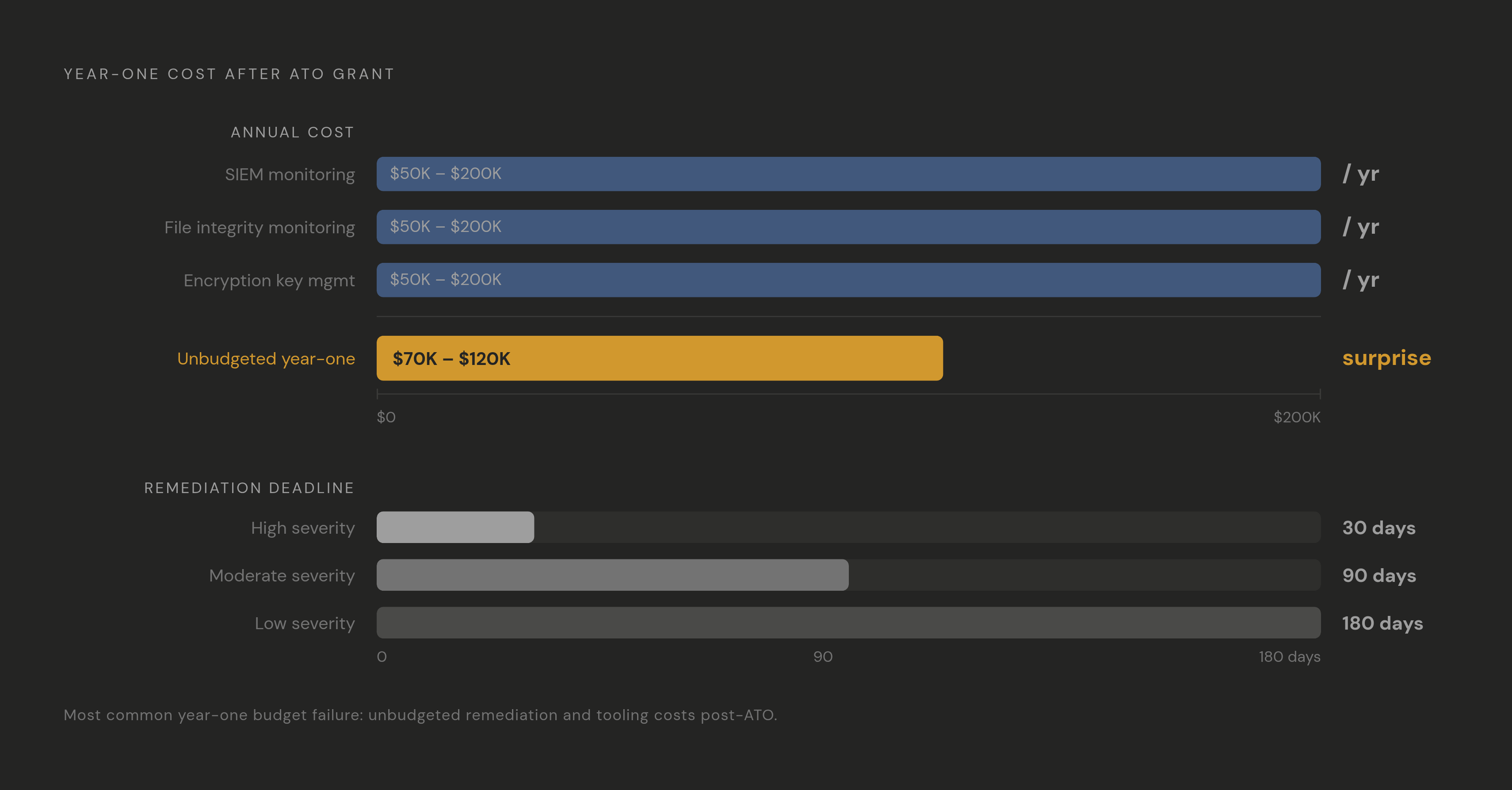
Monthly deliverables include an updated Plan of Action and Milestones, system inventory updates, and vulnerability scan reports. Remediation timelines are not flexible: high-severity vulnerabilities must be resolved within thirty days, moderate within ninety, low within one hundred eighty. Missing those deadlines can trigger ATO suspension or revocation. This is not a theoretical consequence reserved for the most egregious cases. It happens to vendors who assumed the post-authorization environment would be more forgiving than the authorization process itself.
The tooling required to execute continuous monitoring at scale — SIEM platforms, file integrity monitoring, encryption key management — typically costs $50,000 to $200,000 annually. Underestimating this operational layer adds $70,000 to $120,000 in unexpected annual expenses, and it is consistently among the most common budget failures vendors encounter in their first year post-authorization. Almost entirely avoidable with honest upfront planning.
Under the 20x continuous monitoring model being phased in, CSPs must publish an Ongoing Authorization Report every three months and host synchronous Quarterly Reviews with agencies for Moderate and High authorizations. This represents a structural shift from monthly reporting toward structured quarterly accountability. Vendors entering the process today should plan to transition into this model as it becomes standard.
What FedRAMP 20x changes for vendors starting the process now
FedRAMP 20x is the most substantive redesign the program has undertaken since its 2011 launch. The conditions that prompted it are not subtle: authorization times approaching two years, the Joint Authorization Board shut down for nearly a year, roughly 350 authorizations completed across thirteen years of program operation, all against a federal cloud market now measured in the tens of billions of dollars. The throughput problem was severe, and the people running the program knew it.
The stated goal of 20x is to automate authorization steps in ways that make the process simpler, cheaper, and faster while continuously improving baseline security. The intent is to close the structural gap between authorized services and actual federal demand. The mechanisms are still being developed and piloted. Build your timeline around current requirements and monitor PMO guidance on 20x pilots as they mature. Holding your authorization schedule hostage to a reform initiative that is still finding its shape is a real risk, and not a small one.
The CR26 nomenclature changes take effect in 2026 and carry existing authorizations forward without re-authorization. Vendors entering in 2025 should expect to operate under Rev. 5 rules through initial authorization, then transition continuous monitoring reporting to the quarterly Ongoing Authorization Report format as 20x ConMon becomes standard.
The federal cloud market at $28.24 billion in 2025 is served by fewer than 520 authorized services. The authorization burden is real. The cost is real. The timeline is punishing. None of that is going to change substantially before 20x fully matures, which means vendors starting now are navigating the process largely as it has existed. Understanding that clearly, and planning for it without illusion, is what separates vendors who finish from vendors who stall out somewhere between the SSP and the SAR, having spent a year and a half and most of their budget to get there.