Government Procurement Process for Software and SaaS Products
Selling software to government takes years, not weeks, and follows rigid rules.
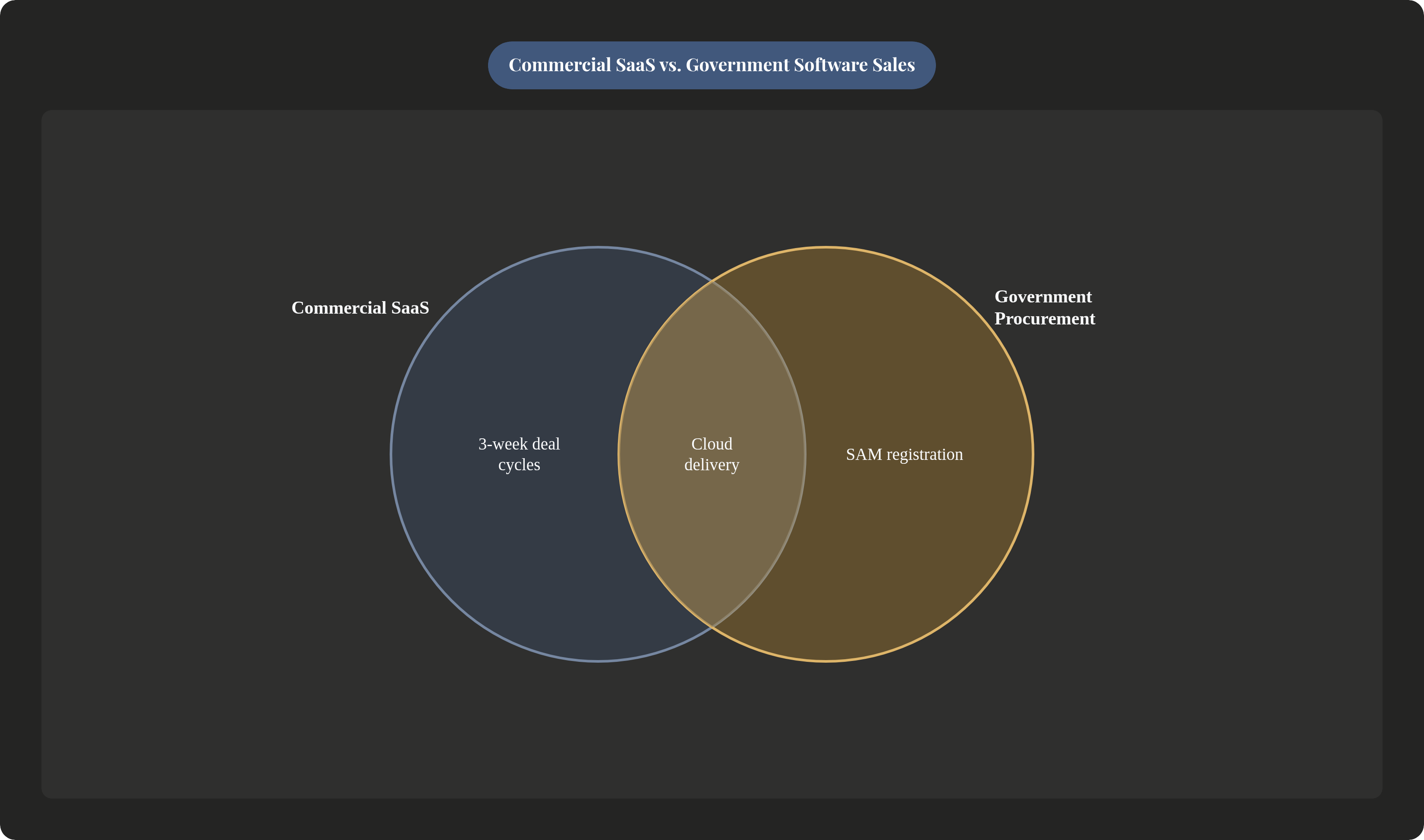
Government procurement of software runs on a completely different clock than commercial sales, and that clock shapes everything else. A SaaS deal that closes in three weeks in the private sector can take three years to close with a federal agency; the delay reflects a deliberate system of checks, budget cycles, and security gates designed to protect public money. The federal government planned somewhere around $140 billion in IT spending for fiscal year 2025 alone, and federal cloud spending has grown from $2.3 billion to more than $10 billion annually over the past decade. That's a big enough number that vendors keep lining up to deal with the paperwork, even when the paperwork takes longer than the software's entire development cycle.
The government software market was valued at $26.4 billion in 2025 and is projected to hit $55.8 billion by 2034. So the money is real. Agencies don't respond to cold emails or unsolicited demos; nearly everything flows through a formal RFP where competing vendors bid against published criteria. The people reading those bids, the contract specialists, are checking whether you followed the rules. That's a different audience than the one most SaaS sales teams are trained to talk to, and it's the first thing that trips people up. This piece walks through the entire lifecycle, the paperwork prerequisites, the contracting vehicles, the regulatory maze, and the FedRAMP process that determines whether any of this even matters for your product. Consider it a map for the vendors who'd rather not learn this by getting lost in it first.
The full procurement lifecycle, from need identification to contract closeout
Every government software purchase follows roughly the same eight beats, whether it's a modest tool for a city parks department or a large enterprise platform for a federal agency. Someone inside the agency first identifies a gap: their current system is broken, outdated, or simply doesn't exist yet. Then comes budget formulation, where that need gets translated into a funding request and justified up the chain. Only after legislative appropriation, meaning the money is formally approved and available, can the agency move to drafting and posting a solicitation. From there it's vendor evaluation, contract award, ongoing contract management, and eventually closeout, where the books get audited and the relationship formally ends.
Here's the part that trips up newcomers: the federal fiscal year runs October 1 through September 30, while most states run July through June. Miss that window and you're waiting for the entire budget cycle to reset. I've watched vendors show up with a great pitch in August, not realizing the agency's money for that fiscal year was already spent in March. SaaS subscription terms, which commercial buyers treat as flexible and month-to-month, often get bent into strange shapes to fit these fiscal boundaries; a 13-month contract isn't a typo, it's an agency trying to bridge two budget years without a gap in service.
The solicitation window itself typically runs 30 to 90 days, and from release to award, even a straightforward opportunity takes 60 to 120 days. Complex procurements, especially ones that draw a protest (more on that later), can run six months or longer. Here's the thing nobody tells you early enough: if you're reading the RFP for the first time when it posts, you're already behind. Relationship-building and requirement-shaping happen back at the need-identification and budget-formulation stages, months before the public solicitation ever shows up. Waiting for the RFP to appear means you're already competing from behind.
Vendor registration and the prerequisites that must be in place before bidding
Nothing happens without SAM. The System for Award Management is the federal government's master vendor database, and without an active SAM registration, you cannot legally submit a bid on any federal opportunity, full stop. Registration requires your NAICS industry classification codes, banking information for payment, and a set of representations and certifications about your company's legal and financial standing. It sounds tedious because it is, and it functions as a thorough background check on your company before you're allowed to bid at all.
Most businesses complete SAM registration in 7 to 14 days if the paperwork is clean. Notice the qualifier: if it's clean. One wrong digit in your banking information or a mismatched entity name, and the clock restarts. I've seen vendors lose two weeks over a typo in their own company address.
Once you're in SAM, you can browse Contract Opportunities and start submitting bids directly. But SAM is federal-specific. If you're targeting state or local agencies, you'll run into a parallel universe of registration systems, each state maintaining its own database with its own quirks. SAM registration also requires annual renewal, and letting it lapse means you quietly fall off the list of vendors agencies are even allowed to consider.
A few other prerequisites worth locking down early: your Unique Entity Identifier (the UEI, which replaced the old DUNS number within SAM), and if you qualify, small business certifications like 8(a), HUBZone, or WOSB status. These create set-aside eligibility, meaning entire categories of contracts are reserved for businesses holding these certifications, which can meaningfully improve your odds before you've written a single word of a proposal.
How the RFP process actually works and what a competitive bid requires
An RFP tells you exactly what the agency wants: the ideal solution, the evaluation criteria, the required format, the submission deadline. This is the single biggest mental shift vendors coming from commercial sales need to make, and a lot of them never quite make it.
A competitive bid typically includes a detailed statement of work or technical approach, a cost proposal with transparent and defensible pricing, an implementation timeline, past performance evidence (references, case studies, contract history), and compliance documentation covering certifications and security posture. Contract specialists then score these against published criteria: cost, technical quality, and vendor history. Here's the part that surprises people who assume government contracts go to the lowest bidder: they often don't. "Best value" determinations let a higher-priced vendor with stronger past performance and lower perceived risk beat a cheaper competitor, because the agency is buying certainty as much as it's buying software.
After an award is announced, there's a protest period where losing vendors can formally challenge the decision. This can add weeks or months to a timeline that otherwise assumes a clean 15 to 30 day window for post-award negotiation and contract execution. The game can look decided and then be reopened entirely.
The mistake I see most often is vendors treating their RFP response like a sales brochure, full of persuasive language and feature lists, when the evaluator on the other end is working through a checklist verifying compliance. If your response reads like marketing copy instead of a direct answer to each requirement, you've lost points before anyone even judges the substance of your product. The upside is that pre-RFP engagement, things like industry days and Requests for Information, is where vendors can legitimately influence requirements before the solicitation gets locked in. That's your window to shape the conversation. Once the RFP posts, you're just answering the questions someone else wrote.
The three main contracting vehicles for software and SaaS, and how each changes the path to award
There isn't just one door into government software procurement; there are three, and each has a different toll booth.
The GSA Multiple Award Schedule, or MAS, is the biggest one. The MAS IT Category lists roughly 7.5 million commercial IT solutions spanning cloud, software licenses, IT services, and telecom, and it's open to federal, state, local, and tribal agencies alike. For most SaaS vendors, the relevant entry point is Software License SIN 511210, which covers perpetual and term licenses plus maintenance. MAS is structured as an IDIQ contract, meaning agencies can issue task orders against it without running a full competition every time they want to buy. That's the appeal: once you're on the schedule, agencies can purchase from you without launching a fresh RFP, which collapses the sales cycle dramatically. There's a cost of admission, though, an Industrial Funding Fee of 0.75% of sales, and getting listed on MAS in the first place is its own multi-month process with its own pile of documentation. It functions as a toll road you build once and then drive on repeatedly.
The second path is working through a reseller or an existing contract vehicle. Plenty of agencies already hold contracts with large, established IT vendors who've cleared security and compliance vetting years ago. Smaller SaaS providers can partner with these resellers and ride their existing vehicle into an agency, skipping the RFP process entirely. The tradeoff is margin: resellers typically mark up software 5 to 10%, so the agency isn't getting the vendor's best price, and the vendor is giving up a chunk of revenue for the privilege of a faster path in. It's a reasonable option for smaller companies that don't yet have the resources for their own MAS listing or a FedRAMP authorization.
Third are cooperative purchasing programs like Sourcewell, OMNIA Partners, and NASPO ValuePoint, which collectively move $35 billion or more every year. These contracts have already gone through competitive bidding once, so agencies, particularly state and local ones without access to federal vehicles like MAS, can buy directly off them without repeating that process.
Which vehicle makes sense depends on who you're selling to, how big your company is, how far along your compliance posture already is, and how fast you need revenue. There's no universal right answer here, only tradeoffs.
Then comes budget formulation, where that need gets translated into a funding request and justified up the chain.
The regulatory framework vendors must navigate, FAR, agency supplements, and pricing rules
The Federal Acquisition Regulation, the FAR, governs how every U.S. government contract gets formed and administered. It exists to protect public trust in how taxpayer money gets spent and to prevent favoritism, which are good goals. The execution, though, runs to roughly 2,000 pages before you even factor in the fact that 20 different agencies maintain their own supplements layered on top.
Here's the part that should make any SaaS vendor raise an eyebrow: as of recent research, the FAR still doesn't define cloud computing. It carries a definition of "information technology" that's roughly 20 years old, and its definition of a commercial product or service doesn't cleanly map onto how cloud delivery actually works. Significant revisions moved through the FAR between April and October 2025, and the cloud computing gap remained unresolved according to a GAO report. Vendors selling a product built entirely for the cloud era are, in a real sense, filling out forms designed for a world of shrink-wrapped software on physical discs, with no category that reflects how their product is actually delivered.
Pricing carries its own trap: Most Favored Nation clauses. Agencies frequently require that the price they're offered be at least as good as your best commercial price for equivalent terms. Give a big commercial customer a steep discount, and you may have just created a pricing obligation to your government customer too, whether you meant to or not. This shapes how smart SaaS vendors structure discounting long before they ever talk to an agency. Multi-year enterprise agreements are common as a workaround, letting agencies negotiate volume discounts tied to user counts and get predictable pricing for budget planning across departments.
Data sovereignty and ownership clauses show up in nearly every government SaaS contract too: where's the data stored, who can touch it, what happens to it when the contract ends. None of this is optional boilerplate. Any SaaS vendor serious about this market needs legal counsel who actually knows the FAR before finalizing pricing or making commitments about data storage. Skipping that step is how vendors end up promising something in a contract that their own infrastructure can't actually deliver.
FedRAMP authorization: what it requires, what it costs, and why it determines whether a SaaS vendor can serve federal agencies at all
FedRAMP is the one gate you cannot route around. Federal policy establishes it as the sole authorization pathway for any cloud service provider storing or processing government data. Without FedRAMP, federal agencies legally cannot use your cloud service for anything touching their data, regardless of how good your product is or how many Fortune 500 logos are on your website.
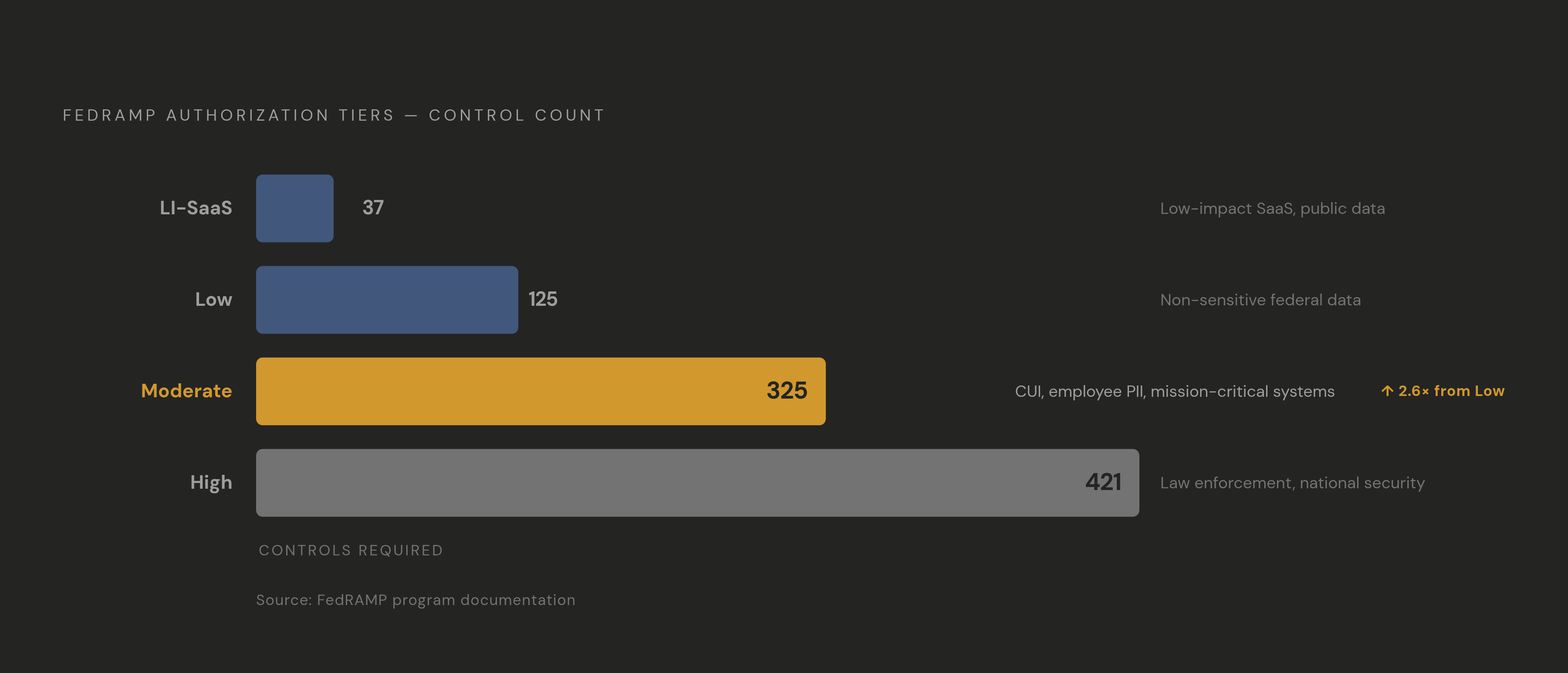
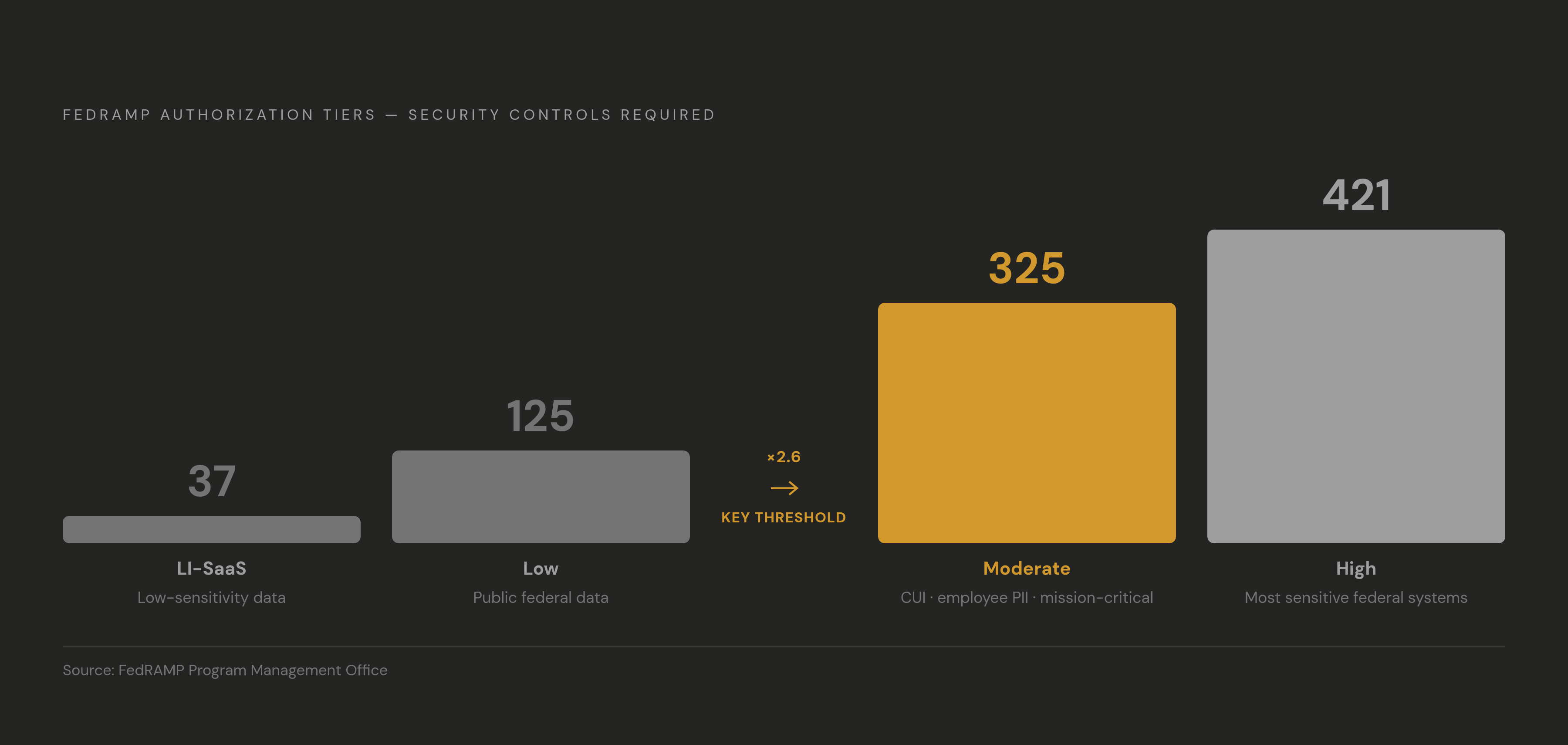
Authorization is tiered by impact level, and the control counts escalate fast. LI-SaaS, the Low Impact SaaS baseline, requires at least 37 controls and covers limited, low-sensitivity data. Low impact requires 125 controls. Moderate, the baseline that most SaaS vendors end up targeting because it covers controlled unclassified information, employee PII, and mission-critical systems, requires 325 controls. High impact, reserved for the most sensitive federal systems, requires 421. Going from Low to Moderate isn't a small step up; it's nearly tripling your control set.
Here's where the numbers get genuinely rough. Traditional FedRAMP authorization timelines have run 2 to 3 years, assuming you can even find an agency sponsor willing to champion your application in the first place (no sponsor, no authorization, regardless of how ready your product is). All-in costs for a Moderate authorization have commonly reached seven figures once you count internal labor, third-party assessment fees, remediation work, and ongoing program overhead. In the program's first 13 years, just over 350 cloud services managed to clear the bar. As of June 2025, the FedRAMP Marketplace listed 430 authorized cloud service offerings. Sit with that for a second: over more than a decade, fewer than 450 products made it through.
Agencies want more authorized software to choose from. Vendors look at the timeline and the price tag and, understandably, a lot of them walk away. That mismatch between demand and access is a known, well-documented policy problem, and it's the exact problem the next wave of reform is trying to fix.
FedRAMP 20x and the 2025–2026 reforms that are changing the authorization calculus
FedRAMP 20x is the first serious rewrite of the cloud authorization framework since 2011, and the core idea is a genuine philosophical shift: a periodic, paperwork-heavy audit that certifies you at one point in time gives way to continuous, automated security monitoring. Authorization becomes an ongoing state rather than a one-time stamp you earn and then mostly ignore until renewal.
Why does this matter so much? Because the 2 to 3 year timeline and seven-figure cost are precisely what the reform is targeting. If 20x delivers on that, it changes the entry calculus for every SaaS vendor currently sitting on the sidelines waiting to see if the investment will pay off. There's early evidence the reuse model is already working: in fiscal year 2025, 131 new authorizations generated 350 Reuse Authorities to Operate, meaning each authorized product got picked up by nearly 3 agencies on average. That's the whole point of the reform: authorize once, reuse widely, instead of every agency reinventing the wheel.
What should a vendor actually do with this information right now? Track the FedRAMP 20x pilot timelines closely, because early participants may get a real competitive edge before the rest of the market catches up. Invest in automated compliance tooling regardless of how the final 20x rules shake out, since continuous monitoring is clearly the direction everything is heading. And resist the urge to assume either extreme: the old 2 to 3 year, seven-figure math may no longer fully apply, but 20x hasn't necessarily solved it either, not until the new process is fully operational and tested by real vendors going through it.
Worth watching at the state level too: several states are building their own cloud security frameworks modeled directly on FedRAMP. A federal FedRAMP authorization is increasingly treated as a credibility signal in state and local procurement as well, even when it isn't strictly required. It's becoming less of a federal-only hurdle and more of a general credential that different jurisdictions recognize on their own terms.
What a realistic entry timeline looks like when all stages are sequenced together
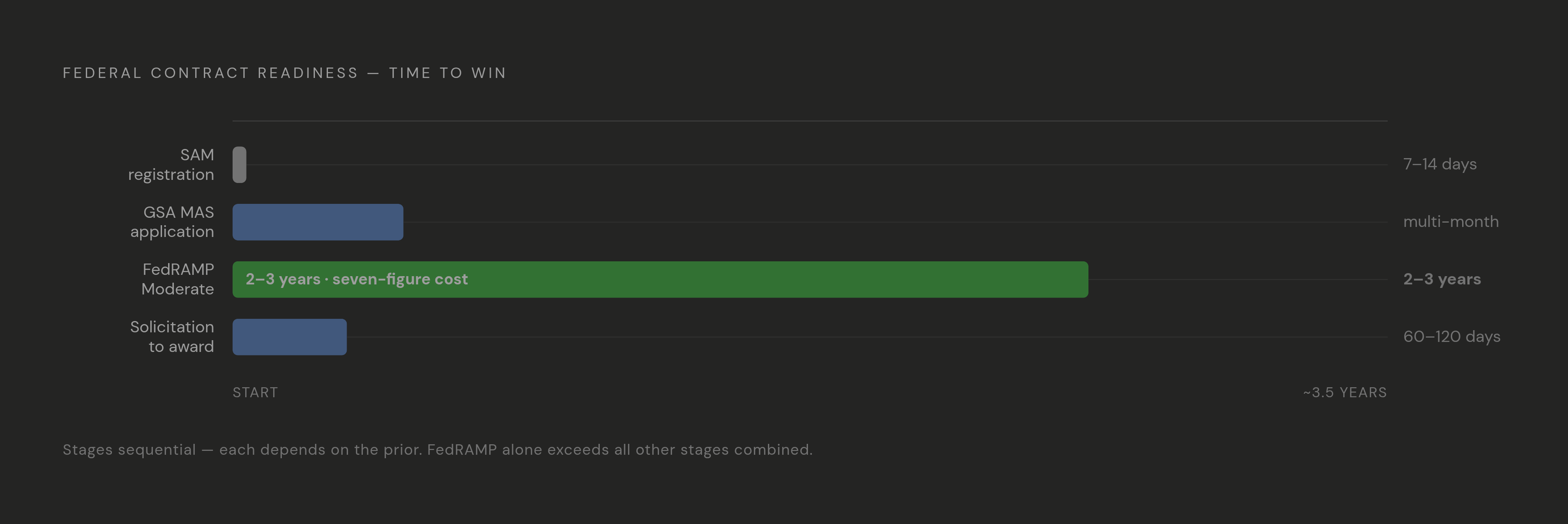
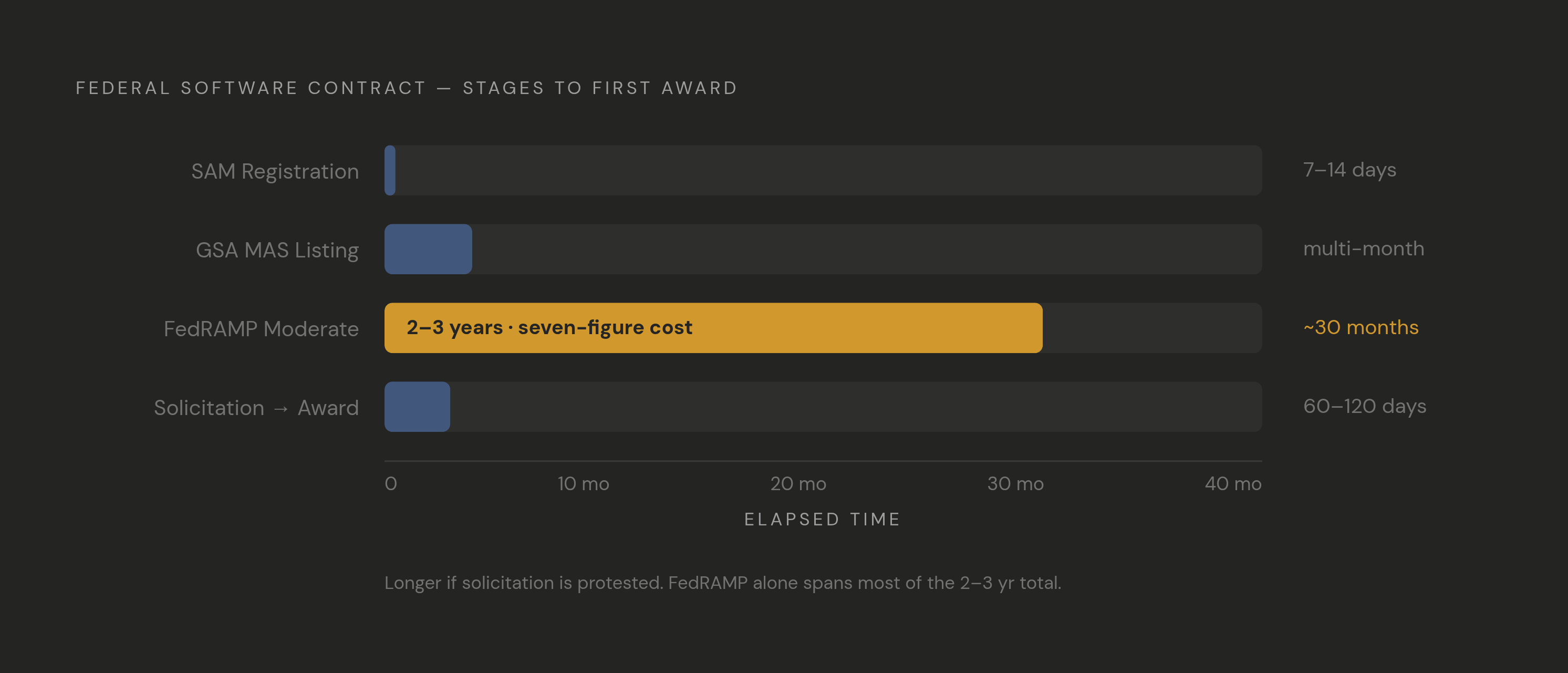
Add it all up and the picture gets clearer, if not exactly encouraging for anyone in a hurry. SAM registration takes 7 to 14 days if your paperwork is clean. A GSA MAS application is a separate multi-month effort on top of that, with its own negotiation process before you actually appear on the schedule. FedRAMP authorization, if you're going the traditional route, runs 2 to 3 years and commonly lands in seven-figure total cost once labor, assessment, and remediation are counted. Solicitation to award, assuming you clear all the prerequisites and actually get invited to bid, takes another 60 to 120 days for straightforward opportunities, more if a protest gets filed.
Layer those together and a vendor starting from zero, no SAM registration, no MAS listing, no FedRAMP authorization, is looking at something closer to 2 to 3 years before their first federal contract, with most of that time consumed by FedRAMP alone. That timeline behaves more like a product roadmap than a sales cycle, and it needs to be budgeted, staffed, and planned for as one.
A $55.8 billion projected market by 2034 says this is worth pursuing. The vendors who win aren't the ones with the best demo. They're the ones who understood, going in, that this was a systems problem, solved by sequencing registration, compliance, and contracting vehicles correctly, months and sometimes years before the RFP they're chasing ever gets posted.
Sources
- https://esper.com/resources/blog/how-do-i-procure-cloud-based-software-in-government/
Provided the 5 to 10% reseller markup figure cited in the section on contracting vehicles.
- https://knoxsystems.com/resources/fedramp-20x
Provided details on FedRAMP 20x as a rewrite of the cloud authorization framework and its shift toward continuous automated monitoring.
- https://elevateconsult.com/insights/fedramp-for-saas-providers-essential-requirements-cloud-vendors-must-meet/
Provided foundational details on FedRAMP authorization tiers, control counts, and requirements for SaaS providers serving federal agencies.