Government Data Center Consolidation Outcomes
Federal agencies saved billions but progress stalled as definitions shifted and oversight tightened.
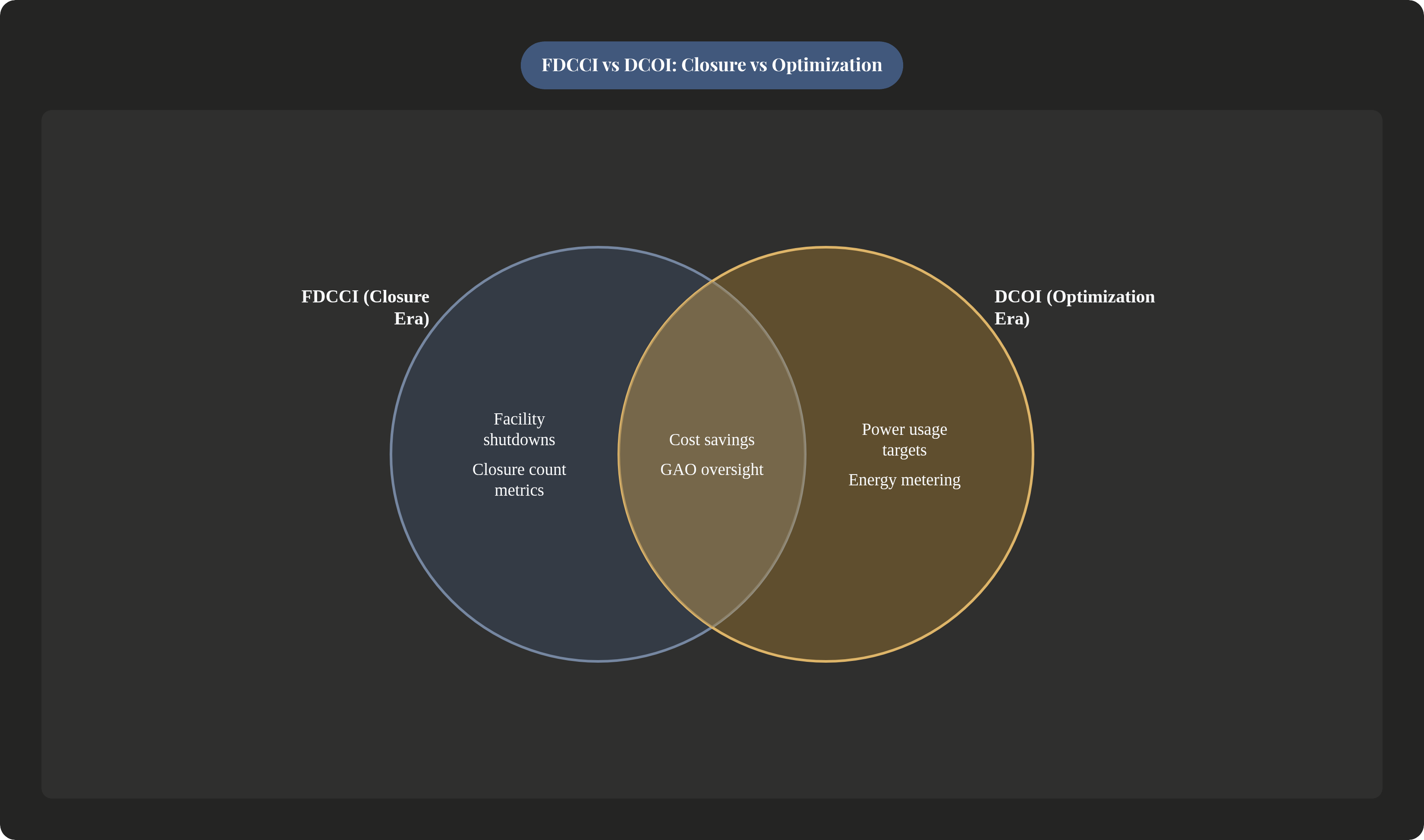
The founding logic was stark and, honestly, embarrassing for the federal government to have to confront. In 2009, federal server utilization sat at roughly 5 percent. OMB's target was 60 to 70 percent. That gap justified the Federal Data Center Consolidation Initiative when it launched in 2010, and the mandate was blunt: close facilities. Twenty-four agencies came into scope. OMB set a goal of shuttering 40 percent of federal data centers by 2015. Success, in that first phase, was measured in closures and closures only.
FITARA changed the accountability structure in 2014. The Federal Information Technology Acquisition Reform Act embedded consolidation inside broader IT reform legislation and mandated annual GAO review of agency inventories and strategies. Independent oversight became statutory, not discretionary. That shift matters more than it sounds, because statutory oversight with teeth is what prevents an initiative from quietly dying when political attention moves on.
The Data Center Optimization Initiative arrived in 2016 and replaced FDCCI with something more demanding. DCOI kept the closure pressure but added specific operational targets: virtualization rates, energy metering, power usage effectiveness, server utilization. The policy was acknowledging, explicitly, that closing facilities without improving what remained was an incomplete answer to the original problem.
OMB's 2019 redefinition of what even counts as a "data center" narrowed the scope considerably, introducing Key Mission Facility exemptions and recategorizing a substantial portion of the federal inventory out of DCOI requirements entirely. Then the Federal Data Center Enhancement Act of 2023, enacted through the FY2024 National Defense Authorization Act, superseded the expired FITARA and DCOI provisions and shifted emphasis toward cybersecurity, resiliency, and availability. OMB's implementing memo from January 2025 covers uptime, power redundancy, physical security, sustainable energy use, and information security, with provisions running through September 2026.
Each of these transitions was a direct response to what the preceding phase left unresolved. The metrics kept changing because the problem kept revealing new dimensions. Anyone comparing outcomes across these eras without accounting for the shifting definitions is comparing apples to facilities that were quietly reclassified out of the fruit category.
The Closure Numbers: What Agencies Actually Accomplished Between 2010 and 2022
By the end of 2012, agencies had closed 420 data centers and planned hundreds more. By fiscal year 2015, reported closures reached into the thousands. That sounds like momentum, and it was. But the inventory was simultaneously expanding as agencies identified facilities they hadn't previously counted. By November 2015, the total federal inventory had grown to many thousands of facilities, far exceeding the original baseline of 3,133. The initiative was chasing a moving target from nearly the beginning, which is either a sign of poor initial scoping or a sign that nobody really knew how many data centers the federal government was running. Probably both.
The peak performance year shows what the initiative could produce when conditions aligned. In FY2020, agencies planned to close 46 data centers and closed 96, generating $875.10 million in savings for that year alone. In FY2021, 58 data centers closed, and 22 of 24 agencies met their cost savings goals. Those are legitimately strong results.
Then the pipeline thinned fast. By August 2022, agencies had closed 20 data centers, with 58 more planned through year-end, a fraction of the initiative's high-water volume. The cumulative total of thousands of federal data centers consolidated since 2010 is a genuine achievement. But the year-over-year trajectory tells a story the aggregate figure obscures.
The $6.6 Billion Savings Record and What It Actually Represents
From fiscal years 2012 through 2021, GAO documented $6.6 billion in cost savings and avoidances. That number leads every press release about this initiative, and it is real. It is also heavily concentrated in ways the headline obscures.
Between FY2011 and 2013, the Departments of Defense, Homeland Security, and Treasury accounted for approximately 74 percent of the $1.1 billion in savings reported for that period. By FY2015, four departments, Commerce, Defense, Homeland Security, and Treasury, had driven roughly 86 percent of the cumulative $2.8 billion in savings through that point. FY2021 alone yielded $612.326 million, identified by 22 of 24 agencies. So yes, most agencies were eventually participating. But the weight of the savings was never evenly distributed.
Treasury is the clearest single-agency proof that the model works at scale. Between 2011 and 2014, Treasury reported $1.05 billion in cost avoidances and reduced infrastructure's share of its overall IT spending from 46 percent to 32 percent. That kind of structural rebalancing is not accidental. It requires deliberate, sustained leadership from the top of the agency, and most agencies didn't have that in the same sustained form.
One definitional point worth keeping straight: cost avoidance is not spending reduction. Avoidance means the agency did not spend money it would otherwise have spent, on deferred hardware purchases, on capacity migrated away from owned facilities. Actual spending reduction means a budget line contracted. Both count in the reported totals. Conflating them leads to inflated impressions of fiscal impact, and federal reporting leaned heavily on avoidance figures throughout.
The $6.6 billion is accurate and meaningful. But it was produced primarily by a small number of large agencies with strong leadership and significant infrastructure to rationalize. The median agency's contribution was modest, and that distribution has real implications for what this model can realistically deliver across a more representative swath of the federal enterprise.
The $2.2 Billion Underreporting Gap and the Data Reliability Problem Underneath the Totals
GAO found that 11 of 21 agencies with planned cost savings were underreporting their FY2012 through 2015 figures to OMB by approximately $2.2 billion. Worth pausing on that: the actual savings were higher than what agencies reported, not lower. Underreporting here points to administrative inconsistency, not inflated claims. Agencies were leaving documented savings on the table because their reporting mechanisms couldn't capture them accurately.
The problem ran in both directions across the initiative's life. Some agencies undercounted savings. Others applied inconsistent methodologies for metrics like power usage effectiveness, making cross-agency comparisons essentially meaningless at the portfolio level. When each agency is using a slightly different ruler, you cannot aggregate the measurements and call the result a precise figure.
OMB's 2019 definitional narrowing removed roughly 2,000 facilities from federal reporting requirements by recategorizing them as outside DCOI scope. Those facilities kept operating. They simply became invisible to the oversight structure. GAO flagged the cybersecurity implication directly: every excluded facility is a potential attack surface, and it recommended OMB require continued reporting on those sites. OMB's response was not fully satisfying on this point.
Key Mission Facility exemptions compounded the visibility problem further. Agencies could designate a data center as a KMF to seek exemption from DCOI consolidation goals, effectively contracting the universe of facilities subject to optimization requirements whenever the process became inconvenient.
Taken together, the reported savings and closure counts are floor estimates. The actual numbers, in both directions, diverge from the official record in ways no one can fully reconstruct. That is not an indictment of the initiative; it is what you get when two dozen independent agencies with different reporting systems and different administrative capacities are asked to measure the same thing over more than a decade.
Where Optimization Targets Fell Short After the Closures Were Counted
DCOI established four core optimization targets: virtualization, availability, advanced energy metering, and server utilization. The FY2022 compliance snapshot is instructive. Seventeen of 24 agencies met the availability target, the strongest result. Thirteen met the virtualization target. Fourteen met both the energy metering and server utilization targets. No target achieved universal compliance across the board.
Energy metering tells a particularly frustrating story. The percentage of facilities with metering capabilities grew from 26.1 percent to 27.8 percent between reporting periods. Directional progress, technically. But at that rate of improvement, the target was not going to close on its own.
Virtualization was more encouraging. Virtual host counts grew each year from FY2019 forward. Server counts declined each year since FY2020. The virtualization rate climbed nearly 4 percent since FY2020, which is genuine movement, even if full compliance remained elusive.
On power usage effectiveness: DCOI originally required tiered data centers to achieve a PUE below 1.5. The Uptime Institute's 2025 Global Data Center Survey found the global average PUE among respondents was 1.54. Commercial operators broadly, including well-resourced private sector organizations, sit above the federal target. I find that worth sitting with for a moment. The standard the federal government set for itself was more demanding than what the commercial market was broadly achieving. That partially explains why so many agencies struggled, and it probably should have been acknowledged more openly during the initiative's run rather than treated as a compliance failure alone.
Optimization is structurally harder than closure. Closing a facility produces a clear, countable outcome. Improving the efficiency of a facility that must keep running while supporting active workloads requires sustained investment, technical capability, and management attention across years, not quarters. Not every agency had the organizational depth or budget flexibility to sustain that consistently.
Why Savings Decelerated and What the Diminishing-Returns Curve Looks Like Going Forward
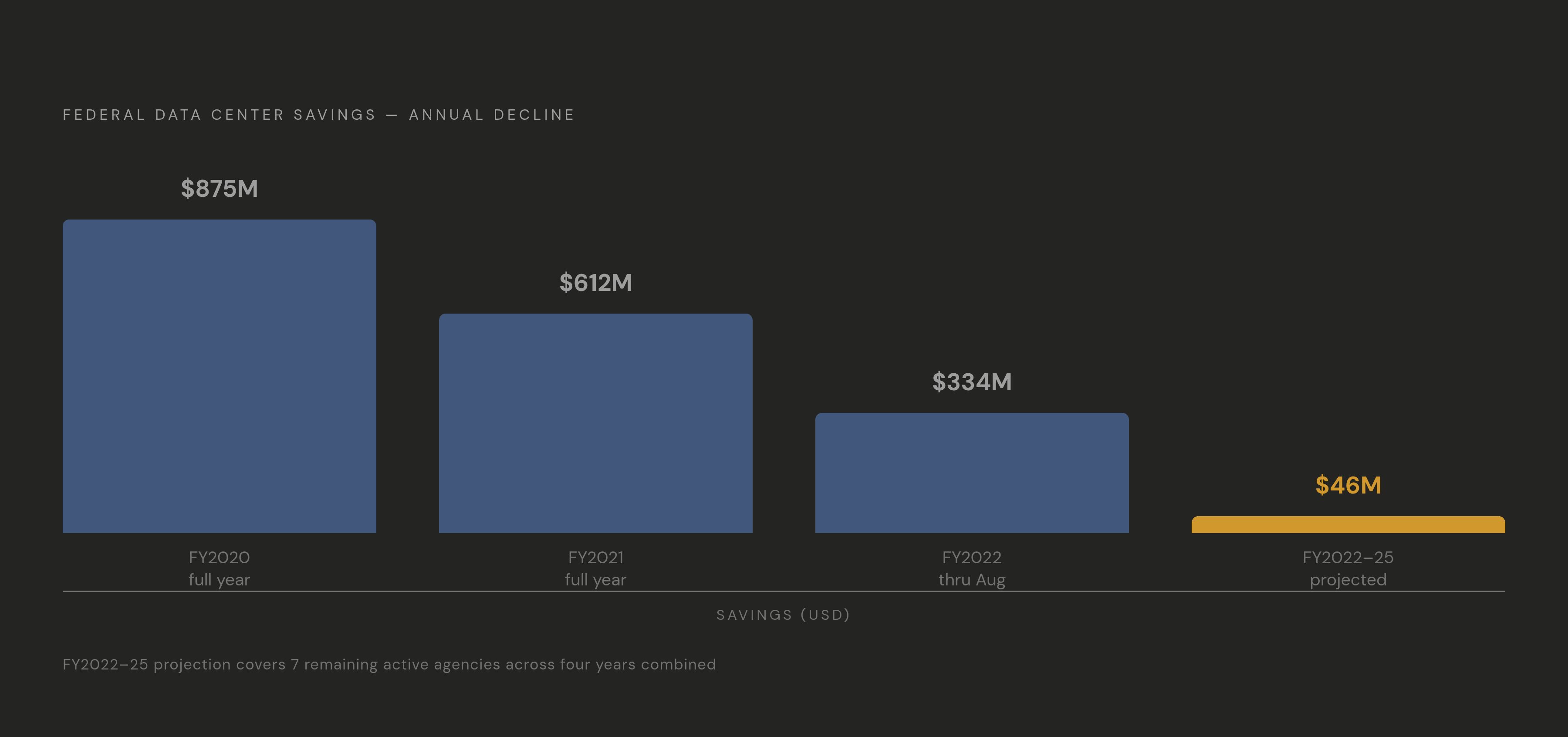
By the later years, the pipeline had become a trickle. Seven agencies reported plans to close 83 data centers across FY2022 through 2025, with projected savings totaling $46.32 million across that entire span. Compare that to the $875.10 million generated in FY2020 alone. The deceleration is not subtle, and it was not surprising to anyone paying attention.
OMB's own assessment acknowledged the straightforward targets were gone. What remains involves more complex facilities, mission-critical systems, and sites with legacy dependencies that make consolidation expensive rather than savings-generating. The easy work was done first, as it always is.
The FY2022 partial-year figure of $334.324 million in savings, identified as of August 2022, was already running below the full-year FY2021 total of $612.326 million. That is a decelerating trend, not a temporary dip.
The HHS experience captures the subtler dimension of what's left. The department closed 49 data centers in FY2022, meeting 100 percent of its planned closure goal. But operating divisions flagged that current funding models don't support utilization-based cloud services. Migration costs don't disappear when you close a data center; they change form. Moving workloads out of owned facilities reduces capital expenditures but introduces ongoing subscription and consumption costs that existing appropriations structures were never designed to accommodate.
This is the real frontier. It is not that agencies stopped wanting to save money. The remaining work requires technical capability and structural budget flexibility that the initiative's original policy architecture did not fully account for, and patching that gap requires changes that go well beyond data center policy.
What the Consolidation Record Reveals About Large-Scale Government Infrastructure Reform
The wins are real. $6.6 billion in documented savings, thousands of facilities closed, and data center consolidation accounting for the majority of all federal IT reform savings during the FDCCI era are not marginal results. They reflect what a sustained, multi-agency infrastructure effort can produce when it is resourced and managed with genuine seriousness over multiple administrations.
But the structural unevenness is the more instructive part of the record. A small number of large agencies with strong CIO leadership drove the preponderance of savings. Median agency performance was considerably weaker. GAO issued 126 recommendations since 2016 to help agencies meet DCOI targets, and agencies implemented 110 of them, a high rate by any reasonable standard. The fact that implementing 87 percent of those recommendations still didn't close all the compliance gaps tells you the recommendations were necessary but not sufficient. There was an execution problem underneath the policy problem.
Definitional and reporting issues persisted throughout: the $2.2 billion underreporting gap, the 2,000 reclassified facilities, the KMF exemption mechanism. Each one reduced visibility into actual progress and complicated accountability in ways the initiative never fully resolved.
The shift to FDCEA in 2023 and OMB's implementing guidance in 2025, with their emphasis on cybersecurity, resiliency, and availability, reflects what the optimization era left on the table. Those are the qualitative dimensions of a data center's value that closure counts and PUE scores never captured. The new framework is trying to measure what the old one systematically ignored.
Here is what this record actually demonstrates about large-scale government infrastructure reform: early phases that target obvious inefficiency can produce substantial, measurable gains quickly because the opportunities are large and the interventions are relatively blunt. Later phases that require sustained operational improvement across dozens of independent agencies, each with its own funding streams, leadership priorities, and mission constraints, are a different problem entirely. They produce slower, less dramatic, and less evenly distributed results, and the agencies that struggle most in those later phases are usually the ones that also struggled earliest.
The federal data center consolidation initiative produced significant aggregate gains, uneven distribution across agencies, incomplete optimization, and a smaller but structurally harder problem at the end. That is the arc. It is also, more or less, the arc of every large-scale infrastructure reform effort I've seen attempted at this scale. The surprise would be if it had gone any other way.