Government Innovation Labs and Internal R&D Capacity
Why governments are building internal R&D labs to escape contractor dependency.

Government innovation labs are not a trend. They are a structural response to a problem that procurement-heavy governments created for themselves over decades: the knowledge leaves with the contractor, the feedback loops are slow, and the institution never learns. Understanding how these labs are built, funded, and operated reveals what it actually takes for a public institution to own its own discovery, and why getting that right matters at a scale most people underestimate.
What a Government Innovation Lab Actually Is, and What It Is Not
Start with what the lab is not. It is not a task force convened to study a problem and write a report. It is not a consulting engagement where external experts arrive with answers. It is not a policy unit whose job is to advise within existing constraints. Those things have their uses, but none of them build lasting capacity inside the institution.
A government innovation lab is a dedicated organizational unit, inside or adjacent to a public institution, with a mandate to experiment with new methods, policies, and services. Three features distinguish it from everything else. First, permanence, at least in intent: a lab is meant to persist across administrations and budget cycles, not dissolve when the project ends. Second, methodological identity: design thinking, behavioral science, data science, systems mapping. The methods are not incidental; they define what the lab does and what it is capable of seeing. Third, and most importantly, a mandate to challenge existing practice rather than just advise on it. That last point is where most imitations fall short.
The OECD Observatory of Public Sector Innovation identifies four orientations a lab can hold: enhancement-oriented, mission-oriented, adaptive, and anticipatory. Some labs hold one clearly; others hold several simultaneously. The boundaries are genuinely blurry. Innovation boxes, FabLabs, internal iTeams, cross-agency digital units — they all overlap with the lab model, and that ambiguity matters because it affects how labs are evaluated and funded. An institution that cannot define what its lab is will struggle to defend it.
What cuts through the definitional fog is this: a lab is a cultural intervention as much as an operational unit. The goal is not to produce outputs inside the lab. The goal is to spread methods into the wider organization until the organization no longer needs the lab to do the work for it — think of it less like a research department and more like yeast: invisible once it has done its job, but essential to the rise. MindLab's director articulated this precisely: "The most important task for public service innovators should be to disseminate the way they work through an organisation." That principle separates labs serious about capacity-building from those running isolated projects and calling it innovation.
The Scale of Public Investment That Gives the Lab Model Its Context
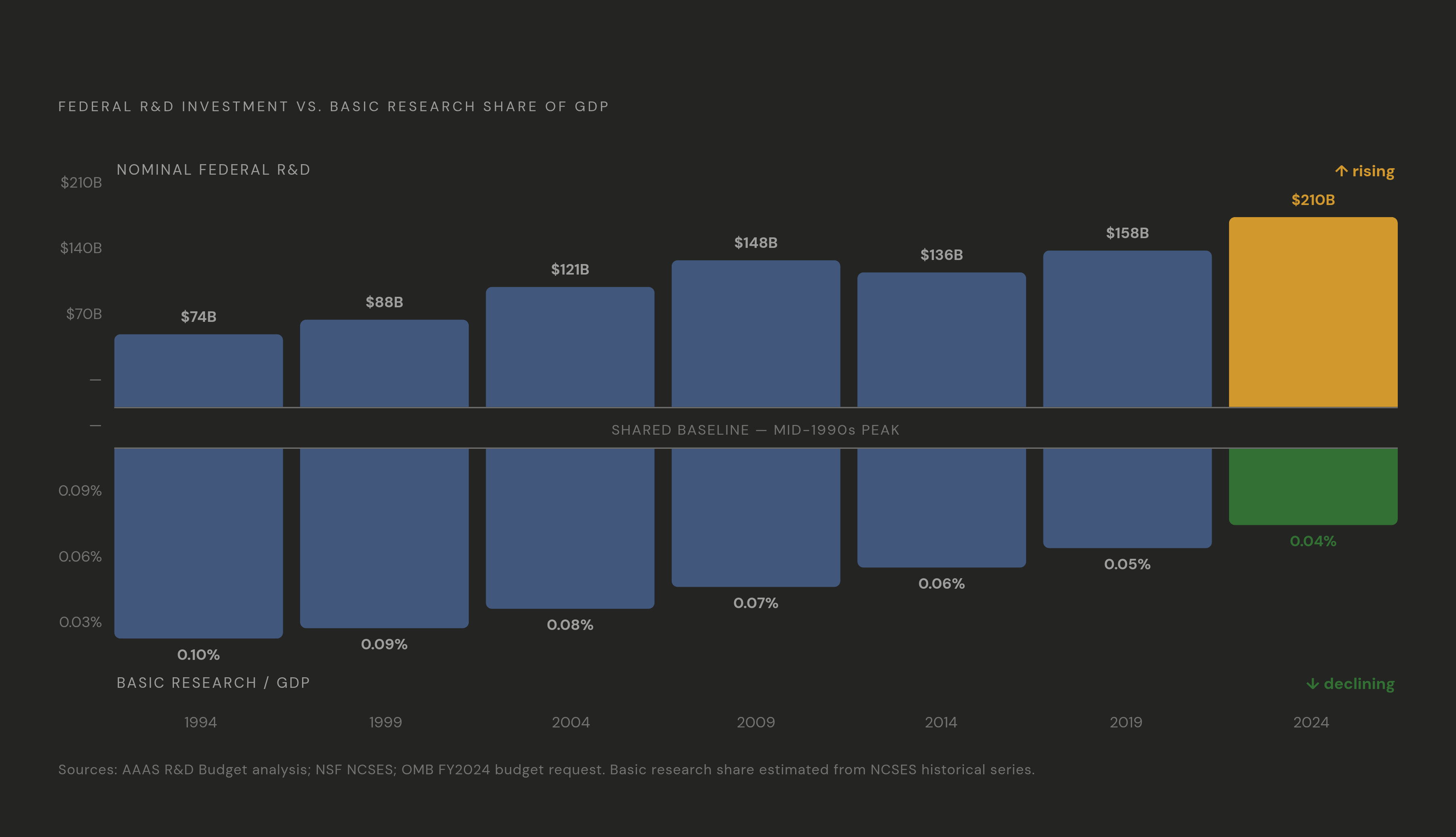
The numbers establish the stakes. U.S. total R&D expenditures are estimated at roughly $993 billion for 2024. The 42 Federally Funded R&D Centers spent $31.7 billion on R&D in FY 2024, up $2.4 billion from the prior year, with federal sources accounting for 98.5% of that spending. That figure has grown from $17.7 billion in FY 2014, an average annual increase of 3.3% in constant dollars — sustained commitment, not episodic enthusiasm. President Biden's FY2024 budget proposed approximately $209.7 billion for federal R&D, nearly $9 billion above the prior year's levels.
Those are large numbers. Here is the tension inside them: since the mid-1990s, government spending on basic research has declined or stagnated as a share of GDP. More total dollars, but shrinking relative ambition for the open-ended, exploratory discovery that labs are often built to do. The headline investment is real. The structural retreat from foundational inquiry is also real.
This is the environment in which internal labs must argue for their existence. Rising nominal investment, declining basic research share, and a public trust deficit that compounds the pressure. OECD data from surveyed member countries found that only about four in ten people trust their national government, and roughly the same share believe government would actually implement an innovative idea in response to public demands. That credibility gap is not just a political inconvenience. It makes internal R&D capacity a political necessity as well as an operational one. A government that cannot visibly learn and adapt cannot credibly ask for continued public investment in its capacity to do so.
How Innovation Labs Are Structured and Where They Sit Inside Government
Placement determines almost everything about what a lab can accomplish. Embed a lab inside a single ministry and it can develop deep subject-matter expertise, but it may lack the cross-cutting authority to change how multiple agencies operate. Place it across ministries and it gains breadth, but risks becoming a coordination mechanism rather than a genuine R&D function. Push it to arm's length and it retains methodological independence, but loses proximity to actual decision-making. Each configuration involves tradeoffs, and the tradeoffs are not hypothetical.
MindLab was deliberately cross-cutting, embedded across three Danish ministries — Business and Growth, Employment, and Children and Education. Its interdisciplinary staffing, combining ethnographers, designers, and public policy specialists, was not accidental. The disciplinary mix signaled the kinds of problems the lab was built to tackle: not technical optimization problems, but complex human systems problems where observation and co-design matter as much as analysis.
The DHS Science and Technology Directorate operates at a different scale entirely, spanning national laboratories, a Silicon Valley innovation program, and university-based Centers of Excellence. That federated model distributes the work across institutional contexts, trading coherence for coverage. The Stanford RegLab is university-anchored, collaborating with agencies rather than owned by them, a hybrid that preserves methodological independence while allowing sustained engagement with real government operations.
The DOE National Laboratories offer perhaps the clearest structural lesson. Organized around defined missions, including clean energy deployment, they convene across the Office of Science and Innovation, the labs themselves, and industry partners with a specific problem as the organizing principle. That is the structural logic that prevents diffusion: a lab organized around a defined problem can be held accountable; a lab organized around a general remit for "innovation" cannot.
What Methods Government Innovation Labs Actually Use
The core toolkit is well established: design sprints, randomized controlled trials, pilot programs, behavioral science, systems thinking, participatory design. What varies is how rigorously any given lab applies them, and whether those methods connect to real decision-making or stop at the presentation.
Latvia's InLab provides a concrete illustration of methods at scale. Working with OECD OPSI assistance, the lab tested 47 prototypes or solution designs and involved over 300 people in design sprints. It set specific KPIs for operational capacity benchmarked to 2026, and reached and exceeded them ahead of schedule. That is not a large program in absolute terms, but it demonstrates something important: methodological rigor combined with external accountability frameworks produces measurable results, and those results can be communicated in terms that bureaucratic institutions actually understand.
Randomized controlled trials and structured pilot programs deserve particular emphasis. They impose a discipline on the lab that design sprints alone do not. Testing a policy idea before full implementation, identifying failure modes early, measuring actual effectiveness rather than stakeholder satisfaction with the process: these practices distinguish evidence-based labs from sophisticated consultation exercises. The difference matters most when a lab needs to justify continued investment to skeptical leadership.
Citizen co-design has gained traction both as a method and as a political signal. Seoul's Innovation Bureau co-designs public services with citizens directly; participatory budgeting and citizen assemblies are emerging as tools for generating both insight and legitimacy. The political dimension is not secondary: a lab that demonstrably involves the public in service design has an argument for its own credibility that a purely internal R&D function does not.
One underappreciated output channel is technology licensing. Research on software companies found that a substantial majority of those surveyed had licensed technologies from multiple government labs in the past three years. That is a concrete, often untracked mechanism through which lab work creates durable economic value, and it suggests that lab output metrics focused only on internal process changes are systematically undercounting impact.
How AI and Digital Infrastructure Are Reshaping What Labs Need to Do
The capacity gap is real and widening. Public sector agencies frequently operate on outdated digital infrastructure, within legal frameworks that were not designed for rapid technology adoption, and without the internal competencies to govern the technologies they are being asked to deploy. That was a manageable problem when technology cycles moved slowly. It is not manageable when artificial intelligence adoption is anticipated at scale within one to two years, which is precisely what a 2025 survey of state and local government respondents found.
The federal government has begun directing resources at this directly. The FY2025 federal budget included $200 million in mandatory R&D funding specifically allocated to using AI to accelerate scientific research across multiple agencies. That funding signal reflects where the government sees AI fitting in its broader R&D strategy: not as a back-office efficiency tool, but as a method for accelerating discovery itself.
Stanford RegLab has framed the problem directly: the public sector increasingly lacks the capacity to build and implement technology initiatives, let alone respond to the pace of AI development. Their model, collaborating with agencies on demonstration projects and AI adoption questions rather than simply advising from the outside, is one response. UNESCO and Oxford's effort, a MOOC on AI and digital transformation in government that enrolled over 30,000 civil servants from 190 countries, signals the scale of the skills deficit and the recognition that procurement alone cannot close it. You cannot buy your way into institutional competence — or as the saying goes, you can outsource the work, but you can't outsource the knowing.
For innovation labs specifically, AI fundamentally expands the internal capacity they are expected to build. A lab that was organized around design thinking and behavioral science now also needs data science, machine learning governance, and digital infrastructure expertise. That is not a modest expansion. It requires different hiring, different partnerships, and different accountability frameworks. Labs that fail to make that transition will find themselves advising on AI adoption from the outside, which is precisely the posture the lab model was designed to replace.
The Recurring Failure Mode: Innovation Theater and Why Labs Lose Their Grip
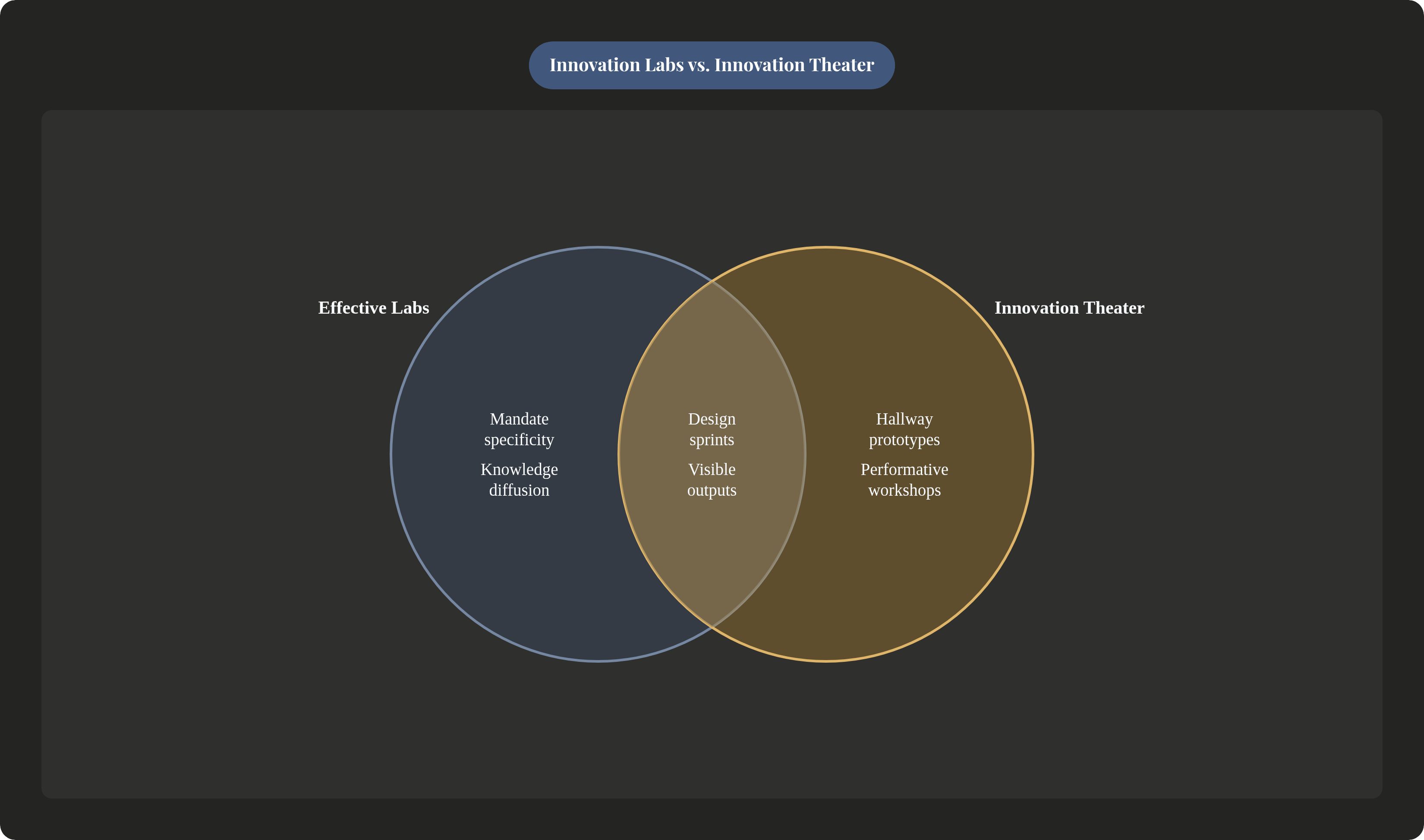
Innovation theater is the term researchers use for what happens when a lab performs the activities of innovation without producing its effects. Workshops are run. Sprints are celebrated. Prototypes are displayed in hallways. Leadership points to the lab as evidence of organizational modernity. And the organization continues to operate exactly as it did before. The theater is not always cynical; sometimes it reflects genuine effort by people who lack the authority or the organizational access to move from prototype to implementation.
The dynamics that produce theater are structural, not just cultural. A lab placed too far from decision-making loses its ability to get ideas implemented. A lab placed too close loses the critical distance to challenge existing practice. That is a genuine dilemma with no clean resolution; the best labs navigate it through deliberate relationship-building rather than structural position alone. They earn proximity by demonstrating value, not by demanding it.
MindLab's closure in 2018 remains the defining cautionary case. One of the first and most influential public sector innovation labs in the world, respected internationally, operationally sophisticated. It did not survive. Institutional influence is not the same as institutional protection. A lab that has become a reference point for the global innovation community can still be closed when its internal coalition erodes or its funding rationale becomes difficult to defend in a budget conversation.
The OECD OPSI has noted plainly that innovation labs cannot do it all. The danger of over-scoping is real: being asked to address systemic challenges, climate, inequality, institutional trust, without systemic authority or resources is a recipe for producing outputs that satisfy no one and change nothing. The mandate that makes a lab visible also makes it vulnerable to becoming a dumping ground for problems that the rest of the organization has failed to solve.
What Distinguishes Labs That Build Lasting Internal Capacity From Those That Don't
The differentiating factors are not mysterious. They are just hard.
Mandate specificity creates accountability. A lab organized around a defined problem, clean energy deployment, measurable public sector capacity milestones, quantifiable service improvements, can be evaluated against something real. A lab with a general mandate to foster innovation cannot. Specificity is uncomfortable for administrators who want flexibility, but it is the condition under which a lab can demonstrate that it earns its place.
Deliberate knowledge diffusion is the lab's core obligation, and the one most frequently deferred. MindLab's founding principle was that the lab's job is to change how the organization works, then become partially redundant. Labs that hoard their methods because diffusion would make them less essential are working against their own stated purpose. The measure of a lab's success is not how indispensable it has become, but how much of what it knows has moved into the wider institution.
Cross-disciplinary staffing held over time is a structural requirement, not a hiring preference. The combination of policy expertise, design skills, and data science cannot be assembled on demand. It requires sustained investment in recruiting and retention against private sector compensation structures that government cannot easily match. Institutions that treat lab staffing as a budget line item to be optimized will consistently underinvest in the human capital that makes the lab function.
Political protection that does not depend entirely on a single champion is the survival condition that labs most often fail to engineer for themselves. Labs that have built broad coalitions of internal users, or embedded themselves in statutory functions rather than discretionary programs, survive ministerial turnover. Labs that exist because one senior official valued them tend to disappear when that official moves on.
External partnerships, the university-anchored model that Stanford RegLab and the World Bank GovTech approach represent, offer a hedge. They provide methodological independence, credibility, and a source of sustained intellectual investment that can outlast internal political fluctuations. They are not a substitute for genuine internal capacity, but they are a meaningful supplement to it.
The broader OECD finding holds: governments that build internal R&D capacity demonstrate inclusiveness, reliability, and responsiveness to citizens — the precise qualities that shift the trust gap that opens this analysis. The lab model is not a communications strategy for a skeptical public. It is a production function for the institutional competence that earns trust back, slowly, through demonstrated results. There is no shortcut to that, and no substitute for doing the work from the inside.