Rural Business Development Grants for Local Government Technology Projects
Federal grants can fund rural broadband projects local budgets cannot afford alone.
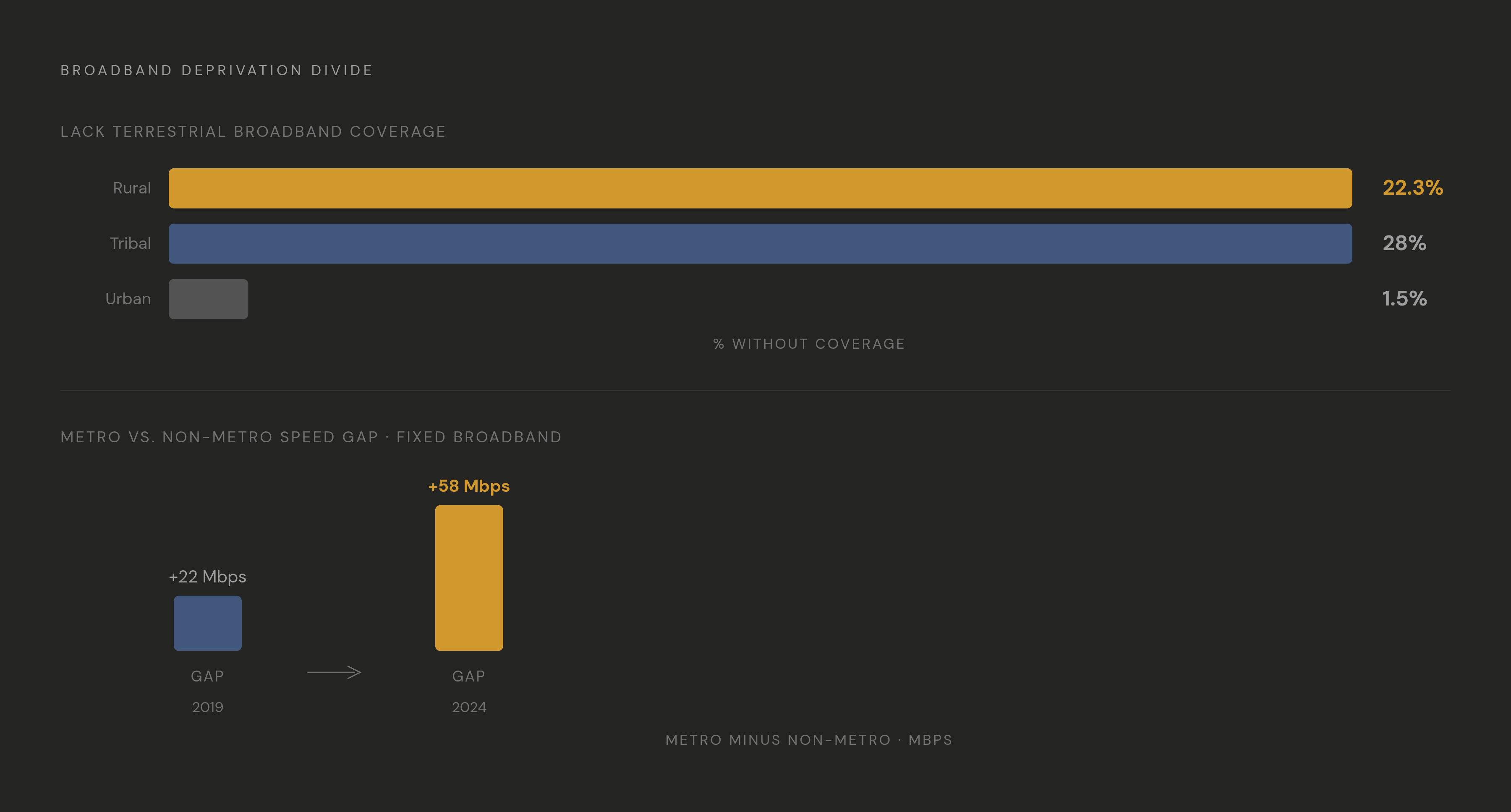
The rural digital divide keeps widening, and USDA's own numbers say so: 22.3% of rural Americans lack terrestrial broadband coverage versus 1.5% in urban areas, a stark gap between the two. This piece walks through one specific tool local governments have to fight that gap, the Rural Business Development Grant, and how to actually win one instead of just applying for one.
Ookla found that despite overall gains in broadband availability, the urban-rural access gap actually grew in 32 states during the second half of 2024. That's the country building broadband faster in places that already have it. The OECD tracked something similar on the speed side: the fixed broadband speed gap between metro and non-metro areas widened from 22 Mbps to 58 Mbps between 2019 and 2024, and whatever momentum exists in closing this gap, it's not evenly distributed, with rural communities losing ground even as national averages tick upward.
Part of the reason is boringly simple: fiber costs money to bury or hang, and rural geography makes the math worse. Aerial fiber installation runs $40,000 to $60,000 per mile in rural areas as of 2025 estimates, and underground installation costs more still, so a small town with a shrinking tax base and three thousand residents cannot self-fund a multi-mile fiber build. So the money has to come from somewhere else, and increasingly, that somewhere else is a federal grant program most local officials have never heard of.
The stakes are concrete. A 2025 Connected Nation report ties $47 billion in lost rural business revenue annually to connectivity gaps, and puts one-third of rural American households in a state of internet insecurity, which carries real weight beyond streaming habits on a Friday night. Local government services, permitting, public records, emergency dispatch, benefits access, all carry digital dependencies now, which means a broadband gap is also a governance gap. Private capital won't build fiber where the return doesn't pencil out, and local budgets can't cover what private capital skips. That's the gap RBDG exists to fill, at least partially.
What the Rural Business Development Grant program actually is and who runs it
RBDG is run by USDA's Rural Business-Cooperative Service, a Rural Development agency, and it works differently from a formula grant. There's no per-capita check that shows up automatically, and getting money means beating other applicants on a scored application rather than filling out a form correctly. It's competitive, re-solicited every year through a Notice of Funding Opportunity published in the Federal Register.
FY 2025 funding for the whole program came in around $30 million total, which sounds like a lot until you remember it's split across every eligible rural community in the country. For FY 2026, the deadlines split by applicant type: June 15, 2026 for Strategic Economic and Community Development applications only, and June 30, 2026 for everyone else. The performance period runs June 1, 2026 through September 30, 2028, but here's the catch that trips people up: projects need to reasonably wrap within one year of starting, regardless of how long the performance window technically stays open.
Award sizes run from $10,000 to $500,000, and USDA gives priority points to smaller requests. Read that twice, because it inverts what most people assume about grant writing. A well-scoped modest project competes better than an ambitious $400,000 one, because the scoring rewards modesty and feasibility over scale, and communities that understand this can target a smaller first-cycle project, win it, build a track record, and come back for something bigger later. There's no regulatory floor or ceiling written into the rules, so the flexibility is real; it's just that competition, not regulation, ends up setting the practical range.
Which local governments are eligible and which geographies qualify
Eligible applicants include states, counties, cities, townships, incorporated towns and villages, boroughs, authorities, districts, and Indian tribes on federal and state reservations. Nonprofit corporations serving rural areas can apply too, though individuals and for-profit businesses cannot, regardless of project quality.
Geographic eligibility hinges on one test: does the project benefit a rural area or a town outside the urbanized periphery of any city with 50,000 or more people? That's a project-level test tied to a specific population threshold, and it trips up a surprising number of applicants near mid-sized metros who assume "rural" is self-evident. If your county touches the edge of a growing city, you need to document, with actual maps and population data, that the benefit lands on the rural side of that line and doesn't just spill into the suburbs.
Indian tribes on federal and state reservations are named explicitly as eligible applicants, and this matters more than a compliance footnote suggests: nearly 28% of residents on Tribal lands lack terrestrial broadband coverage, a gap even steeper than the rural average. For any local government thinking about applying, the first move is calling the state or local USDA Rural Development office to confirm geographic eligibility before writing a single word. State offices sometimes layer on additional local priorities that never show up in the national funding notice, and skipping that call is how applicants waste months on a project that never had a shot.
How the two grant types divide, and which one fits technology projects
RBDG splits every award into two buckets: Enterprise grants and Opportunity grants. The eligible uses differ in ways that should shape how you design the project from day one.
Enterprise grants have to benefit small and emerging rural businesses directly. Eligible uses include training and technical assistance, market research, feasibility studies, professional and technical reports, land and building acquisition, construction and renovation, and equipment and infrastructure. For technology projects, the equipment acquisition and infrastructure categories are where the fit lives, particularly hardware or connectivity build-outs tied to a specific business benefit.
Opportunity grants are where most local government technology projects actually belong. Eligible uses explicitly include technology-based economic development, business support centers, leadership and entrepreneur training, feasibility studies, business plans, and long-term strategic planning. Rural distance learning for job training and adult students qualifies too, along with rural transportation improvement and community economic development. Digital skills programs, broadband feasibility studies, technology planning efforts, community-facing platforms: all of it maps cleanly onto Opportunity grant categories.
So how do you pick? If the project delivers technology infrastructure that directly serves rural businesses, that's Enterprise, and if it delivers planning, training, strategy, or distance learning, that's Opportunity. Plenty of technology projects could go either way depending on how you scope and frame the beneficiary, which means this decision belongs at the design stage, not as an afterthought you bolt on while filling out the application form.
So the money has to come from somewhere else, and increasingly, that somewhere else is a federal grant program most local officials have never heard of.
Which technology project types score well under RBDG criteria
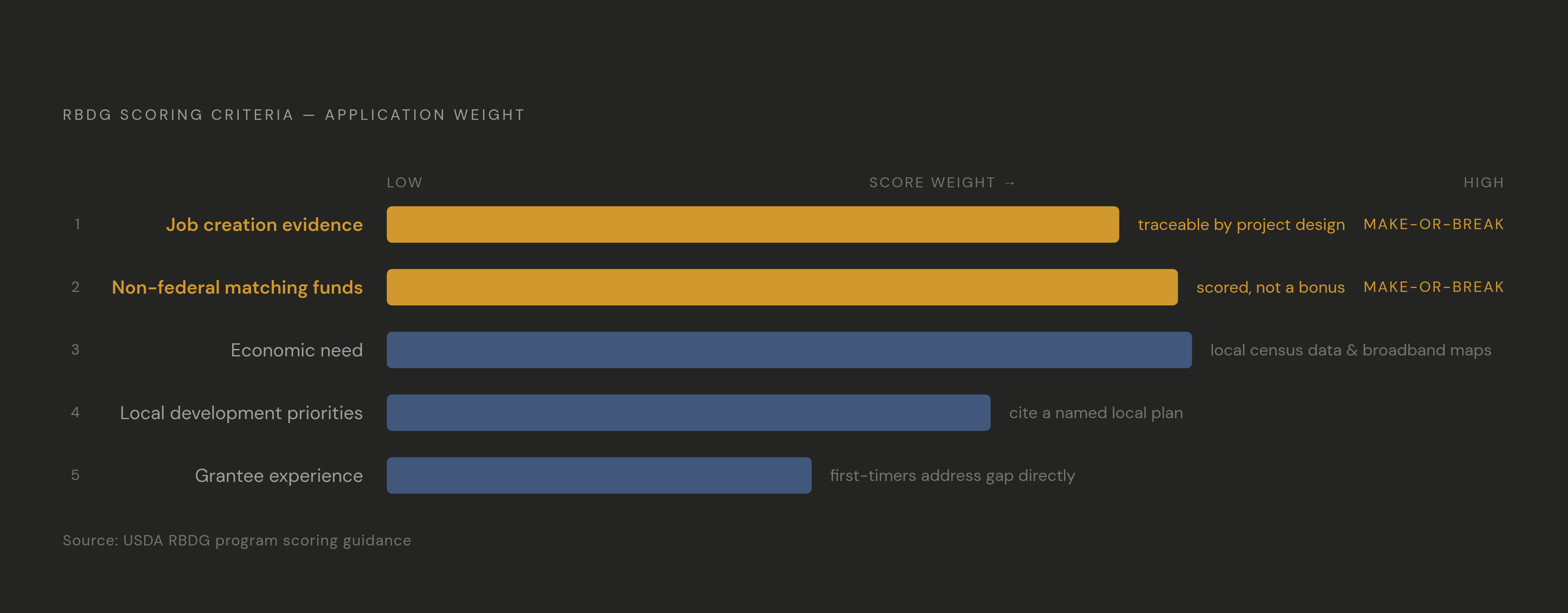
USDA scores applications on five things: job creation evidence, the percentage of non-federal matching funds committed, economic need in the service area, consistency with local economic development priorities, and the grantee's experience running similar projects. Some technology project types happen to hit several of these at once, which is worth noticing before you design your own.
Broadband feasibility studies and community technology assessments are cheap relative to their strategic payoff. They map directly onto the "economic need" and "long-term planning" scoring categories, and they often function as a first-cycle project that unlocks a bigger award down the road. Digital skills and workforce training programs carry a strong job creation argument, since employment outcomes for adult learners are traceable in a way infrastructure spending often isn't, and they qualify explicitly under the rural distance learning category. Local unemployment data and documented digital skills gaps can back up the economic need claim without reaching for a national statistic that doesn't describe your county.
Technology-based business incubators and support centers combine business support infrastructure with a built-in job creation story, and they're named explicitly in the Opportunity grant eligible uses list. Telehealth and distance learning platform buildouts carry a strong economic need argument anywhere healthcare or educational access is thin, and they sometimes overlap with the Distance Learning and Telemedicine grant program covered later in this piece.
The matching funds criterion rewards applicants who've already lined up non-federal money before they apply. A utility partnership, a foundation grant, a state co-funding commitment, any of these signal to reviewers that other parties believe in the project enough to put money behind it, and a meaningful match reads as credibility, not just arithmetic. The "grantee experience" criterion tends to favor governments with a track record administering grants before, which means first-time applicants need to address that gap head-on in the narrative rather than hope reviewers don't notice.
One real example worth studying: Easterseals Wisconsin received a $39,900 grant to provide technical assistance across 47 counties, covering feasibility screening, feasibility studies, and business plan development. It's a technology-adjacent project, modest in size, and it projected five job creation outcomes, a small ask with a clear scope and traceable jobs. That's the formula.
How to build an application that competes: the strategic choices that determine outcomes
Start at the local USDA Rural Development office, not the federal website. State and local offices set concept paper requirements, run their own timelines, and sometimes apply scoring priorities that never appear in the national funding notice. Calling early also signals that your organization takes the process seriously, which quietly feeds into the grantee experience score later.
SAM.gov registration is a prerequisite, and it is not instant, and neither is any required grants.gov registration. Both are free, but applicants who wait until the deadline to start registering routinely miss the deadline entirely, which is a genuinely costly way to lose a grant you never actually competed for.
Scope the project toward a smaller award on purpose. USDA regulation gives priority points to smaller requests, so a modest feasibility and planning project can outcompete a $300,000 infrastructure ask on scoring alone, and still lay the groundwork for a bigger follow-on application next cycle. Document economic need with local numbers: census poverty rates for the specific service area, local unemployment figures, broadband availability maps that show your county, not the national average. Letters from local businesses describing the actual technology barriers they face carry more weight than a paragraph of statistics ever will.
Build the job creation narrative into the project's design before you write a word of the application, because reviewers look for evidence of job creation and that evidence has to be traceable by design. A digital skills training program can count job placements, and a business incubator can count businesses launched or positions filled. Retrofitting a jobs narrative onto a project that wasn't built to produce one rarely convinces anybody.
Secure matching commitments before submission, since the match percentage is scored, not treated as a bonus, and even a modest share from a local utility partner, county fund, or community foundation strengthens the application in a way that's hard to fake after the fact. And frame the whole project within the community's existing economic development plan. "Consistency with local economic development priorities" is a scored line item, and applications that cite a specific local plan by name score noticeably better than ones presenting the idea as if it appeared out of nowhere.
Three other USDA programs that cover what RBDG doesn't
RBDG isn't the only door here, and it's worth knowing when a different program fits better before you force a project through the wrong application.
The Distance Learning and Telemedicine Grant Program has roughly $27 million available in FY 2026, with awards ranging from $50,000 to $750,000, a higher floor and ceiling than RBDG's typical range. It funds audio and video equipment, network infrastructure, computer hardware, and broadband facilities for remote learning and telemedicine. Local governments, tribal governments, educational institutions, rural health care providers, and nonprofits can all apply, targeting rural areas with populations of 20,000 or fewer. The catch is a 15% cash matching requirement: a $500,000 request needs $75,000 in documented match, a $750,000 request needs $112,500. Applications are due June 30, 2026, and the competition is real, with 290 applications requesting a combined $172 million coming in during FY 2025, and 81 funded, roughly one in three or four applicants.
Community Connect is part of a combined $44 million rural broadband package alongside DLT for FY 2026. It's built for the least-connected communities, places where even basic broadband service isn't yet available, and it focuses on broadband infrastructure deployment at a scale RBDG simply doesn't fund.
The Rural Economic Development Loan and Grant Program combines grants and loans and is the right fit when a technology project has a capital investment component too large for RBDG, or when a loan structure makes more sense than competing in a grant cycle.
Put simply: technology planning, workforce training, and feasibility work belong with RBDG's Opportunity grants. Telehealth platforms and distance learning AV systems belong with DLT. Broadband deployment in unserved communities belongs with Community Connect. Larger capital projects needing loan financing belong with REDLG. None of these are mutually exclusive, and a local government can pursue an RBDG planning grant while simultaneously applying to Community Connect for the infrastructure that planning grant is designed to justify.
What a successful RBDG technology project actually looks like in practice
Strip away the acronyms and scoring criteria, and the pattern in successful RBDG technology projects is consistent: modest ask, sharply defined scope, a job creation story that was built in from the start rather than added later, and at least some non-federal money already committed before the application went in. The Easterseals Wisconsin award is a useful template precisely because it wasn't flashy. Forty thousand dollars, 47 counties, a clear feasibility and planning scope, and five projected jobs, a shape that nobody would mistake for a broadband backbone project, but that was never the point.
That raises an obvious question for any local government reading this: does your technology idea actually need $500,000 in year one, or does it need $50,000 to prove the concept, gather the data, and build the case for something bigger in year two? RBDG rewards the second instinct over the first, given how the reviewing criteria are weighted. It's a program built for communities willing to walk before they sprint, and that patience is the strategy that wins.
Sources
- https://www.federalregister.gov/documents/2024/10/18/2024-20344/notice-of-solicitation-of-applications-for-the-rural-business-development-grant-programs-for-fiscal
Provided the FY 2025 total program funding figure of $30 million cited in the program overview section.
- https://www.rd.usda.gov/programs-services/business-programs/rural-business-development-grants
Served as the primary USDA program page describing RBDG structure, eligible applicants, and grant types.
- https://www.rd.usda.gov/newsroom/news-release/rural-business-development-grants-open-applications
Provided the real-world Easterseals Wisconsin award example, including the $39,900 grant amount and 47-county scope.
- https://files.simpler.grants.gov/opportunities/e407af15-6c31-41de-80ac-3ffcaf61ea88/attachments/fdbefa93-dca7-4dcd-972b-5a3eb83eaadb/RBDG_FY26_NOFO_Grantsgov_Final.pdf
Sourced the FY 2026 application deadlines, performance period dates, and eligible use categories for Enterprise and Opportunity grants.