Participatory Budgeting in Municipal Government
How Porto Alegre's experiment in direct democracy spread globally—and what gets lost in translation.
Porto Alegre, Brazil, 1989. The Workers' Party had just won power in a city still finding its footing after decades of military dictatorship, and they were staring down two problems at once: a deeply inequitable distribution of municipal resources, and a public with every rational reason to distrust government. Their answer was to ring-fence roughly 10 percent of the municipal budget and hand residents actual decision-making authority over where it went, with an explicit mandate to redirect funds toward low-income communities. Participation was the mechanism. Redistribution and anti-corruption were the goals.
That dual purpose is not a footnote. PB was never designed as participation for its own sake. It was an instrument for building democratic legitimacy through transparency, and for structurally inverting budgetary priorities that had long favored wealthier neighborhoods. Cities that adopt PB today as a community engagement initiative, stripped of its redistributive intent, are working from a partial reading of the original design. They've kept the form and discarded the substance.
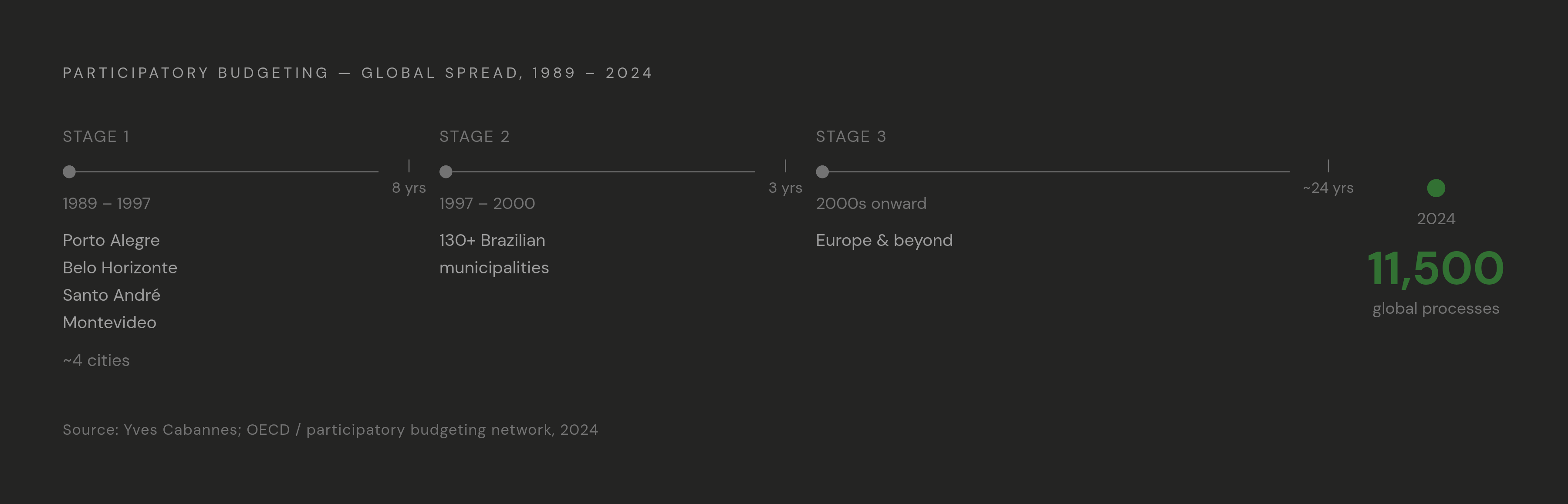
Researcher Yves Cabannes documented three distinct stages of PB's evolution. The first, from 1989 through roughly 1997, was a period of genuine experimentation, confined largely to Porto Alegre and a handful of other cities: Belo Horizonte, Santo André, and Montevideo. The second stage, from 1997 to 2000, saw adoption spread to over 130 Brazilian municipalities. By the third stage, PB had crossed continents, landing in European cities and being adapted to wildly different political and institutional contexts.
Porto Alegre eventually saw its own program decline, undone by shifting political support. The model survived its birthplace by spreading everywhere else, which tells you something important about the model's fundamental vulnerability. PB is structurally dependent on sustained political will. When that will evaporates, the process hollows out, no matter how elegant it looks on paper.
How a PB process moves from community ideas to funded projects
A PB cycle moves through a recognizable sequence. Community meetings or neighborhood assemblies surface resident needs and ideas. Those ideas get developed into concrete proposals, which city staff review for technical feasibility and cost. A refined shortlist goes back to the public for deliberation. Residents vote. Winning projects get funded and implemented, and the city reports publicly on progress. Then the cycle begins again.
The deliberation phases are what separate PB from a simple ballot. Residents aren't just ranking preferences in isolation; they're negotiating priorities with each other, often across lines of income, neighborhood, and competing interest. That process of collective reasoning is where much of PB's civic value actually lives, not in the vote itself. The vote is the punctuation mark. The deliberation is the sentence.
Budget scope varies considerably. Porto Alegre started at approximately 10 percent of the municipal budget. Paris allocates 5 percent of total city spending. Many programs work with far smaller allocations, sometimes a designated pool within a single council district or agency.
Voting formats differ just as widely. Some cities use approval voting, where residents select multiple projects up to a specified cap. Rome and Toulouse cap selections at three projects; Montreal and Cambridge, Massachusetts, allow up to five; Warsaw allows residents to support up to fifteen. Paris made a particularly notable eligibility decision: any resident over age seven, regardless of nationality, can propose and vote. That's not a quirky administrative choice. It is a direct expression of the founding logic. If the goal is to reach people typically excluded from civic processes, you build the eligibility threshold accordingly, and you stop pretending that citizenship is a prerequisite for having a stake in your own neighborhood.
How far PB has spread and what that growth actually represents
The scale of PB's adoption is genuinely striking. As of 2024, over 11,500 municipal PB processes had been implemented globally, up from roughly 1,500 municipalities and institutions in 2014. Countries including Bolivia, Peru, Guatemala, Nicaragua, and the Dominican Republic have implemented PB across all local governments. Portugal, France, Italy, Germany, and Spain have city-level processes. In Canada, PB has been used in public housing, schools, and neighborhood groups across Toronto, Guelph, Hamilton, and West Vancouver. In the United States, at least 64 cities and counties, 258 districts or wards, and over 260 schools have run PB processes, allocating over $360 million in total. In 2024, the European Union recognized PB as a pathway to inclusive and transparent governance.
The growth figures require honest interpretation, though. The range in scale, budget share, and process integrity across those 11,500 cases is enormous. The count measures instances, not equivalent implementations. Some of those programs carry genuine binding authority over meaningful budget shares. Others are labeled PB while functioning closer to the advisory processes PB was designed to replace.
Legal status is a significant variable here, and not enough people talk about it plainly. Some countries mandate PB by law, which structurally reinforces the binding character of outcomes. Others run it as an internally arranged, optional initiative, which means the commitment to implementation rests entirely on the current administration's goodwill. Those are fundamentally different arrangements, even when they share a name and a logo.
What PB looks like in practice across a range of cities
Paris runs the largest PB program in the world. Since launching in 2014, it has allocated 5 percent of total city spending through the process, resulting in more than 21,000 ideas submitted, 1,345 projects funded, and approximately €768 million spent, including €263 million directed specifically to low-income districts. In the 2025 edition, 261 projects were proposed, 104 were selected, and a record 162,395 residents voted.
Seattle's program took shape under distinct circumstances. Launched in 2020 following widespread protests after the murder of George Floyd, it directed $27.25 million explicitly toward BIPOC community needs. Projects selected for the 2025 and 2026 budget included $2 million for mental health crisis response, $4 million for urban farming and food equity, and $7.2 million for a Native-focused youth and community center. The process was explicitly corrective in its design, not generic. That distinction matters for understanding what PB can accomplish when the redistributive logic is honored rather than quietly set aside.
New York City's approach is more fragmented. In 2024, 24 Council Members used PB to allocate $24 million in capital funding for schools, parks, and libraries. Separately, the NYC Civic Engagement Commission allocated $3.5 million through its own process. The programs operate in parallel, with different rules, different institutional homes, and different scopes.
Cambridge, Massachusetts, has sustained its program since 2014, allocating over $10.5 million across 79 projects across eleven cycles. In the eleventh cycle, over 1,300 resident ideas were submitted for a $1 million allocation. That iterative continuity is itself a signal: residents have learned to take the process seriously because the city has kept its side of the commitment, cycle after cycle. Consistency builds credibility in ways that even the most well-funded single-year initiative cannot.
Boston formalized its program more recently, establishing an Office of Participatory Budgeting by ordinance in spring 2023. Its first citywide initiative, "Ideas in Action," launched in 2024 with a $2 million allocation, over 1,200 project ideas, and approximately 4,450 votes.
What these cases collectively demonstrate is that there is no single PB template. Budget size, eligibility rules, issue focus, and institutional home vary widely across programs. The shared commitment, when the process is functioning as intended, is straightforward: resident votes produce funded, implemented outcomes.
How PB is designed to reach residents that standard civic processes miss
PB's equity orientation isn't a feature that was added later to make the process more palatable. It's foundational. Porto Alegre designed it in from the start, with the explicit goal of inverting budgetary priorities that had chronically underserved low-income communities. Every well-designed PB program since has inherited that logic, even when adapted to different contexts.
Broad eligibility is the most visible expression of this commitment. Including non-citizens, minors, and non-registered residents in voting and proposal processes directly extends the franchise to populations that existing civic infrastructure systematically excludes. Paris's age-seven threshold and Taiwan's processes designed specifically for migrant workers are examples of this logic taken seriously, not used as a talking point.
Targeted budget set-asides do similar work at the funding level. Paris reserved a significant portion of its total allocation specifically for low-income districts. Seattle's entire program was targeted at communities historically underserved by public investment. These are structural choices that determine where money actually flows, which is the only thing that ultimately matters.
Youth-specific PB processes have emerged in cities including Medellín, Boston, Rosario, and Cluj, recognizing that young people require purpose-built on-ramps rather than access to processes designed for adults. Rosario, Argentina, went further: beginning in 2002, it embedded explicit gender parity goals into the process and used PB as a vehicle to build participants' sensitivity to the gendered impact of spending decisions. That's not a flourish. That's a different theory of what civic participation is for.
Rhode Island's 2024 PB report framed its goals explicitly around health equity, using Social Determinants of Health as an evaluative framework and targeting projects toward low-income communities of color most likely to experience health inequity. Qualitative research with public managers corroborates what these design choices suggest: when equity is built into the architecture of a PB process, it can produce meaningful outcomes for marginalized groups, including support for homeownership, increased civic participation, and additional education funding.
None of this is automatic. Without deliberate design choices oriented toward inclusion, PB defaults toward whoever already participates in civic life. The process amplifies existing participation patterns as readily as it disrupts them. That's not a theoretical risk; it's what the evidence shows when programs cut corners on outreach and eligibility.
What digital platforms enable — and what they can't solve
Digital platforms solve a real and specific problem for PB: purely in-person assemblies have physical limits on scale and accessibility. Moving proposal submission, deliberation, and voting online allows participation to happen asynchronously, at residents' convenience, without requiring time off work or childcare arrangements. At sufficient scale, this enables something closer to collective intelligence, where a diverse group of participants can, in aggregate, surface community priorities that no individual expert or official would have identified alone.
Decidim, the open-source platform initially developed by the Municipality of Barcelona, is among the most widely adopted tools for this purpose. It's highly customizable and not proprietary, which matters for governments concerned about vendor lock-in. Municipalities worldwide use it to run consultations, deliberations, and full PB processes.
But digital tools are an amplifier, not a solution. They scale participation where access already exists and deepen exclusion where it doesn't. Residents without reliable internet access, devices, or digital literacy are systematically disadvantaged when PB moves primarily online, and those residents are frequently the same populations the process was designed to reach. That irony isn't lost on practitioners who've watched well-intentioned digital migrations quietly gut participation among the communities they were supposed to serve.
São Paulo offers a stark illustration. In its 2025 PB edition, only 6,070 votes were recorded, down 86 percent from 43,000 in 2021. Cited factors include inadequate digital access among marginalized groups and insufficient government outreach. The technology didn't cause the problem. The assumption that technology was sufficient to maintain inclusive participation did.
Where PB runs into trouble: participation gaps, implementation failures, and the scope problem
In São Paulo's 2025 cycle, only about 0.05 percent of the city's population participated, and proposals dropped 31 percent over the five-year period from 2021 to 2025. Distrust in the process, compounded by digital access barriers and low government publicity, eroded the legitimacy that PB requires to function. The residents who show up, even in well-designed processes, tend to be those already predisposed to civic participation, which means PB can end up reproducing the very participation gaps it was built to close. That's a real problem, and acknowledging it doesn't undermine the model; it clarifies the conditions under which the model works.
Post-vote implementation failures are particularly corrosive. When residents vote for a project and then watch it fail to materialize because of cost overruns, safety reviews, or administrative delays discovered after the vote, the message received is that the process was a promise that went unfulfilled. Every implementation failure makes future participation harder to justify. Residents aren't naive; they remember.
The tokenism risk is closely related. Where PB is designed or administered as a symbolic exercise rather than a genuinely binding process, trust gains are weaker or absent. Research on government trust finds that increases come specifically from residents perceiving real influence and being able to monitor implementation and track spending. Remove those conditions and you have a well-branded consultation, not participatory budgeting.
The scope problem is structural. Durham, North Carolina, engaged over 12,000 residents in a PB process allocating $2.4 million. The city's total budget exceeds $900 million. At roughly 0.2 percent of total spending, the enthusiasm and legitimacy gains from PB are real, but transformative fiscal impact is unavailable at that scale. The process builds civic capacity and accountability habits. It does not, at current scales, fundamentally reshape municipal finance. Anyone claiming otherwise is overselling.
Elite capture is a less-discussed failure mode but a genuine one. When proposal development favors groups with existing organizational capacity, well-connected community organizations and politically active residents can effectively pre-sort the outcome before voting begins. The process looks participatory while reproducing existing power distributions. It's the civic equivalent of a consultation designed to ratify a decision already made.
Cleveland's 2023 ballot initiative to mandate 2 percent of the city's General Fund for PB failed by a thin margin, a reminder that institutionalizing PB through democratic means is itself contested. The critics who argue that PB's positive impacts can be overstated, and that the model's benefits may be conditioned on specific political and institutional contexts that don't transfer universally, are making a fair point. The evidence supports their caution.
What the evidence shows about PB's effects on transparency and public trust
A 2025 study drawing on the Global Participatory Budgeting Database and the International Budget Observatory examined PB projects implemented from 2020 through 2024 and found that public trust in government rose substantially in jurisdictions implementing PB over that period, alongside a strong positive correlation between PB implementation and improvements in transparency metrics. These findings are meaningful, though specific figures should be verified against primary sources before being cited as authoritative benchmarks.
What the research clarifies most sharply is the conditions under which trust gains materialize. Trust increased most significantly where citizens could monitor implementation, track spending, and see approved projects completed. That finding makes mechanistic sense: trust in government is built through demonstrated follow-through, not through the act of voting alone. Casting a ballot and watching nothing happen is not a trust-building exercise. It's the opposite.
The research also issues a caution against assuming that transparency alone closes the loop. In some municipalities, transparency improved without corresponding reductions in corruption indicators. Visibility creates the conditions for accountability; it does not automatically produce it. The accountability mechanisms must exist alongside the transparency for any of it to matter.
The picture that emerges is this: PB carries a genuine mechanism for building civic trust, but that mechanism depends entirely on process design. Binding authority, implementation follow-through, and resident capacity to verify outcomes are the active ingredients. Participation volume, on its own, is not. When those conditions are met, PB delivers something most civic engagement initiatives never attempt: a direct, verifiable connection between what residents asked for and what the government actually built. When those conditions are absent, PB becomes another form of the consultation theater it was invented to replace, and residents, quite reasonably, stop showing up.