Atlanta Smart City Technology Initiatives and Lessons Learned
A decade of investment and hard lessons lifted Atlanta to the nation's top smart city.

Atlanta finished 2025 ranked as the top smart city in the country, according to the ProptechOS Smart City Index. Last year it was tenth, sitting behind Seattle, and that kind of jump happens because a decade of infrastructure spending, research partnerships, and a few genuinely painful mistakes finally add up to something measurable, even when a mayor cuts a ribbon at a good press conference along the way.
The index looked at 95 cities across the U.S. and Europe using 17 equally-weighted metrics, spanning tech infrastructure, sustainability, and the strength of the local tech job market, built loosely around OECD guidelines. Atlanta posted an 88 out of 100 on infrastructure and an 82 on job market strength, with roughly 643 tech jobs advertised per 10,000 residents. It also placed third in the country for IoT companies per capita and fifth for AI companies relative to population. That reflects density more than gravity — a lot of specialized firms packed into a mid-size metro that most people still associate with Coca-Cola and traffic on the Downtown Connector.
None of that happened in one budget cycle. The ranking is a lagging indicator of choices made as far back as 2015, some of them smart, some of them costly enough to make a city auditor's eyes water, so let's go back to where the decade actually started.
The SmartATL program's origins and the five pillars that shaped a decade of investment
In 2015, Atlanta joined the White House's Smart Cities Initiative and paired up with Georgia Tech to work on traffic, public safety, and sustainability problems that, frankly, most cities were still treating as separate departments rather than one connected system. That September, Atlanta, Georgia Tech, and Georgia State became founding members of the MetroLab Network, a group meant to connect university research directly to city hall decision-making. That was an early and, in hindsight, pretty savvy move: get the researchers in the room before the RFPs go out.
Out of that came SmartATL, organized around five pillars: mobility, public safety, environment, city operations efficiency, and public and business engagement. Nearly every initiative that follows in this piece traces back to at least one of those five buckets, which is either a sign of disciplined planning or a sign that five buckets are broad enough to catch almost anything, probably some of both.
The financial engine behind it was a $250 million infrastructure bond, and the 2018 RFP built on that bond covered a wide range of priorities: fiber deployment, smart poles, Wi-Fi connectivity, digital kiosks, smart traffic infrastructure, smart lighting, fleet optimization, smart water meters. It's worth sitting with that RFP for a second, because it captures both the appeal and the risk of the whole smart city concept: everything is connected, so why not fix everything at once?
Jennifer Clark, writing in Atlanta Studies in 2017, offered the sharpest answer to that question before most of these projects had even broken ground. Her argument, paraphrased: building the technology is the easy part, while the hard part is deploying it into what she called the "increasingly liminal space" of the American city, where governance, regulation, access, and representation are messy, local, and resistant to clean engineering solutions. That framing turns out to be the thread running through everything that follows in Atlanta's next decade, so keep it in mind — it comes back more than once.
The North Avenue Smart Corridor as a working model for sensor-driven urban infrastructure
Start with the payoff, because it's the clearest evidence this thing actually worked: accidents along different sections of North Avenue dropped somewhere between 20 and 35 percent after the corridor went live. That kind of number gets cited in grant applications for the next twenty years.
The corridor grew out of the Renew Atlanta initiative and was designated a "living lab," a term that sounds like marketing but functioned as an actual operating model. Hundreds of IoT sensors sit across 26 signalized intersections, feeding data into AI systems layered on top of traditional traffic engineering theory, adjusting signal timing and flagging hazards in something close to real time. Arcadis runs the digital mobility center day to day, Georgia Tech serves as the official research partner, and Georgia DOT contributes its own expertise on top of that. It's a three-way partnership that had to function continuously, well past the ribbon-cutting.
There's a free app too, open to drivers, cyclists, and pedestrians, showing real-time signal timing and hazard alerts, including warnings about speeding vehicles nearby. That's the public-facing layer sitting on top of a lot of unglamorous sensor infrastructure that most residents will never think about.
What North Avenue proves is that iterative testing, shared governance across institutions, and continuous monitoring matter more than the hardware itself. Anyone can install a sensor on a light pole; what's harder is building the operating structure that keeps that sensor useful five years later.
But here's the catch, and it's the one Atlanta hasn't fully answered yet: North Avenue is one road, a very well-instrumented, well-governed, well-funded road. Scaling that model across an entire city grid is a different order of problem, and that's exactly where the next chapter of this story runs into trouble.
Where Atlanta's smart streetlight and IoT sensor pilot stalled before scaling
Georgia Power, Current by GE, AT&T, and Intel teamed up to install CityIQ sensor nodes across 200 streetlights in five locations around Atlanta. These weren't simple LED upgrades; the nodes carried optical, acoustic, and environmental sensors bolted onto infrastructure the city already owned.
The pilot tested gunshot detection with real-time reporting meant to improve investigative outcomes, along with mobility monitoring and environmental sensing, checking every box on the public safety and sustainability pillars from the SmartATL framework. On paper, this should have been the easy win: existing poles, established vendor partners, a clear line back to stated city goals.
It informed city planning, and it demonstrated that outcome-based funding models could work for this kind of deployment. Then, as far as public reporting shows, it stayed at 200 lights, with no citywide rollout following.
That gap between 200 streetlights and a citywide network is the actual lesson here, more instructive than the pilot's success. Sensor infrastructure isn't held back by the sensors; procurement frameworks that don't yet exist, data governance policies nobody's finished writing, and the plain political will required to write a check for phase two hold it back. Atlanta has shown, repeatedly, that it can run a good pilot. The harder discipline, the one that separates a pilot from a system, is committing the money and the bureaucracy to make the leap. Keep that pattern in mind, because it shows up again in transit, and again in cybersecurity, in a different form each time.
MARTA's technology modernization program — and the governance failure that shadowed it
MARTA has been spending real money. A $646 million contract with Stadler for new CQ400 railcars, signed in 2019, stands as the largest procurement deal in either organization's history, and a $500 million contract for a new communications-based signaling system followed in 2024. In January of that same year, MARTA rolled out AFC 2.0 with contractor INIT, bringing contactless payment to buses, heavy rail, and light rail through roughly 1,800 fare validators spread across stations and vehicles.
There's also MARTA Reach, an on-demand first-mile, last-mile service running across 12 zones and plugging into the fixed-route system, plus the NextGen Bus Network, which expanded frequent service corridors from 5 to 18 and now delivers 15-minute service to 245 percent more riders than before. A December 2025 contract with RideCo is set to modernize the paratransit fleet, more than 200 vehicles strong, with trip planning and real-time tracking for ADA riders. On the engineering side, this is a genuinely ambitious modernization push.
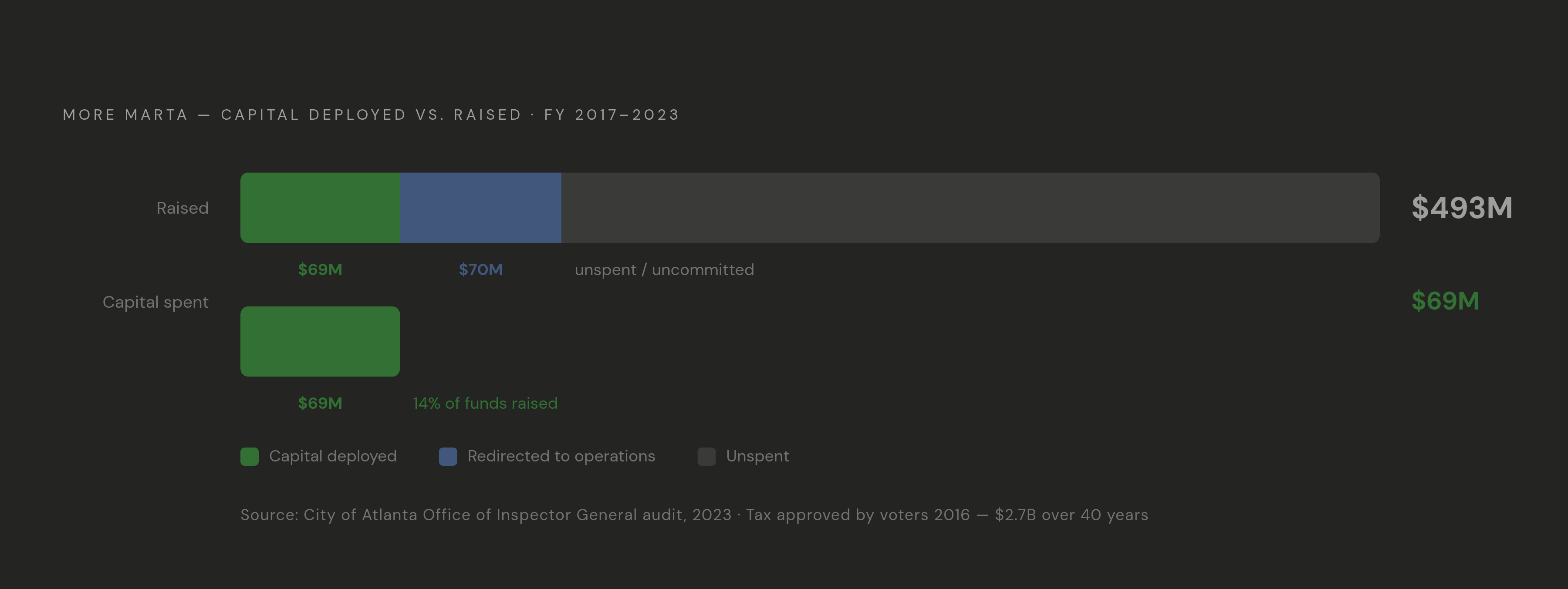
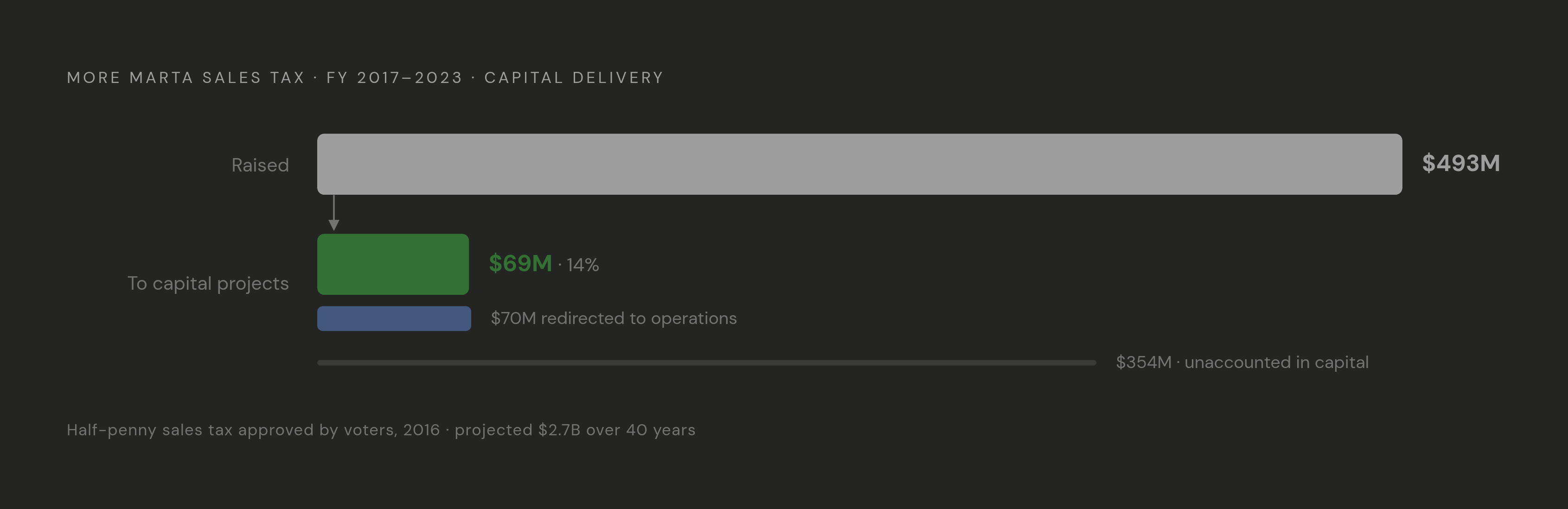
Then there's the audit. A 2024 city review found that $70 million from the More MARTA capital fund, money meant specifically for capital projects, had instead been redirected to cover operating expenses. The math behind that finding is worse than the headline number suggests: the associated sales tax raised $493 million between fiscal years 2017 and 2023, and only $69 million of that actually went toward capital projects in the same window. More MARTA itself was a half-penny sales tax that Atlanta voters approved in 2016, representing $2.7 billion over 40 years, the largest transit investment the region had approved in four decades. That's a lot of public trust to spend down on an accounting gap.
Add one more wrinkle: as of AJC reporting, critical safety testing on the new CQ400 railcars remained incomplete with weeks to go before the 2026 FIFA World Cup deadline. MARTA's interim general manager refused to put the trains into service until testing was fully done, which is unquestionably the responsible call, and it also illustrates, pretty plainly, how engineering timelines collide with political calendars and global events nobody in the signaling department can control. The technology at MARTA works well enough on its own terms; financial oversight running in parallel with the engineering is what's missing, because ambition without that oversight produces exactly the kind of audit finding Atlanta just got.
Jennifer Clark, writing in Atlanta Studies in 2017, offered the sharpest answer to that question before most of these projects had even broken ground.
The 2018 SamSam ransomware attack and what deferred IT maintenance actually costs
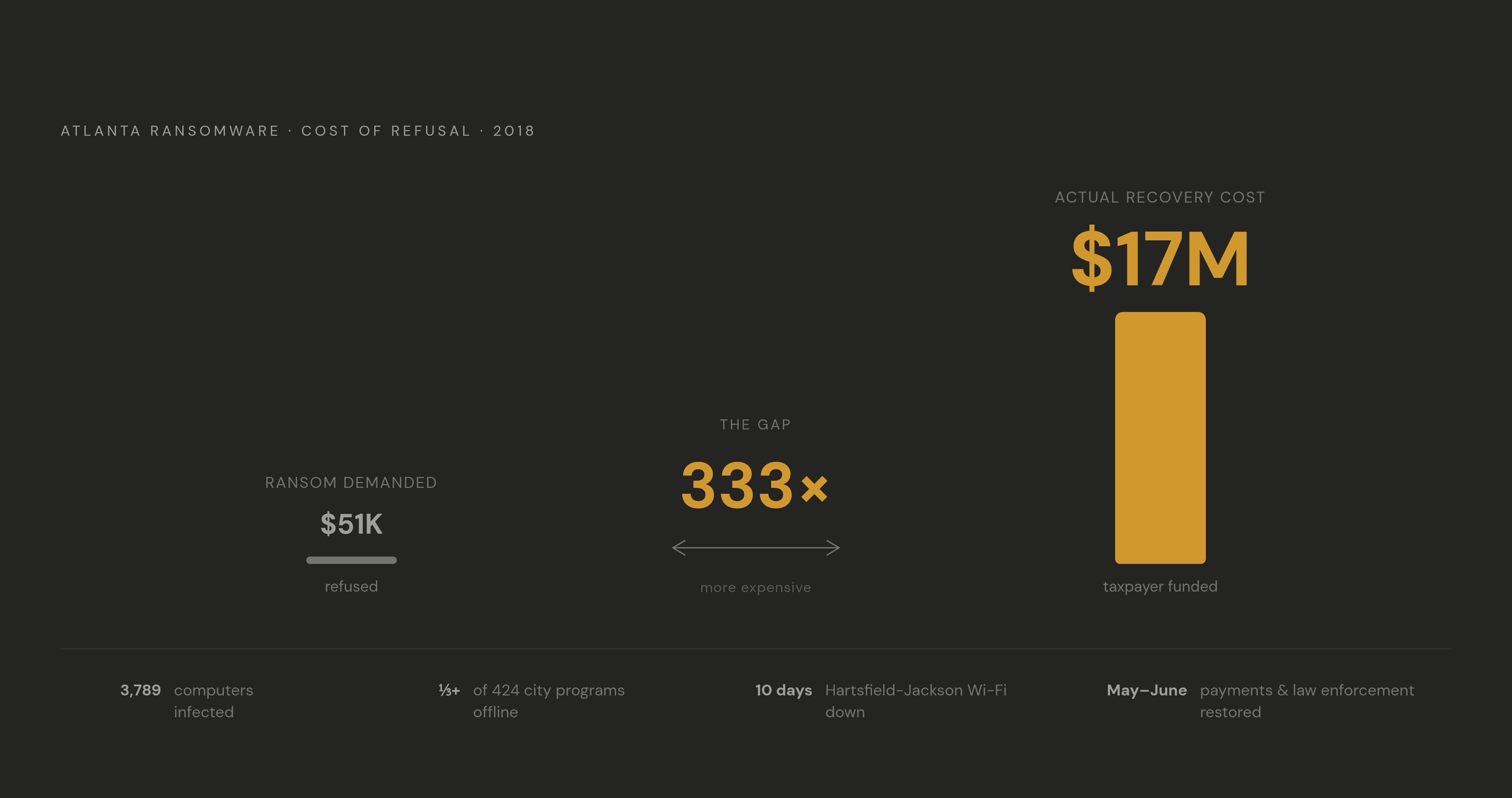
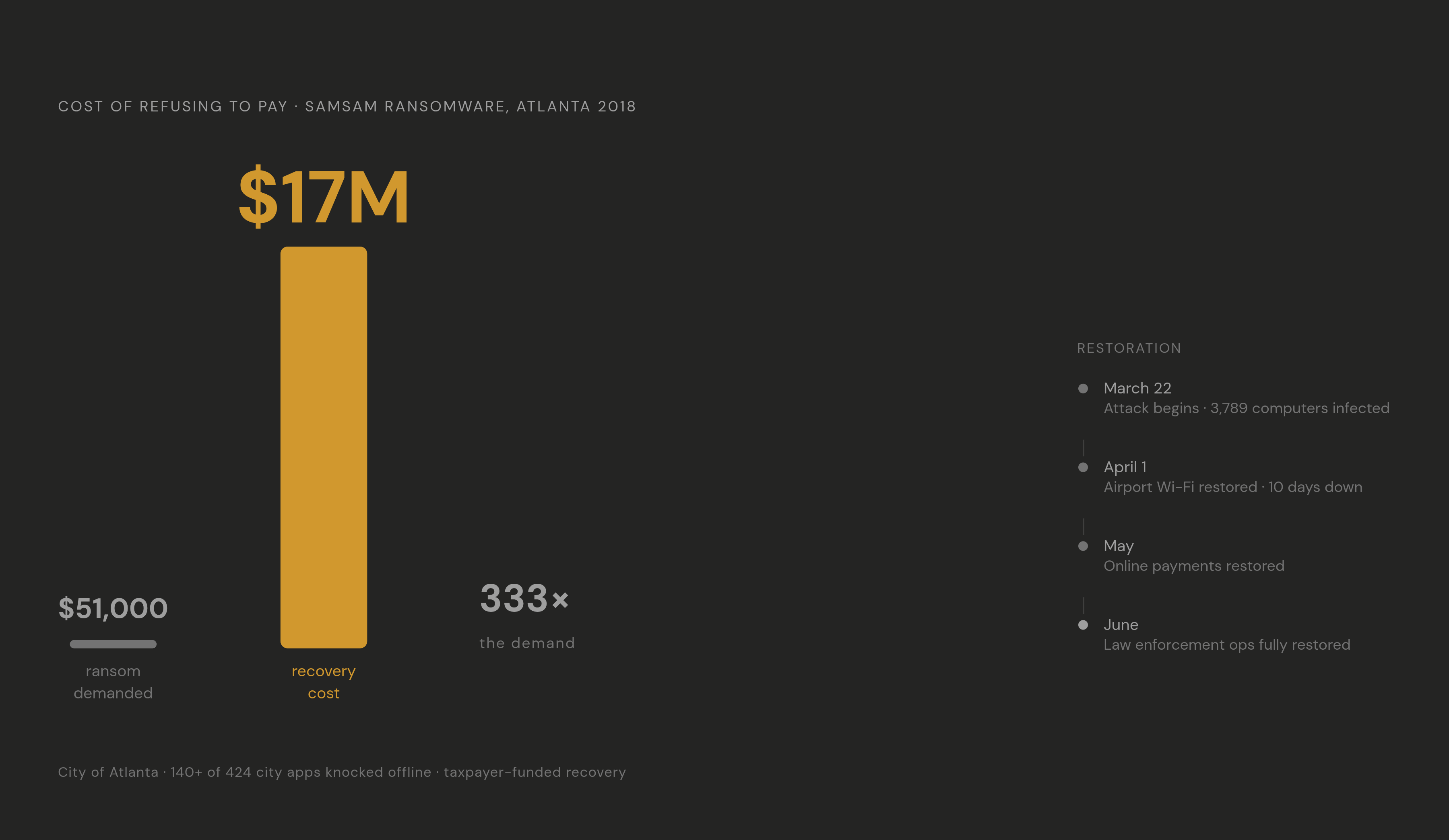
On March 22, 2018, Atlanta discovered it had been hit by SamSam ransomware, an attack later described as the largest successful ransomware breach of a major American city, with exposure potentially touching up to 6 million people. Start with the money, because the asymmetry says everything: the initial ransom demand was $51,000, the city refused to pay it, and recovery ended up costing approximately $17 million in taxpayer funds. That's the gap between a single bad day and a multi-year budget headache.
The scope of the damage was substantial: 3,789 computers infected, more than a third of the city's 424 software programs knocked offline or partially disabled, and more than 30 percent of the affected applications touched critical services, including police and court systems. In the immediate aftermath, the city spent roughly $3 million on emergency contracts, including $650,000 to SecureWorks for incident response and $600,000 to Ernst & Young for advisory work.
Here's the detail that turns this from bad luck into something closer to a policy failure. A city audit conducted in January 2018, two months before the attack, had already found thousands of vulnerabilities across city systems. Close to 100 government servers were still running a version of Windows that Microsoft had stopped supporting back in 2015. The audit even noted that the sheer volume of known vulnerabilities had made city workers complacent, which is a genuinely uncomfortable sentence to read in an official report written two months before the largest municipal ransomware breach in American history.
Recovery took time nobody wanted to spend. It took five days just to regain access to critical technology, Wi-Fi at Hartsfield-Jackson, one of the busiest airports on the planet, was down for 10 days, and online payment systems weren't restored until May. Law enforcement's digital operations didn't fully come back until June. The breach exposed a governance failure well beyond IT: what happens when a city chases smart city ambitions without first locking the foundation those ambitions are supposed to sit on.
How Atlanta rebuilt its technology culture after the ransomware breach
Gary Brantley took over as CIO after the breach, and his framing of what changed is worth quoting directly: "Going forward, we have a security strategy at the front of everything we do. We're still going to innovate, but we've started to focus on having a secure operational environment and having that be the foundation before we get into disruptive types of technology." That statement amounts to a full reordering of priorities: security first, disruption second.
The cultural problem SamSam exposed wasn't a mystery. Atlanta had spent years moving fast on visible, ambitious projects (smart corridors, sensor pilots, transit contracts) while underfunding the unglamorous infrastructure holding all of it up. That's Jennifer Clark's argument from 2017 showing up again, almost eerily on schedule: the technology was never the hard part. Governance, accountability, and the organizational discipline to actually maintain what gets built, that's the real challenge, and it took a $17 million ransomware bill for the city to feel it in its budget.
What changed in practice was less flashy than a new app or a new sensor network. Security review got embedded into procurement and project planning from the start, rather than added on after a vendor was already selected. The irony, and it's a real one, is that the ransomware attack probably did more for Atlanta's long-term technology resilience than any single smart city initiative on this list, simply because it made the cost of neglect impossible to wave away in a budget meeting. This section isn't a victory lap for Atlanta's IT department; it's a reminder that the reorientation required leadership willing to slow down the visible, exciting stuff long enough to fix the boring, invisible stuff underneath it.
Digital equity as the unfinished work inside Atlanta's smart city narrative
Here's a number that sits uncomfortably next to that 88 out of 100 infrastructure score: along parts of the BeltLine, American Community Survey data shows somewhere between 25 and 33 percent of residents lack fixed broadband access. In a city ranked first in the country for smart city infrastructure, that gap sits at the center of the whole argument.
It's Clark's 2017 framework playing out in real time, eight years later. The technology clearly exists, the fiber's been laid, the sensors are up. The unresolved piece is deployment into communities where access, governance, and representation are genuinely complicated, not just a matter of running one more cable.
There's a real success story worth naming here too, so this section isn't only about gaps. The Atlanta Better Buildings Challenge launched in 2011 as a public-private partnership aiming to cut energy use 20 percent by 2020. The city hit that target two years early, in 2019, and saved 1.3 billion gallons of water along the way. That's a legitimate win, no hedging required.
But even that program shows the same unevenness running underneath everything else. The City of Atlanta Energy Efficiency Education Project specifically targeted Thomasville Heights and Norwood Manor, two of the city's most energy-burdened neighborhoods, as a deliberate precursor to what became WeatheRISE ATL. Somebody at the city noticed the gap and built a program to address it directly, which is exactly the right instinct. Equity requires its own targeted effort every single time, because the default path of infrastructure spending doesn't distribute benefit evenly on its own. Smart city rankings measure inputs like jobs, companies, and infrastructure scores; they don't measure who actually gets to use any of it.
What Atlanta's experience teaches other cities planning their own smart city programs
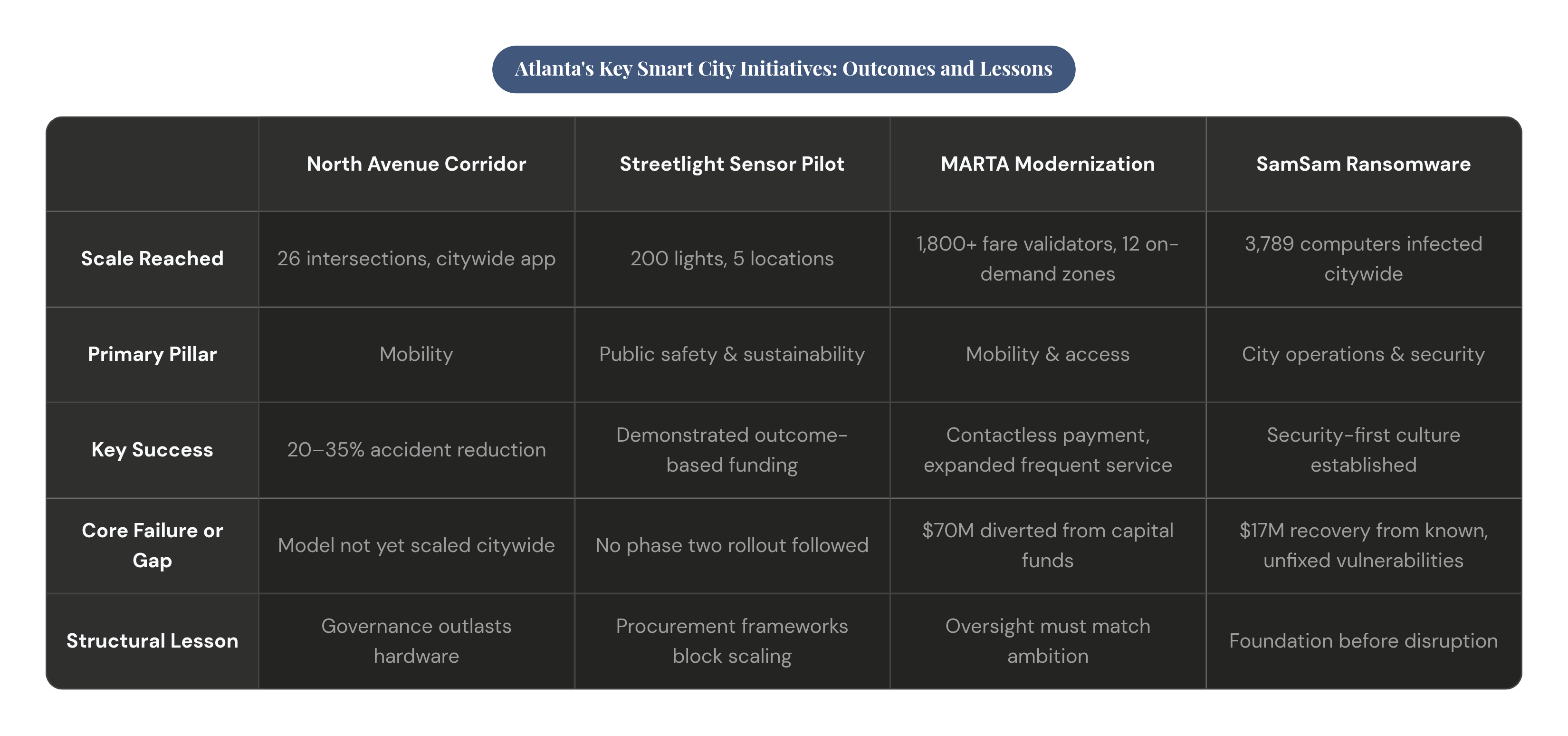
Pull all six of these threads together and a pattern emerges that has nothing to do with Atlanta specifically and everything to do with how cities build technology at scale.
The pilot-to-scale gap isn't bad luck; it's structural. The streetlight sensors, the North Avenue corridor, MARTA's modernization contracts, all of them show that running a good pilot is the easy discipline. Scaling requires procurement frameworks, sustained funding across multiple budget cycles, and governance mechanisms that survive a change in mayor or general manager. Security functions as the prerequisite for the whole smart city effort, and Atlanta's $17 million ransomware recovery is the receipt proving what happens when a city treats it as optional. Partnership design matters just as much as the technology itself: North Avenue worked because Georgia Tech, Georgia DOT, and Arcadis stayed embedded in daily operations, well past the opening ceremony.
Financial oversight has to move at the same speed as ambition. MARTA's audit, $70 million pulled from capital into operations, $493 million raised against just $69 million actually spent on capital work, shows how fast a public mandate can quietly erode when nobody's watching the ledger closely enough. And equity can't be treated as a follow-up phase. Neighborhoods sitting at 25 to 33 percent broadband gaps inside the top-ranked smart city in the country aren't a strange exception to the rule; they're the predictable result of designing around infrastructure scores instead of designing around who actually gets to use the infrastructure.
Atlanta's climb from tenth to first in the ProptechOS index is real, and it's earned. But the more useful export, for any city or organization trying to build technology strategy at scale, is the set of failures that forced Atlanta to slow down and build more carefully: the ransomware attack that rewired its security priorities, the audit that exposed the gap between what was promised and what was funded, and the pilots that quietly revealed just how much harder citywide scale is than a 200-streetlight test run. Speed without a foundation is recoverable, but it's expensive, and Atlanta already picked up the tab so the rest of us wouldn't have to guess what it costs.
Sources
- https://www.smartcitiesdive.com/news/10-cities-best-prepared-smart-city-future-atlanta-san-francisco-oakland/747963/
Provided the ProptechOS Smart City Index ranking, scoring details, and metrics used to assess Atlanta's smart city standing.
- https://www.us-ignite.org/tools/rfps/atlanta-smartcity-strategic-infrastructure-initiative/
Provided details on the $250 million infrastructure bond and the 2018 RFP priorities including fiber, smart poles, and smart water meters.
- https://finance.yahoo.com/news/10-cities-best-prepared-smart-104534633.html
Provided figures on the Atlanta Better Buildings Challenge, including the water savings of 1.3 billion gallons.
- https://www.arcadis.com/en-us/projects/north-america/united-states/north-ave-corridor
Provided specific outcome data for the North Avenue Smart Corridor, including accident reduction figures and the number of signalized intersections with IoT sensors.
- https://www.justice.gov/usao-ndga/pr/atlanta-us-attorney-charges-iranian-nationals-city-atlanta-ransomware-attack
Provided official figures on the scope of the 2018 SamSam ransomware attack, including computers infected, population exposure, and the share of critical services affected.