Economic Development Administration Grants for Smart City Projects
Framing smart infrastructure as job creation unlocks federal flexibility most applicants overlook.

EDA grants sit near the top of the flexibility rankings in federal funding, and communities that pitch smart city work as economic development, jobs created, investment attracted, regional competitiveness improved, tend to win. That framing is the whole game. Get it right and a fiber optic install becomes an economic revitalization project. Get it wrong and it's just a really expensive cable.
The Economic Development Administration's mission is spelled out plainly enough: promote innovation and competitiveness, get American regions ready for growth in a global economy that doesn't wait around for anyone. What makes EDA different from, say, a Department of Transportation grant is that it doesn't care much how you solve the problem, only that you can prove the solution moves the economic needle. That's why EDA funding gets described, even by its own staff, as some of the most flexible federal money out there. It covers a strange and wide range of issues: brownfield cleanup, port expansion, broadband, workforce training, disaster recovery. Smart city infrastructure fits inside that basket more comfortably than most applicants realize.
Here's the pattern worth noticing: most cities chasing smart infrastructure dollars line up first for DOT's SMART grants, or HUD, or the FCC's broadband programs. Those lines are long and the competition is fierce. EDA sits a little further down the hallway, less crowded, and it rewards exactly the kind of applicant who can translate "smart traffic sensors" into "reduced logistics costs for regional manufacturers." Between January 2021 and November 2024, EDA pushed out nearly $6 billion across 3,393 awards, work the agency estimates created or saved more than 554,700 jobs and pulled in over $67.7 billion in private investment. That's not a rounding error. If your smart city project can show job creation or private capital coming off the sidelines because of it, EDA belongs on your shortlist, probably nearer the top than most people put it.
How the 2024 reauthorization changed EDA's scope for technology and broadband projects
The Economic Development Reauthorization Act of 2024, signed into law January 4, 2025, was EDA's first reauthorization since 2004. Two decades is a long time to run an agency on old statutory language, especially when the underlying economy shifted from manufacturing corridors to broadband corridors somewhere in between.
The change that matters most for smart city applicants: EDRA created a distinct broadband grant program and opened eligibility to public-private partnerships specifically for broadband projects. It also amended the Public Works program to state, in plain terms, that broadband is an eligible use. That sounds like a small fix, but it isn't. Before EDRA, applicants had to argue their way around ambiguous statutory language to justify fiber or wireless infrastructure spend, and grant writers hate arguing around ambiguity almost as much as reviewers hate reading around it.
EDRA also authorized four new program areas that brush directly against smart city priorities: high-speed broadband deployment under 42 U.S.C. §3154g, workforce training under §3154e, renewable energy on brownfield sites under §3154d, and critical supply chain site development under §3154h. On top of that, capacity building and project predevelopment are now explicitly eligible uses, which matters more than it sounds like on paper. A lot of communities aren't ready to build; they're ready to plan, to study, to figure out where the fiber should go before they lay it. Now there's a funding lane for that stage specifically, instead of forcing every applicant to pretend they're construction-ready on day one.
Then there's the cost-share change, which is the kind of detail that decides whether a rural county director sleeps well at night. The standard federal share rose from 50% to 60%. Severely distressed regions can get up to 80%. Disaster assistance situations and communities under 10,000 people can hit 100%. Rural and tribal communities chasing smart infrastructure now carry a noticeably lighter local match burden than they did under the old rules, and EDRA's prioritization language calls out small, rural, under-resourced, and tribal communities by name. If you're writing the application, that's not background information, that's your opening argument.
The Public Works program: the most direct route to smart infrastructure funding
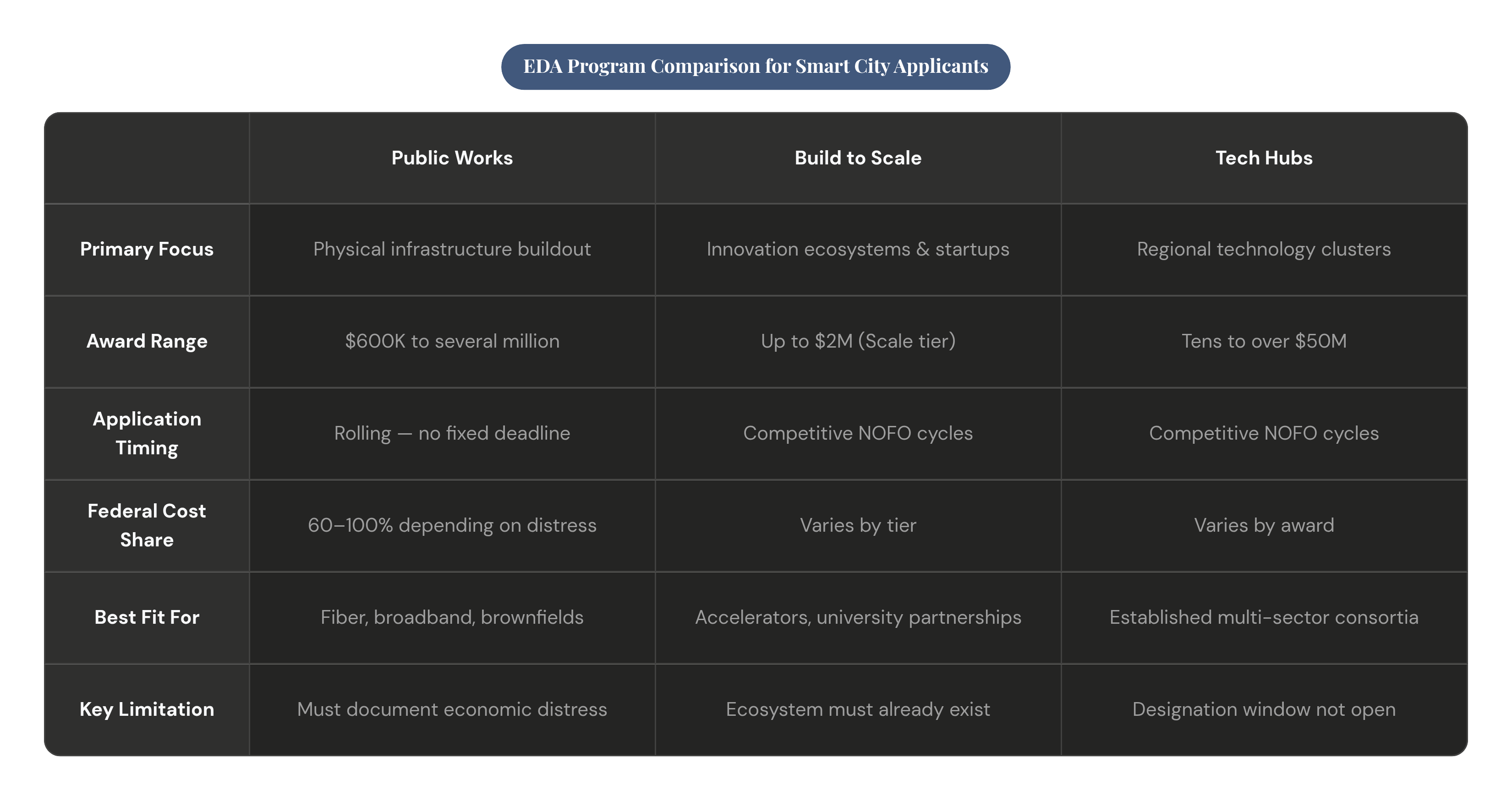
Public Works is the workhorse. Its stated purpose is helping distressed communities revitalize, expand, and upgrade physical infrastructure so they can attract industry, grow existing businesses, and create jobs that stick around longer than a ribbon-cutting ceremony. EDA and DOT jointly list smart city eligible uses that read almost like a checklist someone wrote specifically for this article: technology-based facilities using distance learning networks, smart rooms and smart buildings, fiber optic and telecommunications buildout in business and industrial parks, broadband deployment generally, advanced manufacturing or research centers, and brownfield redevelopment.
Award sizes run from $600,000 to several million dollars, with the standard 60% federal share climbing to 80% in the more distressed regions. Here's the detail that separates Public Works from almost every other federal grant program you'll deal with: there's no fixed deadline. Applications get accepted on a rolling basis, subject to available funds. That's a quiet advantage for communities that need six extra weeks to pull together a good economic narrative instead of racing a clock set by someone in Washington.
Eligibility for distress runs on three criteria, and an applicant needs to document at least one. Either the unemployment rate sits at least one percentage point above the national average over the most recent 24-month stretch, or per capita income sits at or below 80% of the national average, or the community can demonstrate what EDA calls a "Special Need." Eligible applicants include EDA-designated Economic Development Districts, Indian Tribes, states, counties, cities, universities, and public or private nonprofits working alongside a political subdivision. Individuals and for-profit companies need not apply, literally; they're not eligible on their own.
A concrete example helps here more than another paragraph of program description. In May 2024, EDA gave the Coushatta Tribe of Louisiana over two million dollars to build fiber optic cable within the US 165 right-of-way, buried infrastructure meant to serve the tribe's telecommunications needs for decades. Worth noting: EDA tends to focus on last-mile connections rather than massive regional buildouts, which is NTIA's territory with significantly more capital behind it. Treat the two as teammates, not rivals competing for the same dollar, and whatever you do, don't let the application read like a fiber spec sheet. The application needs to connect the infrastructure to outcomes, jobs created, investment attracted, businesses now able to operate, not just describe how many strands of cable are going in the ground.
The Economic Development Reauthorization Act of 2024, signed into law January 4, 2025, was EDA's first reauthorization since 2004.
Build to Scale: funding the innovation ecosystems that make smart cities work
If Public Works is the concrete and cable, Build to Scale is the people and startups layer. The program funds organizations supporting innovators and entrepreneurs building emerging technologies, with the goal of growing regional economies around the industries that are coming, not the ones already here.
Build to Scale runs three tiers. Ignite grants, up to a few hundred thousand dollars, go to emerging ecosystems just establishing the basic infrastructure. Build grants, up to several hundred thousand dollars, go to ecosystems already running programs and looking to expand. Scale grants, the top tier at up to two million dollars, go to advanced ecosystems with proven models and outcomes they can actually document. In FY2024, the total program pot was tens of millions of dollars, up from literally zero funding back in 2013, a decade of Congress deciding this approach works.
The period of performance runs 24 to 60 months, longer runway than most federal programs give you, which makes sense given that ecosystem building isn't something that happens on a two-year sprint. Eligible applicants include economic development organizations, entrepreneur support groups, universities, innovation hubs, nonprofit startup programs, and public-private partnerships.
The Northern Virginia Smart Region Initiative is worth studying closely here. Led by Smart City Works, a nonprofit accelerator focused on urban livability and resilience, the Initiative brings together government, university, corporate, and nonprofit partners to grow the smart city technology cluster around Northern Virginia. Since 2016, it has launched more than 20 companies with market-ready infrastructure solutions. Over its grant period, the Initiative projected more than 45 companies graduating from the accelerator, 30 new smart city products hitting the market, 60 apprentices trained, and 90 new jobs created. Notice what's happening in those numbers: nothing vague, nothing hand-wavy about "fostering innovation," just counts. Companies, jobs, products. That's the language B2S reviewers are trained to look for, and it's the language that wins.
If your city or region already runs an accelerator, or has a university partnership humming along, or has something resembling an innovation district, B2S is the mechanism to formalize and scale what's already working rather than inventing something new from scratch.
Regional Technology and Innovation Hubs: the largest EDA vehicle for technology transformation
Tech Hubs is the big one, at least on paper. Established under the CHIPS and Science Act of 2022, the program was authorized for billions of dollars over five years. Actual appropriations have landed well short of that number, which is a pattern worth remembering every time a federal program gets announced with a headline authorization figure attached.
The competition for designation was brutal from the start. EDA received 379 applications and designated 31 Tech Hubs in October 2023. In July 2024, Phase 1 implementation awards went out: hundreds of millions of dollars split across 12 of those 31 hubs, with individual awards ranging from tens of millions to over fifty million dollars. The remaining 19 designated hubs each got a modest Consortium Accelerator Award, essentially seed money to sharpen strategy and go find additional investment elsewhere.
Then politics happened, because of course it did. A planned multimillion-dollar funding slate for six additional Tech Hubs in 2025 got canceled following a Trump administration review. As of July 2026, EDA announced plans to award over a hundred million dollars to six of the 31 designated hubs, bringing total Congressional appropriations for the program past several hundred million dollars cumulative, still a fraction of that original $10 billion authorization. Anyone applying into this program needs to understand it operates inside a shifting appropriations environment, not a stable multi-year pipeline.
Two of the designated hubs land squarely in smart city territory. Montana's hub is developing smart sensing systems with applications spanning defense, resource management, and disaster response. The NY SMART I-Corridor Tech Hub, led by CenterState CEO, focuses on semiconductor manufacturing, the hardware layer underneath basically everything a smart city runs on. No sensor network works without chips, and no chips get made without fabs, and Tech Hubs money is chasing that whole chain.
Realistically, this program serves regions that already have a technology cluster, a consortium with real governance across government, university, and private sector partners, and the organizational muscle to manage a genuinely complex multi-year federal award. The designation window isn't currently open for new entrants, so communities not already in the 31 should focus energy on Public Works or Build to Scale while keeping an eye on future rounds.
How EDA evaluates applications and what makes a smart city project competitive
Across every single EDA program, the same rule holds: technology deployment alone doesn't win. The project has to demonstrate economic outcomes, jobs created or retained, private investment attracted, regional competitiveness improved. That's not optional, and it's not negotiable, and reviewers will find the gap if it's not there.
For Public Works specifically, distress documentation acts as the gatekeeper. Unemployment data, per capita income figures, or a Special Need designation; gather this from third-party sources like the Bureau of Labor Statistics or Census Bureau before you start drafting, not after. Strong applications across all programs share a few traits: quantified projected outcomes stated in real numbers, not adjectives; demonstrated need tied to actual economic data rather than a general sense that the town could use better internet; a consortium structure showing the whole region is behind it, not just city hall; and a clear line connecting the technology investment to long-term economic resilience.
Match funding strategy deserves its own attention. Knowing which distress tier applies can shift the local match burden from 40% down to 20%, or in some qualifying circumstances, to zero. That's the difference between a project that pencils out and one that dies in a budget committee meeting. EDA positions itself deliberately alongside NTIA rather than in competition with it, so the smartest funding strategies layer EDA money (last-mile fiber, innovation ecosystems, workforce training) with NTIA (large-scale broadband), DOT's SMART grants, and state-level programs, rather than betting everything on one source.
One operational note that's easy to miss: PWEAA runs on rolling applications, which rewards early movers and communities with the writing capacity to move fast. Build to Scale and Tech Hubs run on competitive cycles with specific Notice of Funding Opportunity windows, so tracking Grants.gov and EDA's own funding page needs to be a standing task, not a once-a-year check-in. Remember, too, that predevelopment and capacity-building funding is now explicitly eligible under EDRA 2024, so communities that aren't ready for a capital ask yet can still get money to plan and study before they build. One last point worth repeating: for-profit companies can't apply directly to most of these programs. Smart city vendors and tech companies need to structure their involvement through an eligible nonprofit, university, or government partner from the start, not as an afterthought once the application's half-written.
Building the content and documentation stack a winning EDA application requires
An EDA application is, underneath everything, a writing project. Economic narrative, regional data analysis, project description, outcome projections, letters of support, match documentation, each piece needs to argue the same case in a consistent voice. That's harder than it sounds when five different departments are contributing sections.
The economic narrative carries the weight. It has to connect the technology investment to job creation and private investment in language EDA reviewers actually recognize from their own scoring criteria. This is a strategy and writing challenge first, a technical challenge a distant second. The most common failure mode isn't a bad project, it's a good project described badly: technically sound work that explains the sensors and the fiber and the smart grid in loving detail but never quite translates any of it into economic development terms. Reviewers score economic impact, not how cool the technology is, no matter how cool it actually is.
The documentation stack typically includes a Comprehensive Economic Development Strategy alignment or update, which is required for many EDA-eligible applicants anyway. Add third-party distress data from BLS or Census, letters of support from regional employers and co-investors, a detailed budget narrative with match documentation spelled out, and an outcome framework with specific, countable job and investment projections. None of this is exotic, but all of it takes time to assemble correctly.
Speed matters more than most applicants expect, especially for rolling programs like Public Works. Communities that can move from concept to a submitted application faster are competing in a thinner field, since a lot of good projects simply never get written down in time. Organizational readiness and writing capacity turn out to be real competitive advantages, maybe the most underrated ones in this whole process. Content workflows that pair AI-assisted drafting with a human editor doing the actual judgment calls, the kind of setup marketing teams use to keep multi-stakeholder campaigns consistent, apply just as well here. The same discipline that keeps a brand's messaging aligned across ten channels can keep a grant narrative aligned across five sections written by five different department heads who've never agreed on anything else in their careers.
EDA's flexibility only pays off for communities that can say clearly, and quickly, what their economic development story actually is. The money is sitting there, and the edge goes to whoever treats the application like the strategic communication problem it actually is, not like a form to fill out on a Friday afternoon.
Sources
- https://www.eda.gov/funding/programs/build-to-scale/past-grantees/2019-venture-challenge/Smart-City-Works
Provided details on the Northern Virginia Smart Region Initiative, including its projected outcomes of companies, jobs, and smart city products during the grant period.
- https://www.transportation.gov/grants/SMART
Referenced as the competing DOT grant program that many cities pursue before considering EDA funding.