Digital Equity and Broadband Access Policy
Federal broadband programs are dismantling just as construction was beginning to start.

Start with the numbers, because they're already in dispute. The FCC's official count says 19.6 million Americans lack access to fixed broadband at 100/20 Mbps. A 2025 nationwide audit of over 109,000 ISP-address tests puts the real figure at 26.0 million. That's a 6.4 million-person undercount, roughly 33% larger than the official tally. The Census Bureau's American Community Survey adds a third data point: 24% of households, more than 31 million, have no home wireline broadband subscription at all.
These numbers don't contradict each other. They measure different things. The FCC counts addresses where infrastructure technically exists. The audit measures whether you can actually order a qualifying plan at that address. The Census measures whether anyone in the household is paying for service. The fact that 66.5% of addresses the FCC lists as fiber-served could not actually order a 100/20 Mbps plan in that 2025 audit tells you something important: the measurement problem is a serious structural flaw, not a technical footnote. The $42.45 billion BEAD allocation formula runs almost entirely on the National Broadband Map, and a 2025 GAO report found the map's accuracy, in their words, "is uncertain." The GAO also flagged that there is no agreed-upon process to prevent multiple federal programs from funding the same location. Undercounting risk and de-duplication risk compound each other on a $42 billion program.
Income is the sharpest dividing line. Only 54% of adults in households earning under $30,000 subscribe to home broadband even where infrastructure exists, per Pew's 2025 data. Forty-three percent of that income group remain unconnected overall. For households earning over $100,000, the non-connection rate is 5%. Geography doesn't explain that gap.
Forty-five percent of unconnected households cite high monthly cost as the primary reason. The typical standalone broadband fee paid by a low-income consumer, defined here as household income at or below $50,000, runs about $67 per month. For a household earning under $30,000, that is a crushing line item, not an incidental one.
Geography layers on top of income. Roughly 64.4% of rural households have broadband access, compared with about 98% of urban households. Twenty-three percent of people on Tribal lands lack access to fixed broadband as of 2024. These are populations without infrastructure reaching them, not populations that simply chose to forgo a subscription.
Race adds a third dimension. Eighty-six percent of White households have home broadband. The figure is 82% for Black and Hispanic households. American Indian and Alaska Native households have the lowest rate at 75%. The gap shows up in quality, too: majority-Black neighborhoods recorded lower upload speeds than majority-White neighborhoods, with those disparities widening during the COVID-19 period. Researchers and advocates use the term "digital redlining" to describe the pattern of discriminatory infrastructure disinvestment that concentrates connectivity gaps in communities of color and low-income areas.
The third barrier is the one that gets most consistently underweighted: device access and digital literacy. Only 69% of Black Americans and 67% of Hispanic Americans have a desktop or laptop computer, compared with 80% of White Americans. Smartphone parity, where it exists, does not substitute for full participation in digital civic and economic life. Applying for a job, accessing telehealth records, filing taxes: these tasks demand a real keyboard and a stable connection, not a phone screen on a cellular data plan.
Why does the three-barrier distinction matter? Because a policy that only builds infrastructure leaves the affordability and literacy gaps completely untouched. A policy that only subsidizes monthly bills does nothing in areas where no service exists. Until recently, the federal policy framework was actually structured to address all three simultaneously. Now it has been dismantled.
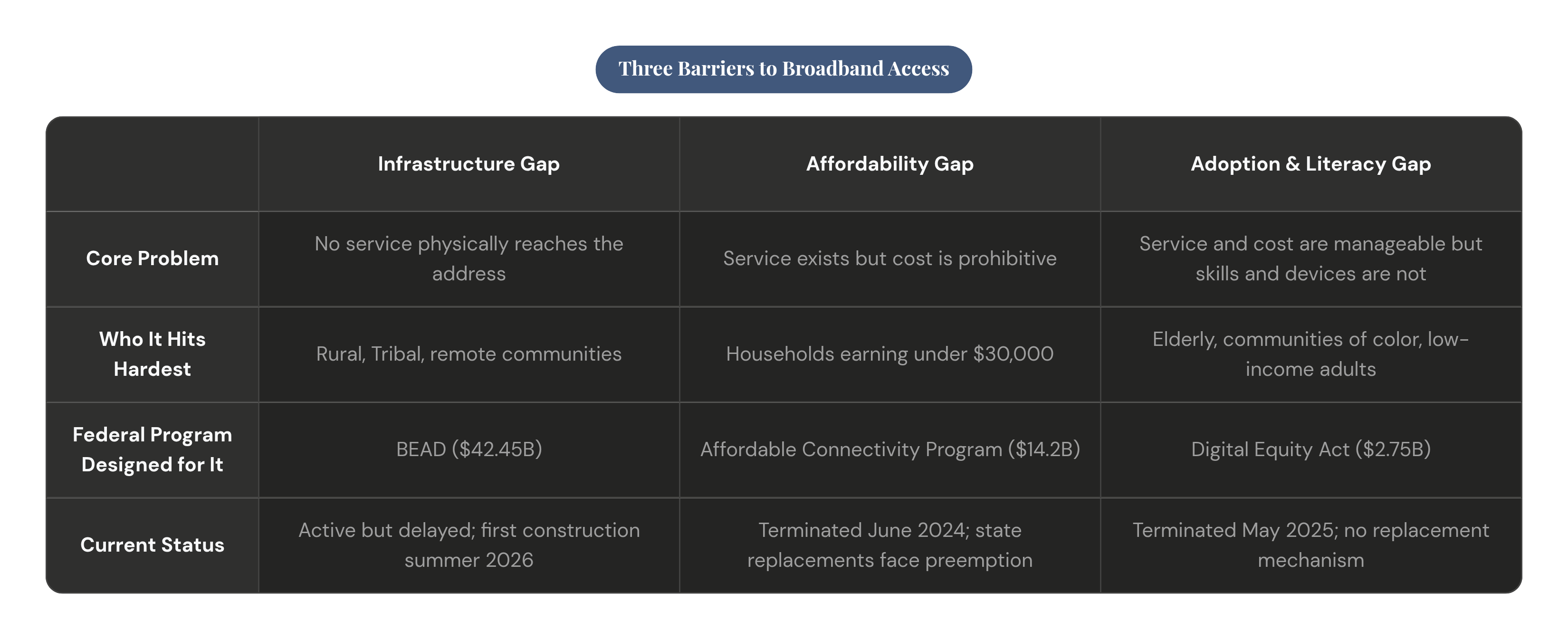
What the $65 billion federal investment was designed to do and how it divided the work
Private investment in broadband infrastructure since 1996 totals approximately $2.2 trillion. The Infrastructure Investment and Jobs Act's $65 billion was never meant to replace that. It was designed as targeted federal co-investment, pointed specifically at what the private market had not reached and apparently would not reach on its own. The program architecture that resulted was deliberate, each component addressing a distinct failure mode rather than a general one.
BEAD, at $42.45 billion, addressed the infrastructure gap: no service exists, so build it. It operates through state-administered grants, with states allocating money to ISPs and other eligible entities to construct last-mile networks in unserved and underserved locations. Physical infrastructure is the prerequisite for everything else, which is why BEAD is the largest single component.
The Affordable Connectivity Program, at $14.2 billion, addressed the affordability gap. It provided monthly discounts of up to $30 for eligible households, up to $75 for Tribal households. Building a network to a neighborhood and getting low-income households to actually subscribe are two different problems, which is why ACP operated separately from BEAD. A 2022 study found that ACP's monthly subsidies reduced ISP customer turnover and cut break-even costs by 25% when building networks in new service locations. The affordability program was actively subsidizing the economics of the infrastructure program. They were interdependent, not merely parallel.
The Tribal Broadband Connectivity Program, at $3 billion, targeted the deepest geographic and racial connectivity gap in the country. It resulted in $1.86 billion in awards to 226 Tribal entities, making it the largest-ever federal investment in high-speed internet on Tribal lands, with more than 4,500 Tribal homes connected or seeing their costs reduced.
The Middle Mile Infrastructure Program, with $980 million awarded to 36 organizations across 40 states and territories, addressed backhaul. Even when a community wants to build a last-mile network, if there's no affordable fiber transport connecting that community to the broader internet, the economics of last-mile deployment collapse. Middle mile is what makes the rest of the framework viable.
The Digital Equity Act programs addressed the third barrier directly: literacy, adoption, device access. They were designed to serve rural communities, low-income households, aging populations, communities of color, and veterans; the populations for whom physical infrastructure and an affordable monthly bill still don't produce meaningful connectivity, because the barrier is knowledge and equipment.
That architecture no longer exists intact.
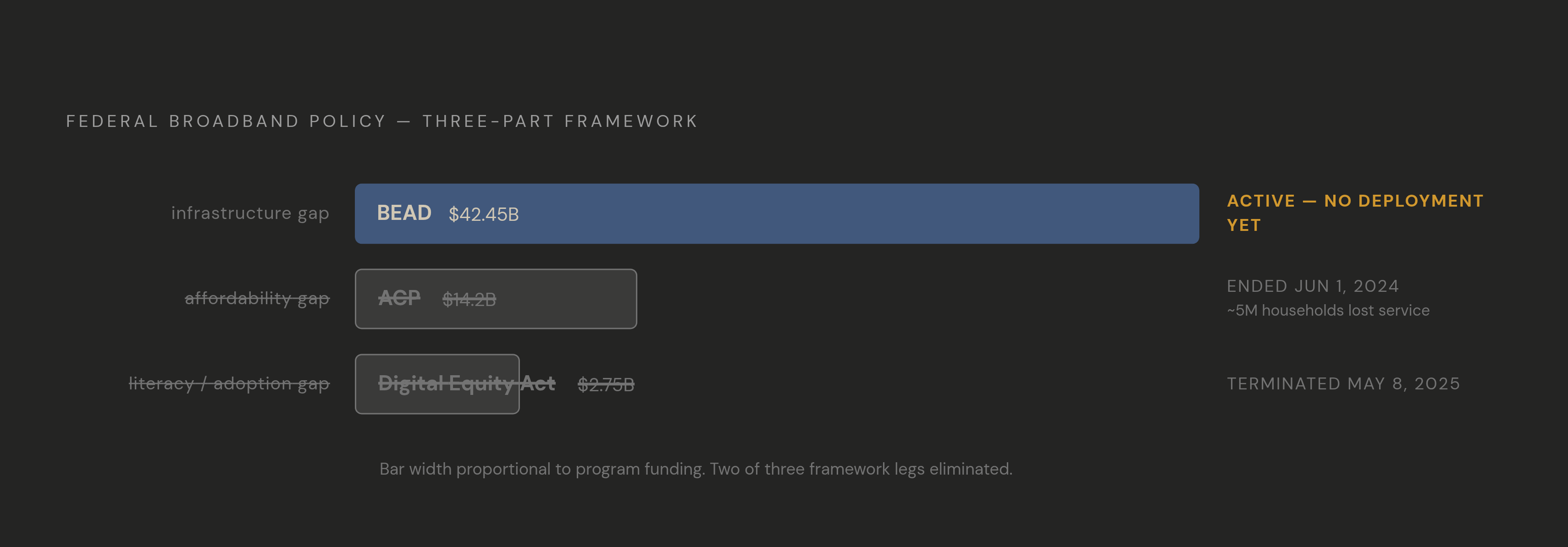
Where BEAD actually stands in mid-2026 and what slowed it down
The facts without editorializing: all 56 states and territories submitted final BEAD proposals, 54 received NTIA approval, 52 signed award agreements, and as of August 2025, no BEAD funding had been distributed for any eligible broadband deployment project. First construction was expected in summer 2026, five years after the IIJA was enacted.
Texas is a useful illustration of the scale involved. The state leads all allocations at $3.31 billion, selected 22 applicants to serve over 240,000 broadband serviceable locations and more than 2,700 community anchor institutions, and received Final Proposal approval in December 2025. Still in pre-construction.
Several forces produced the delay. BEAD's design required states to go through eligibility verification, environmental review, and a multi-stage federal proposal approval process. These were accountability measures, not bureaucratic sadism. When you are distributing $42 billion based on a map the GAO has already flagged as inaccurate, you want verification. The tradeoff is time, and that tradeoff was always embedded in the design.
In June 2025, NTIA issued a BEAD Restructuring Policy Notice that changed technology eligibility, eliminated certain non-statutory requirements, and introduced an accelerated "Benefit of the Bargain Round" weighted toward cost above other factors. NTIA claimed $21 billion in projected savings. Critics argued the restructuring forced states that had already developed proposals under the original framework to start over, adding at least another year of delay. The restructuring saves money while also costing time, and the net value of that tradeoff is not yet measurable because construction data doesn't exist.
Permitting remains a genuine bottleneck. NTIA launched an environmental screening and permitting tracking tool in early 2025 but acknowledged concern that federal agencies lack the staffing to process permits within preferred timelines. That staffing concern is concrete; it directly governs when shovels reach the ground.
Nondeployment funds added another complication. State broadband offices had planned these funds for permitting support, cybersecurity, workforce training, and consumer outreach. The June 2025 notice placed an indefinite hold on them. A December 2025 executive order made states with certain AI regulations ineligible for such funds entirely. Consumer outreach and workforce training are operational requirements in a program of this complexity, not ancillary additions.
BEAD's complexity was intentional. The restructuring trades some of that accountability for speed. Whether that tradeoff produces better outcomes than the original design will not be knowable until construction data exists.
What happened when the ACP ended and why states are trying to fill the gap
The Affordable Connectivity Program ended June 1, 2024. Twenty-three million enrolled households lost their monthly discount.
The immediate consequences were measurable. A Brattle Group report estimated approximately 5 million households cut internet service altogether following the ACP's termination. A January 2025 National Lifeline Association survey found that nearly 40% of former ACP participants cut back on food to afford their internet bill after the program ended. Thirty-six percent discontinued telehealth. Sixty-four percent reported being unable to maintain regular contact with friends and family.
States have moved to fill the void with uneven authority to do so. New York passed the Affordable Broadband Act, the first state law requiring ISPs to offer a $15 per month plan to qualifying residents. California, Massachusetts, Vermont, Connecticut, Maryland, and Minnesota have proposed similar mandates. The industry response was swift: CTIA, NCTA, and USTelecom filed comments urging the Department of Justice to preempt these laws federally. If federal preemption succeeds, the ceiling on state-level affordability policy becomes whatever the federal government permits, which is currently nothing.
The ACP-BEAD relationship clarifies the structural damage here. ACP's subsidies strengthened the business case for building networks in previously unserved areas by reducing the demand-side risk that makes private deployment in low-income communities economically unattractive. Its absence removes that demand-side anchor precisely when BEAD is attempting to stimulate supply-side investment. One program was designed to reinforce the other. One is gone.
How the Digital Equity Act's termination broke the third leg of the policy framework
On May 8, 2025, President Trump announced the intent to end the Digital Equity Act. The Department of Commerce terminated grants and froze the remaining appropriated funds from the $2.75 billion Congress had allocated. State recipients were told to cease all program activities immediately. Pennsylvania, which had received $1.6 million from the State Digital Equity Planning Grant Program, received a cease-and-desist letter from Commerce the following day.
What the DEA was funding: broadband adoption efforts, digital skills training, device access, and targeted outreach to populations for whom physical infrastructure does not automatically produce meaningful connectivity. Rural communities, low-income households, aging populations, communities of color, veterans.
The gap this creates maps directly onto the data. Forty-three percent of households earning under $30,000 remain unconnected even where service is available. Infrastructure is their barrier only in part. Literacy, device access, and the confidence to engage with digital systems are their barriers too, and those are precisely what DEA programs addressed. The termination did not eliminate the populations those programs served. It eliminated the mechanism for reaching them.
The FY 2027 budget proposal tracks Project 2025 recommendations to dismantle federal digital inclusion work more broadly. If that direction holds, no federally funded mechanism specifically targeting adoption, digital literacy, or device access for underserved populations will exist going forward. What remains: BEAD's infrastructure program, some state-level affordability laws that face preemption challenges, and the unaddressed third barrier.
How municipal broadband is expanding into the policy gaps while fighting legal barriers
Nearly 450 community-owned broadband networks were operating across the country as of January 2024. Forty-seven new community networks came online since 2021. This expansion is practical rather than ideological: where municipal broadband operates, it consistently delivers faster speeds, more reliable service, and lower prices than incumbent ISPs.
The legal barrier is straightforward. As of late 2024, 16 states maintained preemption laws preventing or significantly restricting municipalities from building publicly-owned networks. These laws were enacted at the behest of large cable and telecom incumbents who correctly identified municipal broadband as a competitive threat. They have nothing to do with consumer protection and everything to do with market protection.
Minnesota under Governor Tim Walz repealed its preemption laws, targeting two statutes that had shielded large monopoly providers from local competition. It required explicit legislative action to undo protections that incumbent providers had lobbied for and won decades earlier.
The structural irony is considerable. Billions of BEAD dollars are flowing to states where local governments are legally prohibited from being eligible subgrantees. A municipality that wants to build a network, has the capital and expertise to do so, and sits in an unserved area identified by BEAD cannot participate in the program if state law prevents it. The BEAD restructuring did not resolve this conflict.
Municipal broadband receives no dedicated federal funding stream. Its expansion depends entirely on state legislative change and local capital formation, which means it fills the policy gaps that federal programs have vacated unevenly. The communities most in need of an alternative provider are often in the states most legally hostile to municipal network development. That is not a coincidence.
What the current state of broadband policy means for who gets connected and when
BEAD construction is expected to start in summer 2026, with full deployment unfolding over a multi-year timeline after that. Mapping inaccuracies mean some unserved locations will go untargeted by the program entirely, because they don't appear on the map that drives the allocation. The infrastructure investment is real, but it is incomplete by design of its own data inputs.
The affordability situation has no federal floor. ACP is gone. State mandates like New York's face active preemption challenges. The 54% home broadband subscription rate among households earning under $30,000 will not move substantially on infrastructure investment alone. For that population, the barrier was always cost, not physical availability. Building the network is necessary but insufficient.
The adoption and literacy barrier has been eliminated as a federal priority. The DEA termination leaves no dedicated national mechanism for the populations whose obstacle is skills and devices rather than infrastructure or monthly cost. Those populations still exist. They are simply no longer being served by a federal program designed to reach them.
The economic stakes are not hypothetical. Research estimates the U.S. would have lost $1.3 trillion in economic growth between 2010 and 2020 if broadband speeds and adoption had remained at 2010 levels. Incomplete connectivity is a measurable drag on economic output, not merely a social policy failure in isolation.
The next observable milestones are concrete: first BEAD-funded construction in summer 2026, the outcome of state affordability law preemption challenges in court, and whether Congress acts to restore any affordability or digital inclusion funding before BEAD deployment completes. Each of those milestones will answer, for specific communities in specific locations, whether the policy framework closes the gap or merely narrows it. The communities waiting on that answer have already been waiting a long time.