AI Adoption Strategy for State and Federal CIOs
Federal memos require governance before pilots scale into programs.

The federal policy landscape is not a single document. It is a layered sequence that has to be read together, because no single memo gives you the complete picture, and assuming otherwise is how agencies end up compliant on paper but exposed in practice.
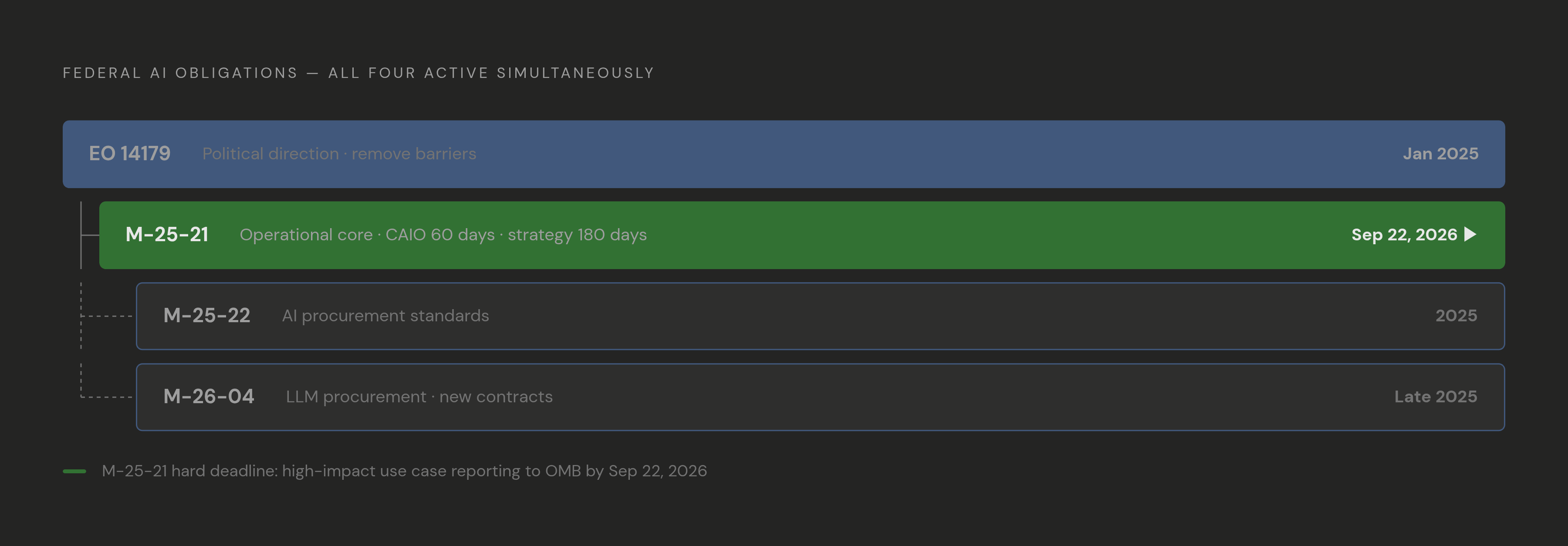
Executive Order 14179, issued in January 2025, set the direction: remove barriers, move toward deployment. That is the political signal. The operational core sits in OMB M-25-21, issued April 3, 2025. That memo requires CFO Act agencies to publish agency-wide AI strategies within 180 days and designate Chief AI Officers within 60 days. It also introduces the "high-impact AI" category, defined as any AI output that serves as a principal basis for decisions with legal, material, or significant effect on civil rights, privacy, access to services, health, safety, or critical infrastructure. By September 22, 2026, agencies must report minimum risk management practices for every high-impact use case to OMB. Non-compliant use cases must be discontinued.
M-25-21 also simplified the previous administration's multi-tiered risk classification into a single high-impact category. Simpler framework, higher stakes for what lands inside it. Those two facts are inseparable.
Two companion memos complete the picture. M-25-22 governs AI procurement, setting standards for how agencies acquire AI tools, not just how they use them. OMB M-26-04, issued in late 2025, implements the "Preventing Woke AI" executive order and requires agencies to apply new large language model procurement standards to all new contracts, with modifications to existing contracts where practicable.
What this means operationally: you are facing simultaneous mandates on governance structure, workforce roles, procurement standards, and use-case-level compliance. These cannot be addressed sequentially. Agencies that treat them as a checklist, knocking them off one by one, will find themselves out of compliance on three fronts while they were focused on the fourth.
The Federal-State Regulatory Fault Line Every State CIO Must Map Before Deploying
More than 1,000 AI-related bills were introduced across U.S. states and territories in 2025. State CIOs who assume federal policy resolves the regulatory question are taking on real compliance risk, and the assumption is increasingly expensive to hold.
Executive Order 14365, issued in December 2025, created an AI Litigation Task Force directed to challenge state AI laws on grounds of preemption, interstate commerce interference, and First Amendment concerns. States with laws deemed "onerous" risk losing eligibility for federal discretionary grant funding. That is not a theoretical lever; it is a direct fiscal instrument, and it has already changed the calculus in several state legislatures.
The carve-out that every state CIO needs to understand precisely: the White House National Policy Framework, issued in March 2026, explicitly preserves state authority over a state or locality's own procurement and use of AI, including in law enforcement and public education. Internal governance is protected. Broader regulatory activity affecting private entities or interstate commerce is contested.
That distinction is the fault line. State CIOs retain significant authority over their own programs but must draw a clear boundary between what they govern internally and what they regulate externally. Governance frameworks that blur that line create exposure that compounds over time, particularly as the litigation task force becomes more active.
California adds another layer. Governor Newsom's EO N-5-26, issued March 30, 2026, directs state agencies to develop new vendor certification and procurement standards. Because California is the nation's largest state AI market, its standards are likely to function as de facto national benchmarks. What California requires, vendors will build to, because the alternative is losing access to the largest single government AI market in the country. That market pressure is real, and it matters for procurement decisions in states that have not yet set their own standards.
NASCIO's stated position is that state CIOs broadly oppose federal preemption of state AI regulation while supporting federal standards as a floor states can build upon. Plan for continued state-level evolution. Federal uniformity is not coming.
Why Governance Must Be Built Before Pilots Become Programs
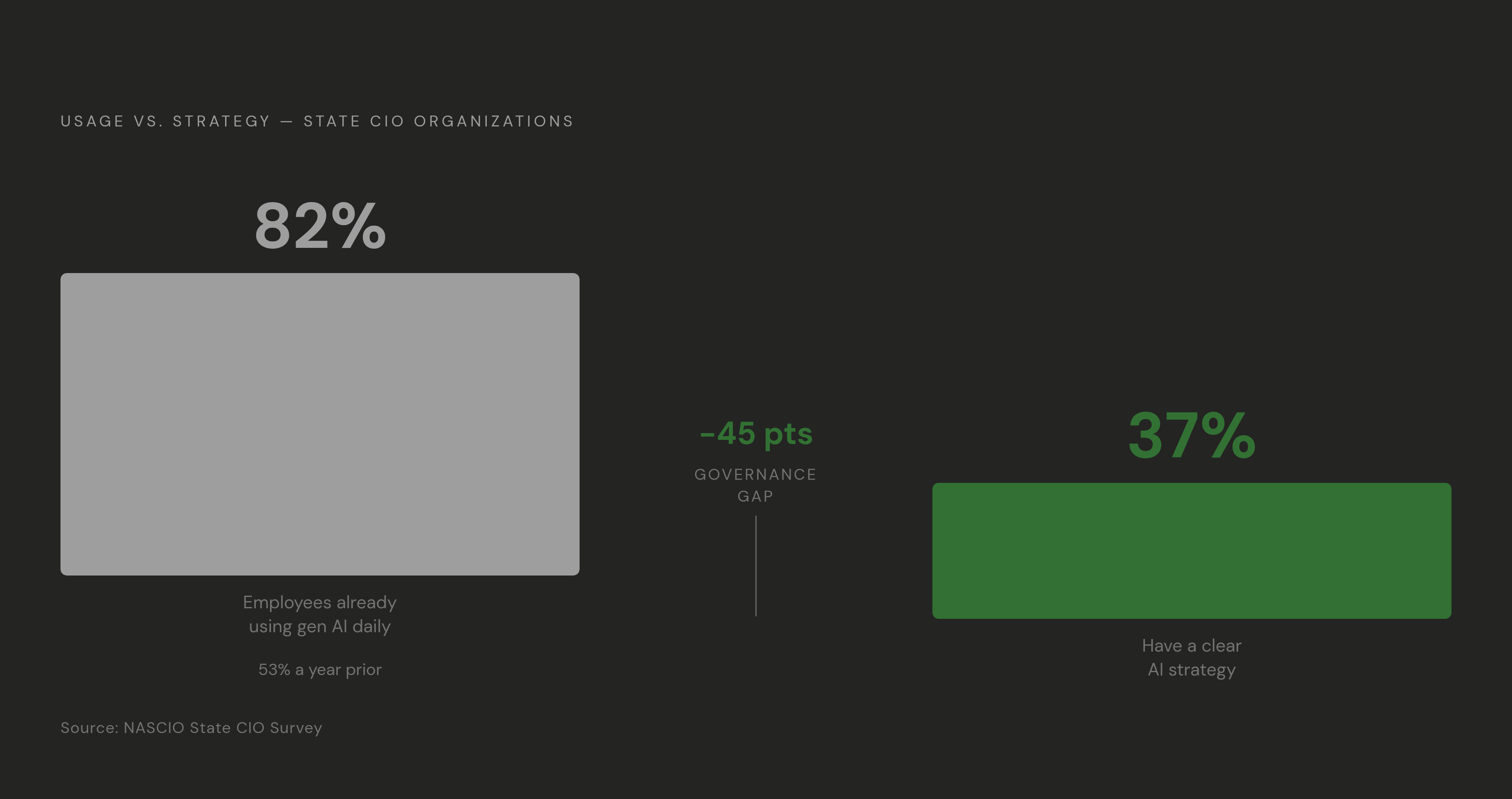
As of April 2026, 82 percent of state CIO organizations report that employees are already using generative AI tools in daily work, up from 53 percent a year earlier. Fewer than 37 percent of public-sector organizations report having a clear AI strategy. Usage is running well ahead of strategy. Tools are embedded in workflows before governance frameworks exist to manage them, and that sequence is nearly impossible to reverse cleanly once it sets.
NASCIO's 2026 top priority framing reflects this reality directly. The number one priority is not AI deployment; deployment is already happening. It is AI governance and policies, alongside security and privacy, workforce skills, data quality, and ethical use. The governance is the work that is actually behind.
The cost of skipping this sequence is not abstract. I have watched agencies stand up benefits-screening tools that were technically sound and operationally efficient right up until an audit revealed the model had been producing systematically skewed eligibility determinations for months. The downstream work, legal review, case remediation, public communications, was an order of magnitude more expensive than building the governance layer first would have been. Governance architecture is cheaper than governance recovery.
In practice, that architecture has to operate across four distinct concerns: risk accountability, meaning who has actual authority to approve, monitor, and halt a specific use case; workforce readiness, meaning whether staff can use AI tools effectively and evaluate outputs critically before those outputs drive decisions; data quality, meaning whether the inputs to AI systems are accurate, current, and appropriate for the specific use case; and ethical guardrails, meaning how the agency ensures outputs do not discriminate or violate civil rights in frontline service delivery.
Of the 3,611 federal AI use cases reported by 2025, 445 are classified as high-impact. Those are exactly the cases where governance failure is most consequential and most visible, and the ones where a gap between capability and oversight produces real harm to real people.
How to Structure the Chief AI Officer Role and the Accountability Layer Around It
OMB M-25-21 mandates CAIO designation within 60 days. The mandate creates a title. It does not, on its own, create a functioning governance layer.
The most consistent failure mode in early implementations is placing the CAIO at an organizational level without authority to halt a use case or redirect procurement. That produces governance in name only, and it is worse than no formal structure in some respects, because it creates the institutional impression of accountability without the substance. When something goes wrong, and at scale something will, no one has clear ownership of the failure.
Effective CAIO authority has a specific shape. The role needs a direct reporting line to the CIO and, for high-impact use cases, meaningful access to agency leadership. Formal sign-off authority on any use case classified as high-impact under M-25-21 is not optional; it is the mechanism by which the classification system produces real consequences rather than paperwork. The CAIO must function as a coordination point with legal, civil rights, and procurement offices, not as a siloed IT function buried three levels below where decisions actually get made. And there must be a defined escalation path when a deployed system produces unexpected outputs or generates public complaints, specified in advance, not improvised after an incident.
The CAIO also cannot function without a live AI inventory. Agencies must maintain a catalog of use cases, their risk classifications, and their compliance status. The September 2026 OMB reporting deadline makes this non-optional for federal agencies. For state CIOs without an equivalent federal mandate, the CAIO model and the inventory requirement still hold; the governance logic is sound regardless of whether a deadline compels it.
Accountability must extend below the CAIO as well. Program-level AI leads, clear ownership of each deployed use case, and a defined process for flagging and escalating issues from frontline staff are the mechanisms that translate executive governance into operational reality. The CAIO who lacks those connective structures is managing governance on paper, not in practice.
M-25-21 also simplified the previous administration's multi-tiered risk classification into a single high-impact category.
What Workforce Readiness Actually Requires at This Stage of Adoption
Gallup data from Q4 2025 show that 43 percent of public-sector employees report using AI at least a few times a year, including 21 percent who use it daily or multiple times per week. That is up from 17 percent in Q2 2023 and 28 percent in Q2 2024. The acceleration is real, and it is outpacing organizational preparation at nearly every agency I have seen.
Usage frequency and actual capability are different things, and conflating them is a governance error. An employee using an AI tool daily without understanding its failure modes is not a workforce asset; that person is an unmanaged risk at the point where AI outputs become consequential decisions. Increased frequency of use does not mean staff are interpreting outputs critically, recognizing errors, or applying appropriate judgment before acting.
The strategy gap makes this worse. Fewer than 37 percent of public-sector organizations have a clear AI strategy, compared to 53 percent in the private sector, per Gallup's April 2026 data. That gap means most employees using AI tools are doing so without organizational guidance on when to use them, how to verify their outputs, or when to escalate a concern. The tool is in the hands. The framework for using it responsibly is not.
Workforce readiness, in the practical sense, is not a training day. It is four distinct things that generic onboarding does not deliver. First is literacy: understanding what AI systems can and cannot do, and why outputs can be fluent and plausible but factually wrong. Second is role-specific skill: knowing how to apply AI tools appropriately within a specific job function, whether that is benefits processing, procurement review, or infrastructure planning. Third is critical review: the habit and the organizational permission to push back on AI outputs before they become decisions, particularly in high-impact use cases. Fourth is escalation fluency: knowing which situations require human review and which require CAIO-level attention, and feeling safe enough to raise the flag.
One procurement lever that remains underused: workforce readiness requirements should be written into vendor contracts as required deliverables, not optional add-ons. Agencies that treat training as something to figure out after deployment consistently end up with capability gaps that compound.
Data Quality as the Hidden Constraint on Government AI Reliability
Data quality appears explicitly in NASCIO's 2026 governance priorities, not as a technical footnote but as a core concern alongside risk, workforce, and ethics. That placement reflects something practitioners have known for years: government data presents structural challenges that most AI deployments fail to account for adequately, and the consequences of ignoring those challenges are not gradual; they are sudden and visible.
The structural problems are familiar to anyone who has spent time inside a public-sector IT environment. Legacy systems predate interoperability standards by decades. Data is siloed in ways that prevent AI from accessing it cleanly or require extensive manual preparation before it is usable. Inconsistent data entry across agencies, jurisdictions, and time periods produces a particularly dangerous failure mode: AI systems generate fluent, authoritative-sounding outputs even when the underlying data is unreliable. Sensitive data categories, including health information, criminal history, and immigration status, require specific legal handling before they can lawfully serve as AI inputs. And historical government data often encodes past inequities; AI systems trained on it replicate those patterns in their outputs, usually invisibly until litigation or audit forces the issue.
In the high-impact category under M-25-21, data quality failures are not just operational problems. An AI system screening public program applications on inaccurate data produces incorrect eligibility decisions at scale, with direct legal exposure under civil rights law. The harm is distributed across thousands of individuals before anyone catches it.
Governance must require specific steps before a use case is approved: a data quality assessment specific to that use case, not a generic data governance policy; clear identification of data sources, their provenance, and their known limitations; and a monitoring plan for after deployment, because models drift as underlying data changes over time.
Two infrastructure resources matter here. GSA's USAi platform, launched in August 2025, gives federal agencies cost-free access to models from Google, Meta, Anthropic, and OpenAI for testing, providing a low-risk environment to evaluate how a model performs on agency-specific data before committing to deployment. FedRAMP's 2025 AI Prioritization Initiative, completed in April 2026, accelerated authorization of AI-based cloud services designed for repeated federal worker use. FedRAMP authorization is a prerequisite for federal AI deployment, not an optional compliance enhancement.
How to Move from Pilots to Durable Programs Without Losing Governance Control
More than 60 percent of state CIO organizations report at least one generative AI practice implemented, per the NASCIO 2025 State CIO Survey. Most agencies are past the "should we?" stage. The harder question now is how to manage what has already started.
The failure modes at this transition point are consistent, and I have seen all of them. A pilot succeeds in a controlled environment, then scales without adapting governance to the broader population or data set. Or a pilot runs indefinitely because no one owns the decision to scale or sunset it, leaving a governance vacuum where accountability should be. Or multiple pilots run in parallel with no inventory or coordination, so the agency cannot accurately report its own AI footprint when asked.
Here is how the last one tends to unfold in practice. An agency stands up a document-processing pilot, celebrates early efficiency gains, and then quietly expands it to cover benefits determinations without revisiting governance, reclassifying the use case, or notifying the CAIO. By the time someone asks who approved the expansion, three different teams each assume another one did. No one did. The pilot became a program the moment the first real claimant's file went through it, but the governance scaffolding stayed sized for a test. That gap does not surface until an audit, a complaint, or a public records request forces it open.
The sequence that prevents this is straightforward but requires organizational discipline to hold. Every use case requires classification by impact level before deployment begins; high-impact use cases require CAIO sign-off and a data quality assessment. Minimum risk management practices must be defined in writing before go-live, not rationalized after the fact. Monitoring triggers must be defined in advance: specific thresholds at which a deployed use case is reviewed, escalated, or paused. The decision to move from pilot to program must be explicit and documented, with criteria stated before the pilot begins. And every use case must be added to the agency's live AI inventory with an owner, a risk classification, and a compliance status.
The urgency of getting this right is growing. The Department of Defense's FY2026 AI and autonomous systems request signals that scaling is already the federal direction of travel. Beyond that, 53 percent of federal agencies are actively exploring or piloting agentic AI, meaning multi-step autonomous workflows that raise governance stakes significantly compared to single-task tools. The same framework applies to agentic systems, but with heightened scrutiny at the monitoring and escalation stages, because the surface area for unexpected behavior is larger and the failure modes are harder to trace after the fact.
What CIOs Should Look for When Evaluating AI Platforms and Vendors for Government Use
Procurement is a governance instrument. OMB M-25-22 makes this explicit at the federal level, and California's EO N-5-26 signals that the same logic is spreading to states. How an agency buys AI is not separable from how it governs AI.
FedRAMP authorization is the non-negotiable baseline for federal deployments. Any AI platform operating in a federal environment without it is out of compliance before the first use case goes live. For state agencies, FedRAMP authorization is an increasingly useful proxy for security posture even when not strictly required, because it signals that a vendor has undergone structured third-party assessment rather than self-certification.
Beyond authorization status, the evaluation dimensions that matter most are not always the ones vendors lead with. Transparency in model behavior: can the vendor explain, in terms your legal and civil rights teams can actually evaluate, how the model produces its outputs and where it is known to perform poorly? That explainability is not a nice-to-have in government use cases; it is the basis on which you defend a consequential decision. Data handling and residency commitments matter equally: where does the data go, who can access it, and how does the vendor handle the sensitive categories that appear regularly in government workflows?
Vendors should be required to demonstrate performance on government-specific data, not just benchmark scores from commercial datasets. The USAi platform provides a testing environment for exactly this purpose. Any serious vendor evaluation should include assessment against the agency's own data before commitment, not after contract signature.
Contractual provisions deserve more attention than most procurement teams give them. Workforce training and documentation should be required deliverables. Audit rights, model update notification requirements, and clear incident response obligations should be negotiated into the agreement, not assumed. M-25-21's high-impact classification creates real accountability for what AI systems produce in consequential decisions; that accountability should flow through vendor contracts, not stop at the agency boundary.
The procurement pattern worth resisting is evaluating AI platforms purely on feature sets. Capability is necessary but not sufficient. Ask vendors how they have supported agencies through compliance gaps, audit requests, and incident responses. The vendors who have done this work have specific answers; the ones who have not will speak in generalities. How they respond to that question is as informative as any technical demonstration, and it tells you something about what the relationship will look like when something goes wrong.
The agencies building durable AI programs right now are not waiting for the policy environment to stabilize. They are building frameworks flexible enough to absorb continued regulatory evolution while structured enough to provide real accountability today. Governance-first is not caution dressed up as strategy. It is the only sequencing that actually scales.
Sources
- https://www.whitehouse.gov/wp-content/uploads/2025/12/M-26-04-Increasing-Public-Trust-in-Artificial-Intelligence-Through-Unbiased-AI-Principles-1.pdf
Provided the basis for the discussion of OMB M-26-04 and its large language model procurement standards.
- https://www.hunton.com/privacy-and-cybersecurity-law-blog/omb-issues-revised-policies-on-ai-use-and-procurement-by-federal-agencies
Provided detail on M-25-22 governing AI procurement standards for federal agencies.
- https://www.akingump.com/en/insights/ai-law-and-regulation-tracker/omb-issues-memorandum-on-accelerating-federal-use-of-ai-through-innovation-governance-and-public-trust
Supported the description of M-25-21 requirements including the OMB reporting deadline for high-impact use cases.