Information Governance Framework Comparison for State CIOs
State CIOs need a governance mix, not a single framework.
State CIOs are juggling seven governance frameworks, four competing priorities, and a legislature that wants to know why the data warehouse still can't talk to the DMV. This piece works through which information governance framework actually fits a state government's mix of accountability, budget, and now, AI. The honest answer: no single framework covers all four things state CIOs care about, and picking one and calling it done is the most common mistake in this space. A state CIO who adopts NIST CSF and calls information governance "finished" has confused a cybersecurity spine for a full skeleton.
State government answers to a different set of pressures than a company chasing shareholder value or a federal agency navigating one clean set of regulatory triggers. It answers to legislative oversight committees, inspector generals, the governor's office, agency directors who each think their data is special, and constituents who just want their unemployment claim processed without three phone transfers. The 2024 NASCIO State CIO Survey flagged a persistent gap between rising demand for digital services and flat or shrinking budgets, so every framework decision is really a budget decision wearing a technical costume. Add in the push toward consolidated infrastructure and centralized IT project management, and the scope of what "governance" even covers keeps growing. Meanwhile the Chief Data Officer role is still finding its footing: The Chief Data Officer role is still finding its footing across states, which sounds like progress until you notice that information governance, in most states, still lands on the CIO's desk by default rather than by design.
How state CIO priorities have shifted — and what that signals for governance framework needs
For twelve straight years, cybersecurity sat at the top of NASCIO's annual Top 10 list, long enough for whole generations of state employees to onboard, retire, and never know a world where the CIO's biggest headache was anything else. Then the 2026 list, NASCIO's 20th edition, drawn from 51 state and territory CIOs, knocked cybersecurity out of first place, and AI took over.
That shift tracks where the money and the accountability pressure are actually moving. Agentic AI is starting to handle multi-step administrative workflows, and generative AI is already drafting and summarizing policy documents and legislative language in state agencies right now, not someday. Look at the 2025 and 2026 lists side by side and the trend gets clearer. Cybersecurity and risk management, covering governance, security frameworks, data protection, and third-party risk, held the number one spot in 2025, AI, machine learning, and robotic process automation sat at number two in 2025 before jumping to the top slot in 2026, and data management and analytics, covering governance, architecture, and strategy, ranked fourth in 2025, while budget and cost control, along with accessibility, both moved up heading into 2026.
Here's the wrinkle worth sitting with: state CIOs generally prefer broad federal ethical guidance on AI over prescriptive federal mandates. That preference means whatever governance structure a state builds now needs enough give in it to bend as federal posture shifts, rather than breaking the first time Washington changes its mind. Put those pieces together and the requirement for 2026 gets clear fast: an adequate framework has to handle cybersecurity risk, AI accountability, data quality, and budget efficiency, ideally without forcing a state to run four separate frameworks side by side.
What "information governance framework" actually means across the leading options
Before comparing these frameworks, it helps to admit they aren't solving the same problem. That's the part that trips people up in vendor demos and conference sessions, where someone says "framework" and everyone in the room means something different.
NIST's Cybersecurity Framework 2.0, released February 26, 2024, its first major revision since 2014, is a cybersecurity risk framework. It's built around six functions, 22 categories, and 106 subcategories, and the 2.0 update added a new function called Govern that deals directly with leadership accountability and enterprise risk management. It also widened the framework's reach beyond critical infrastructure operators to organizations of any kind. COBIT 2019, maintained by ISACA, is an IT governance and audit framework; it ties data governance back into existing IT audit and risk management processes and tends to shine in places already running COBIT for other IT controls. DAMA-DMBOK is different again: a practitioner knowledge body covering eleven data management disciplines, things like data quality, metadata, stewardship, and architecture, it reads more like a reference shelf than a step-by-step manual.
ISO 27001, updated in 2022, defines an Information Security Management System using the Plan-Do-Check-Act cycle, and it's a certification-path standard, meaning an outside auditor can stamp a program as compliant. The Data Governance Institute's DGI Framework focuses narrowly on organizational design: who owns data, who decides what happens to it, how disputes get resolved. DCAM, from the EDM Council, is a capability assessment model, useful for figuring out where an organization stands before it commits real budget to a full framework rollout.
Each one carves out its own territory, and treating them as competitors is where most comparisons go wrong. Most mature state programs stack them, running NIST CSF for cybersecurity posture alongside DAMA-DMBOK for data stewardship, the way a kitchen runs a fire suppression system and a health inspector checklist at the same time. Different risks, different tools, but the same building.
How each framework handles cybersecurity and risk — the historically dominant state CIO concern
NIST CSF 2.0 wins this one, and it's worth asking why before just nodding along. The new Govern function speaks directly to enterprise risk management, leadership accountability, and third-party or supply chain risk, the exact categories NASCIO's 2025 survey flagged under cybersecurity priorities. CSF carries voluntary status for state governments, but it lines up with DHS and CISA guidance and federal Zero Trust architecture requirements, and it overlaps usefully with regimes like HIPAA. That voluntary status gives state CIOs room to tailor adoption without tripping a formal compliance obligation nobody asked for.
COBIT 2019 brings an audit trail to the table. States with active legislative auditors or finance oversight bodies get real value from COBIT's habit of tying IT risk to formal audit readiness. One study of a public sector agency running COBIT 2019 found it operating at Level 3, or "Defined," maturity: processes were written down and standardized, but automation, proactive risk management, and real-time monitoring still had gaps. That's a useful way to think about the COBIT and NIST relationship. COBIT tells a state where it stands on risk maturity right now, while NIST CSF tells it what to build next.
ISO 27001 matters most for states that contract with regulated industries or federal partners who want to see a certified ISMS documenting real, verifiable controls. It demands documented controls and visible management commitment, and the implementation lift runs heavier than CSF for a comparable cybersecurity outcome. DAMA-DMBOK and the DGI Framework don't touch cybersecurity risk directly, and that's a scope boundary, not a flaw. A state leaning on either one alone for risk management finds that gap the hard way, usually during an active incident, which is a rough time to discover what your framework doesn't cover.
How each framework handles data quality, stewardship, and cross-agency sharing — the operational challenge that cybersecurity frameworks underserve
Government data has demands that general IT frameworks weren't built to answer: public accountability, metadata that stays consistent across dozens of agencies, and privacy protection for citizen records that pass through many hands before reaching wherever they're going. This is the layer where cybersecurity frameworks quietly run out of runway. It's also the layer most state governance plans skip past, because it doesn't have a name as familiar as "cybersecurity."
DAMA-DMBOK's eleven knowledge areas map almost one-to-one onto problems state data teams actually hit, from metadata that two agencies define two different ways without anyone noticing until a report comes out wrong, to data quality gaps that show up hard in legacy state systems built before half the current staff were hired, to stewardship roles that give states a direct answer to who's accountable for a dataset once it crosses an agency line. The catch: trying to adopt all eleven knowledge areas at once tends to overwhelm even well-funded programs, so most state efforts pull from DAMA-DMBOK selectively rather than treat it as a mandate to implement wholesale.
The DGI Framework is narrower but faster to stand up. It answers who decides, who owns, and how disputes get resolved, which makes it genuinely useful for a state that needs data ownership structures in place quickly. COBIT 2019's data governance coverage links data management to existing IT audit controls well enough, but it wasn't built for the depth of metadata and stewardship work that multi-agency data sharing actually requires. NIST CSF 2.0 treats data confidentiality and integrity as security properties, full stop; a state relying only on CSF ends up with security-oriented data controls and no stewardship layer underneath to support analytics or AI work. Some states already inside the ISO ecosystem look to principle-driven extensions as complements, though these tend to be light on operational detail.
The frameworks that win on cybersecurity and the ones that win on data management cover different domains of state operations entirely, and mistaking one for the other is exactly how a state ends up with strong security controls and weak data-sharing practices. That's the practical reason single-framework adoption is rare among mature state programs. It's also why the CIOs who lean hardest on NIST CSF alone tend to be the ones surprised, six months later, that two agencies still can't agree on what "active case" means in a shared database.
Then the 2026 list, NASCIO's 20th edition, drawn from 51 state and territory CIOs, knocked cybersecurity out of first place, and AI took over.
How each framework positions a state to govern AI — the dimension that now tops the NASCIO list
None of these frameworks was built with generative or agentic AI in mind, and that gap deserves to be named plainly rather than papered over. The real question is which framework bends toward AI governance without a full rebuild.
NIST CSF 2.0's Govern function adapts fastest. The enterprise risk management, policy documentation, and accountability structures the Govern function already requires come close to what's needed to govern AI procurement, deployment, and audits. States already running CSF 2.0 get a built-in structural foundation for expanding into AI risk management rather than a cold start. DAMA-DMBOK matters here in a different way: AI output quality is bounded by input data quality, and states already using GenAI to draft policy language or review contracts need metadata lineage and quality controls to check that output against its source. States that already put DAMA-DMBOK stewardship structures in place are, in effect, better positioned to audit what an AI system produces.
COBIT 2019's audit-readiness angle stays relevant, since AI procurement and deployment draw legislative scrutiny, and COBIT's control structures generate the kind of audit trail legislators tend to ask for. ISO 27001 covers the data AI systems consume as information assets subject to confidentiality, integrity, and availability controls, a necessary but partial piece of the picture on its own. DGI and DCAM apply less directly, though DGI's accountability structures could stretch to cover AI decision-rights questions, like who signs off on an AI-generated output before it reaches a citizen. The pattern showing up in states: build AI governance policy on top of whatever information governance framework already exists rather than standing up a separate AI-specific system from scratch, which makes the base framework choice carry more weight than it used to. Given that state CIOs favor flexible federal guidance over prescriptive mandates, the frameworks offering structure without dictating specific technical controls fit that posture best. NIST CSF, again, edges ahead here, since its structure bends without breaking.
How each framework fits state budget realities and implementation maturity
Budget and cost control climbed the 2026 NASCIO list for a reason, and picking a framework while ignoring what it costs to run makes for an incomplete decision no matter how good the framework looks on paper.
Implementation cost swings wide across these options. DCAM sits at the low end, built as a capability assessment to run before full framework adoption, which suits a state with low governance maturity that needs to see its gaps before spending real money closing them. The DGI Framework is relatively light too; its focus on organizational design means a state can put it in place through policy and role definitions without a major tooling purchase. NIST CSF 2.0 scales, one of its strongest practical selling points: a state adopts the framework's structure at whatever depth its budget allows, then deepens it over time as funding permits. DAMA-DMBOK, taken as a whole, costs real money and real staff time, which is exactly why selective adoption of individual knowledge areas is both common practice and good sense for a resource-strapped agency. ISO 27001 sits at the top of the cost curve: documentation, audit requirements, management commitment, and recurring surveillance audits that keep billing the state long after initial certification. COBIT 2019's cost depends heavily on history: incremental for a state already running COBIT elsewhere, substantial for a state adopting it fresh.
Oregon's Enterprise Information Services model offers a useful real-world reference point. It runs a formal Maturity Assessment across agencies under IT investment oversight, evaluating governance, project management, and organizational structure before setting the oversight level each agency operates under, with a stated target of a large majority of agencies running formal IT governance procedures and functioning IT Governance Committees. Separately, a systematic literature review of 23 articles on COBIT 2019 implementation between 2020 and 2024 found successful use across education, healthcare, logistics, and mining, evidence the framework adapts across sectors, though public sector accountability structures don't map cleanly onto any of those industries.
For a state working with a tight budget, here's the sequence that actually holds up: run a DCAM or DGI assessment first, adopt NIST CSF 2.0 as the cybersecurity spine, then layer in DAMA-DMBOK selectively for the data quality and stewardship domains that AI and analytics programs actually demand. Trying to do all three at once tends to leave a state with three half-finished frameworks and an overworked CIO, and that outcome shows up often enough that it's worth naming as the default failure mode, not the exception.
A side-by-side evaluation of the frameworks against the four dimensions that matter most to state CIOs
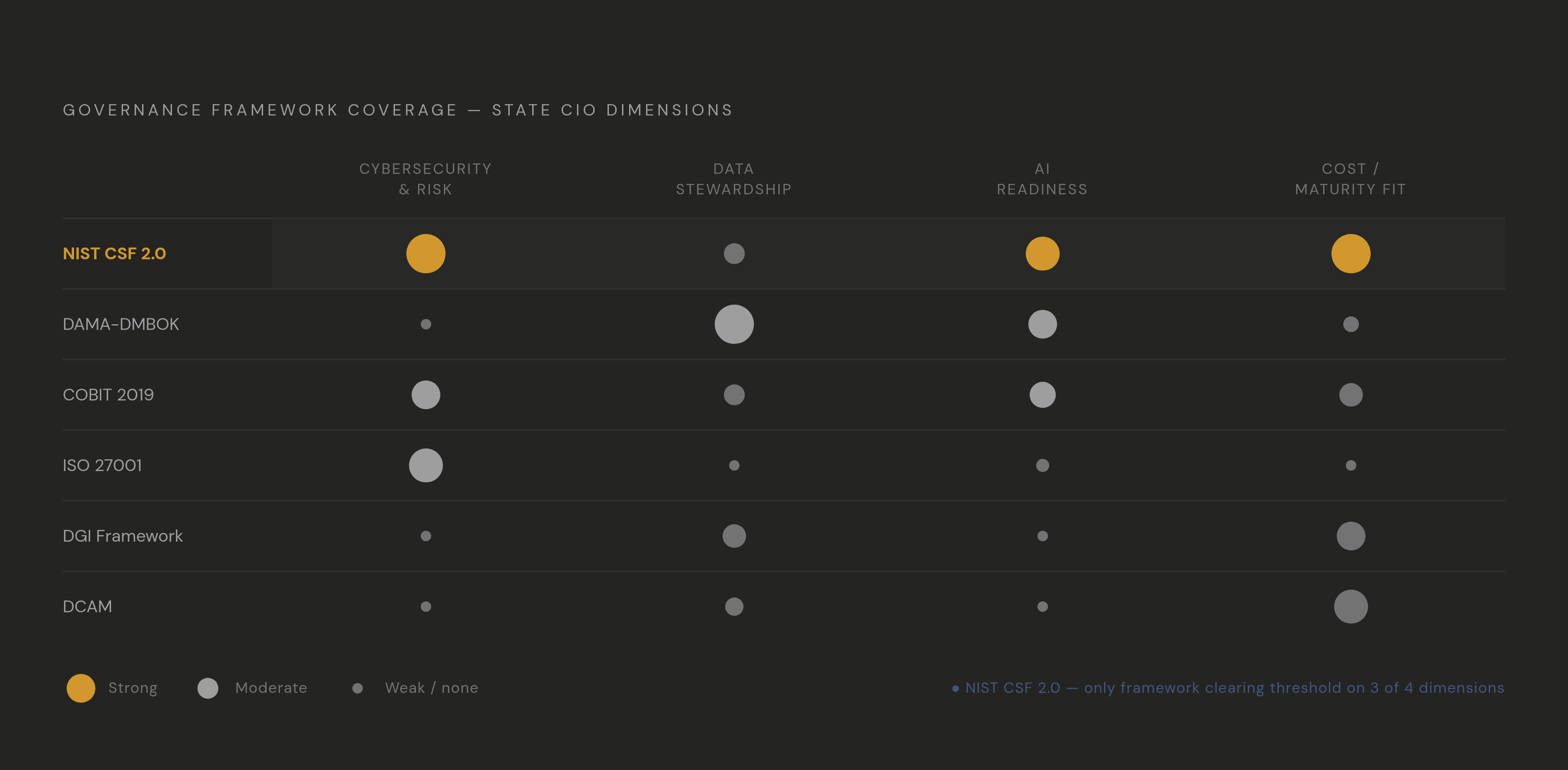
Line the frameworks up against the four dimensions that have shaped this whole comparison: cybersecurity and risk governance, data quality and cross-agency stewardship, AI governance readiness, and implementation cost against maturity fit.
NIST CSF 2.0 leads on cybersecurity and risk, no real contest there, and its Govern function gives it a real head start on AI governance readiness too, since enterprise risk accountability structures carry over almost directly. It runs weaker on data quality and stewardship depth, since confidentiality and integrity as security properties aren't the same thing as metadata lineage and stewardship roles. Its implementation cost scales, which makes it a strong fit across nearly any state budget size. If a state can only pick one framework to start with, this is the one. The mistake most states make is treating NIST CSF as the finish line instead of the floor, closing the tab once the cybersecurity box is checked and calling the rest "phase two," which somehow never arrives.
DAMA-DMBOK inverts that profile: strongest option for data quality and cross-agency stewardship, meaningful contribution to AI governance through its data lineage and quality disciplines, but it does nothing for cybersecurity risk directly and carries real implementation weight if adopted wholesale rather than selectively.
COBIT 2019 offers middling-to-strong performance across cybersecurity audit readiness and AI procurement oversight, particularly for states with existing IT audit infrastructure, but its cost profile depends entirely on whether COBIT is already embedded in the state's IT culture. ISO 27001 delivers a certifiable cybersecurity posture, which matters for states dealing with regulated partners, but it's the most expensive option on this list to implement and maintain, and its contribution to data stewardship and AI governance stays thin. DGI and DCAM both play supporting roles rather than headline ones: DGI for fast, lightweight data ownership structuring, DCAM for maturity assessment before a state commits to anything bigger. Neither covers cybersecurity risk on its own, and neither was built with AI governance in mind, though DGI's accountability logic extends there reasonably well.
None of this resolves into a single winning framework, and that's the actual finding here. The state CIOs getting the most out of this landscape are combining a cybersecurity spine, usually NIST CSF 2.0, with selective data stewardship structure from DAMA-DMBOK or DGI, then stretching both toward AI governance instead of starting over. The real friction shows up less in picking the framework and more in getting the resulting policy language, data workflows, and accountability rules written down and pushed out consistently across dozens of agencies that don't even share a communications team. A framework document sitting on a SharePoint site does nothing for the DMV clerk who's never heard of NIST CSF and just needs to know which fields she's allowed to share with Health and Human Services.
That's a publishing and content operations problem as much as a governance one. The framework sets the rules; someone still has to write them down in a way fifty different agency directors can actually follow, and that last step is where most of these frameworks stop being useful.
Sources
- https://www.nascio.org/wp-content/uploads/2024/12/NASCIO-2025-State-CIO-Top-10-Priorities.pdf
Provided the 2025 NASCIO Top 10 rankings, including cybersecurity at number one and AI/ML at number two, used in the priority-shift analysis.
- https://www.oregon.gov/eis/Documents/01%20-%20EIS%20-%20IT%20Governance%20Guide%20-%202024.pdf
Supplied the Oregon Enterprise Information Services model details, including its Maturity Assessment approach and IT Governance Committee targets.
- https://www.nascio.org/resource-center/the-2024-state-cio-survey/
Cited as the source for the persistent gap between rising demand for digital services and flat or shrinking state budgets.
- https://www.nascio.org/wp-content/uploads/2025/09/The-2025-State-CIO-Survey_a11y.pdf
Cited as the basis for the 2026 priority rankings drawn from 51 state and territory CIOs, including AI displacing cybersecurity at the top.