IT Workforce Hiring and Retention Crisis in Government
Government lost 17,000 tech workers in one year, crippling cybersecurity and agency operations.

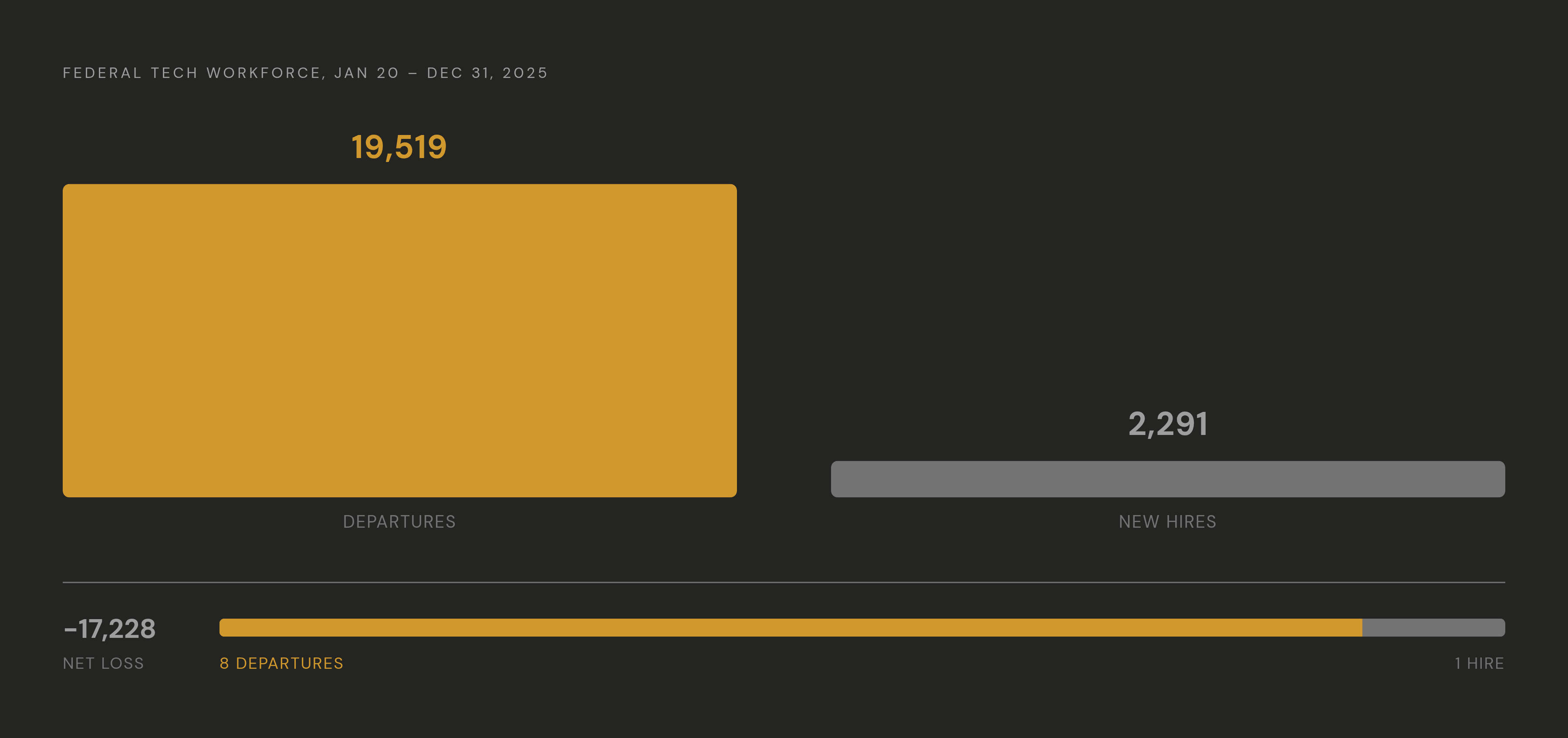
Between January 20 and December 31, 2025, 352,285 federal employees departed government service. Of those, 19,519 were in IT management, computer science, computer engineering, data science, and telecommunications. Net the new hires, and the government shed 17,228 tech employees in under a year. Nearly eight departures for every one hire. That is not a turnover problem. That is a structural collapse.
The administration called most of those departures voluntary. Former employees describe something more coercive: work environments that became untenable, layoff threats credible enough that waiting felt like a losing bet. The distinction is consequential. Voluntary attrition is harder to reverse than a layoff. Those workers have already moved, recalibrated their professional identities, and self-selected out of the federal orbit. You can't recall them with a reopened requisition.
The damage spread across agencies. The Department of Defense lost over 61,000 employees in 2025, roughly 8 percent of its total workforce, including approximately 3,500 in IT. IRS tax system upgrades slowed. A federal health benefits program for postal workers approached operational risk. Cybersecurity defenses came under strain at precisely the moment threat actors have every incentive to probe for weakness.
All six agencies that absorbed the largest IT management losses (Defense, Treasury, Agriculture, Veterans Affairs, Homeland Security, and GSA) are now actively recruiting on USAJobs. The whiplash is real: reduce, then scramble to rehire, at higher cost, for the same institutional knowledge that just walked out the door.
One demographic pattern deserves attention on its own. The share of federal employees under 30 fell from 8.9 percent to 7.9 percent in a single year. Younger workers have fewer switching costs and more private-sector options; they were among the first to leave, and among the least likely to come back.
CISA as a Case Study in What Happens When Cybersecurity Staffing Collapses
CISA entered fiscal year 2025 with approximately 3,400 employees. By December it had around 2,400, a loss of roughly 1,000 people through layoffs, buyouts, and early retirements. Per Senator Warner's June 2026 letter, the agency's authorized staffing level is 3,292 positions; only 2,324 are filled. Five of CISA's ten regional directors are currently serving in acting capacities.
That last detail is worth sitting with. Regional directors are the primary federal points of contact for state and local governments during a cyber incident. Rotating acting leaders erode exactly the institutional knowledge and trust relationships that make incident response work under pressure. When ransomware hits a water utility or a hospital network at 2 a.m., an established federal contact is a practical asset. Starting cold is not equivalent.
Budget pressure compounds the personnel losses. The proposed FY2026 CISA budget of $2.49 billion is down from $2.87 billion under the continuing resolution, a $380 million cut. The federal cybersecurity scholarship program that feeds future government security workers would be reduced by over 60 percent. That program takes years to produce results, and it is being cut at the moment when the pipeline it feeds is most depleted. The asymmetry is not subtle.
CISA matters here not because it is a unique case, but because it makes explicit what stays implicit elsewhere. Staffing gaps in security roles don't just slow operations. They reduce the government's capacity to detect and respond to threats. The agency is a working demonstration of what the broader federal IT crisis looks like when it plays out in the open.
The Retirement Cliff That Was Already Building Before Any of This
Over 40 percent of federal IT professionals are already eligible for retirement, concentrated in cloud operations, cybersecurity, and data engineering. Less than 7 percent of the total federal workforce is under 30, and only around 4 percent of those younger workers are in IT and cybersecurity roles. In the private sector, roughly 23 percent of the workforce is under 30. The government's pipeline of digitally native talent is not just thinner; it is a fraction of what the commercial market is producing and absorbing.
Losing a full percentage point of the under-30 share in a single year means the workers who would have eventually replaced retiring seniors aren't somewhere in the pipeline building experience. They're gone. That is a different kind of problem.
And the succession gap isn't only numerical. It is a knowledge transfer problem with no clean solution. Many of the systems federal IT workers maintain are decades old. The institutional knowledge required to operate them — the undocumented workarounds, the interdependencies nobody wrote down, the reasons why that particular configuration exists — lives in the heads of senior employees. When those employees leave without overlap, that knowledge is lost. There is no manual. There is a retiree who has moved on, and a junior employee staring at a system they were never trained to understand.
The 2025 attrition didn't create this cliff. It accelerated it by several years, simultaneously.
Why Federal IT Pay Fails to Compete and How Far the Gap Actually Runs
Federal employees on the General Schedule earn 24.72 percent less than private-sector employees in comparable roles, per FY2024 Federal Salary Council data. The Federal Employees Pay Comparability Act of 1994 was supposed to close that gap to within 5 percent. Thirty years later, it has never been fully implemented.
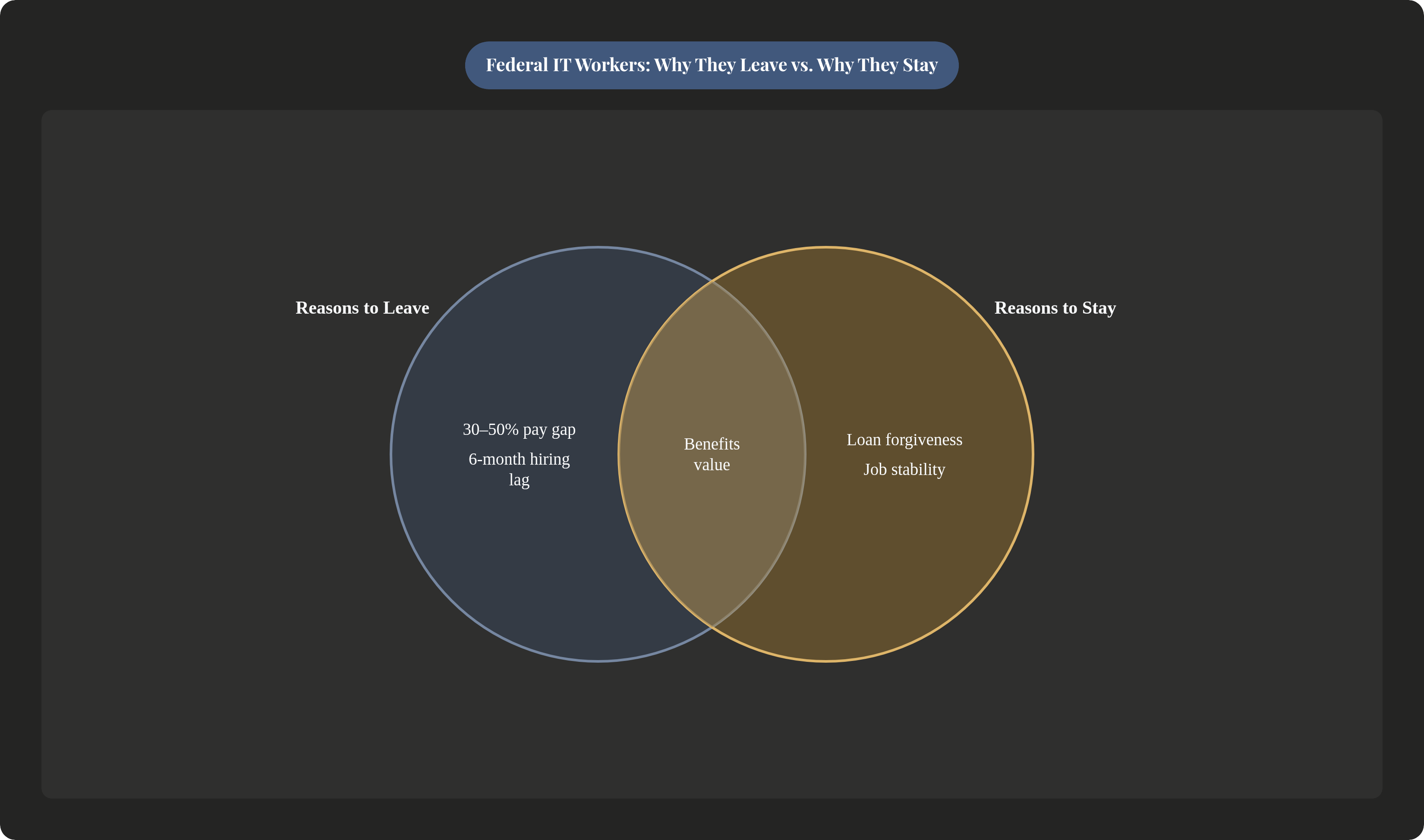
The gap is not uniform. It widens at the top of the technical ladder. Senior cybersecurity professionals face a disparity somewhere in the range of 30 to 50 percent. AI and machine learning engineers face an even larger divergence. The roles the government most urgently needs to fill are precisely the ones where its compensation is most uncompetitive.
The honest counterargument is that total compensation, including defined-benefit pensions, lower health insurance premiums, Public Service Loan Forgiveness eligibility, and genuine job stability, narrows the headline gap for certain candidate profiles. Some analysts argue that when benefits are fully valued, federal compensation is less disadvantaged than the salary figure alone suggests. That argument is real, and it has limits.
Benefits packages structured around retirement security appeal most to mid-career workers who are already seeking stability. They do not resonate the same way with an early-career engineer fielding three competing offers, or a senior technical specialist who can earn substantially more in the private sector and negotiate their own benefits package. The government's most competitive compensation offer is aimed at a candidate profile that is not its most urgent hiring need.
There is also a sequencing problem that is easy to underestimate. Candidates see a salary number before they see a benefits breakdown. The number loses.
The Department of Defense lost over 61,000 employees in 2025, roughly 8 percent of its total workforce, including approximately 3,500 in IT.
How Federal Hiring Processes Block the Candidates Who Do Want to Serve
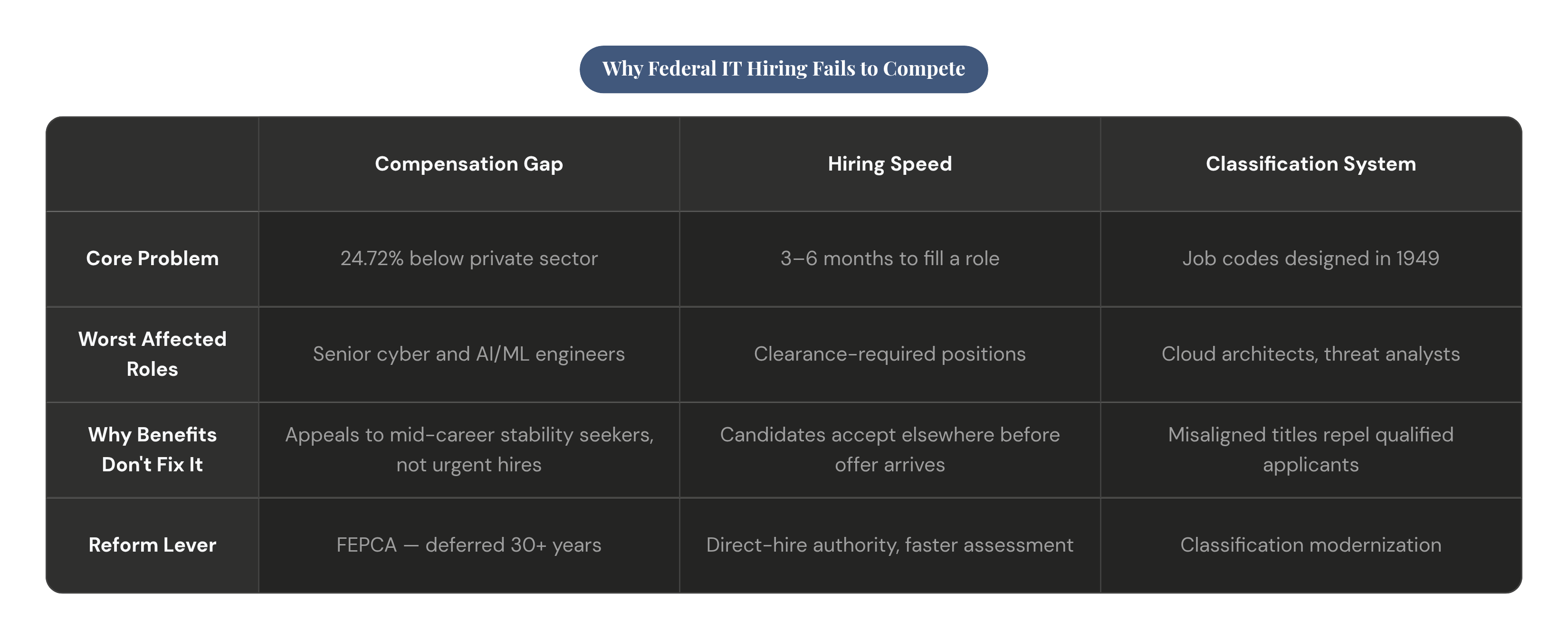
The average federal IT position still takes three to six months to fill, even with incremental gains from AI-assisted HR tools. A candidate who enters the process in January will not receive an offer until summer. By then, they have almost certainly accepted something else. Not because they gave up on public service. Because they had rent.
Job classification systems still in active use were designed in 1949. They were not built to describe a cloud architect, a threat intelligence analyst, or a machine learning engineer. When agencies shoehorn modern technical roles into antiquated classification structures, the titles and salary bands they can offer are often misaligned with how the private sector frames identical work. A talented candidate comparing options will not even recognize the federal version of the role they are looking for.
Security clearances compound the timeline further. Roles requiring clearances extend hiring windows significantly, and candidates who receive private-sector offers while waiting rarely stay in the federal pipeline. The window is too long. The opportunity cost is too legible.
NIST CyberSeek data from June 2025 recorded hundreds of thousands of U.S. cybersecurity job postings in a single twelve-month window, with roughly a quarter of roles unfilled. Government agencies are competing for those same people against contractors, financial services firms, and technology companies, all of which move faster and pay more.
The structural problem compounds itself. Slow hiring drives away candidates. Fewer applicants means less selectivity. Less selectivity erodes the quality of the hiring signal. Lower confidence in the process makes agencies more cautious, not less. Which means slower hiring. The system was designed for a different era, and it behaves accordingly.
Short-Term Hiring Models and Why the Government Is Experimenting With Them Now
The "Tech Force" model, built on earlier OPM frameworks, recruits IT workers for short-term government engagements. A tour-of-duty structure rather than a permanent civil service commitment. The logic is direct: if permanent hiring is slow and compensation is uncompetitive, short-term arrangements sidestep both barriers. Workers don't commit to a General Schedule salary for twenty years. Agencies don't run a full competitive hiring process.
Short-term models also address knowledge transfer in a specific, useful way. Bringing in technical specialists for twelve to twenty-four month engagements to work alongside permanent staff can preserve operational continuity while modernization projects move forward. The specialist's expertise transfers into the institution rather than remaining trapped with the individual.
The risk is worth naming plainly. Tour-of-duty models create their own continuity problems if engagements aren't managed with intentionality. Institutional knowledge built during a short engagement walks out at the end of the term, same as it walks out when a permanent employee retires without overlap. The mechanism of loss is different; the result is similar if handoffs aren't structured.
At the state and local level, managed services and IT contracting firms fill a parallel function, stepping in where agencies lack the infrastructure to run even a simplified hiring process. These models address immediate operational gaps. They are not a permanent fix. They buy time while longer-term pipeline and compensation reforms move at their considerably slower pace.
Early-Career Pipelines as the Longer-Term Structural Answer
OPM's directive to agencies to prioritize early-career hiring was a direct response to a concrete loss: the under-30 share of the federal workforce fell a full percentage point in a single year. The directive acknowledges something that often gets treated as an abstraction. The problem is not only about filling today's vacant roles. It is about reconstituting a generational cohort that was actively depleted.
The federal cybersecurity scholarship program that placed graduates into government roles is now cut by over 60 percent. Pipeline programs take years to show results and are among the hardest investments to rebuild once dismantled. The asymmetry between how fast they can be cut and how slowly they can be reconstructed is one of the most underappreciated dynamics in workforce policy, and one of the most consequential.
Apprenticeship models and skills-based hiring pathways offer a different route into the pipeline. They bypass the credential inflation that traditional federal classifications reinforce, which matters specifically in cybersecurity and data roles where bootcamp-trained and self-taught candidates compete credibly with four-year degree holders. Requiring a degree for a role that doesn't need one is a self-imposed constraint on the available talent pool, and the government imposes it constantly.
University partnership models, including agency residencies and cooperative education programs, allow agencies to build relationships before students graduate. A student who has already worked in a federal environment, understands the mission, and has a name associated with the agency is a categorically different recruiting prospect than a cold applicant. The activation energy of the eventual hiring moment drops considerably.
Max Stier of the Partnership for Public Service has observed that disproportionate numbers of young, tech-savvy employees departed during the 2025 reduction. Pipeline programs aren't starting from zero. They are rebuilding a cohort that was already being assembled, and then lost. That framing clarifies the actual magnitude of what reconstruction requires.
Streamlining Security Clearances as a Lever on Hiring Speed
Security clearance timelines are among the most frequently cited reasons technical candidates withdraw from federal hiring processes. The wait creates a window, sometimes months long, during which a private-sector offer closes the deal. The candidate who genuinely wanted to serve the public mission walks away not because they lost interest, but because they ran out of time to wait.
The Department of Defense, which absorbed the largest share of IT staff losses in 2025 and operates the largest portfolio of clearance-required roles, faces this problem at its most acute. The clearance pipeline issue is not evenly distributed; it is concentrated precisely where the government's technical needs are most sensitive.
Continuous evaluation models represent one reform pathway. Rather than periodic reinvestigation on a fixed schedule, continuous evaluation monitors credentialed individuals over time, which can reduce the reinvestigation backlog and give agencies more flexibility to move already-cleared contractors into new roles quickly. Provisional or tiered clearance pathways, allowing candidates to begin work in lower-sensitivity roles while full processing continues, have been piloted and give agencies the ability to start extracting value before adjudication concludes.
The clearance reform conversation intersects directly with the short-term hiring model. Contractors who already hold active clearances are the fastest path to filling urgent gaps in classified environments. That is a significant part of why the managed-services channel expands when federal hiring slows. The market finds the workaround even when policy doesn't.
Clearance reform alone does not touch compensation or classification barriers. It is one variable in a multi-variable problem, most useful for the subset of roles where timeline is the primary bottleneck and the candidate would otherwise accept the offer. For those roles, it matters enormously.
What Actually Has to Change for the Compounding Loop to Stop
Each layer of this crisis reinforces the others. Slow hiring produces unfilled roles. Unfilled roles degrade mission performance. Mission degradation makes it harder to recruit candidates motivated by public service. Harder recruitment leads back to slow hiring. Nothing in this loop self-corrects. It requires deliberate intervention at multiple points simultaneously, which is precisely why it resists easy fixes and survives bad ones.
Short-term models buy time but don't rebuild institutional depth. Early-career pipelines rebuild depth but can't fill this year's gaps. Clearance reform helps a specific subset of roles. Compensation reform requires legislative action that has been deferred for thirty years and counting. The FEPCA gap (authorized to close in 1994, still sitting at 24.72 percent below the private sector in 2024) is the clearest available illustration that good policy frameworks and actual implementation can diverge for an entire generation and nobody closes the distance.
The interventions gaining traction now (Tech Force short-term engagements, OPM's early-career directive) are working within existing constraints rather than changing them. That limits their ceiling. They are load-bearing repairs that prevent the structure from worsening while the foundation remains unaddressed.
What would actually break the loop: classification reform that lets agencies title and price modern technical roles competitively, so a machine learning engineer sees a job description that reflects the work they actually do. Sustained pipeline investment that isn't cut when budgets tighten, which means treating workforce development as infrastructure rather than discretionary spending. Hiring processes that move in weeks, not months. The government has demonstrated it can meet faster timelines in emergency contexts, which means the barrier is structural preference, not operational impossibility.
The cost of replacement is a documented concern in workforce economics. At scale, across thousands of departures in a single year, the economics of the status quo warrant scrutiny.
Agencies that have made measurable progress (typically through some combination of direct-hire authority, skills-based assessments, and retention bonuses funded through budget reprogramming) offer a replicable template. The barrier to replication is not the absence of a model. It is the uneven distribution of political will and operational capacity across an enormous, heterogeneous enterprise. That unevenness is the final structural problem, and no single directive, budget line, or reform proposal resolves it alone.
Sources
- https://cogentinfo.com/resources/public-sector-tech-workforce-2025-eight-trends-shaping-government-it-talent
Provided the statistic that over 40 percent of federal IT professionals are already eligible for retirement.
- https://gov.appmaisters.com/retain-top-it-talent-in-government/
Provided the estimate that senior cybersecurity professionals face a pay disparity of 30 to 50 percent compared to private-sector counterparts.
- https://www.nextgov.com/people/2026/02/agencies-lost-around-20000-tech-workers-last-year-and-now-trump-admin-hiring/411222/
Provided the core workforce departure figures: 352,285 total federal employee departures, 19,519 tech workers lost, and a net loss of 17,228 tech employees in under a year.
- https://federalnewsnetwork.com/technology-main/2026/06/trump-administration-builds-on-tech-force-model-to-recruit-it-workers-for-short-term-jobs/
Provided figures on the Department of Defense losing over 61,000 employees, representing 8 percent of its workforce, including approximately 3,500 in IT.
- https://federalnewsnetwork.com/hiring-retention/2026/08/agencies-told-to-prioritize-hiring-early-career-employees-tech-talent/
Sourced OPM's directive to agencies to prioritize early-career hiring in response to the drop in the under-30 federal workforce share.
- https://www.metaintro.com/blog/cisa-job-cuts-workforce-cybersecurity-federal-workers-2026
Provided CISA staffing figures showing the agency dropped from approximately 3,400 to 2,400 employees through layoffs, buyouts, and early retirements.
- https://www.gblock.app/articles/cisa-staffing-cuts-warner-2026
Sourced Senator Warner's June 2026 letter data on CISA's authorized staffing level of 3,292 positions with only 2,324 filled.