Edge Computing Applications in Government Operations
Real-time decisions in contested environments require processing at the edge, not the cloud.
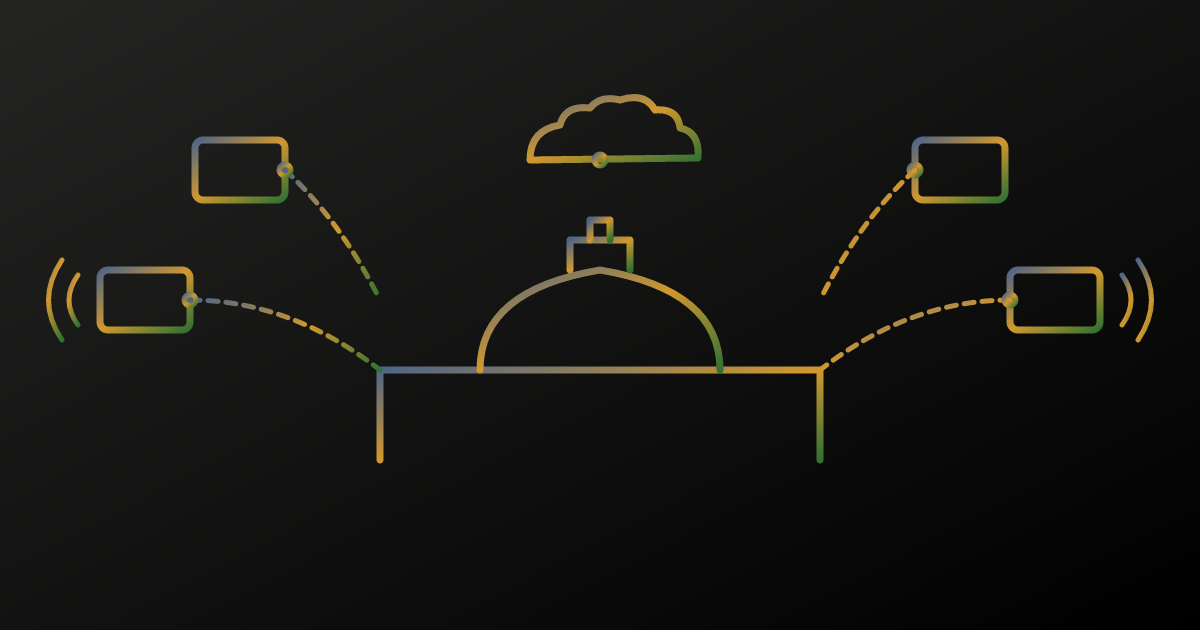
Edge computing moves processing to where data is generated: a sensor, a surveillance camera, a vehicle, a field device. Instead of shipping raw data across a network to a distant data center and waiting for results, a local compute node handles that work on the spot. The latency difference is not marginal. It is the difference between a system that informs a decision and one that confirms what already happened.
In practice, this means ruggedized servers, purpose-built nodes, or deployable compute units sitting at or near the operational environment. They run completely independently of cloud connectivity, or sync selectively when a connection becomes available. The architecture is typically layered: device-level processing feeds a local edge node, which feeds a regional hub, which eventually syncs to a cloud back-end when appropriate. The DoD calls the middle layer the intermediary operational edge, framing it explicitly as a bridge between continental U.S.-based cloud infrastructure and forward-deployed tactical units.
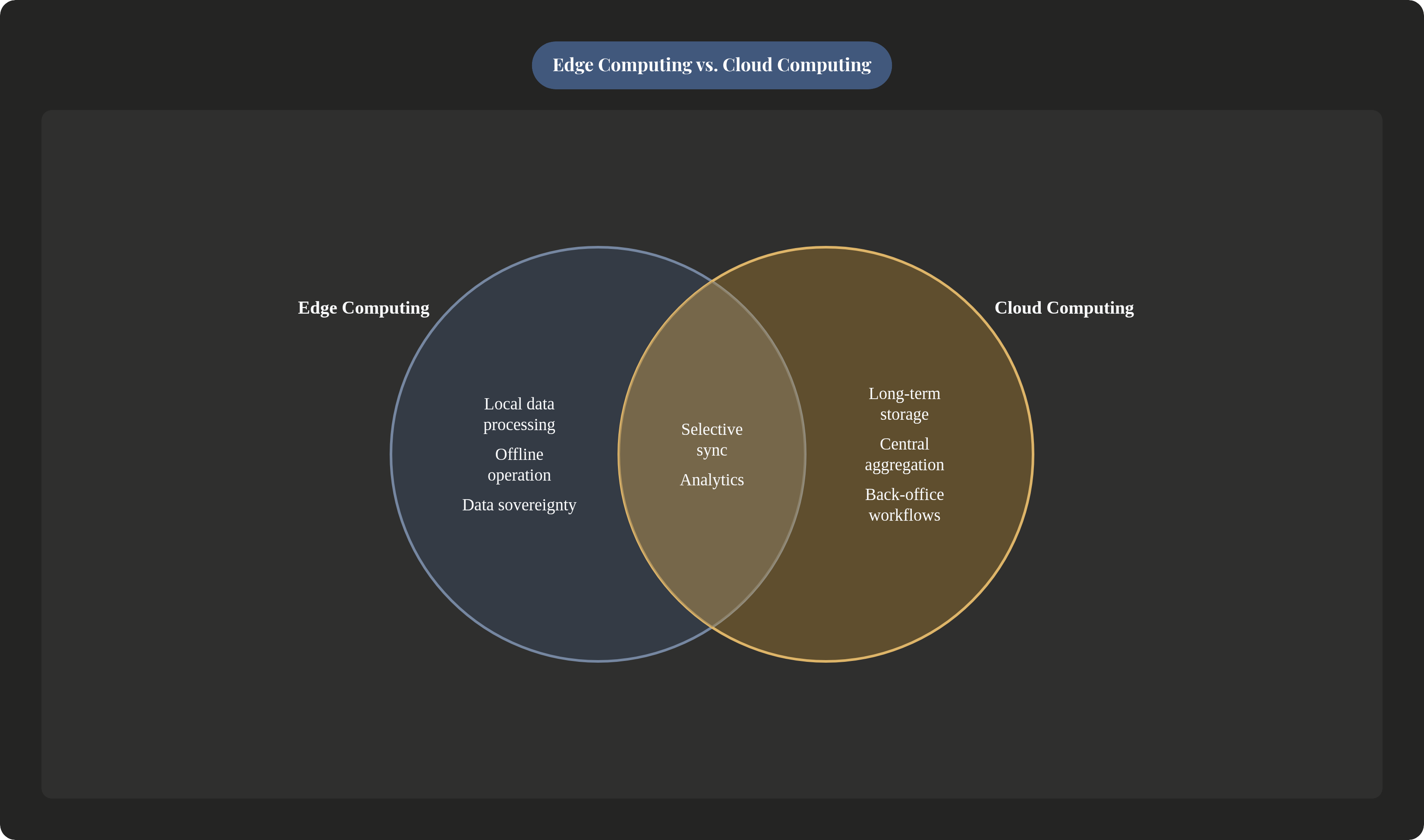
Edge is not a replacement for cloud. It is a complement. Latency-sensitive and connectivity-constrained workloads run at the edge; aggregation, long-term storage, and non-time-critical analytics run centrally. The error is treating either architecture as the default.
Three constraints explain why edge fits government work in ways it largely does not fit commercial use cases. Latency first: cloud round-trips run between 100 and 500 milliseconds depending on network conditions and distance. Tolerable for back-office workflows, disqualifying for adaptive traffic signals, threat detection, or battlefield coordination where decisions resolve in real time. Connectivity second: remote border terrain, forward-deployed military units, and disaster zones operate in environments where reliable, high-bandwidth connectivity is intermittent or simply absent. Cloud architectures assume a live connection; many government operational environments cannot guarantee one. Data sovereignty third: classified data cannot traverse public networks regardless of connectivity quality, and regulations including FedRAMP, FISMA, and CJIS frequently require sensitive data to remain within specific jurisdictions. Gartner projected that 75 percent of enterprise data would be generated outside traditional data centers by 2025, up from 10 percent in 2018. At that volume and distribution, centralizing processing is not just inefficient, it is increasingly untenable, and government operations are among the clearest illustrations of why.
Military and Defense: Edge Computing at the Tactical Edge
The military case is the most structurally compelling because the constraints are not preferences, they are hard requirements. Wartime scenarios destroy or degrade the data centers and networks that cloud architecture depends on. Security restrictions independently prohibit public networks for classified data. Local processing is not a design choice; it is a structural necessity.
The F-35 program is an instructive early proof of concept. Sensors on each aircraft assess the environment, fuse data across multiple aircraft, and distribute a unified tactical picture automatically via a multifunction advanced data link while planes fly in formation. No human in the loop, no cloud round-trip. Edge processing happens on the aircraft, in real time, at scale. It works because the processing serves a defined operational action: situational awareness that any meaningful latency would degrade or destroy.
Common tactical edge use cases extend across sensor and IoT data fusion, command and control systems, and autonomous vehicles, all requiring situational awareness that cannot wait for a cloud response. A Dell Technologies and NVIDIA partnership is developing field-deployable AI enterprise solutions specifically for real-time analytics and generative AI applications at the tactical edge. Major infrastructure vendors are now building for this environment rather than adapting general commercial products to it. That is a meaningful shift.
The DoD's stated direction combines edge, AI, and 5G: real-time decision-making, seamless interconnectivity, and data-driven efficiencies in contested environments. The 2024 National Defense Authorization Act allocated $179 million for next-generation communications research, focused on moving from 5G pilots to full-scale adoption on military bases. The CHIPS and Science Act's more than $52 billion in semiconductor and compute infrastructure funding explicitly covers electromagnetic warfare, secure computing at the tactical edge, AI hardware, and 5G/6G research. That linkage between federal industrial policy and military edge deployments is unusual for an emerging technology category, and it matters for how long the funding environment remains favorable.
Border Security and Customs: Real-Time Detection at Ports of Entry
CBP's IT strategy for 2024 through 2028 explicitly names greater use of edge computing under Goal 3 for operational and information technology. In July 2026, CBP held an Edge Computing Industry Day. That is active procurement movement.
The AI-at-the-edge applications already in CBP's use case inventory are concrete. Intelligent Computer-Assisted Detection, known as ICAD, processes photographs and video from field imaging equipment at the point of capture. Machine vision tools detect vehicles and monitor real-time streaming video at ports of entry and along the Southwest border. The U.S. Border Patrol's 2024 through 2028 strategy document describes autonomous technologies detecting, identifying, and classifying threats, then tracking them in near real time through an integrated network.
Processing high-resolution video feeds locally avoids saturating backhaul links and eliminates the cloud round-trip that would delay an alert. At a busy port of entry, bandwidth constraints alone make local processing the more practical architecture, independent of any latency argument.
Civil liberties organizations have raised questions about the scope of surveillance authority implied by these programs. Those questions are legitimate and unresolved, and they belong to policymakers and courts. What they do not change is the technical reality that local, high-bandwidth video processing at the border has an obvious architectural fit with edge, and CBP is proceeding on that basis.
Smart Cities and Municipal Public Safety: Edge at the Local Government Level
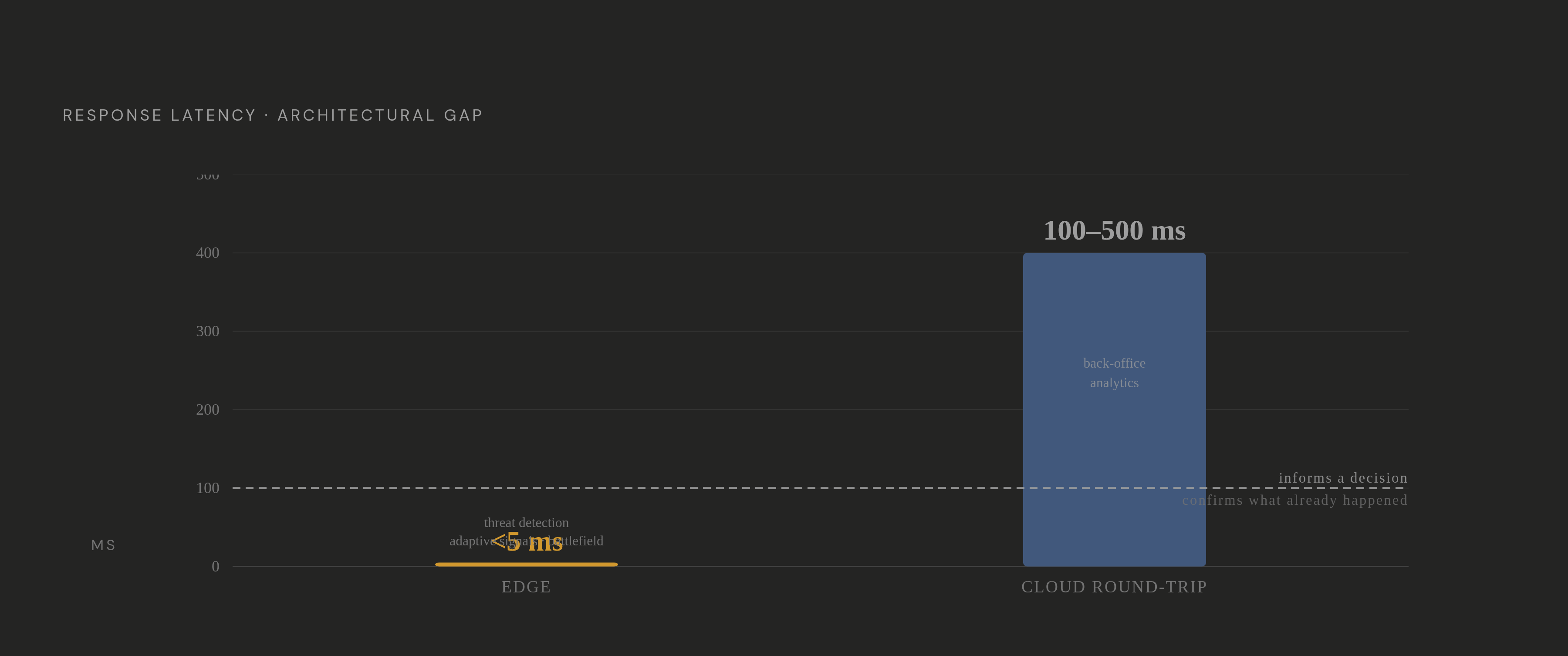
Traffic management is the clearest latency case at the municipal level. Tokyo's smart transport network uses localized edge controllers to adjust signal timing dynamically based on immediate conditions, operating correctly even when cloud connectivity is disrupted. Edge processing drops response time from the 100 to 500 millisecond cloud range to single-digit milliseconds. For a vehicle already in an intersection, that gap is not an abstraction.
Public safety surveillance deployments use AI-powered edge devices to flag suspicious behavior or crowd surges and trigger alerts without waiting for centralized analysis. The shift is from post-incident review to proactive intervention, which changes how emergency services actually respond rather than reconstruct.
For first responders, portable edge compute units establish temporary, secure local networks in emergency zones, giving field teams real-time data processing when permanent infrastructure is unavailable or destroyed.
One predictive monitoring deployment applied a distributed edge framework across utility sensors and detected potential water main failures up to 72 hours in advance. Unplanned maintenance dropped 78 percent, downtime fell 45 percent, and estimated annual savings reached $2.3 million. For a city comptroller evaluating an edge infrastructure proposal, those numbers do the work. Latency reduction becomes avoided costs and improved service continuity, and that is how capital expenditures get approved at the local government level.
Three constraints explain why edge fits government work in ways it largely does not fit commercial use cases.
Military Health: Managing Data Volume for a Global Patient Population
The Defense Health Agency's scale makes the architectural case without requiring abstraction. On a typical day in 2024, the military health system encountered 164,000 patients and 205,000 procedures globally, with an estimated 60 million occurrences projected for fiscal year 2025. Care is delivered in locations where connectivity back to a central EHR system is unreliable or nonexistent.
Edge processing allows clinicians at forward operating locations to access and act on patient data without a live cloud connection, maintaining care continuity in environments where a central system would be inaccessible. At 60 million annual occurrences, routing every record and image through a central system creates bottlenecks regardless of how well that system is engineered. Edge nodes that handle local processing and sync selectively reduce that load in the same way distributed sensor networks reduce bandwidth pressure in infrastructure monitoring.
What is worth noting about the military health case is how unremarkable it should seem after reviewing defense, border, and municipal contexts. The populations differ, the missions differ, the regulatory frameworks differ. The underlying architecture problem is identical: high data volumes generated at distributed, often remote locations, where the cost of a degraded or absent connection is measured in patient outcomes rather than inconvenience.
The Regulatory Environment Agencies Must Navigate Before Deploying Edge
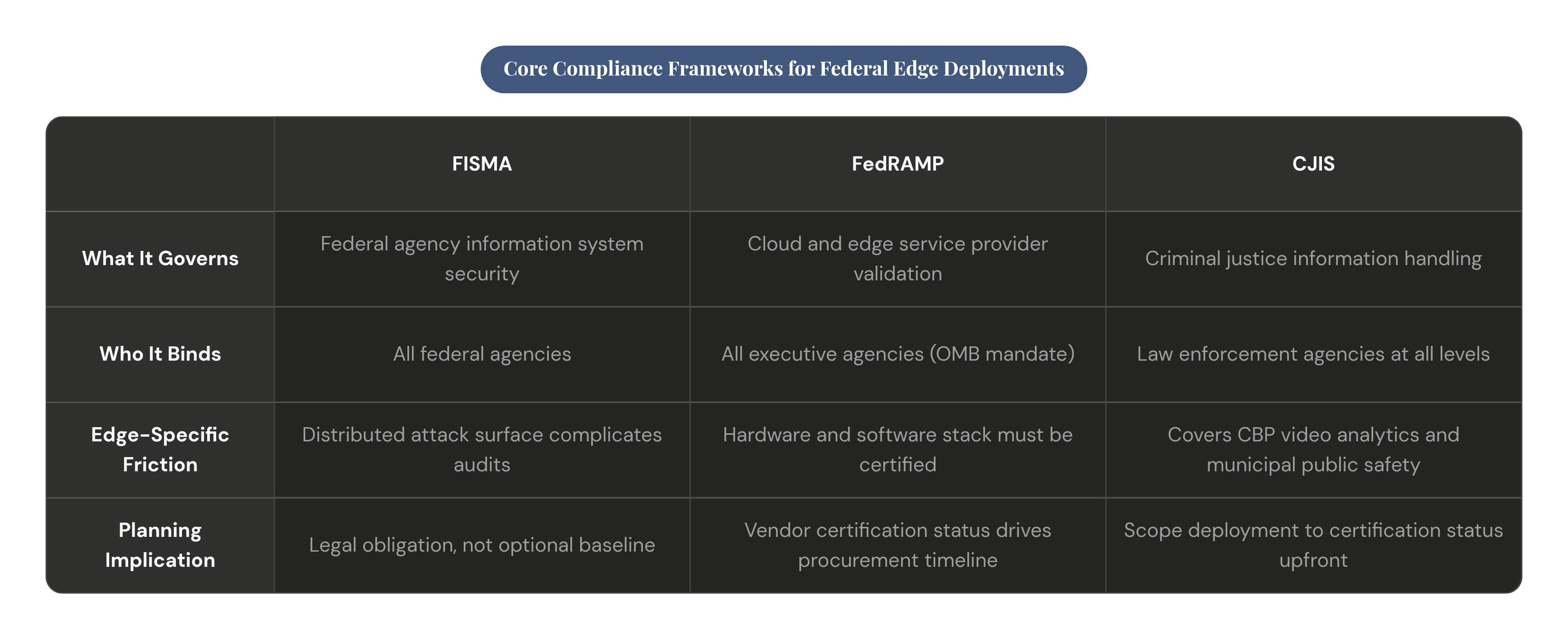
Three frameworks define the compliance landscape for federal edge deployments. FISMA creates the legal obligation, governing what a federal agency must do to secure its information systems. FedRAMP is the fulfillment mechanism, governing what cloud and edge service providers must prove before an agency can use them; the Office of Management and Budget requires all executive agencies to use it for cloud service validation. CJIS applies specifically to criminal justice information, which means it governs any law enforcement edge deployment, including CBP video analytics and municipal public safety systems.
These frameworks were designed with centralized architectures in mind. Edge deployments distribute the attack surface and complicate the audit trail. That is where compliance friction concentrates. Navigating these frameworks will delay deployment and increase costs; agencies that treat that as a surprise mid-project have not been paying attention. It is a planning reality, and building around it starts at vendor selection.
The data sovereignty argument runs in both directions here. Compliance frameworks that require data to remain within specific jurisdictions are an affirmative argument for edge: local processing keeps data local. But the edge hardware and software stack itself must still be certified, which means vendor selection and procurement timelines need to account for certification status before any deployment work begins.
State and local governments face a parallel but distinct set of challenges. Procurement processes, IT staff capacity, and budget cycles at the municipal level require different justification frameworks and different vendor engagement strategies. An edge deployment that advances smoothly through federal procurement will require substantially more groundwork to move through a city or county budget cycle. That is not an obstacle unique to edge technology; it is a structural feature of how local government acquires anything, and it should be scoped accordingly from the start.
Federal Investment and Policy Signals Shaping the Market
The financial signals are unambiguous in both scale and direction. The White House allocated $500 million in 2023 for edge computing capability development within federal agencies, explicitly tied to real-time data processing and regulatory compliance. The CHIPS and Science Act's $52.7 billion in semiconductor funding, including $39 billion in manufacturing subsidies and $13 billion for research and workforce training, directly underpins the hardware layer that edge deployments require. North America generated roughly $23.3 billion in edge computing revenue in 2025, supported in part by DoD edge modernization budgets.
Market sizing estimates for the U.S. federal edge computing segment vary depending on methodological scope. Market Research Future places the market at $934 million in 2025, growing to approximately $3 billion by 2035 at a 12.4 percent compound annual growth rate. Emergen Research's estimate is considerably larger, at $2.5 billion in 2024, projected to reach $10.5 billion by 2034 at a 15.5 percent CAGR. Both trend lines point in the same direction. Readers evaluating vendor landscapes should pick one estimate, name the source, and understand what the scope definition includes or excludes rather than averaging figures that were never designed to be averaged.
The FCC projects connected devices in the federal sector to exceed 1 billion. IBM's June 2025 launch of an AI-driven edge computing solution tailored specifically for federal applications confirms what the market sizing already implies: major enterprise vendors are actively targeting this segment, not waiting for federal procurement to adapt to commercial products built for other markets.
What Agencies and Technology Buyers Should Take from the Domain Mapping
Across defense, border security, smart cities, and military health, the pattern is consistent: edge is deployed when cloud latency, connectivity gaps, or data residency requirements make centralized processing operationally inadequate. The technology follows the constraint. Think of the cloud as where data goes to rest; edge is where it goes to work.
The practical question for any agency evaluating edge is specific: which workloads have a latency, connectivity, or sovereignty constraint that disqualifies cloud-only processing? Those are the edge candidates. Everything else can stay centralized. Agencies that deploy edge infrastructure without a clear answer to what decision it enables faster generate data without improving outcomes. The F-35 works. The CBP video analytics work. They work because the processing serves a defined operational action. Infrastructure that precedes that definition produces dashboards rather than decisions, and government agencies have more dashboards than they need already.
Compliance is a planning input, not a blocker. FISMA, FedRAMP, and CJIS require early engagement with certified vendors and longer procurement timelines. Treating them as obstacles rather than parameters produces avoidable delays, and avoidable delays in this procurement environment carry real costs.
The investment signals, from CHIPS Act funding to the $500 million White House allocation to DoD modernization budgets, suggest the procurement window for early edge deployments is open now. The infrastructure is being built. The policy frameworks are in motion. Agencies that wait for conditions to fully stabilize will find vendor capacity and funding cycles less favorable than they are at this moment.
Sources
- https://www.govconwire.com/articles/dod-edge-computing-ai-5g-research-development
Provided the $179 million NDAA allocation for next-generation communications research and details on DoD's edge, AI, and 5G direction.
- https://www.rocket.chat/blog/edge-computing-for-mission-critical-communications
Informed the discussion of mission-critical real-time communications as a core edge computing use case in government contexts.
- https://www.dlt.com/blog/2023/05/11/growing-importance-and-opportunities-edge-computing-public-sector
Provided the Defense Health Agency patient volume figures: 164,000 patients, 205,000 procedures daily, and 60 million projected annual occurrences.
- https://statetechmagazine.com/article/2023/07/top-challenges-implementing-edge-computing-state-and-local-governments-perfcon
Informed the discussion of connectivity constraints facing state and local governments in remote and challenging terrain.
- https://centurioncg.com/how-edge-computing-is-supporting-smart-city-initiatives/
Supplied the Gartner projection that 75 percent of enterprise data would be generated outside traditional data centers by 2025, up from 10 percent in 2018.