Public Procurement Differences Between Federal and State Agencies
State procurement fragments across 50-plus rulebooks while federal follows one.

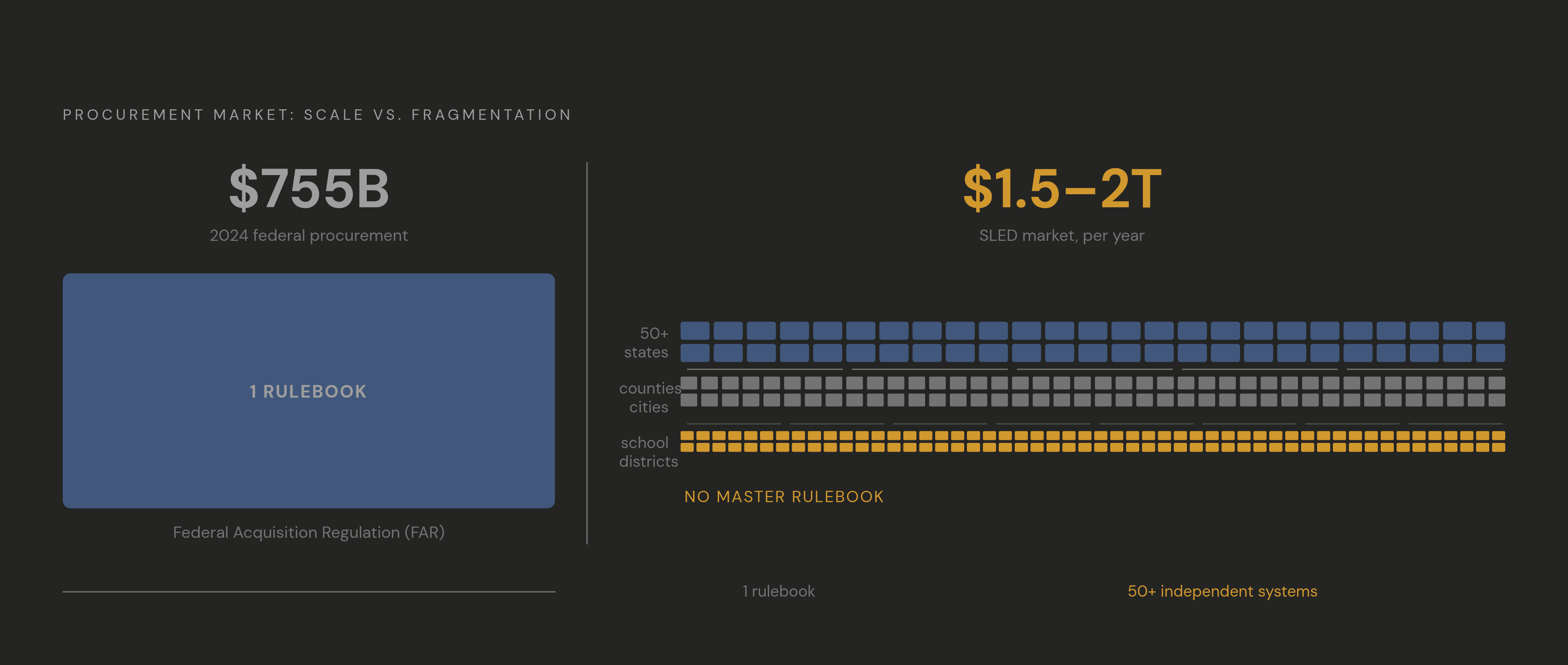
Federal procurement runs on one rulebook applied nationwide. State and local procurement runs on fifty-plus separate rulebooks, then splinters again below that into counties, cities, and school districts that each write their own rules on top of their own state's rules. That single structural fact explains almost everything else here: how contracts get competed, how disputes get resolved, and why a vendor's federal playbook can backfire the moment it crosses a state line.
Start with the money, since that's where the scale of the divide becomes obvious. Federal contracting hit roughly $755 billion in 2024, a figure that makes it one of the largest procurement markets in the world. The market known in the industry as SLED, short for state, local, and education, runs somewhere between $1.5 trillion and $2 trillion a year, split across a vast number of independent buyers, each keeping its own rules and its own calendar. It's a bigger pie cut into far more pieces, and most vendors show up unprepared for how differently that pie is served.
The single rulebook governing federal procurement versus 50-plus independent state systems
The Federal Acquisition Regulation, known to nearly everyone in the business simply as the FAR, lives in Title 48 of the Code of Federal Regulations. The Department of Defense, the General Services Administration, and NASA jointly issue it, and it applies the same way to every executive agency buying supplies or services with appropriated money. An invitation for bid, a request for proposal, a request for quote, a request for information: all of it traces back to the same base document, and so do the rules governing prime contracts and the subcontracts underneath them.
That uniformity comes with a catch, since agencies layer their own supplements on top of it: the Defense Federal Acquisition Regulation Supplement for DoD, the NASA FAR Supplement for, well, NASA. A contractor who knows the FAR cold still has homework to do depending on which agency is buying.
Walk over to the state side, and the picture changes completely, because there's no federal-style master document guiding the states. California runs its procurement world off the Public Contract Code, Florida works from Chapter 287 of its statutes, Texas has Title 10 of its Government Code. Stack counties, cities, and school districts on top of each state's base law, each with the authority to add its own conditions, and a single state can contain dozens of overlapping frameworks operating at once.
Vendors get one part backwards: they assume federal experience is the harder credential to earn, so it should transfer everywhere. In practice, a contractor who spent a decade mastering FAR clauses walks into a new state and starts from something close to zero, and the burden isn't just memorizing new statutes; it's not knowing which office even owns the decision. Federal contractors already face dozens of audits a year across financial, cybersecurity, quality, contract, and information security domains, a workload state-only vendors rarely see. So is federal procurement actually harder, or just harder in a way that's been mapped out in more detail? The federal system carries a heavier documented load, but at least someone drew the map. State procurement carries a lighter documented load and a much bigger navigation problem, and vendors who treat it as the easier cousin of federal work usually find that out the expensive way.
How procurement authority is organized — and why decentralization at the state level creates hidden complexity
Federal procurement authority sits in a fairly clean hierarchy. Each agency has a defined acquisition structure, and disputes escalate to one of two bodies: the Government Accountability Office or the Court of Federal Claims. Vendors know where to look, because there's only one place to look.
State procurement decentralizes by design, and this is where a lot of vendors misjudge the market. Decentralization looks like more opportunity on paper; in practice, it means more places to get lost. Some states centralize purchasing through a single office with authority across every agency. Others hand purchasing power directly to individual agencies, which means a vendor's first job isn't finding the state, it's finding the right office within the state. Drop below the state level and the fragmentation multiplies again: counties, municipalities, and school districts each run independent purchasing operations, often with their own vendor portals, their own procurement officers, and calendars that share nothing in common with the state's calendar or with each other.
That creates a visibility problem cutting both directions. Buyers can't always see total procurement spend across their own departments, let alone across neighboring jurisdictions. Vendors face the same problem in reverse: no reliable way to see the full scope of opportunity without manually working through office after office, one login at a time.
Dispute resolution follows the same pattern. Federal protests go to GAO or COFC, with no exceptions to that rule. State protest bodies vary by jurisdiction: administrative hearing offices in some places, internal agency review in others, state courts in others still. Federal procurement rewards knowing the rulebook; state procurement rewards knowing the local offices and the people who run them.
Dollar thresholds that determine how a contract is competed — and how they just changed at the federal level
The thresholds just moved, and they moved by statute, not by whim. Federal dollar thresholds adjust periodically for inflation, and that adjustment took effect on October 1, 2025.
The Micro-Purchase Threshold rose to $15,000, and purchases at or under that line generally require minimal or no competitive process. The Simplified Acquisition Threshold climbed to $350,000, and crossing that line triggers full competitive procurement requirements.
Consider the scale of what just shifted. Bump the micro-purchase line to $15,000, and a real slice of award volume that used to require more paperwork now clears with none of it. The stretch of contracts that used to sit between the old MPT and the old SAT now sits inside a bracket with a higher ceiling and lighter competition requirements attached. That's a real shift in how much federal spend moves without a full competitive fight behind it, and vendors pricing work near these lines should know exactly which side of them a deal now falls on.
State thresholds offer no such national clock, no uniform number, nothing close to consistency from one state line to the next. Here's a detail that trips up vendors more than any other rule in this piece: if a state or local threshold sits lower than the federal one, vendors need to know which requirement governs their specific contract before assuming the federal number applies. Same dollar amount, same type of contract, two entirely different competition requirements depending on which state line the buyer happens to sit behind. Checking local thresholds before bidding isn't optional homework, since skipping it means a vendor shows up prepared for the wrong process entirely.
How bid protests work at the federal level — and why the state equivalent is far less predictable
Federal protest procedure is well-documented, predictable machinery. GAO is the main venue, COFC the alternative, and the timelines and grounds for relief are mapped out well enough that a good bid protest attorney can sketch the likely path before a losing proposal is even finalized.
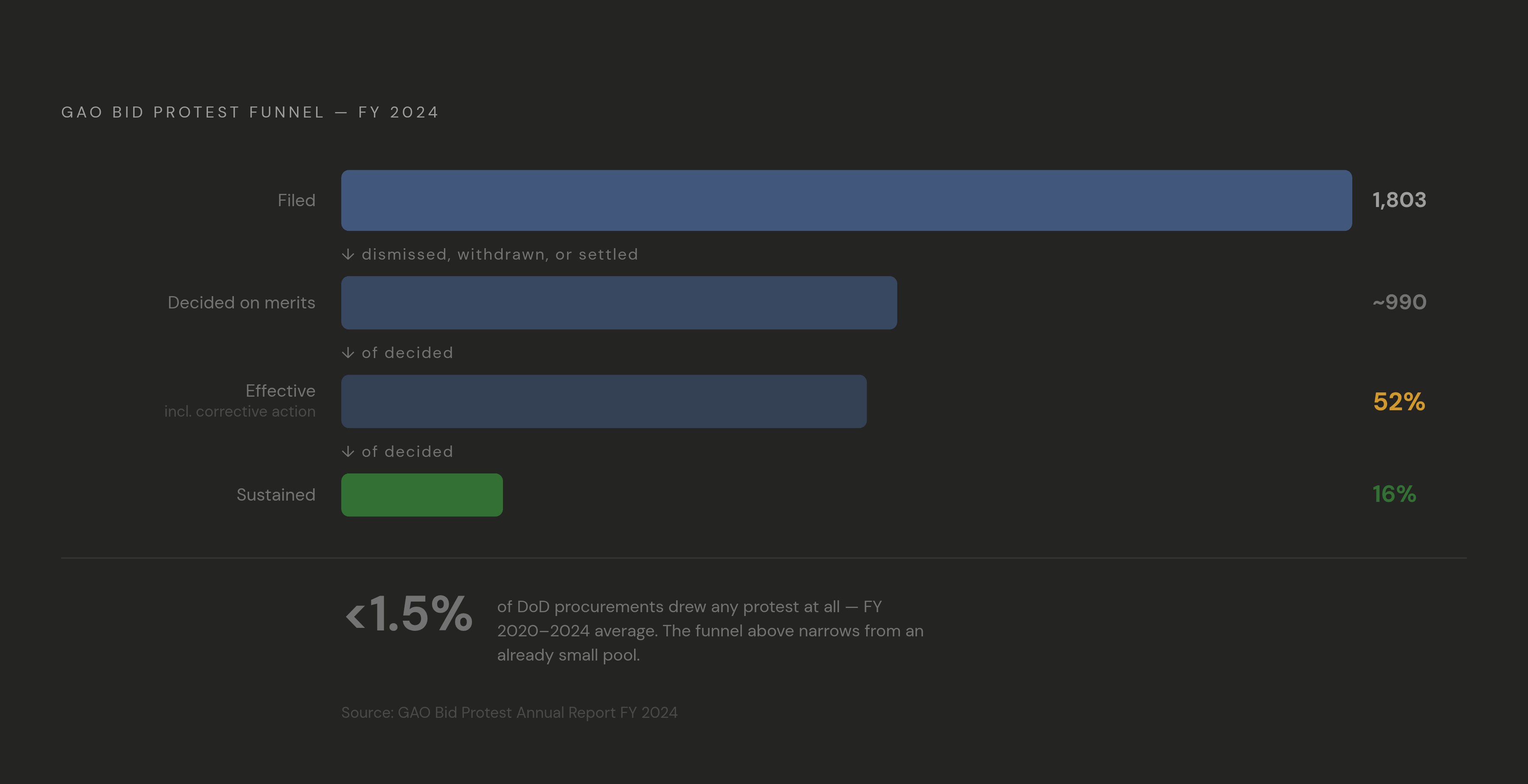
GAO logged 1,803 protests in fiscal year 2024, down from 2,025 the year before, continuing a decline that's stretched across the last decade. Of the protests decided on the merits that year, GAO sustained roughly 16%. The effectiveness rate, meaning cases where the protester got some form of relief whether or not GAO formally sustained the protest, held at 52%, and most of that came from agencies voluntarily taking corrective action before a ruling ever landed.
What actually wins a sustained protest? Cases where a documented process failure sits visible on paper rather than buried in judgment calls tend to fare best. Meanwhile, the odds of getting protested in the first place run smaller than the attention bid protests tend to draw: across fiscal years 2020 through 2024, at most 1.5% of DoD procurements drew a protest at GAO. That gap between perception and actual risk matters, because vendors who over-prepare for protest exposure often under-prepare for the parts of the bid evaluators actually weigh, like technical approach and past performance.
Compare that to the state side, where there's no single national forum, no GAO-equivalent umbrella. Disputes might go to the procuring agency itself, to an administrative hearing office, or to state court, depending entirely on where the contract was let. Sovereign immunity adds another wrinkle with no federal parallel, and many states cap what a contractor can actually recover in a dispute, sometimes sharply, through constitutional or statutory protections federal contractors never have to think about. The move here isn't complicated: research the specific state's protest mechanism before submitting a bid, not after losing one.
Contract terms, negotiation room, and where state flexibility can cut both ways
Federal contracts run on standardized FAR clauses, and the room to negotiate away from those clauses is narrow and specific, since any deviation needs formal agency approval. It's rigid, but the rigidity is at least predictable.
State contracts, particularly for professional services or smaller-dollar work, often leave more room to negotiate scope, price, and terms before the ink dries. That flexibility looks like a clear win for vendors, and treating it that way is exactly where a lot of state contractors get burned. Flexibility just means nobody's stopped the contractor from signing something worse, and plenty of contractors do exactly that.
Broader indemnification clauses show up more often in state contracts, sometimes pushing contractor liability further than anything a federal contract would attempt. Rights to an equitable adjustment when conditions change mid-contract tend to run thinner at the state level too. Most states operate under balanced budget requirements, so procurement budgets face mid-year cuts in a way federal appropriations generally don't. Negotiating room works as a tool, not a guarantee; experienced state contractors read non-standard terms line by line rather than assume flexibility cuts in their favor by default.
Communication rules add a layer that trips up plenty of vendors who assume federal norms travel everywhere. Many states impose a "cone of silence," a blackout period during active solicitations restricting who a vendor can talk to and when. Some states impose particularly broad restricted periods that run from solicitation posting through final contract award. Other states and localities impose similar restrictions, funneling all contact through designated procurement officials. Federal rules on this exist too, but state variations tend to run stricter, and none of it standardizes across jurisdictions. A federal business development strategy built on broad early engagement with agency staff before a solicitation drops can, in certain state markets, create real legal exposure. What counts as normal relationship-building in one jurisdiction can register as an ethics violation in another, with no warning label attached to the difference.
Small business and supplier diversity programs — similar goals, very different mechanics
Federal small business programs run through the SBA, with government-wide targets and defined certification categories: 8(a), HUBZone, SDVOSB, WOSB, and SDB among them. Federal policy has pushed agencies to direct a growing share of contract spending to Small Disadvantaged Businesses, with goals set at the government-wide level.
The Department of Transportation runs its own parallel track through the Disadvantaged Business Enterprise program, setting contracting goals for DBEs on federally funded highway, transit, and airport work — a rule that reaches down into state and local governments receiving DOT grant money. That program just went through a real legal shake-up: DOT issued an Interim Final Rule removing race- and sex-based presumptions of social and economic disadvantage from DBE eligibility. How individual states implement that change is genuinely unsettled right now, and it leaves real uncertainty hanging over vendors currently certified under the old criteria.
State programs branch off in their own directions from there, with goals and preferences varying widely from one state to the next, and plenty of states apply in-state or regional bidder preferences with no federal counterpart whatsoever. Preference categories can include local business status, minority or women ownership, products containing recycled content, and reciprocal preferences worked out between neighboring states. State certifications generally stand apart from federal ones: holding SBA 8(a) status doesn't automatically hand a vendor state DBE certification, nor does it work in reverse. The task is straightforward even if the landscape isn't: check which certifications each target state actually recognizes, and watch how the DBE rule change trickles down into state-level program requirements over the coming months.
Building a practical approach for vendors competing across both markets
Two different markets need two different sets of muscles, and running one playbook across both is the single most common mistake in this whole picture. Federal work rewards compliance infrastructure built well before any bid goes out the door: SAM.gov registration current and accurate, FAR clause expertise sharp enough to spot a problem clause on sight, audit readiness baked into daily operations rather than assembled the week before a review. State work leans on something closer to fieldwork: local market research, relationships built patiently within decentralized buying offices, legal review tuned to the specific jurisdiction before a bid ever goes in.
Threshold awareness belongs at the start of that process, not somewhere in the middle. Knowing whether a target contract sits above or below the MPT and SAT federally, or the equivalent line in a given state, determines which rules apply and how much prep the bid actually demands. Protest strategy deserves the same early treatment: federal vendors already know GAO is the address to write to, but state vendors need to identify the right forum and timeline for each jurisdiction well before submission, not after a loss shows up in the inbox.
Certification portfolios need separate maintenance too, since federal and state programs rarely overlap cleanly, and the current uncertainty around the DBE rule change is reason enough to review that portfolio sooner rather than later. Communication protocols should split the same way: who a vendor can appropriately reach out to, and when, differs meaningfully between federal and state pursuits, and even between one state and the next.
None of this is exotic; it's mostly discipline, applied consistently, to two markets running on entirely different clocks. Proposals that win in either market tend to share one trait: they're built around what the specific buyer actually values in that specific solicitation, rather than a generic pitch reused across a dozen opportunities. For teams juggling federal deadlines alongside several overlapping state calendars at once, that kind of tailored, criteria-first prep is what separates finding an opportunity from actually submitting something worth reading.