Governance Risk and Compliance Platforms Compared for Federal Agencies
Federal agencies need GRC platforms built for FedRAMP and NIST, not generic commercial compliance.

Federal agencies looking for governance, risk, and compliance software are buying in a market made for other customers. Most GRC comparisons judge tools on setup speed, per-seat cost, and the number of commercial frameworks they cover, which assumes buyers just want things easy. A federal agency is optimizing for something else: FedRAMP authorization, NIST and FISMA alignment, and whether the platform can get a system through an Authority to Operate without breaking down halfway. Here I go through what federal buyers really have to verify, then test today's platforms against that list, and reach a simple verdict: most big GRC names don't fit this job, and only one or two were made for it.
The GRC software market is expanding quickly. Mordor Intelligence puts it at $21.04 billion in 2025, rising to $39.01 billion by 2031. Banks, retailers, and SaaS firms mapping SOC 2 and ISO 27001 controls drive most of that growth. Federal agencies barely register in that total, so vendor roadmaps, marketing decks, and analyst rankings end up shaped by a buyer who isn't sitting in a SCIF. Before any platform-specific sections below, we should ask: does a tool labeled "Leader" in a commercial Magic Quadrant truly do RMF and eMASS well? Not always. That gap is exactly why this evaluation framework is needed, and why a federal buyer relying on a commercial analyst report is already off track before the first demo call.
The regulatory stack federal GRC platforms must actually support
There's no single federal compliance law. It's layered. FISMA, set up in 2002 and revised in 2014, forms the base and covers nearly anyone handling federal information systems: agencies, contractors, state agencies running federal programs. It calls for using NIST SP 800-53 Rev. 5 controls in areas such as access control, audit and accountability, configuration management, and incident response. It's required reading. A platform must speak this control catalog natively, like a restaurant speaking the health inspector's checklist instead of merely cooking good food.
On top of FISMA is the NIST SP 800-37 Rev. 2 Risk Management Framework, the real cycle, categorize, select, implement, assess, authorize, monitor, that makes a paper policy a working ATO. Congress made FedRAMP law in December 2022 through that year's NDAA. FedRAMP targets cloud service providers selling to federal agencies, and unlike FISMA, its authorization is portable: get authorized once through a certified Third Party Assessment Organization (3PAO), and other agencies can reuse that authorization instead of starting the whole process over. GovRAMP, once called StateRAMP, plays the same role for cloud sold to state and local government.
CMMC 2.0 also applies to defense contractors handling Controlled Unclassified Information and is based on NIST 800-171 r2 and NIST 800-172. Phase 1 self-assessments became required starting November 10, 2025. Phase 2, which required mandatory C3PAO assessment for Level 2, was due to begin a year later on November 10, 2026, but the DoD paused it on July 13, 2026 pending a program review. Agencies and contractors tracking those dates should read "pending review" literally: it's on hold, not scrapped, with no new date set.
DoD-adjacent agencies face additional demands beyond the civilian stack: staying within DoD Impact Level boundaries, working with eMASS, and handling OSCAL packages both ways. A vendor that handles SOC 2, ISO 27001, and HIPAA hasn't shown it can take a system through the whole RMF lifecycle, and assuming those frameworks are the same is where most procurement teams first go wrong. That difference seems nitpicky until an agency is half a year into an ATO effort and discovers the tool can generate a polished audit report but can't output an SSP in a format eMASS will accept.
What FedRAMP 20x changes about platform selection right now
FedRAMP 20x remakes the authorization process, replacing old paperwork and screenshots with automated, machine-readable checks. The Consolidated Rules for 2026 (CR26) bundled all FedRAMP 20x requirements into a single ruleset with new terminology: "FedRAMP Authorized" becomes "FedRAMP Certified," and the familiar Low, Moderate, High impact levels become Certification Classes B, C, and D, plus a new entry-level Class A pilot.
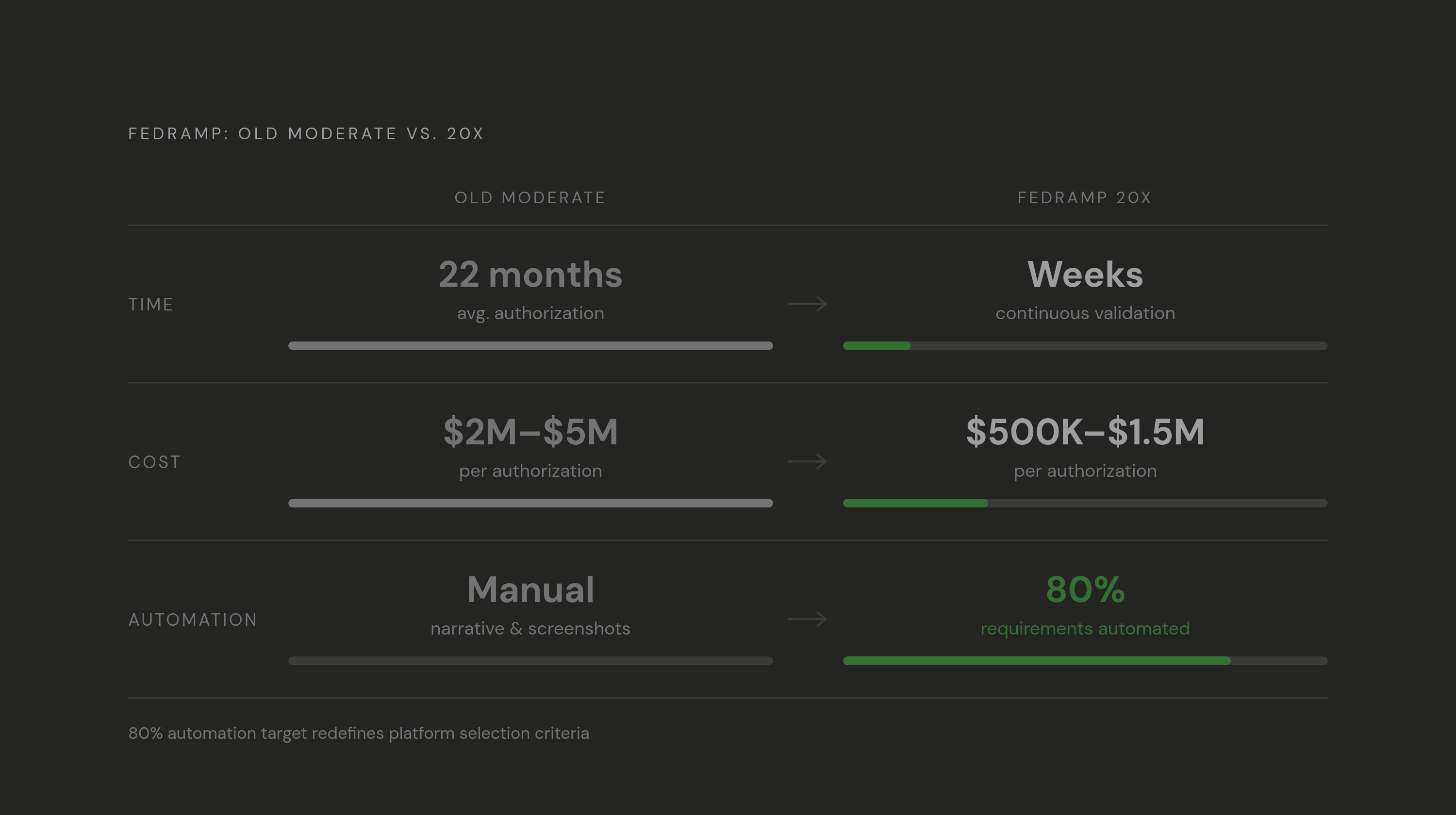
The key number here is 80%, FedRAMP 20x's stated goal for automating that share of security requirements. The aim is continuous, machine-checked validation against requirements posted as structured JSON in a public GitHub repo, not narrative evidence and screenshots a human reviews. A platform that pulls those requirements directly and keeps pace with updates is in a different race than one still parsing PDFs by hand, and buyers who skip asking which race a vendor runs are the ones stuck re-doing work in eighteen months.
Why change the whole system at all? GAO-24-106395, a GAO report, found FedRAMP Moderate approvals took 22 months on average, leaving over 200 vendors waiting in line. In twenty-two months, a presidential administration can change, a budget cycle can reset, and half the original project team can leave for different jobs entirely. Early FedRAMP 20x pilots put end-to-end authorization costs at roughly $500,000 to $1.5 million, versus $2 million to $5 million for the old FedRAMP Moderate process, and the savings come mostly from fewer 3PAO labor hours.
As of mid-2026, Phase 3 of the rollout is in progress, CR26 is being wrapped up, and the pipeline for taking 20x submissions is scheduled to open in the July-to-September quarter, kicking off with Class A pilot, Class B (Low), and Class C (Moderate) certifications. By June 2025, the FedRAMP marketplace listed 430 FedRAMP authorized cloud service offerings, but that number matters less as the only readiness sign. Just being authorized isn't enough anymore. 20x readiness is becoming the line that divides platforms designed for where FedRAMP is heading from those still built for where it was, and by next year that line will outweigh the FedRAMP badge itself.
The five criteria that should anchor every federal GRC procurement decision
Five tests, ordered by the cost a buyer incurs for ignoring each.
The platform itself must have FedRAMP authorization for its own cloud setup, not just a claim that it "supports FedRAMP compliance" for customers. Those mean two different things, and vendors sometimes mix them together on purpose. The impact level is just as important as the authorization: a platform with FedRAMP Moderate can't legally run a High-impact system. That's it, no exceptions.
Second, native NIST RMF lifecycle support. RMF steps, categorize, select, implement, assess, authorize, monitor, should form the platform's core workflow, not serve as an add-on to a generic risk register. Does it manage system categorization, control selection, SSP development, assessment, and continuous monitoring as one linked process, or as five separate spreadsheets dressed up as GRC?
Third, native OSCAL support. OSCAL, the Open Security Controls Assessment Language, is NIST's machine-readable format for control catalogs, baselines, SSPs, and assessment results, and FedRAMP 20x uses it. A platform unable to take in or put out OSCAL packages will face friction that grows, rather than eases, as 20x expands.
Fourth, an eMASS interface covering DoD and DoD-adjacent agencies. eMASS is the DoD's web-based RMF automation system, and native integration avoids manually re-entering and matching data across two systems that should already talk to each other. Civilian agencies don't all need it. All DoD components and all defense industrial base contractors do.
Fifth, and the one buyers most often get wrong: a staffing and implementation model that fits the real agency, not the vendor's dream customer. Most agencies fixate on the feature list and never run the staffing numbers, which is backwards. Typical enterprise GRC implementations take 6 to 12 months and cost tens of thousands to hundreds of thousands of dollars or more per year, with dedicated GRC consultants and administrative staff running them. Plenty of agencies lack that bench. Check any vendor claim against the agency's real team size, procurement timeline, and budget authority before you sign anything. A platform that needs three full-time admins an agency can't staff isn't a platform. It's a staffing plan dressed up as a product demo.
Then weigh the rest: CMMC 2.0 alignment for DoD contractors, third-party risk management depth, how much of continuous monitoring is actually automated versus manually refreshed, and whether the vendor's support model understands government customers or just puts up with them.
Telos Xacta: the purpose-built federal option
Xacta, now a suite (Xacta 360, Xacta.io, Xacta.ai), was made for federal compliance from day one instead of being retrofitted. Continuous assessment has been built into the product since 2004, so its federal-specific architecture predates most of the acronyms this piece has already covered.
On July 15, 2025, Xacta 360 was granted FedRAMP High authorization, and the whole suite received its own FedRAMP High authorization on April 9, 2026. OSCAL-native capability is locked in before the September 30, 2026 deadline for machine-readable packages, and the suite ships with a native eMASS interface for federal civilian and DoD customers. Xacta covers parts of more than 100 major IT security regulations and policies, including NIST RMF, RMF for DoD IT, CNSS 1253, NIST CSF, and FedRAMP.
Because it's built for one job, agencies needing a single tool to cover SOX or commercial third-party risk outside the federal supply chain should look elsewhere. Implementation expects staff who already know RMF workflows, so it's not an easy start for a team new to the framework. Though if a CSP is going after FedRAMP High, Xacta leads the pack for pure RMF and ATO automation today, and nothing else covered here gets close on that front. The choice is clear: for RMF and ATO, put Xacta at the top of the shortlist and require every other vendor to earn its place.
ServiceNow IRM: broad enterprise platform with a credible federal track record
ServiceNow's Integrated Risk Management product uses the Now Platform and deploys to federal environments through Government Community Cloud (GCC), with FedRAMP compliance documented in version 3.3 as of February 2025 (the Xanadu release). It makes real sense only if the agency already uses ServiceNow ITSM at FedRAMP High or DoD IL5. In that scenario, moving risk management onto infrastructure the agency already runs is a genuine case, not just a sales pitch posing as strategy.
Its real advantage is the connective layer: IT, security, and operations working from shared workflows rather than sitting in silos that trade spreadsheets by email. Agencies already using ServiceNow for asset management or ticketing get real integration here, instead of a compliance bolt-on stuck to an unrelated platform. ServiceNow has expanded its integrated GRC suite to support enterprise clients with cybersecurity workflows. ServiceNow's Federal CTO has advocated for simplifying FedRAMP processes to help government adopt secure technology faster.
One thing to say plainly: the federal compliance documentation from February 2025 came before CR26 was finalized, so agencies looking at this platform should request the current 20x positioning and OSCAL-native status instead of assuming last year's paperwork matches this year's roadmap. An agency starting from scratch with ServiceNow gets a full build, not a plug-in, with the same 6-to-12-month, $50,000-to-$500,000-plus cost as any other enterprise GRC rollout. Picking ServiceNow IRM without the ServiceNow platform already in place means buying the wrong product for the wrong reason.
Archer: the configurable legacy standard and what that means in a federal context
Archer, formerly RSA Archer and now independent, was named a Leader in Gartner's October 27, 2025 Magic Quadrant for GRC Tools, one of the vendors evaluated in that report. It earned that name: big companies treat it as the top choice when they want a GRC platform they can shape to fit, pass audits with, run heavy risk analysis on, and apply across many regulations. The on-premises option also counts for agencies whose data-sovereignty rules bar cloud hosting outright.
This is the catch federal buyers must face, and it's exactly why Archer sits in its own category instead of alongside Xacta. Just because something's highly configurable doesn't mean it's natively federal. Archer can be set up for NIST RMF, FedRAMP-aligned workflows, and CMMC, but "can be configured to do this" and "does this out of the box" cost very different amounts. Agencies need to pin down before they sign what federal content comes ready-made and what turns into a paid services project later, since that's how budgets blow up. An agency that treats Archer like Xacta out of the box will learn that lesson mid-implementation, with the invoice already climbing.
Questions to ask Archer point‑blank: where FedRAMP cloud authorization stands now, whether OSCAL packages are supported, how eMASS integrates, and if ATO workflow support is built in or billed hourly as consulting. That 6-to-12-month, $50,000-to-$500,000-plus implementation timeline assumes dedicated GRC administration staff, which is reasonable for a large civilian agency but a real obstacle for a smaller one. Archer works best when an agency already uses it, runs a complex multi-framework risk program, or has chosen on-premises hosting for reasons wholly outside FedRAMP.
Where commercial-first GRC platforms fit and where they fall short for federal use
Optro (formerly AuditBoard), Diligent, IBM OpenPages, and LogicGate also made Gartner's October 2025 Leaders quadrant, and they're solid choices for commercial enterprises. Another group of platforms keeps coming up in commercial GRC comparisons: Hyperproof, MetricStream, OneTrust GRC, Scytale, Vanta. They all bring genuine strengths that deserve specific mention, not vague generalities.
Scytale supports more than 80 compliance frameworks with cross-mapping between them, connects to over 150 integrations, and uses AI-assisted evidence collection and gap detection, backed by a highly rated G2 score across more than 500 reviews. It's a solid choice for a company handling several commercial frameworks at once. Hyperproof provides tools for mapping controls and managing evidence, often used in audit preparation workflows. MetricStream offers enterprise risk management and regulatory reporting capabilities, but it was not positioned in the Leaders quadrant of Gartner's October 2025 Magic Quadrant for GRC Tools.
None of that's a knock on them. They’re made for SOC 2, ISO 27001, HIPAA, PCI DSS, GDPR: the frameworks that govern commercial data handling, and that’s exactly where they prove their value. What's usually absent or only partly built is the federal machinery this piece covered section by section: NIST RMF as a real lifecycle instead of a mapped checklist, ATO workflow support, eMASS integration, OSCAL-native output. If a platform's own hosting lacks FedRAMP authorization, it can't legally run a federal cloud deployment, even if every commercial framework badge on its dashboard glows green.
If there's one habit to break before any contract gets signed, it's this: buying off the dashboard instead of the five criteria laid out earlier is the single most common mistake in this whole procurement process. A federal buyer shopping for SOC 2 polish plus a FedRAMP High ATO in one product is chasing something that, as of this writing, isn't on the commercial side of this list, and agencies that pretend otherwise re-procure eighteen months into a failed rollout.