California Cloud Migration Funding Rounds in 2024 and 2025
California claimed most of a multibillion-dollar cloud migration funding boom in 2024 and 2025.
The cloud migration funding for 2024 and 2025 makes one thing clear: California didn't just join this investment cycle, it claimed most of it. California drew in billions for GPU infrastructure, data protection, and DevOps tooling as other tech hubs, including seasoned venture markets like Massachusetts, saw their totals decline. This piece breaks down the specific funding rounds, the companies involved, and the bets being placed.
Begin with the scope issue, since migration funding figures vary a lot based on who counts and what they include as "migration." Grand View Research estimates the cloud migration services market at $16.90 billion in 2024, rising to $70.34 billion by 2030. We’re using the narrower definition throughout this piece, as funding rounds align more directly with specific tools and services than with the broader cloud market. Cloud computing startups raised more than $33.6 billion in 2024 inside a market where AWS, Google, and Microsoft already controlled roughly two-thirds of the underlying compute. That ratio sums up the situation: migration-layer startups never aimed to unseat the hyperscalers. They plugged into them instead, which turned out to be the better trade by a wide margin. Placing a wager on the giants flopping would’ve cost you, and the numbers prove few smart players tried.
How California became the gravitational center of this investment cycle
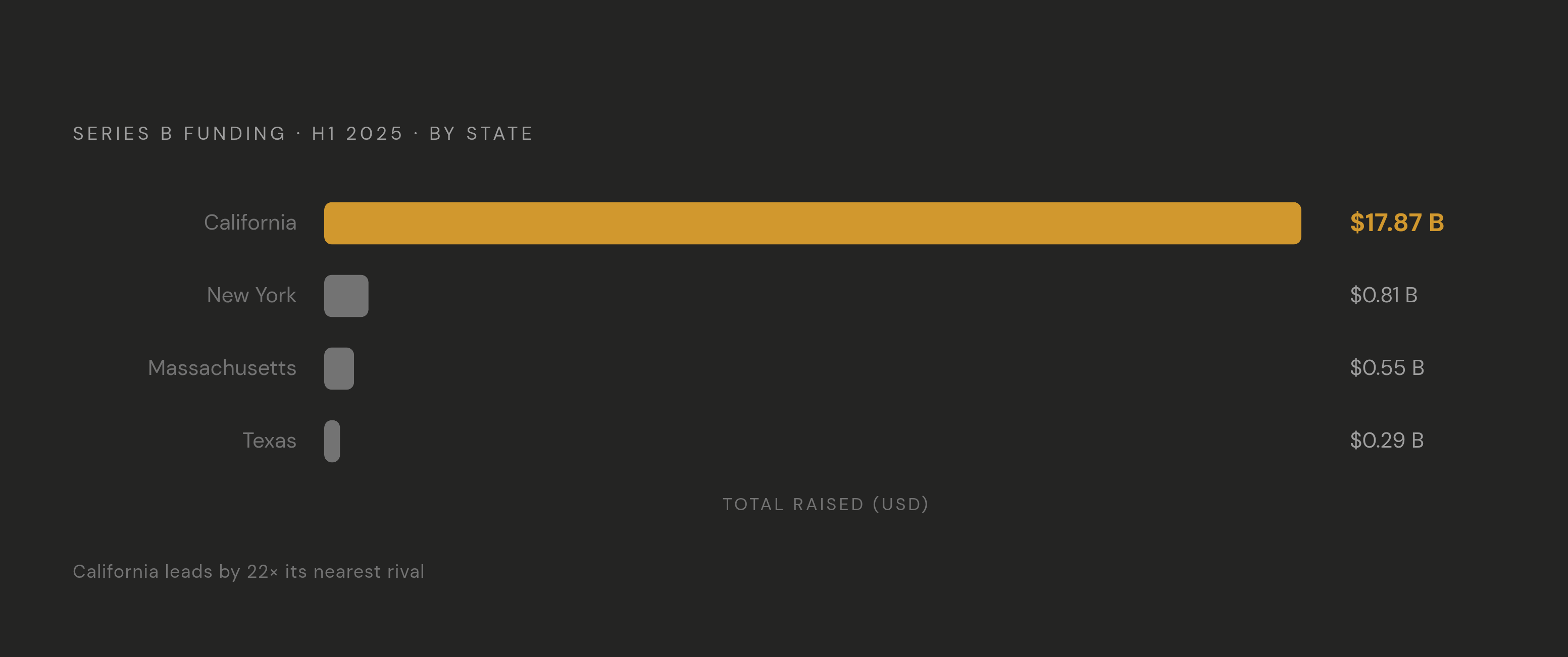
The concentration numbers are too far apart to be called a trend. They're in a completely different league. In the first half of 2025, California secured $17.873 billion in Series B funding, according to Fundraise Insider's data. New York, the next closest state, managed $0.811 billion. Massachusetts received $0.547 billion; Texas, $0.291 billion. California brought in more Series B funding by itself than the next four states put together, and then some, so that difference needs attention before focusing on any one company.
The pattern became almost cartoonish in 2024. Crunchbase reports that Bay Area firms OpenAI, xAI, Anthropic, Safe Superintelligence, and Scale AI together raised over $15 billion. That’s no accident of location. Northern California combined deep-tech talent, investor networks, and proximity to hyperscaler campuses, making it nearly essential for GPU-era companies to raise funds. Massachusetts and other states lacking a flagship AI unicorn saw their 2024 venture funding decline. Not all boats rose with the AI boom. It lifted the ones already docked in San Francisco Bay and left everyone else checking the tide charts.
Look at cloud migration alone, and the pull is just as strong. U.S.-based companies led the category, drawing significant funding. Considering all that, the bulk of that funding is located just a short drive from Highway 101. The rest of this piece doesn't hint at any upcoming changes, and savvy investors aren't sticking around to see if it does.
Lambda AI: the defining California cloud infrastructure story of 2024–2025
If one company had to stand in for this entire cycle, it would be Lambda AI. Founded in 2012 by brothers Stephen and Michael Balaban, Lambda started as a facial-recognition AI outfit, pivoted into selling GPU workstations, and eventually became a full-stack GPU cloud operator offering on-demand access to NVIDIA's H100, H200, and Blackwell B200 chips. Its path wasn't direct, but it landed right where enterprise AI needed it.
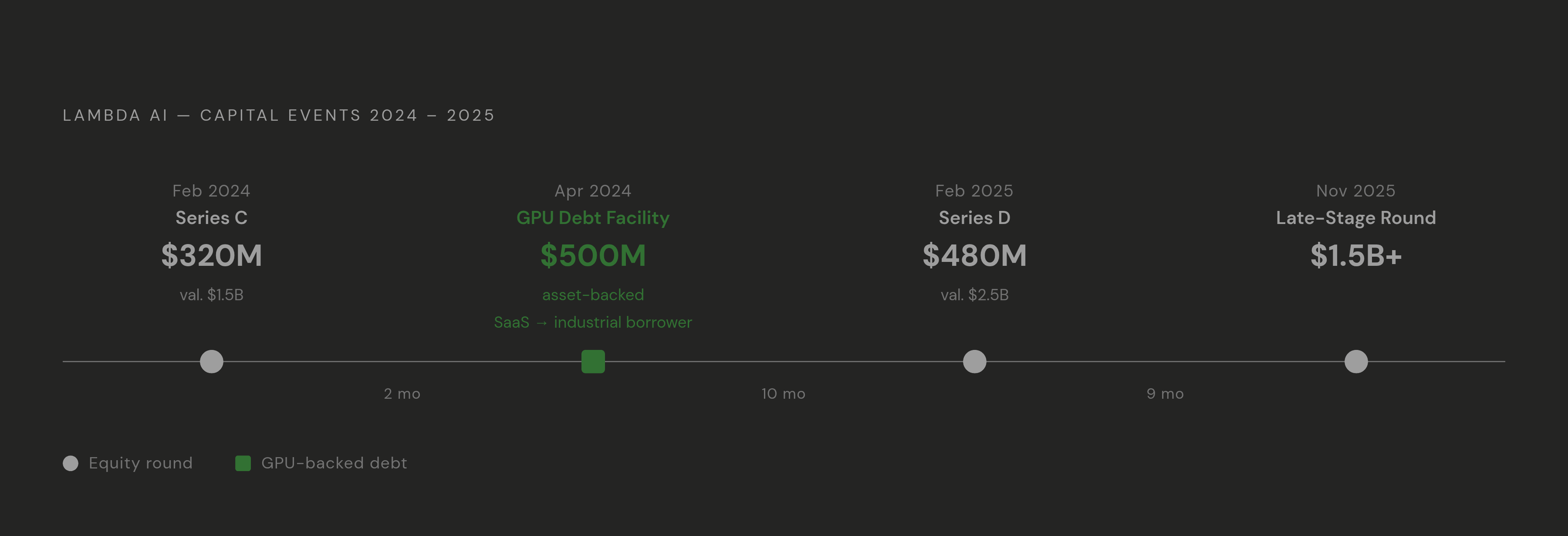
Lambda's funding is growing as fast as its market. On February 15, 2024, Lambda raised $320 million in a Series C round valued at $1.5 billion, led by USIT along with B Capital, SK Telecom, T. Rowe Price Associates, alongside existing investors Crescent Cove, Mercato Partners, 1517 Fund, Bloomberg Beta, and Gradient Ventures, completed the round. That funding round made Lambda a unicorn. Two months later, in April 2024, came something structurally different: a GPU-backed debt facility worth up to $500 million, led by Macquarie Group with Industrial Development Funding also participating. It’s not equity, it’s a loan secured by the GPUs, and that shift matters: these tech firms are beginning to resemble industrial firms that borrow against physical assets like trucks or shipping containers, not your average SaaS startup.
The February 2025 Series D, co-led by Andra Capital and SGW, raised $480 million at an estimated $2.5 billion valuation, bringing total equity to roughly $863 million. On November 18, 2025, another funding round topped $1.5 billion, headed by TWG Global (Thomas Tull and Mark Walter). Lambda didn't disclose the exact figure when it was announced, and this gap between known and estimated figures shows how quickly valuations change compared to their paperwork.
Along with its equity growth, Lambda signed a multibillion-dollar deal with Microsoft to run AI infrastructure on tens of thousands of NVIDIA GPUs, a real contract that strengthens the balance sheet beyond any press release. Crunchbase reports that Lambda has raised several billion dollars so far, including both equity and debt. Plotting the zigzag path from facial recognition to workstation sales to GPU cloud to Microsoft infrastructure partner on a single chart is strange. But that jagged path shows what "cloud migration" really means today: the two fields have quietly merged, almost entirely, with AI infrastructure, and Lambda is the best evidence.
Cohesity, Druva, and Clumio: California's data protection layer draws its own investor attention
Compute draws headlines. Backup work pays the bills that stop firms from freaking out during a move, and three big California players handle it, no one’s tweeting about them. Say this plainly: the boring layer is where the money quietly proves it can last, while the GPU headlines are still figuring out what "lasting" even means.
Cohesity, started in Santa Clara in 2013 by Mohit Aron, creates a single platform for backup, recovery, and data protection, the behind-the-scenes system that determines if a migration actually works. In December 2024, Cohesity merged with Veritas' enterprise data protection arm, creating the world's largest data protection software provider, boasting over $1.5 billion in annual recurring revenue and tens of thousands of global customers. Cohesity got well over a billion dollars in disclosed equity from Series A to H, plus billions more in debt from the Veritas deal. Call this what it is: not a funding round in the traditional sense but a consolidation event. Mature markets can handle M&A, so consolidation events occur instead of just another round of venture bets.
Santa Clara’s Druva offers cloud-based backup, disaster recovery, and data security as a service. It has raised hundreds of millions of dollars altogether, with its latest confirmed funding round, a Series H. Druva is valued at a significant benchmark for 2025, but no new equity funding rounds were publicly announced for 2024-2025. See that valuation as a benchmark, not a new funding round. People often mix them up, yet they aren't the same.
Clumio operates a SaaS cloud backup service and has raised hundreds of millions of dollars overall, including a Series D round disclosed in February 2024. Sutter Hill Ventures, Index Ventures, Altimeter Capital, and NewView Capital are among the recorded investors. Three California companies, tackling the same unflashy issue, are drawing significant investment. Migration wasn't just about compute. Enterprise procurement teams really worry about data continuity, and that's what drives them to spend the most money to end their sleepless nights.
Opsera, CloudSphere, FluidCloud, and Vercel: the smaller rounds filling out the ecosystem
Billion-dollar valuations aren't needed for rounds to be important, and smaller rounds show true investor interest. An $8 million seed investment isn’t made on hype alone. That money demands tougher answers than any big-name round ever does. A DevOps and cloud pipeline automation company, Opsera, secured tens of millions of dollars over four rounds, including a multi-million-dollar Series B in April 2025. Prosperity7 Ventures led that round.
CloudSphere handles cloud migration and governance. It has raised tens of millions of dollars across four rounds, including a multi-million-dollar Series B on September 5, 2024, led by Atlantic Bridge Capital, with participation from HighBar Partners, ST Engineering Ventures, and Themvar VC.
The newest company in this list is FluidCloud, located in Pleasanton, California. Started in 2024, FluidCloud got several million dollars in seed money for its B2B SaaS platform focused on multi-cloud use and automated infrastructure. That a company founded in 2025 got seed funding right away in the multi-cloud niche makes one thing clear: investors still want to solve this problem, even as bigger deals grab the headlines.
Vercel, also San Francisco, doesn't fit neatly into "cloud migration tooling" in the narrow sense. Its tools help devs create and launch web apps, yet its September 2025 Series F, hundreds of millions of dollars from Accel and GIC at a multibillion-dollar valuation, shows the story another way. That’s the size and moment of the AI-driven cloud infrastructure boom, and California controls it completely. Every funding stage was covered here, from FluidCloud's modest seed round to Vercel's $300 million Series F. At every funding stage, someone in this state was writing checks during this time.
What the investor appetite behind these rounds reveals about where the sector is heading
Tracxn's data shows the cloud migration sector's growth: 223 companies tracked, with 68 funded and 53 at Series A or beyond. What really stands out is the acquisition rate: more than one in six tracked companies, or 36, have been bought. That’s well above average tech exit rates, and most people skimming the big funding numbers overlook what it really means.
So what's the real takeaway for investors from that elevated acquisition rate? It reveals the category is consolidating, best exemplified by Cohesity's Veritas deal. Investing in early-stage companies in 2024 and 2025 isn't just about an IPO, it's about getting bought by a strategic acquirer before needing more funding. That’s a safer bet than the AI mega-rounds seem to be, and probably the wiser choice between the two options here. Mega-rounds grab headlines, but the real discipline lies in the acquisition math. If you're only looking at the big valuation numbers, you're missing the real story.
The thesis money consistently funds three sub-categories: FinOps platforms built for cloud cost optimization, cloud-native security tools, and multi-cloud orchestration. They’re not chosen by chance. They're where enterprise buyers feel most locked in to vendors, so startups can step in and get paid to fix the problem. Lambda’s shift from a simple equity raise to a GPU-backed debt deal shows the same trend differently: when the asset is a physical GPU cluster, not a software subscription, the financing has to adjust accordingly. The data shows that 2024-2025 is when this shift became apparent.
This doesn't look like a market that's about to crash, and assuming California's dominance will fade seems like the wrong bet. The deals listed here, including Lambda’s $3.2 billion, Cohesity’s Veritas acquisition, and Vercel’s $9.3 billion valuation, are signs of an early cycle, not a market top. This prompts a clear question for anyone in this sector now: is the funding ahead of its narrative? Firms landing nine-figure funding and huge cloud deals must spell out their work to backers, big clients, and staff before the ink dries. Letterstory, an end-to-end content marketing platform, helps teams turn those funding milestones into clear public narratives quickly. It's no minor issue when a funding announcement takes two quarters to become a clear public narrative. In a sector moving as fast as Lambda, that delay can cost a company its next pipeline round.
Sources
- Cloud Migration - 2026 Market & Investments Trends - Tracxn
- Among Biggest Startup Funding States, California Gains While Massachusetts Declines
- List of Funded Series B Startups (2026) - Fundraise Insider
- 4,700+ Funded Cloud Computing Startups 2026 | Verified Contacts & Funding Data
- AIwire - Covering Scientific & Technical AI
- Lambda Raises Over $1.5B from TWG Global, USIT to Build Superintelligence Cloud Infrastructure
- How Much Did Lambda Raise? Funding & Key Investors | Clay
- texau.com