Data Migration Strategy for State Government Agencies
Plan longer or watch your migration fail in a legislative hearing.
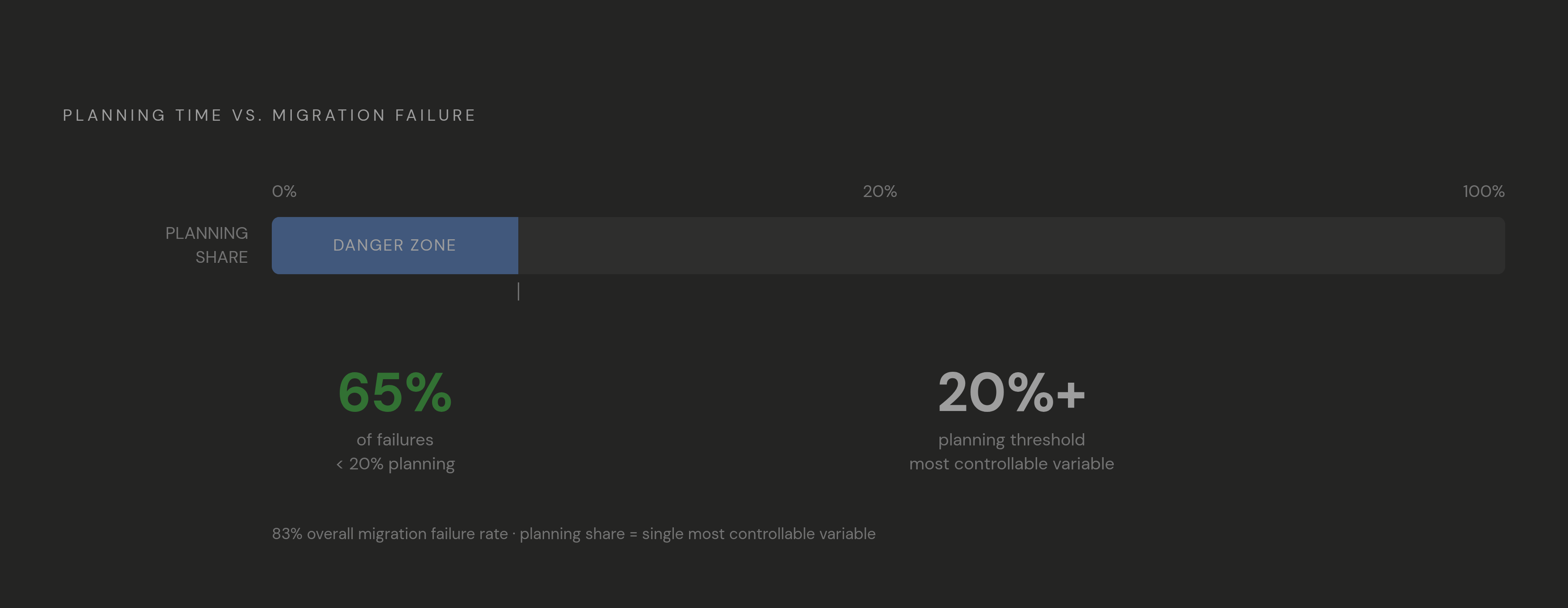
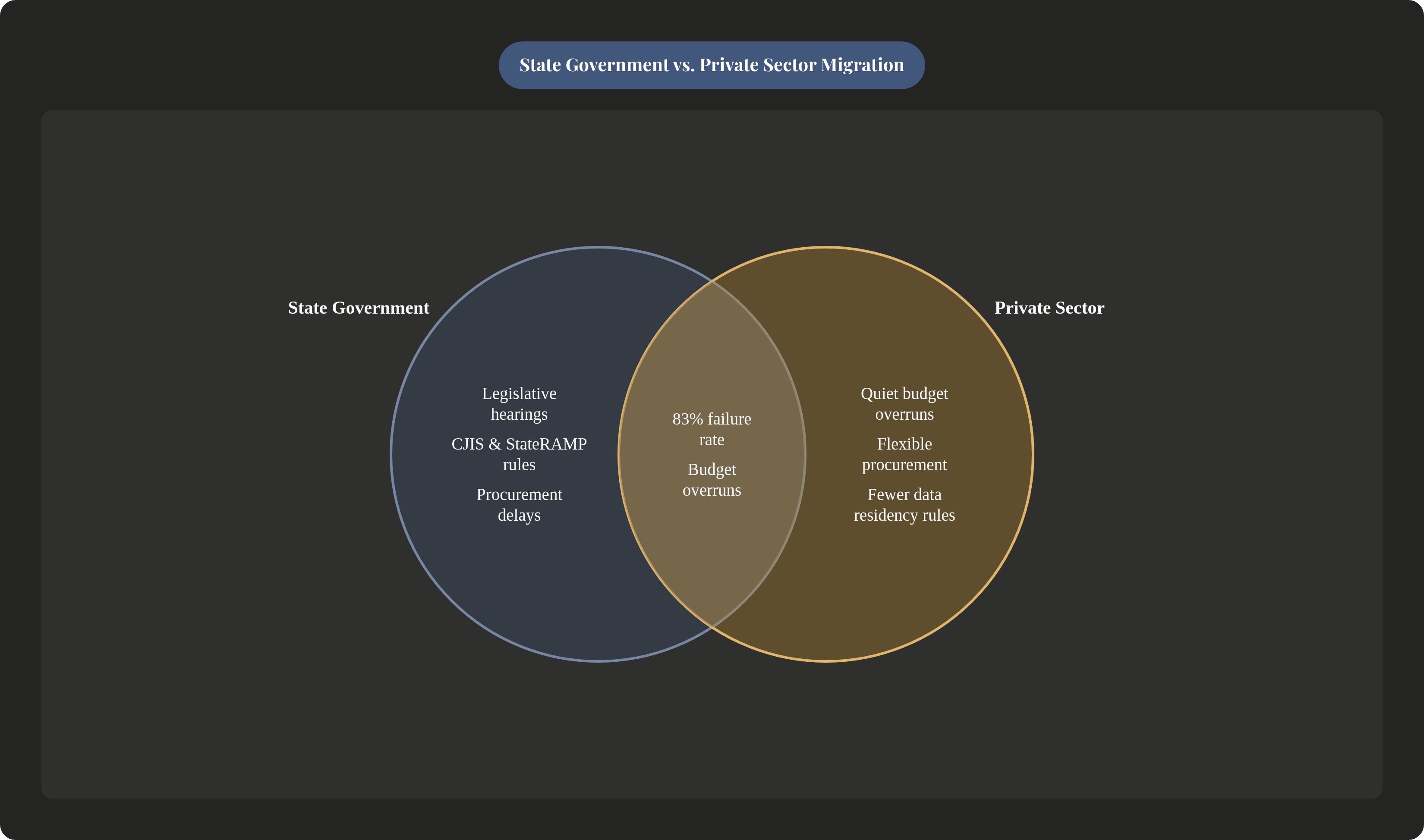
Data migration projects fail constantly, and government feels the failure differently than everyone else. Gartner puts the failure and overrun rate at 83%, and Bloor Group research cited in an Oracle white paper puts the average damage at 30% over budget and 41% over schedule. A private company eats that quietly and moves on, but a state agency eats it in a legislative hearing, with a camera pointed at whichever deputy director drew the short straw that week. This piece walks through what a phased, state-specific migration roadmap looks like when you build it around the sector's actual constraints instead of a vendor's generic checklist.
Here's the root cause: 65% of failed migration projects spent less than a fifth of their total timeline on planning. Washington State's Criminal Justice Training Commission spent close to two years trying to migrate a proprietary database, and it never worked. The agency's current plan is to shut the system down and limit access while it winds things down, which is the outcome this entire roadmap exists to help someone avoid.
The constraints that make state government migration different from the private sector
Legacy systems in government aren't just old, they've been running critical parts of daily life for decades, functions nobody notices until they break in front of a reporter. A GAO report from July 2025 reviewed 69 federal legacy systems and flagged 11 as most critical. Eight of those 11 run on outdated programming languages, seven carry known cybersecurity holes, and some date back 23 to 60 years. State systems run comparable hardware and code, kept alive by whoever on staff still remembers COBOL, and that person is usually one retirement away from becoming an expensive problem nobody planned for.
About 79% of federal IT spending goes toward keeping the lights on for what already exists, which leaves a thin margin for anything new, and state budgets follow the same pattern.
The regulatory surface here is wider than almost any private industry you could name. HIPAA governs health data, CJIS governs law enforcement records, and NIST 800-53 sits underneath as the baseline security framework touching nearly everything else. Add data residency rules that often require U.S.-based servers, or environments authorized under FedRAMP or StateRAMP, and the compliance map turns into dozens of requirements that interlock in ways nobody fully diagrams until something goes wrong. The personal data at stake covers a citizen's entire life: birth certificates, court records, benefits history, criminal justice files. Get one field wrong, and it's not a bug ticket; it's a headline.
Then there's procurement, which can stall a project for months before anyone even notices the work has stopped. In many states, just issuing an RFP takes weeks, and capital planning stretches the runway further. Route Fifty's 2025 reporting notes that the federal modernization funds which used to cushion earlier migration cycles have largely dried up, so agencies now fund this work out of tighter, more contested budgets. Layer on a workforce gap, agencies short on staff fluent in cloud security or FinOps, and the people who understand the COBOL-era systems retiring faster than anyone's replacing them, and you get a structural problem no vendor pitch deck fixes by itself.
Public accountability closes the loop, and it doesn't close gently. Failures here don't get buried in a quarterly earnings footnote; they get audited, reported, and sometimes turned into a hearing with a name tag on the table. GAO found incomplete modernization documentation directly raises the odds of cost overruns and outright failure, and MeriTalk found 96% of IT decision-makers believe legacy applications put critical infrastructure at risk, with nearly half having watched a digital services project collapse because a legacy system simply couldn't carry it. That's a shared, well-documented problem across the sector.
What a pre-migration assessment must cover for a state agency
If 65% of failures trace back to a planning shortfall, the assessment phase is where that debt gets paid down. It needs more calendar time than agencies usually give it, and real, granular inventory work, not a kickoff meeting and a Gantt chart nobody touches again after month two.
Start with the data itself: every data set, every format, every owner, cataloged and written down, with particular attention to proprietary or legacy formats with no modern equivalent. That's the exact trap Washington's CJTC fell into, a system so bespoke that migration turned into reverse-engineering records with no documentation to guide it. Flag anything with regulatory weight (HIPAA-covered, CJIS-restricted, PII-heavy) and trace where the data actually comes from, how it moves, what downstream processes quietly depend on it staying in its current shape.
Application dependency mapping comes next, and it matters more than it sounds like it should. Research suggests roughly half of existing applications can't access migrated data without modification, so map those dependencies before migration, not after something breaks in production. Note every integration point, especially ones reaching into other agencies or federal systems; those are the dependencies nobody remembers until they fail, usually at the worst possible moment.
Data quality gets its own audit, separate from the inventory. Poor data quality touches an estimated 84% of migrations, and duplicate or corrupted records don't just look messy in a spreadsheet, they cause real performance problems once they land in the new environment. Set a quality baseline before migration starts, and treat remediation as its own scheduled task rather than something you patch mid-move once everyone's out of patience.
Risk and compliance mapping runs alongside all of this. Which data sets need a StateRAMP or FedRAMP-authorized environment, and is there data that legally can't cross state lines? Document the compliance obligations of the destination, not just the source, since agencies routinely design for where data lives today and forget to ask what rules apply to where it's headed.
Last piece, and the one people skip: a skills and resource audit. Who on staff can actually support cloud security, migration tooling, and post-migration operations, and where are the gaps that need a contractor? The output of this whole phase should be a written migration readiness report, something that works as both a project charter and an audit trail. When the legislature asks what happened eighteen months from now, this is the paper trail that answers, assuming somebody kept it current.
How to set a migration strategy and sequence that reflects state government realities
Every system carries its own risk profile and timeline. Sequencing isn't a scheduling exercise you hand off to a project manager; it's the actual strategy.
Prioritize by risk and cost first. Systems with known security holes or running on unsupported hardware go to the front of the line, both because they're the most dangerous to leave alone and because they're usually the most expensive to keep on life support. NASCIO's 2025 Top Ten priorities list puts cloud services, cybersecurity, and legacy modernization all in the top four simultaneously, which tells you sequencing should lean toward the cybersecurity payoff early rather than saving it for later. A practical starting point: the four cloud categories states most commonly migrate first are email and calendar, collaborative platforms, service management, and project and portfolio management. Lower regulatory complexity and faster wins give a chance to build institutional confidence before tackling something like a CJIS-restricted case management system that leaves little room for error.
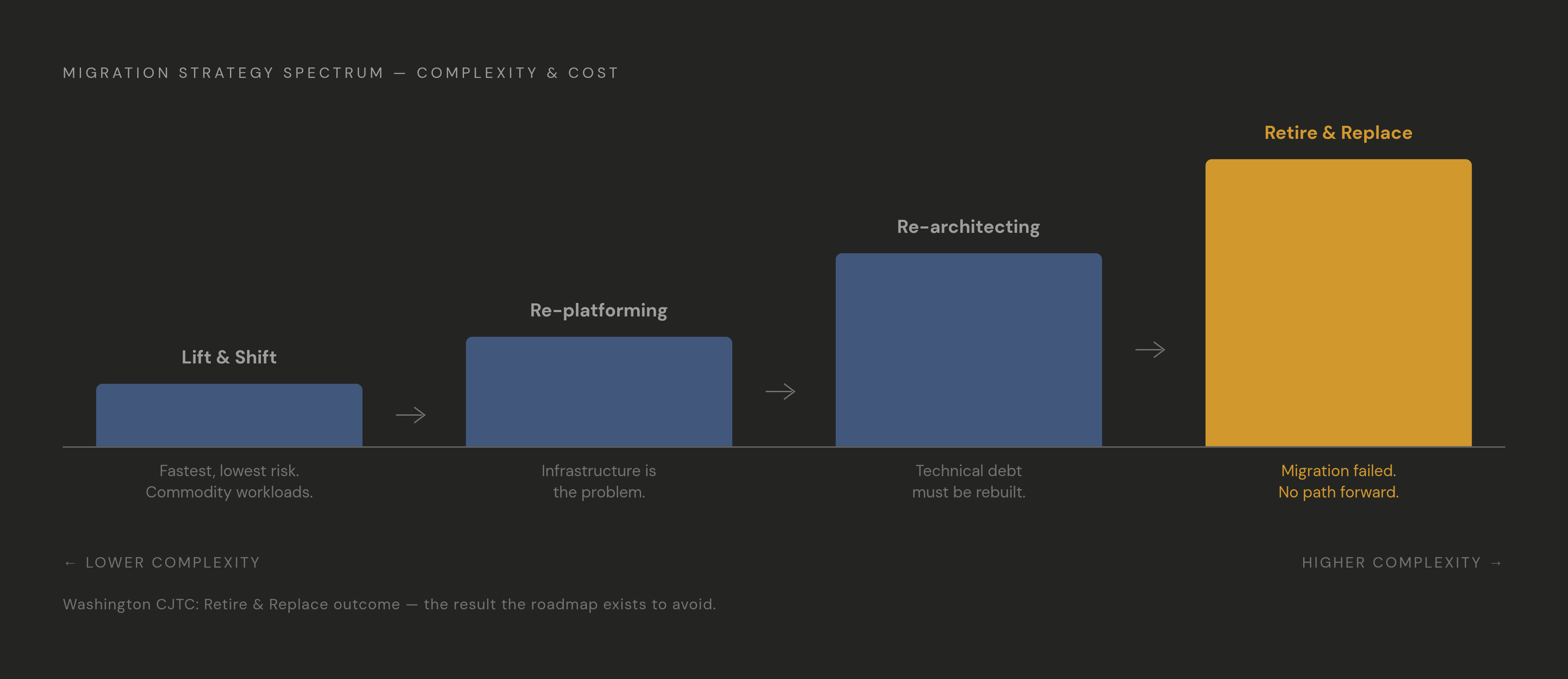
The migration approach has to match the system in front of you. Lift-and-shift is fastest and lowest risk, good for well-documented, commodity workloads that don't need reinventing. Re-platforming sits in the middle, useful when the application logic still works but the infrastructure underneath it is the actual problem. Re-architecting is the most expensive and complex option, so save it for systems where a plain lift-and-shift would just relocate the technical debt instead of resolving it. And sometimes the honest answer is retire and replace, which is the Washington CJTC path: migration has already failed, or there's no viable route forward, and a controlled shutdown beats another year of sunk cost dressed up as progress.
Phased migration beats a big-bang approach in nearly every state government scenario, and it's not close. Public services can't absorb long downtime, and budget cycles rarely fund one enormous investment in a single appropriation anyway. Map each phase to a budget cycle on purpose, and build the case for the next round of funding using savings the last phase already proved out. Pennsylvania's modernization work delivered $37 million in savings, which is the shape of ROI story that actually unlocks the next appropriation instead of asking the legislature to trust you on faith.
Procurement strategy needs its own line item, not an afterthought bolted onto the schedule. Confirm early whether StateRAMP-authorized vendors are required, and build the RFP timeline with realistic lead times, because those lead times routinely add months before anyone touches actual migration work.
A GAO report from July 2025 reviewed 69 federal legacy systems and flagged 11 as most critical.
Building the compliance and security architecture before data moves
Order of operations matters more here than almost anywhere else in the roadmap. Compliance architecture goes in before data moves, and well before someone notices a gap during an audit.
Map NIST 800-53 controls to the target cloud environment's control catalog before migration starts. StateRAMP, the state-level counterpart to FedRAMP, exists specifically to authorize cloud vendors for state government procurement, so check a vendor's authorization status before signing anything, not after the contract's already moving and everyone's committed. On the infrastructure side, NASCIO's 2025 survey found 42% of states have implemented mainframe-as-a-service. For the other 58%, mainframe migration carries compliance obligations that cloud-first frameworks don't always cover out of the box, and agencies shouldn't assume cloud compliance work automatically extends to the mainframe piece, because usually it doesn't.
Data classification enforcement has to exist in the target environment before anything arrives. CJIS-restricted data needs specific access controls, audit logging, and often a dedicated cloud region, all provisioned ahead of migration rather than requested as an afterthought once someone spots the gap. HIPAA-covered data needs business associate agreements with the cloud provider, plus encryption both in transit and at rest, though encryption at rest is technically an addressable specification under HIPAA rather than a single mandated standard. That gives agencies some latitude in how they implement it, not whether they do it.
The riskiest window in the whole process is data in motion, full stop. Define key management practices and access controls for the migration pipeline itself, not just for the destination once data lands safely. And because state agencies operate under public records laws and audit obligations, the migration process needs to generate its own documentation as it runs. Build logging into the migration tooling itself rather than trying to reconstruct a paper trail afterward, which never works as well as anyone hopes it will.
This can go right, and it has. The VA migrated more than 350 applications to the cloud and finished five months ahead of schedule. Structured compliance architecture didn't slow that project down; it's arguably what made the speed possible, since nobody had to stop mid-migration to figure out where the CJIS-equivalent controls should have gone in the first place.
Executing migration in phases while keeping public services running
Operational continuity isn't a nice-to-have here, it's central to the mission. A DMV database going dark for a weekend is a minor inconvenience in the private sector, but in state government it can mean a line at the counter, a news story, and a court docket that stopped moving.
Run the source and target environments in parallel during migration windows. Yes, it costs more short-term to keep two systems live at once, but that cost is almost always smaller than the cost of a public-facing outage. Define cutover criteria based on validation thresholds, not a date circled on a calendar, and let the parallel run end when the data checks out, not when the project plan says it should.
Validate continuously during migration, not just at the finish line. Legacy incompatibility causes up to 45% of migration failures and adds delays averaging three to six months, and most of that damage traces back to format or structure conflicts nobody caught until after cutover. Catch them mid-migration instead: run automated reconciliation checks, record counts, checksums, referential integrity, continuously through the window rather than as one audit at the end.
Every phase needs a documented rollback procedure before that phase starts, no exceptions. Rollback works as a controlled response to a validation check that failed, and treating it as a normal part of the plan rather than an embarrassment changes how teams behave when something does go sideways, since it will, eventually, for someone.
Communication has to be tailored, since agency leadership, legislative oversight, and public-facing service teams each need different information at different levels of detail. Washington's Secretary of State migration ran into resource delays and ended up needing a public, multiyear project plan just to manage expectations. Proactive communication beats reactive explanation nearly every time, if only because a delay is easier to accept when it's flagged early rather than explained after the fact to someone already annoyed.
Timeline estimates in this space run off by 40% to 60% on average, so build contingency into each phase explicitly, and give appropriators realistic numbers rather than optimistic ones you'll walk back in six months. A second, revised timeline rarely carries the same credibility as the first, and appropriators have long memories for that particular letdown.
Post-migration validation and the governance structures that keep the new environment stable
Cutover isn't the finish line, whatever the project plan implies. Migration is complete once the new environment is verified, documented, and something a governance structure can actually manage going forward.
Run the full validation checklist. Reconcile record counts and critical data fields against the pre-migration baseline, and verify every application that touched migrated data still works. Given that roughly half of applications need some modification post-migration, treat this as an expected phase with known failure points rather than a surprise when something breaks. Confirm regulatory controls are active and auditable in the new environment, and run a compliance scan against NIST 800-53 or whatever framework applies before anyone even thinks about decommissioning the source system. Document baseline performance metrics in the new environment too, so six months from now there's something to measure against instead of a shrug.
Don't decommission the legacy system until validation is fully signed off. Premature decommissioning is one of the more common ways agencies lose data permanently, and it's an unforced error every single time it happens. Keep documentation of the legacy system's data structures and configurations even after it's gone, for audit purposes down the line.
Governance in the new environment is where a lot of the earlier problems either get fixed for good or quietly reappear in a different form. Assign clear data ownership, because the fragmented ownership that probably caused half the migration headaches needs actual resolution in the target state, not a shrug and a new org chart nobody follows. Build FinOps practices from day one, since cloud cost accountability is a consistent blind spot in public-sector migrations, and without it, cloud spending just replaces legacy maintenance costs instead of reducing them, which defeats half the point of migrating at all. Data management and analytics climbed to the number four spot on NASCIO's 2025 Top Ten list, so design the new environment to support analytics use cases going forward instead of simply replicating whatever the legacy system used to do.
Train staff on the new environment before the old system gets shut down, not after everyone's forgotten the login process. The skills gap that existed before migration doesn't vanish just because the migration finished; it sticks around unless someone deliberately closes it. And document the completed migration thoroughly, because GAO's finding here is blunt: agencies without complete modernization documentation face higher odds of cost overruns on the next project. This documentation package is the foundation the next phase of work gets built on, whether anyone actually reads it or not.
How to build the internal case and sustain momentum across budget cycles
Most state migrations stretch across multiple appropriations cycles, which means every phase has to be re-justified to whoever controls the money, and nobody assumes it's a given just because phase one went well. That's not how legislatures work.
Frame the return on investment in terms legislators actually respond to. Pennsylvania's modernization work produced $37 million in savings, a concrete, attributable number that earns credibility for the next ask. Better still, frame savings as reinvestment capacity: Pennsylvania's 2025-2026 budget included $10 million in new cybersecurity funding and $11.5 million for CODE PA, its enterprise platform modernization effort, a 40% increase built directly on the credibility of savings already demonstrated. Prove the last dollar worked before asking for the next one.
Quantify the cost of doing nothing too, since inaction has a price tag even when nobody's watching it pile up. GAO identified 10 legacy systems costing $754 million annually just in maintenance, and a maintenance bill that climbs every year is a political liability as much as a technical one. That framing tends to land harder with appropriators than any argument about elegant architecture ever will.
Document every funding source available, because migrations rarely run on one budget line alone. State general funds and capital appropriations are the obvious base, and the Technology Modernization Fund, created under the Modernizing Government Technology Act, offers a federal loan option worth exploring. Federal grants tied to specific programs, Medicaid IT systems or criminal justice data systems among them, can sometimes fund the migration work if it's framed against the program's own modernization goals.
Finally, use AI and analytics as the forward-looking case for why any of this matters beyond compliance. NASCIO's 2025 survey shows AI has risen to the top of state CIO priorities, and none of that runs on a data foundation still sitting on a decades-old proprietary database that only a handful of staff know how to query. The migration is the prerequisite for whatever the next decade of state technology ends up asking of these agencies, and that's the argument that should open the next budget conversation, not close it.
Sources
- https://ardham.com/step-by-step-guide-for-government-agencies-and-regulated-industries-migrating-to-the-cloud
Provided the example of the VA migrating more than 350 applications to the cloud ahead of schedule.