How Vendors Challenge a Federal Contract Award
Agency, GAO, or court: each forum offers different speed and power.

A vendor may contest a federal award at the agency itself, before the Government Accountability Office, or in the Court of Federal Claims. Each path moves at a different speed, carries different costs, holds different authority, and shields vendors differently while contract performance continues. That makes the choice of forum a strategic element in any protest decision.
Why the choice of protest forum shapes the outcome before the argument begins
Forum choice and timing mistakes can permanently cost a contractor its protest rights. An objection to an award, even a good one, does not by itself keep open the chance to challenge it. The GAO bid protest FAQs stress that procedural requirements are intricate and applied strictly. Certain filing windows close even before the award. For other deadlines, a contractor may have just days to analyze what the agency did and draft its protest.
The 1984 Competition in Contracting Act established a framework designed to offer parties a genuine opportunity to settle disagreements while enabling agencies to obtain essential goods and services quickly. This equilibrium influences both the remedies offered and the timeframes involved. Because each forum operates under distinct powers and procedures, a vendor eligible for one might find itself without equivalent safeguards elsewhere. Which forum a vendor selects dictates both the reviewer of the claimed mistake and the scope of that reviewer’s power to correct it.
What agency-level protest offers and where it falls short
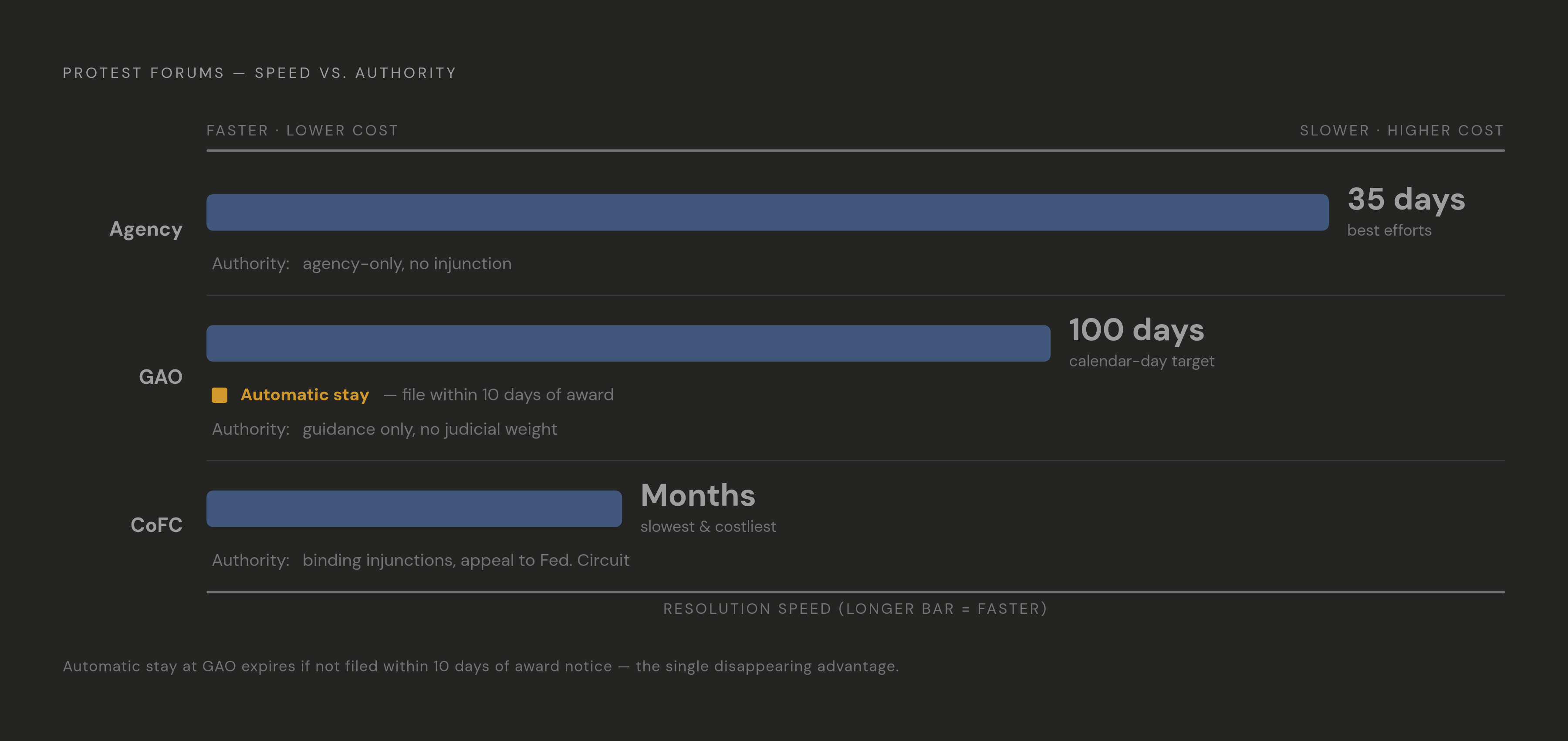
When the disagreement is limited in scope and the agency is open to reconsidering, an agency-level protest is the fastest way to get a correction. The Federal Acquisition Regulation requires agencies to make their "best efforts" to settle such matters within 35 days. Relief can come through voluntary corrective action, for example changing a solicitation or reviewing proposals again, which may settle a clear administrative error on the spot. An ambiguous solicitation term can also be fixed without the dispute ever leaving the agency.
The officials assigned to handle the protest are part of the same institution whose decision is under challenge. As a result, it is not a detached forum comparable to the court or GAO, nor can it enjoin its own conduct.
Before the protest is resolved, the agency generally cannot make the award without a written rationale grounded in urgency, compelling need, or what best serves the government. That protection gives the process real value. This forum is best for fixable objections that must be addressed quickly, where the vendor can reasonably anticipate good-faith reconsideration. It does not suit a dispute that calls for binding outside authority.
How GAO protests work — standing, deadlines, the automatic stay, and what a win actually produces
GAO hears most federal bid protests. Its quick process, lower cost, and automatic stay of performance have made it the forum most vendors choose by default. Agency-level proceedings are the least expensive, while GAO proceedings are generally cheaper than federal court proceedings. Only an “interested party,” meaning a bidder, actual or prospective, with a direct economic interest in the award or the decision not to make it, may file.
Eligible protesters file their cases through GAO’s Electronic Protest Docketing System, known as EPDS. The first deadline issue turns on the subject of the protest. Protests of apparent solicitation defects must be lodged prior to bid opening or initial proposal receipt. A vendor cannot hold back until after losing and only then raise a flaw apparent in the solicitation. After an award, a protester generally has 10 calendar days from actual or constructive knowledge of the protest basis to file.
When a debriefing is required and actually given, the clock on filing does not start running until the agency has answered each question posed to it. GAO counts its deadlines in calendar days. It slides forward to the following workday. These deadlines must be met before GAO will take up the challenge, and the separate timing rules tied to a performance stay also play into the filing decision.
Under CICA, an automatic stay takes effect if a protest is lodged no more than 10 days after award or before the close of the period following a mandatory and sought-after debriefing, whichever occurs last. Work halts during GAO's review of the challenge. An agency can lift this pause only by issuing a written finding of pressing necessity or public benefit, though such actions remain rare. This swift safeguard sets GAO apart from a forum where the contractor needs judicial intervention to halt performance.
GAO aims to resolve protests as fully as practicable no later than 100 calendar days after filing. GAO can dismiss a protest lacking a facially valid basis instead of continuing its consideration for the entire review period. Filing by an attorney is optional. According to GAO’s FAQs, however, only attorneys may access confidential proprietary information belonging to other companies in the record.
When GAO sustains a protest ordinarily, the agency takes corrective action. During the latest completed fiscal year, agencies most often lost protests over flawed technical reviews, faulty cost or price assessments, and improper proposal eliminations. Remedies can include reassessing proposals or issuing a fresh solicitation, offering the vendor a renewed opportunity to compete. Both sides typically accept such resolutions. Yet GAO's guidance carries no judicial weight, a limitation that surfaces whenever an agency declines to comply.
This equilibrium influences both the remedies offered and the timeframes involved.
What the Court of Federal Claims adds that GAO cannot provide
The Court of Federal Claims wields conclusive judicial power and may hand down mandatory directives, among them directives halting contract performance. It further allows hearings and restricted discovery. These capabilities prove valuable when resolving the dispute requires facts that extend past what the agency documented in its file. This tribunal alone holds authority over nearly all government contract bid protests, save for a handful of carve-outs like maritime disputes and specific Other Transaction Agreement challenges. Its rulings stand as final unless challenged before the Federal Circuit.
The 2025 case involving Kropp Holdings, Inc shows how far judicial review can reach. During a lengthy corrective-action process, the agency kept letting the awardee cure proposal defects without justification. The court addressed the agency’s repeated course of action.
By consolidating objections raised by 12 construction firms, the 2025 MVL USA, Inc. litigation addressed a broader policy concern. The court threw out a blanket federal requirement, rooted in an executive order, forcing prospective contractors to sign union project labor agreements before bidding on construction work over $35 million. Because the dispute required review of a systemic rule, it illustrates using the court for something other than correcting an evaluation error.
Those powers also bring more cost and more complexity. A vendor shut out at GAO, or one that waits past GAO’s cutoff for challenging an award, may sue in court, but it still must file quickly to preserve a real chance at meaningful relief. Protest filings at the court reached a new high in 2024, well above 2023. That rise helps account for more parties choosing the court while GAO changes reshape forum strategy.
How the automatic stay and the debriefing window create timing pressure that shapes forum strategy
Timeliness for submitting a protest and the period triggering an automatic pause guard different things. The former safeguards the right to challenge an award, and the latter halts work until disputes are resolved. Without a debriefing extension, an 11th-day post-award submission forfeits the pause, though later-found objections might still satisfy their deadline. The winning contractor remains free to proceed with the work. Consequently, a vendor must evaluate if filing promptly also secures meaningful commercial relief.
A vendor has only a brief debriefing window to gather details before deciding how to proceed. The applicable extension is available only if the vendor properly requests the required debriefing within three days after a pre-award exclusion notice or, after award, within three days after the award notice. That period continues through the agency’s full response to every question. Those extra details may strengthen the protest, but the deadline benefit is lost without quick action.
ATP Gov. case shows what happens when it proceeds without a stay. The agency let the awardee continue performing through the protest, then rejected GAO’s corrective action because performance had kept going. The agency agreed to GAO's recommended reimbursement of protest expenses. Still, ATP lacked a binding remedy that could get the agency to do the reevaluation and re-award.
Companies ought to retain legal advisors while preparing their bids. Waiting until the contract announcement appears often leaves no time to dispute obvious flaws in the solicitation. Bringing in counsel sooner ensures the adjudicating body considers every remaining argument and available safeguard instead of viewing the contract announcement as the protest's sole trigger.
How the new GAO pleading standard and the FY26 NDAA’s partial loser-pays rule are changing forum strategy right now
GAO's 2025 reforms heightened the pressure, especially for incumbents. Under the tougher pleading rule, unveiled July 14, 2025 and since put into effect, protesters must "provide, at a minimum, credible allegations that are supported by evidence and are sufficient, if uncontradicted, to establish the likelihood of the protester's claim of improper agency action." The former standard required "either allegations or evidence." Now protesters need both from the start.
The FY 2025 NDAA’s Section 885 required this threshold only for Department of Defense challenges, yet GAO extended it universally. That shifts how much weight pre-filing details carry. Firms unable to meet the bar get turned away prior to accessing the administrative record. So a protester cannot rely on that file for the proof required merely to gain entry.
The FY26 NDAA's Section 875 imposes a unique financial risk on specific incumbents. The Secretary of Defense may hold back part of certain payments when the Comptroller General throws out an incumbent contractor's protest as legally and factually groundless. This limited trigger means how strong the opening case is affects both payment exposure and the chance of relief.
The debate centers on ways to curb groundless filings while preserving valid challenges. At a House Subcommittee hearing, the General Counsel for GAO opposed fee-shifting, cautioning that it might discourage valid protests by small businesses and that dependable data for setting cost benchmarks were unavailable. The Subcommittee Chairman closed the hearing by saying the current system still deserved his trust. For four consecutive years, the agency’s effectiveness rate has stayed above half, meaning vendors received some relief in that portion of protests. Practitioners in government contracting law say those results show weak protests are not a major concern.
Vendors need evidence to back allegations before seeing the record, while impacted incumbents should weigh withholding. These changes push some vendors toward court, despite its own costs and complex rules.
Matching forum to situation — a decision framework for vendors
Vendors should pick a forum by looking at the remedy needed, available evidence, time left, and what they can afford to spend. Being the incumbent introduces yet another consideration. Challenging a specific, fixable issue at the agency level makes sense if officials have acted in good faith and speed matters most. Prompt filing keeps GAO open as a fallback, but Vendors on that path still must satisfy the time limits governing any subsequent challenge.
GAO is still the right starting point for numerous post-award disputes in which the automatic stay matters and the vendor meets the credible-evidence threshold. Its reduced expense compared to lawsuits and 100-day timeline may align with the vendor's commercial priorities. Incumbent contractors should likewise consider the recent risk of withheld payments. Judicial review becomes preferable if precedent-setting rulings are essential, targeted fact-finding might prove outcome-determinative, GAO's filing window has closed, or an industry-wide problem demands court intervention.
Process breakdowns may shift that assessment too. With EPDS unavailable from midday, October 1, 2025, during the fall 2025 lapse in appropriations, filings accumulated as reporting deadlines converged. For vendors shut out of GAO, the court had to remain an available forum.
Skilled procurement lawyers can weigh those forum choices in agency proceedings, before GAO, and in court. Lawyers steeped in federal procurement disputes can match viable arguments with realistic relief and preserve the short protest deadlines. Vendors should involve them at the outset, because delay over forum choice may foreclose the strongest remaining option.
Sources
- FAQs
Provided GAO's procedural rules on standing, filing deadlines, the automatic stay, the 100-day timeline, and attorney access to protected information.
- U.S. GAO - Bid Protests: Key Features and Trends
Supplied the comparative picture of protest trends and forum use, including the rise in Court of Federal Claims filings.
- Federal Contracts Are Highly Coveted—What Happens When There’s a Fight Over Them?
Explained the three protest forums and the Competition in Contracting Act balance between resolving disputes and procuring goods quickly.
- Part 33 Protests, Disputes, and Appeals
Supplied the FAR rules on agency-level protests, including the 35-day best-efforts target and limits on awarding during a protest.
- U.S. GAO - GAO Bid Protest Annual Report to Congress for Fiscal Year 2025
Provided the latest fiscal-year statistics on sustain reasons and the effectiveness rate.