State Chief Digital Officer Role and Responsibilities
Most states have created the role in the last fifteen years, but almost no two do it the same way.

Colorado stood up the first state Chief Data Officer position in 2011, a year after the role appeared anywhere in state government at all. Fifteen years later, 73% of states and territories have someone carrying that title. I keep coming back to how fast that happened, because bureaucracies don't usually move at this speed. A budget office took centuries to become boring and permanent, while a CDO office did something similar in about a decade and a half, which either means government is getting faster or data got scary enough to force the issue. Probably some of both.
How the role spread across states, and why it emerged when it did
Nobody in 2010 sat down with an org chart and declared that every state needed one of these. The role spread the way weeds spread: unevenly, opportunistically, wherever there was a crack nobody else had covered. Agencies needed to share data and legally couldn't figure out how, which sounds like a paperwork problem until you realize it means a foster care agency and a Medicaid office might be tracking the same kid without knowing it. Governors wanted numbers behind policy calls instead of vibes, and residents got tired of driving to the DMV to do something their banking app handles in ninety seconds, so somebody had to own the embarrassment of that gap.
Then AI governance showed up as a fifth pressure, and this one didn't exist in any form when Colorado created its office. It arrived suddenly and demanded attention, well before most offices were prepared for it.
The pace on that front is genuinely strange. In recent years, a growing number of states have passed legislation regulating government's own use of AI, across multiple legislatures, in one unglamorous technology category, in a remarkably short window. A source quoted in GovTech framed the underlying shift about as well as it can be framed: data isn't just something government collects to run its business, it carries value beyond whatever it was originally gathered for. That's basically the whole argument for why this job exists.
The core responsibilities that define the state CDO's day-to-day work
The 2025 NASCIO/Beeck Center CDO Survey splits the job into five domains: strategy and vision, governance and policy, business relationship management, leadership and organizational management, and analytics and data literacy. Read through all five and notice what's absent: no mention of servers, no patching, no uptime, no ticket queues. This is not a technical infrastructure job wearing a data label.
Breaking down silos is the actual center of gravity here, and the examples get concrete fast. Figuring out how Long COVID hit the state workforce means stitching together health records, HR files, and absence logs that normally sit in three separate fiefdoms, guarded by three separate agency heads who've never had a reason to talk to each other. Measuring whether state procurement treats vendors fairly requires the same kind of stitching, just applied to contracts instead of sick leave. Neither project happens if the data stays locked in whichever agency collected it first, which is the default setting almost everywhere.
Then there's responsible AI, a category that didn't make it into the original job description because the original job description predates ChatGPT by roughly ten years. AI governance has become a leading priority for state technology leaders heading into 2026, and priorities like that don't stay politely on one side of the hallway. It drags the CDO into policy fights they weren't hired to referee, using authority that may or may not formally exist on paper.
Which brings up the obvious question: how much authority does a CDO actually have? Often, less than the title suggests. Whether or not a state has bothered to write down real power for the position, the CDO tends to move things forward through persuasion, relationship-building, and a fair amount of showing up to meetings nobody else wanted to attend.
How states formally establish, or fail to establish, the CDO position
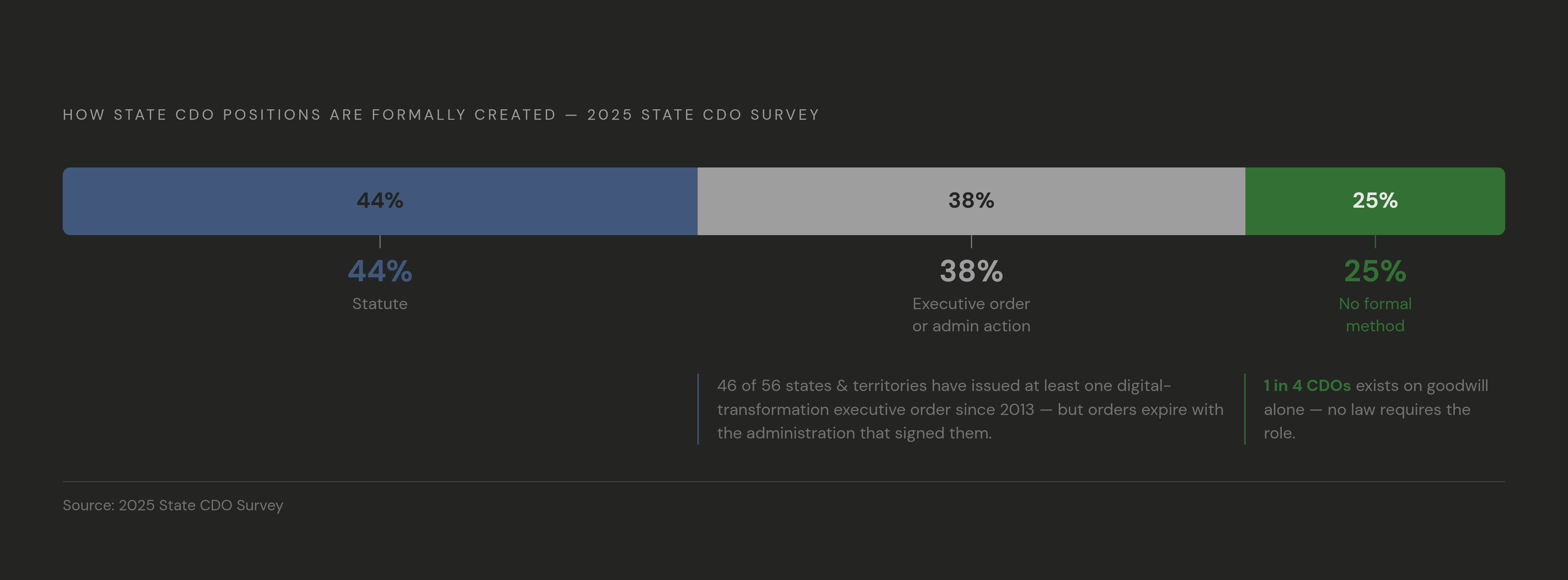
Here's where the patchwork stops being a figure of speech and starts being an actual spreadsheet problem. Per the 2025 State CDO Survey, 44% of CDOs are established by statute, 38% by executive order or similar administrative action, and 25% have no formal method of establishment whatsoever. Sit with that last figure for a second: one in four state CDOs exists purely because somebody with enough clout decided it should, not because any law says it must.
Executive orders are the popular route. Some 82% of states and territories, 46 of 56, have issued at least one executive order tied to digital transformation since 2013. But an executive order lasts exactly as long as the administration that signed it, and a new governor can erase one with a signature and zero legislative pushback. Statute holds up better; a CDO written into law tends to survive leadership turnover and the occasional budget hawk who wants to "streamline" the office out of existence.
Route Fifty reported in 2026 that, across nearly 40 states, "no common model defines how they are structured, resourced, or positioned." Translation: everybody built their own version of this from scratch, and almost nobody compared notes along the way. That's not automatically a failure, since it might just mean the role is too young for convergence yet. Still, it means two states can print the identical business card and hand it to two people doing almost unrecognizable jobs.
Where the CDO sits in the org chart and why it shapes their influence
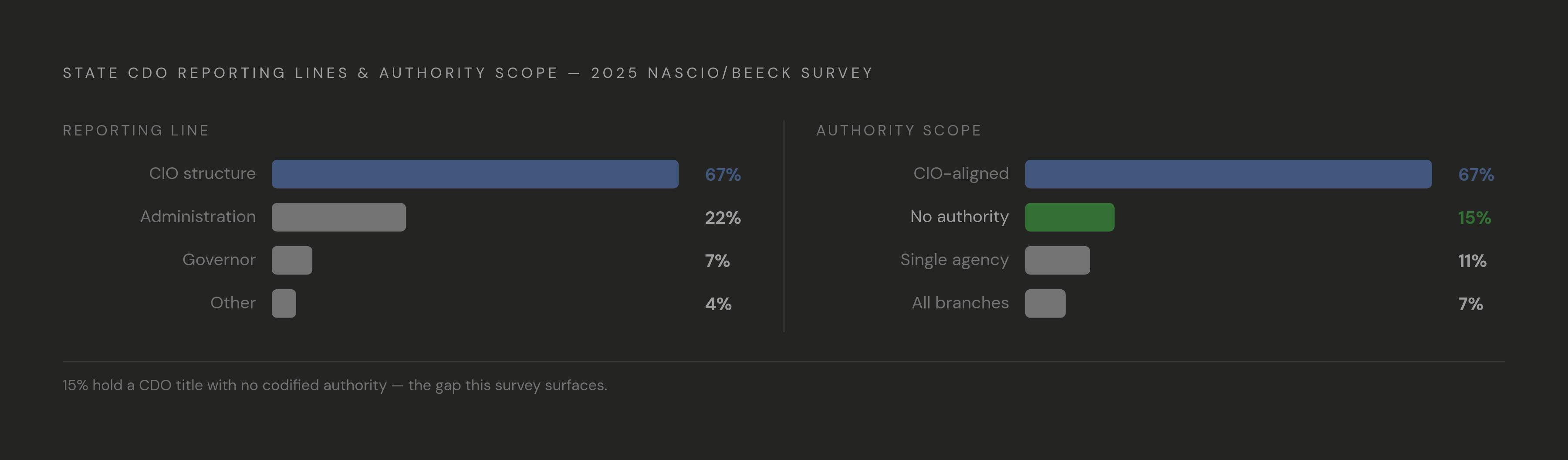
An org chart is really just a map of who gets listened to in a room, and the state CDO's map is lopsided. Per the 2025 survey, 67% report to the state CIO or someone inside the CIO's structure, whether that's a deputy CIO, a CTO, or a CISO. Smaller shares land under administration, budget, or finance departments, and only 7% report directly to the governor. Another 4% sit somewhere else entirely, in structures that don't fit neatly into any of the above.
Reporting into the CIO isn't nothing; it plugs the CDO into infrastructure and staff that already exist, rather than forcing them to build an execution arm from zero. But the CIO's whole job is optimized for uptime, security, and system performance, not for treating data as a strategic asset in its own right. The 2025 NASCIO/Beeck Center report calls this out directly, warning that the CDO role risks getting absorbed into the broader CIO umbrella until a strategic mandate shrinks down to routine technical data management. It's the difference between running the kitchen and running the menu: related, even dependent on each other, but not the same job, and not judged by the same priorities.
Ohio tried something else. There, the state CDO and CIO report jointly to the governor's cabinet director of administration, a setup built specifically to keep data positioned as an enterprise asset rather than an IT sub-function. Does that actually produce better outcomes than the CIO-aligned model most states use? Genuinely unclear, and I'd guess there isn't one right answer here; it reads more like a bet on where influence should sit than a proven fix.
Authority scope tells a related but slightly different story. Among CDOs, 67% report through the CIO's structure, 11% have authority limited to their own single agency, 7% hold the widest possible mandate spanning legislative and judicial branches plus independent state agencies, and 15% have no established authority at all. Add that up and you get a role that, in a meaningful chunk of states, runs on goodwill and personal credibility rather than anything codified.
Then AI governance showed up as a fifth pressure, and this one didn't exist in any form when Colorado created its office.
The six archetypes that capture how states have actually configured the role
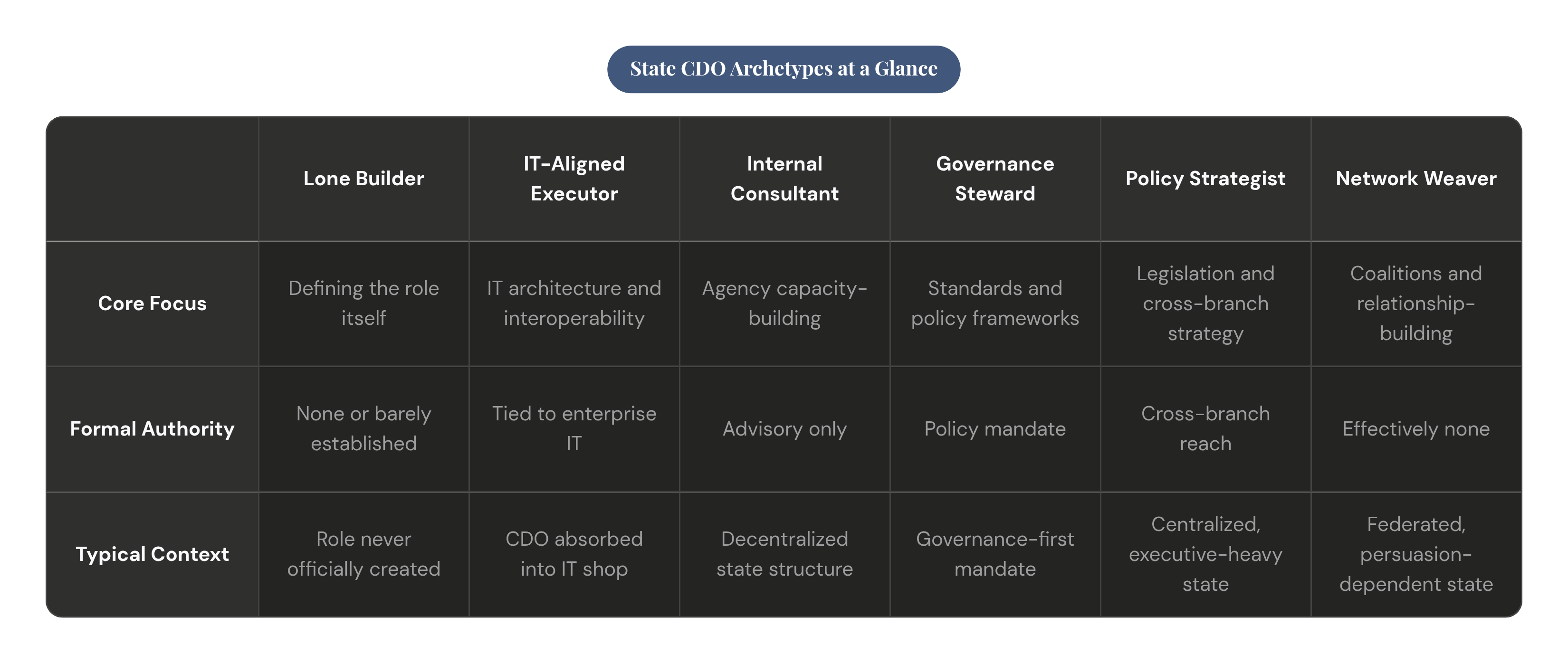
If the org chart numbers feel scattered, the 2026 Beeck Center/NASCIO report "State Chief Data Officer Archetypes" tries to impose some order on the mess, drawing on the same 2025 survey to name six recurring configurations.
The Lone Builder operates with no formal mandate, or a narrow one that's barely dry on the page; often this is one person absorbing CDO-shaped work in a state that never officially created the role, figuring out the job's edges in real time because nobody handed them a map. The IT-Aligned Executor holds authority tied to enterprise IT: architecture, infrastructure, interoperability, with little actual say over data policy. The Internal Consultant advises agencies and builds their capacity rather than directing anyone. The Governance Steward makes policy, standards, and governance frameworks the whole job. The Policy Strategist works at a higher altitude, often with cross-branch reach, actually shaping legislation. And the Network Weaver builds influence purely through relationships and coalitions, because formal authority never arrived to back them up, so they're negotiating for cooperation on every single project.
The report's real finding, buried under the taxonomy, is that none of the six wins. Authority, resourcing, existing relationships, and how mature the office already is all decide which archetype fits, and states seem to build the role around whatever power structure was already sitting there rather than importing someone else's template. Centralized, executive-heavy states tend to grow more authoritative CDOs, while decentralized, federated states tend to grow coordinators who survive on persuasion because command was never on the table to begin with.
One number puts the whole thing in perspective: only a third of respondents have an established data management program. The other two-thirds are still planning, still building, or haven't formalized anything, which tells you this isn't a field that's settled into its final shape yet.
How the CDO differs from the CIO, and why that difference is getting harder to ignore
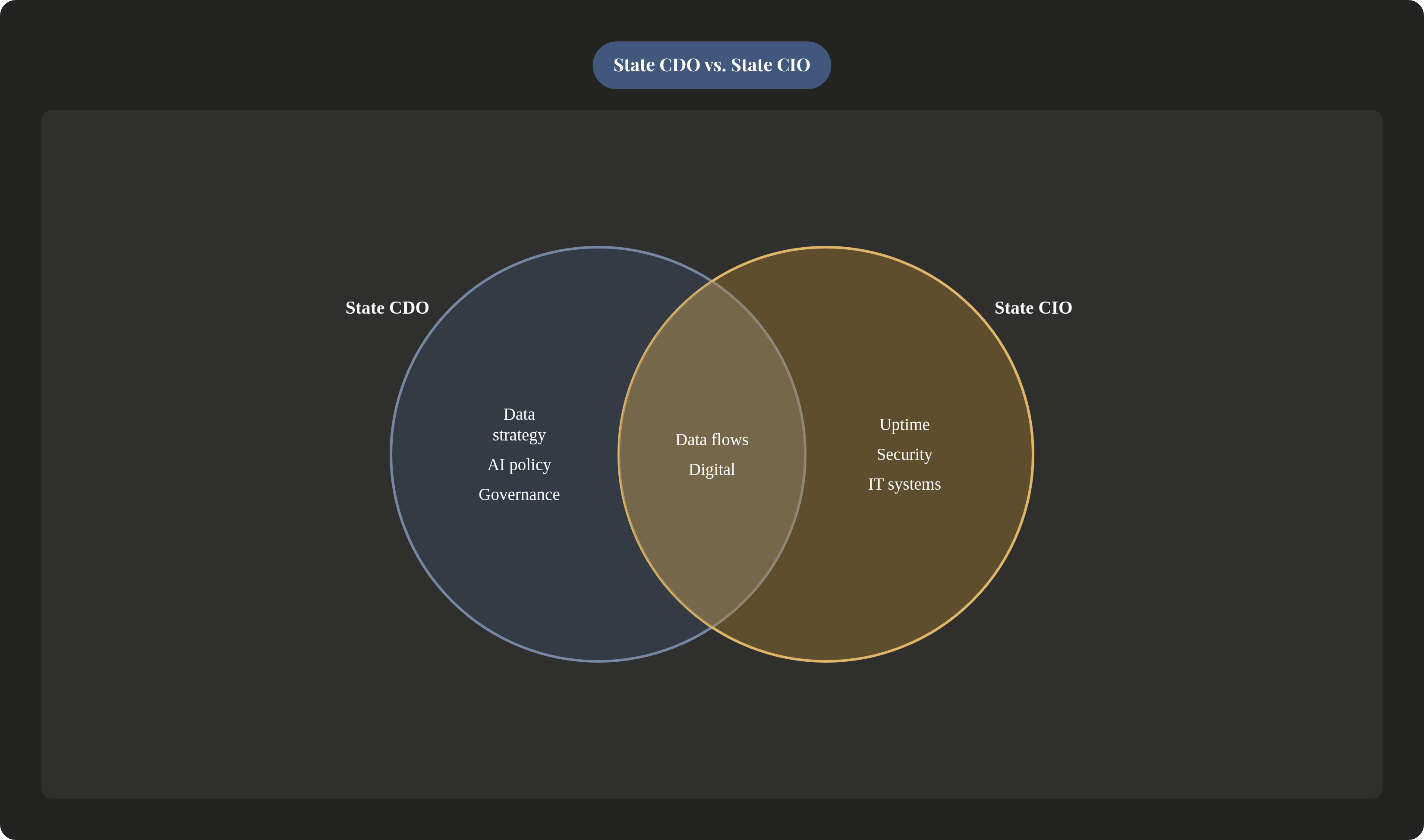
The CIO's job is older and more settled: infrastructure, cybersecurity, system operations, running whatever digital transformation project is currently on fire. Gartner draws the CDO line cleanly, defining the role around enterprisewide data and information strategy, governance, policy development, and making sure data actually gets used rather than just stored.
Here's a rough way to hold the two in your head: the CIO keeps the systems running, and the CDO decides what data flows through them and why it matters. That distinction holds up until you actually look at a real org chart, where the two jobs blur together far more than the tidy version admits.
A lot of what CDOs handle today used to just fall on CIOs and CTOs by default, because there was no one else standing there to catch it. States are only now prying these functions apart, mostly because data complexity has outgrown what any one technology-focused leader can carry alongside cybersecurity, network uptime, and the dozen other fires already demanding a CIO's attention on a Tuesday morning. The IT-Aligned Executor archetype is basically a live case study in what happens when that separation never fully completes: the CDO sits too close to the IT shop, and the role slides back toward technical execution, losing whatever strategic altitude the title was supposed to carry.
AI governance is now stress-testing this whole arrangement in real time. States have to decide whether AI policy belongs to the CIO, the CDO, or some shared arrangement between the two, and that line gets drawn differently in every statehouse. Whoever ends up owning it gets to set the rules for one of the most consequential technologies to hit government in a generation, which is a strange amount of weight to rest on an org-chart dispute.
What a well-resourced CDO office actually produces for state government
So what does a state get back when it actually funds this office, instead of treating it as an IT afterthought with a fancier title?
Cross-agency data sharing that would otherwise stay locked behind institutional walls, with the Long COVID workforce analysis and the procurement equity work standing in as real examples rather than hypotheticals somebody made up for a slide deck. A statewide analytics capability no single agency could build alone, because no agency has the budget or the mandate to construct shared infrastructure for actual insight, as opposed to just shared rules about who's allowed to touch what data. Governance frameworks that make AI adoption less reckless, with CDOs frequently the ones translating that growing pile of AI legislation into policy that functions day to day instead of sitting in a binder nobody opens. And digital service improvement: A number of states have stood up dedicated digital service teams, and those teams need centralized data leadership to even know which parts of a resident's experience are broken and worth the redesign effort.
Take away the org charts, the six archetypes, the reporting-line percentages, and what's left is mostly organizational glue: trust, relationships, and shared standards that let data move across a government that was never built for data to move easily in the first place. Hard to put a dollar figure on that, but that doesn't make it small.
The spread across archetypes, authority levels, and program maturity says states are still figuring this out in real time, testing structures against whatever power dynamics already exist in their own capitol buildings. But the direction isn't really in question anymore. Data leadership stopped being a specialty function bolted onto IT and started turning into infrastructure, the kind of thing a state government just runs on now, whether every state has gotten around to admitting that out loud or not.
Sources
- https://beeckcenter.georgetown.edu/projects/state-cdo-network/
Provided the framework of five CDO job domains from the 2025 NASCIO/Beeck Center CDO Survey cited in the article.
- https://digitalgovernmenthub.org/publications/state-chief-data-officer-archetypes-the-evolving-roles-and-capabilities-of-cdo-offices/
Provided the six CDO archetypes and the finding that no single model defines state data leadership, drawn from the 2026 Beeck Center/NASCIO report.
- https://www.route-fifty.com/workforce/2026/04/new-report-aims-help-states-define-chief-data-officer-role/413210/
Supplied the Route Fifty finding that across nearly 40 states no common model defines how CDO offices are structured, resourced, or positioned.
- https://www.govtech.com/analytics/no-single-model-defines-state-data-leadership-report-shows
Provided the GovTech-sourced framing that data carries value beyond what it was originally gathered for, cited in the section on why the CDO role exists.
- https://digitalgovernmenthub.org/library/state-chief-data-officer-archetypes-the-evolving-roles-and-capabilities-of-cdo-offices-executive-summary/
Supplied the executive summary details on CDO archetypes and the warning that the CDO role risks absorption into the CIO umbrella.