Information Governance Examples in Federal Healthcare Programs
Federal rules now require privacy, interoperability, and audits to work together.

Federal healthcare programs provide no one rulebook on information governance. Medicaid, Medicare, plus ONC spread IG demands through many standards and checks, so it shows up in bits: a permission rule over here, filing for API there, plus review of AI logs. IG is simply the decisions a group makes about who controls the data asset, who can access it, what standard it must meet, how much time it stays, and how updates are tracked. Hospitals tend to break these tasks into four connected areas: keeping files, AI rules, health data management (patient matching, HEDIS tracking), and handling privacy alongside HIPAA plus local regulations. A big network might field specialized teams here; a small facility typically stuffs them all into a single cross-functional body that meets weekly and goes over the same few issues each time. Below is a guide to what these federal requirements call for day to day, within the programs compliance and IT health groups already operate inside.
How HIPAA and the 42 CFR Part 2 revisions establish the privacy baseline for IG during 2026
American Institute of Healthcare Compliance states enforcement for revised HIPAA Notices of Privacy Practices began on February 16, 2026, under February 2024 Final Rule, which rewrote Part 2 of 42 CFR. This rewrite aligns substance use privacy protections alongside HIPAA standards, and for that first time ever, gives Part 2 violations actual consequences: fines plus corrective plans, aligning enforcement risk with HIPAA standards.
Under the framework, people get protections that NPPs must clearly state. One signed authorization now applies to later releases of information under the revised framework. They can now request specific privacy protections under the revised standards. And SUD files come with explicit restrictions limiting use in court cases.
This isn’t about paperwork. Doing this well takes getting sign-up steps, permission management platforms, EHR settings, and worker training on the same page, since a front-office okay that conflicts with what the EHR blocks trips up compliance teams. And this risk runs both ways at once: limit too much and proper care access is refused, give out too much, violating consent restrictions, and any error can bring scrutiny from HIPAA and Part 2 alongside information blocking. Privacy must integrate with interoperability workflows, making data segmentation, consent management, and role-based access active tools rather than static policies.
What USCDI Version 3 interoperability standards expect from data governance teams
Starting January 1, 2026, USCDI Version 3 was required for approved EHR tools and health IT vendors, AIHC states. This version expands the scope to include social determinants of health, health equity data, and insurance information, items that once fell outside the official interoperability scope.
Every one of those groups drags extra governance work with it. Each kind of data carries its own access settings, its own consent steps, and its own accuracy standards, with SDOH data requires careful handling alongside other sensitive information. Platforms must distinguish between shareable and restricted data elements within the same record.
Failing to meet USCDI v3 bar requirements, stemming from one governance lapse, brings information blocking claims, certification trouble, plus contractual noncompliance facing payers alongside federal programs. AIHC describes a collision of broader data access and harder privacy rules as among healthcare groups’ toughest compliance issues during 2026: privacy obligations and interoperability obligations are tied together, not handled in sequence. Data governance teams face a version mandate that exceeds a technical fix. Teams must figure out what data classes this mandate now covers, learn which consent terms attach per category, and see if current access controls can enforce those limits at the required size.
ONC HTI-5 proposed rule turning EHR certification into an IG tool
On December 22, 2025, ASTP/ONC released its HTI-5 Proposed Rule, called Health Data, Technology and Interoperability: ONC Deregulatory Actions meant to Unleash Prosperity. Federal Register listed it December 29, 2025, and the 60-day comment period ended on February 27, 2026.
It's tough to understate how far the proposal reaches. The HTI-5 Proposed Rule drops 34 of the 60 existing certification criteria while revising others, affecting nearly 70% of all requirements. Among criteria slated to be cut, those 24 would be gone when that final rule publishes; among them are clinical decision criteria calling for "model card" details, such as attributes plus predictive risk management records. The proposal also removes audit reporting and multifactor authentication requirements.
ONC is setting certification on FHIR-based APIs plus interoperability standards, matching 21st Century Cures Act's shift into data exchange rather than checklists for prescriptive functionality. Yet Dropping privacy and safety checks from certification shifts responsibility to purchasers to verify HIPAA-required features and spell out exact terms in vendor deals and partner audits. The proposal suggests certification no longer provides comprehensive assurance. Groups relying on certification as an IG assurance mechanism carry that accountability themselves.
The companion HTI-2 withdrawal plan, released on December 22, 2025 aims to remove non-finalized parts from ONC's August 2024 interoperability rule and covers plans around USCDI v4, plus a deadline expiration tied to USCDI v3. According to Holland & Knight, the agency's justifications are money, difficulty, and no clarity.
CMS interoperability and prior authorization rules as a data-access governance example
On April 14, 2026, CMS issued its proposed rule for Medicare, Medicaid, plus ACA programs to improve data exchange while reducing friction around prior authorization through interoperability across health care. Impacted payers must send CMS the API endpoints they use, plus other info for these APIs: Patient Access, Provider Directory, Provider Access, Payer to Payer, along with Prior Authorization.
Also, CMS plans to track metrics for those APIs and check if policies are doing their job. Instead of remaining purely technical, this API is now reportable and auditable, letting CMS use it for governance oversight.
For any payer's IG team, each API endpoint requires documentation plus CMS sign-up, data must stay reportable, while prior authorization workflows now face federal oversight covering the data exchange rather than only the clinical decision. Rather than blunt mandates, the CMS rule leans toward favoring public-private partnerships and incentive alignment. Framing aside, API reporting means actual accountability.
Under the framework, people get protections that NPPs must clearly state.
Medicare fraud prevention as a large-scale applied information governance operation
Medicare applies data analytics for spotting anomalous billing, surges and spikes that point to fraud early enough, before it drains the system. For instance, analytics let Medicare suspend 15 providers who billed over $4 billion for urinary catheters nobody actually received. Between 2022 and 2024, Medicare says it blocked a substantial sum in fake claims, showing what running fraud spotting as constant data governance work looks like, not the mess an auditor stumbles across down the road.
One weakness in this setup proves instructive. CMS began sharing data on Medicare provider suspensions with private plans, supplemental payers, and Medicaid programs. Before that, without information sharing, supplemental payers still covered beneficiary charges for bills CMS saw as fraudulent. That data was already there. Choices were reached using that data. But that governance structure failed to reach everyone requiring information so they could act sensibly; the bill moved downstream to supplemental payers left in the dark about what CMS had already seen.
Stopping fraud this big requires access rules about who views anomaly flags, standards ensuring billing files checked are correct from the first, audit trails strong enough to back up actions like stopping payments and getting money back, plus information sharing across programs built into the governance structure as a core part instead of an afterthought.
CMS's AI governance models, WISeR and ACCESS, as emerging IG structures inside Medicare
CMS uses a pair of AI models that also work as Medicare IG structures. The program called Wasteful, Inappropriate Service Reduction began in January 2026 across six states, using AI alongside medical checks to catch unnecessary care during Original Medicare's prior authorization. ACCESS kicks off July 2026, using AI to find individuals with long-term conditions who'd gain from technology-enabled management, tying pay to results rather than how many procedures got billed.
Both models fit CMS's own description of itself as "AI first," a posture agency leadership laid out at a recent policy conference event while previewing the Strategic Framework for 2026 through 2031. GAO's figures reveal the extent of that change: federal AI use cases across the government almost doubled, moving from 571 during 2023 to 1,110 by 2024. HHS drove the biggest growth of any agency, growing from 157 to 271 total AI applications, and within HHS specifically, generative AI projects went from 7 to 116 in that same window.
ACCESS plus WISeR add fresh IG requirements: documentation showing what enters and leaves the models to catch unfair patterns, audit trails when that AI shapes a clinical decision, governance for kill-switch use on tools operating in production, plus FDA-aligned validation before any code drives care decisions.
All of this is contested. Wording the House Appropriations Committee approved would stop federal spending from going to WISeR, showing AI governance inside Medicare has become a party issue alongside technical and compliance concerns. Partisanship matters here too. In 2026, compliance teams must work within a governance framework that puts NIST's AI Risk Management Framework and ISO 42001 alongside HHS's AI rules plus existing HIPAA requirements and information blocking obligations, while figuring out how these elements align presents a separate challenge. Those behind the oversight now want more than words confirming AI choices are controlled. They demand proof, and this expectation currently shapes the way healthcare workflow automation programs secure budget and pass scrutiny.
State-level AI rules are fragmenting IG compliance across plans operating across Medicare plus Medicaid
During 2026, over 280 healthcare AI proposals across states addressed transparency and disclosure mandates, plus AI chatbot use and utilization management. No national federal AI framework yet preempts any part, meaning all plans operating across many states must shape their internal technology policies around a state-by-state patchwork.
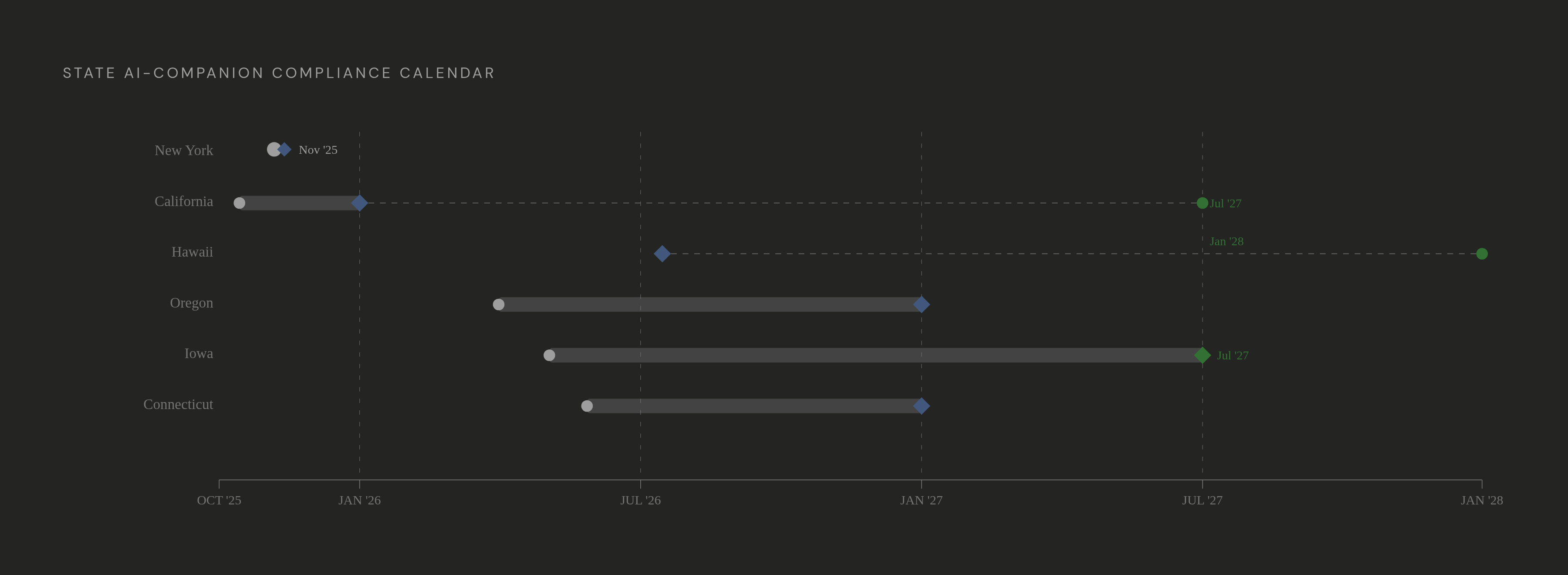
These AI-companion bills make clear how the patchwork works in practice, through exact tasks instead of wide plans. York's measure, Part U in FY2026 budget legislation, took force November 5, 2025; it requires one crisis-referral protocol plus AI disclosure every 3 hours, with enforcement by the Attorney General. Under California's SB 243, enacted October 13, 2025, effective January 1, 2026, providers must use one crisis-referral protocol plus AI disclosure, give minors reminders, and file annual reports with Office of Suicide Prevention after July 1, 2027, supported through a private right to recover harm, with $1,000 each time, whichever amount is higher.
Effective when signed July 14, 2026, Hawaii's Act 248 requires AI disclosure plus safeguards protecting minors alongside crisis-protocol rules, enforced as deceptive conduct, with yearly annual reports going to the Behavioral Health Administration of the Department of Health from January 1, 2028. Oregon's SB 1546, approved March 31, 2026 with an effective date of January 1, 2027, imposes additional requirements: it mandates suicidal-ideation protocols, referral mechanisms featuring 988 contact plus hyperlink, alongside legal restrictions targeting simulated dependence and simulated romantic interest, plus role-play involving minors, while maintaining California's private right structure.
The Attorney General enforces Iowa's SF 2417, which was approved on May 2 of 2026 and takes effect July 1, 2027. It requires AI disclosure for minors alongside a crisis-referral protocol, stops any companion from saying it offers licensed behavioral health help, hits firms with fines reaching $500,000 each, and grants no private right to sue. On May 27, 2026, lawmakers approved Connecticut's Public Act 26-15, whose AI-companion rules take effect January 1, 2027, creating the toughest rule among these states: it demands an evidence-based 988 crisis-detection protocol, forbids anthropomorphic deception, and bars minors from any mental-health service unless the companion was built for that exact aim, resting on robust and peer-reviewed clinical data, organized around clear accountability, open about what it does and cannot do for the person and their clinician, and watched over by a licensed health professional who has judged suitability and directed its operation, with a disclosure at the beginning of every exchange stating it is not a licensed practitioner.
Every one of these rules imposes obligations that vary in start date, deadline, plus enforcement mechanism. An insurer operating across six states must complete six distinct compliance builds rather than a single framework tweaked by region. This is fragmentation in simple words: federal healthcare programs create the governance base, but legislatures put barriers above it, and they fail to match.
Sources
- HIT Perspectives Feb 2026: Policy Signals
Supplied the Medicare fraud example of suspended providers billing over $4 billion for urinary catheters.
- HTI-5 Proposed Rule
Provided the HTI-5 proposed rule details, including release date, comment period and certification criteria changes.
- AI Healthcare Regulations Map 2026: Every Federal and State Rule, Kept Current
Provided the state AI-companion law details and penalty figures.
- https://www.gao.gov/products/gao-26-107799
Provided the federal AI use case counts and the HHS growth figures.
- ASTP/ONC's Year-End Moves Mark a Strategic Pivot in Federal Health IT Policy | Insights | Holland & Knight
Explained the HTI-2 withdrawal and the agency's stated reasons for its year-end moves.
- American Institute of Healthcare Compliance - AIHC
Supplied the Part 2 NPP enforcement date and the USCDI v3 requirement and privacy-interoperability tension.
- https://www.federalregister.gov/documents/2026/04/14/2026-07205/medicare-and-medicaid-programs-patient-protection-and-affordable-care-act-interoperability-standards
Source for the April 2026 CMS proposed rule on API endpoint reporting and metrics.
- https://www.cms.gov/priorities/innovation/innovation-models/wiser
Described the WISeR model's AI-assisted prior authorization in Original Medicare.