Zero Trust Architecture Components Explained for IT Teams
Identity, device, enforcement, and segmentation must work together.
Zero Trust Architecture makes identity, device health, and context the basis for access decisions rather than assuming trust from where a connection originates. For IT teams, the payoff comes from its parts working as a unified whole. Identity, device posture, enforcement points, segmentation, and telemetry must work together to verify access, constrain reach, and react as circumstances shift.
Why the perimeter model broke and what Zero Trust Architecture replaces
The perimeter model treats traffic inside the network as trustworthy. Firewalls and virtual private networks guard the edge, yet authentication there often grants broad access past it. That is why a stolen VPN credential can give an intruder network reach identical to its rightful owner's, facing minimal opposition to moving laterally. In effect, the credential itself becomes the perimeter.
That boundary breaks down as Cloud-native infrastructure, SaaS applications, remote workforces, and IoT devices make “inside the network” an unreliable security concept. Under Zero Trust Architecture, or ZTA, every request is treated as suspect, with identity, device, and context checked ahead of each session. Location by itself grants nothing. This takes more than a single tool or guiding idea. It depends on connected technical controls to eliminate implicit trust, broad access, free internal movement, and visibility limited to the perimeter.
The architectural skeleton: control plane, data plane, and the three core logical components
NIST SP 800-207 sets out three core logical components: the Policy Engine, the Policy Administrator, and the Policy Enforcement Point. Together, the engine and administrator comprise the Policy Decision Point (PDP). The control plane manages access decisions and the administration around them, whereas the data plane carries resource traffic governed by those decisions. Decision-making and enforcement stay architecturally distinct.
While the PDP judges requests by policy rules, the PEP (Policy Enforcement Point) executes those rulings in the space separating requester from resource. PIPs (Policy Information Points) supply the threat, endpoint, and identity details that underpin NIST’s trio of core components as auxiliary data feeds.
The PAP, short for Policy Administration Point, is where teams write and maintain the rules the PDP draws on. Well-run setups offer policy-as-code, versioning, audit logs, and pre-deployment simulation. Managing policy centrally spares teams the chore of reauthoring rules separately at each enforcement point. The real architectural question for IT teams is not the physical route traffic takes through the decision engine, but whether a PEP governs every access path with control-plane decisions.
Identity as the primary control variable and what a mature identity fabric requires
Determining who may enter relies on confirming the requester's identity at that exact moment. Such rules cover staff, outside contractors, and off-site personnel alongside service credentials, API keys, plus deployment pipelines.
In a mature identity fabric, an IdP, or Identity Provider, handles account creation, sign-in, and removal. Directory services add context, such as a user’s department, assigned role, and groups, so access choices go beyond a successful login. MFA sets the baseline for acceptable security and must apply to all users, even in cases where making an exception would be easier. Authentication cannot stop once the user has signed in. Continuous authentication monitors in-session behavior, escalating challenges or ending the session when activity looks unusual or a location is impossible.
Least privilege then restricts an authenticated identity’s available actions according to current conditions. HR staff can reach payroll only from approved devices during designated hours, with any additional access requiring documented approval. Access permissions are updated as roles and contextual conditions evolve. Identity verification alone remains insufficient, since the authenticated user might work on a device that is unmanaged or compromised.
Device trust and posture evaluation: why a verified identity on a compromised device grants nothing
Device posture supplies the second signal the PDP requires prior to granting access. The assessment checks management enrollment, the OS version and patch state, whether encryption is active, what security software is running, and signs of compromise. Device health and identity serve as joint inputs. Neither being part of a domain nor having VPN access can replace that evaluation.
EDR, software that detects and responds to endpoint threats, functions as a PIP, feeding the PDP live signals about device health. If a machine is device compliant at 9 but gets flagged at 10, that shift changes the decision for active sessions. So ongoing confidence hinges on up-to-date status.
Unmanaged devices call for a defined access tier instead of being trusted automatically or forcing every endpoint under management. A personal unmanaged device might get access to a limited set of applications under heightened monitoring, whereas a healthy managed device is granted whatever the role of its user allows. A verified identity cannot override device restrictions. Still, both signals mean anything only when some mechanism of enforcement carries them out on each route that leads to the resource.
Policy enforcement: how the PEP translates decisions into access control at every resource boundary
The PEP applies a policy decision as access control. The PEP’s implementation varies with the protected resource, encompassing network proxies, load balancers that recognize identity, API gateways, application-layer agents, and Zero Trust Network Access gateways. In every case, it enforces the decision made by the PDP where access to the resource is granted.
Every route leading to a secured asset must traverse a PEP, since an unregulated alternative undermines the entire design. Under ZTNA, access targets a single application, leaving the user blind to and disconnected from all other systems. Rather than granting broad tunnels to users, controls apply individually to each session and application.
A gateway enforces access according to policy and signal inputs from upstream, while PAP updates made in one central place flow out to the enforcement layer so locations do not need their own rule changes. Those protections still do not stop a uniform internal network from enabling lateral movement after a breach or misuse of valid access.
Under Zero Trust Architecture, or ZTA, every request is treated as suspect, with identity, device, and context checked ahead of each session.
Microsegmentation: dividing the network so lateral movement after initial compromise stops at a boundary
Microsegmentation cuts down how far an initial compromise can spread through the use of tiny, separated network zones. Lateral movement across those segments demands prior approval. Even after the perimeter fails, internal reachability is still governed by these boundaries.
Enforcement can happen at the network layer with perimeters defined in software, on individual machines via agents running in server or container environments, or at apps and their API gateways. Workload-level controls don't require a full network rebuild. One healthcare organization put identity-based microsegmentation in place with blocking rules live on day two and finished deploying it in three weeks, leaving the underlying network untouched.
As AI agents use APIs and pass data from one service to another, their lateral routes require controls comparable to those for human workloads. With more of those paths, teams have more to handle when they update policy by hand to keep segmentation in place. Automated policy enforcement lets that scope hold up. And teams still need to watch segmentation so they can see whether boundaries work and whether allowed traffic shows signs of abuse.
Continuous monitoring and the SIEM layer: closing the detection gap the other components leave open
By keeping watch over logins, sessions, endpoint condition, and network flows, continuous monitoring operationalizes the assumption of breach. A routine sign-on is no proof that later activity is benign. Someone pulling large amounts of data after signing in may set off an anomaly flag tied to behavior. It also watches lateral traffic moving inside and between segmented zones, an area where perimeter alerts capture only a fraction of the activity.
SIEM, or security data and incident coordination, consolidates and connects identity activities, configuration shifts, traffic patterns, and app usage. From this unified perspective, teams can examine the information and trigger automated responses. Occasional reviews cannot replace this continuous oversight. The outdated belief that a secure perimeter guarantees a secure interior creates blind spots once attackers breach the network.
Enforcement must also be informed by monitoring. Behavioral irregularities trigger additional verification or end sessions automatically, and endpoint telemetry refreshes how the PDP evaluates ongoing connections. A warning by itself leaves that cycle open. Information needs to drive action, with policies adapting accordingly, which makes orchestration and automation essential to the entire architecture.
How the five CISA pillars map onto these components and why all five must advance together
In CISA's Zero Trust Maturity Model, Identity, Devices, Data, Networks, and Applications and Workloads form the core architecture. The identity fabric is the focus for Identity, while Devices covers posture evaluation alongside endpoint integration. Networks addresses microsegmentation plus ZTNA, and Applications and Workloads handles enforcement at the application layer together with workload identity. Data enforces least privilege by pairing classification with access control, allowing only necessary access.
Each pillar moves through a distinct maturity level: Traditional, then Initial, Advanced, and finally Optimal. Progress in one does not carry over to another. One enterprise might operate Advanced identity controls yet keep data protections at the Traditional stage, meaning robust authentication exists alongside a substantial deficit in data safeguards. Likewise, an unsegmented network erodes identity controls, and poor identity leaves segmentation policy without a dependable subject.
All five pillars therefore require simultaneous advancement, although technical dependencies determine the sequence of deployment. Through monitoring, changes across the pillars become visible, while orchestration ties them to enforcement policy. These pillars cannot be treated as separate procurement categories. Their value comes from how the controls already described connect.
Where real ZTA deployments stall and the objections practitioners raise about implementation depth
Incomplete coverage is where ZTA programs break down. Groups secure devices and identities, declare victory, yet let networks alongside monitoring, data, and applications run on legacy assumptions. The objection that these deployments are cosmetic holds up. Lacking identity at the workload layer, rules revert to hostnames, IP ranges, plus ad hoc exceptions, so the trust boundary stays unestablished.
Non-human identities expose this gap, since programs designed around human login tend to overlook service accounts alongside API keys and machine identities. Proliferating tools compound the issue, as disjointed environments cannot deliver unified telemetry for PDP evaluation. Integration then becomes the bottleneck. Inadequate coordination and oversight widen the divide between stated rules and real-world application.
Scalability demands, limited resources, and regulatory requirements further hinder deployment by forcing organizations to treat full coverage and system integration as deliberate engineering priorities. Expectation-setting is equally vital: identity and device controls deliver measurable wins in months, but enterprise-wide maturity across all five pillars demands far more time. Mistaking initial progress for the finish line invites lingering vulnerabilities and erodes leadership support once remaining efforts surface.
A practical component-first implementation sequence for IT teams starting or restarting a ZTA program
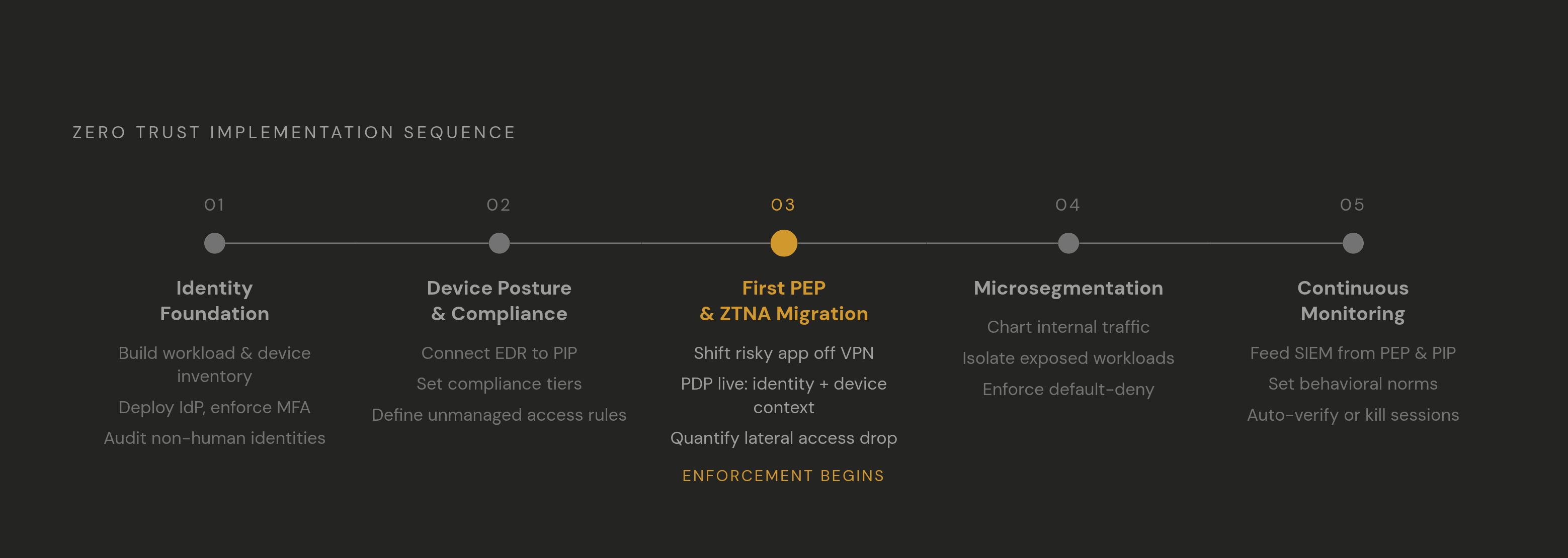
When a team is launching or relaunching a program, order the work around dependent components while keeping every pillar covered. First, create the trusted inventory across workloads, devices, and users, then put the IdP in place or strengthen it, require MFA everywhere, and open the review of non-human identities. Next, build confidence in devices by making EDR feed the PIP, setting compliance tiers, and using access controls that reflect posture. Set rules for unmanaged devices at the very start.
Once those inputs are ready, shift a risky app from VPN to ZTNA and bring the initial PEP online. Confirm the PDP can use identity and device context to decide each session, then quantify the drop in lateral access. Then chart internal traffic paths, isolate the most exposed workloads into segments, and enforce a default-deny policy across those boundaries.
Close the loop by feeding SIEM with PEP and PIP records, establishing behavioral norms, and triggering escalated verification or session kills when anomalies show up. Measure advancement against CISA's maturity framework, detailing gains per pillar rather than declaring victory after one rollout phase. Keep Coverage visible for the whole program. Because ZTA unifies PDP, PEP, PIPs, identity fabric, device posture, microsegmentation alongside continuous monitoring, grasping what each component supersedes must come before constructing a functional system.
Sources
- Zero Trust in 2026: Principles, Technologies, and Best Practices
Covers the same principles and technologies, including identity, device posture, microsegmentation, and continuous monitoring with SIEM.
- A Systematic Literature Review on the Implementation and Challenges of Zero Trust Architecture Across Domains
Supports the discussion of where ZTA deployments stall, including scalability, resource limits, integration, and regulatory challenges.
- What Is Zero Trust Architecture? Key Elements and Use Cases - Palo Alto Networks
Provided background on core ZTA elements such as the policy decision and enforcement components, ZTNA, and least-privilege access.